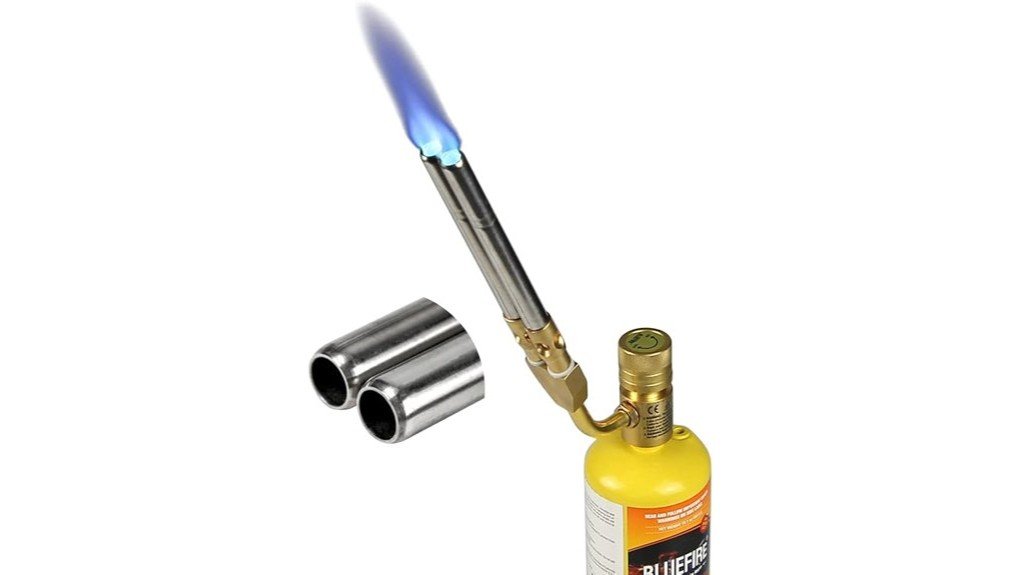
The BLUEFIRE double flame jet turbo torch is a handheld gas torch with two flames, a metal body, and manual ignition. The listing quotes up to 2,372 degrees F (1,300 degrees C) and 17,060 BTU/hr, which puts it in heavy-duty brazing and soldering territory, such as large-diameter copper pipe. It is an air-fuel torch, so it cannot weld steel. Because ignition is manual, you need a striker or lighter, and beginners should practice the startup sequence first.
BLUEFIRE Double Flame Jet Turbo Torch Specs
These figures come from the Amazon listing. Check the listing for fuel type and cylinder connection before you order.
| Item | Detail |
|---|---|
| Flame | Double (dual) jet flame |
| Listed maximum temperature | Up to 2,372 degrees F (1,300 degrees C) |
| Listed heat output | 17,060 BTU/hr |
| Construction | Full metal body, stainless steel burner tube |
| Ignition | Manual (striker or lighter needed) |
| Flame control | Adjustable |
| Listed weight and size | About 1.19 lb, 9 x 6 x 2 in |
| Fuel | Check the listing for compatible fuels and cylinder thread |
What the Double Flame Is For
Two flames cover more surface at once, so large copper pipe and fittings reach brazing temperature faster than with a single small flame. Typical jobs are:
- Brazing and soldering 3/4 in and larger copper pipe
- Heating stuck or seized hardware
- General shop heating, bending, and thawing
It is too broad for tiny jewelry or electronics soldering. A pencil flame torch suits that work better.
Safe Startup and Use
- Check the hose or cylinder connection for damage and leak test with soapy water.
- Open the valve slightly, light the gas with a striker, then set the flame.
- Keep the flame away from insulation, wood, plastic, and anything flammable.
- Wear safety glasses and leather gloves, and keep a fire extinguisher or blanket nearby.
- When finished, close the cylinder valve first, let the line burn off, then close the torch valve.
- Let the torch cool before you put it away.
Pros and Limitations
Pros
- Dual flame heats large pipe quickly
- Metal body and stainless burner tube
- Adjustable flame
- Fairly light for its output
Limitations
- Manual ignition takes more care than a trigger-start torch
- Too broad for fine work
- Does not weld steel
- Fuel and connection details vary, so confirm them on the listing
Who Should Buy It
Buy it if you braze or solder large copper pipe and want strong heat at a modest size. If you want trigger-start convenience, look at the BLUEFIRE BTS-8090 instead.
Related guides: BLUEFIRE BTS-8090 propane torch review, BLUEFIRE Hot Turbo torch head review, BLUEFIRE MRAS-8210 torch review, propane brazing torch kit review.
Frequently Asked Questions
What fuel does the BLUEFIRE double flame jet turbo torch use?
Check the Amazon listing for the compatible fuels and the cylinder thread type. Do not connect it to a fuel the manufacturer does not approve.
Is the torch good for beginners?
It can be used by beginners, but manual ignition and high heat call for practice and careful safety habits.
Can it weld steel?
No. An air-fuel torch is for brazing, soldering, and heating. Welding steel needs an arc welder or an oxy-fuel setup.
Can I adjust the flame?
Yes. The listing says the flame is adjustable. Use the smallest stable flame that finishes the job.
How long does a cylinder last?
It depends on cylinder size, fuel, and flame setting. A high-output torch uses fuel faster than a small one.
Final Thoughts
The BLUEFIRE double flame jet turbo torch is a solid heat source for large copper pipe and general shop heating. Confirm the fuel and connection on the listing, and follow torch safety rules.