Disclosure: As an Amazon Associate, we earn from qualifying purchases. If you click a link on this page and make a purchase, we may receive a small commission at no extra cost to you.
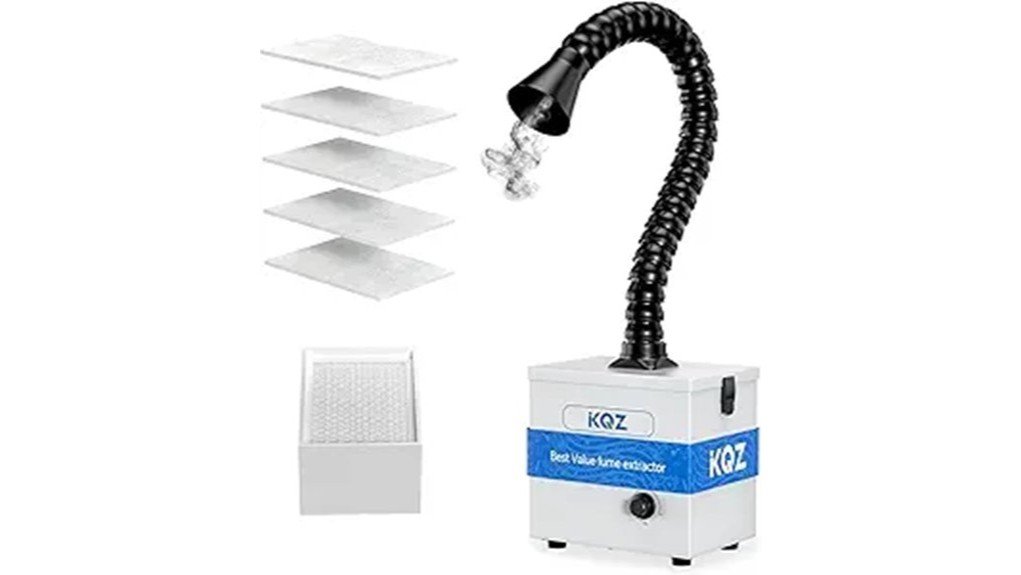
Soldering fumes can drift directly into your breathing zone when you work at a small electronics bench, so capturing them close to the source matters. The KQZ 100W Solder Fume Extractor combines 180-210 m³/h airflow with H13 HEPA and activated-carbon filtration, a flexible extraction arm, and adjustable suction. It is a more substantial setup than a basic desktop smoke absorber, but its filters require regular replacement and it should not be treated as a substitute for appropriate ventilation in demanding industrial work. This review explains where the KQZ KQZ-100W fits, how to set it up, and what you should know before buying.
Quick Verdict
Rating: Recommended with caveats
Best For: Electronics benches, hobby soldering, light maker workflows, 3D-printing stations, and other localized fume sources where you need adjustable source capture.
Bottom Line: The KQZ-100W gives you strong listed airflow, a flexible hood, and HEPA plus activated-carbon filtration in one dedicated extractor. Its main tradeoffs are its 16.46-pound weight, ongoing filter replacement, and the need to position the hood close to the source for effective capture.
KQZ-100W Key Specifications
| Specification | Detail |
|---|---|
| Brand | KQZ |
| Model | KQZ-100W |
| Product Type | Portable fume extractor |
| Power | 100W |
| Airflow | 180-210 m³/h |
| Filtration | H13 HEPA + high-iodine activated carbon |
| Listed Filtration Efficiency | 99.97% for particles as small as 0.3 µm |
| Noise Level | ≤50 dB |
| Main Unit Dimensions | Approx. 10.7 × 9.7 × 7.7 inches |
| Weight | Approx. 16.46 lb |
| Airflow Control | Stepless rotary knob |
| Electrical Protection | Built-in 3A fuse |
| Included Items | Main unit, flexible extraction arm with hood, 2-in-1 main filter, five pre-filters, power adapter, and manual |
| Supported Workflows | Soldering, laser work, 3D printing, DTF workflows, and other suitable localized fume-control tasks |
Key Takeaways
- The KQZ-100W is rated at 100W with 180-210 m³/h airflow, giving it considerably more extraction capability than a simple tabletop fan-style smoke absorber.
- Its filter combines H13 HEPA media and high-iodine activated carbon to address both fine particles and odors or gases that activated carbon can adsorb.
- The flexible arm lets you position the hood close to the work rather than relying on room-wide air cleaning.
- A stepless rotary control lets you reduce or increase suction instead of choosing from a small number of fixed speeds.
- The listed noise level is ≤50 dB, although your perceived noise will depend on airflow setting, placement, and room acoustics.
- Filters are consumable parts, so ongoing maintenance cost should be part of your buying decision.
What Is the KQZ 100W Solder Fume Extractor?
The KQZ-100W is a dedicated source-capture fume extractor built around a 100W motor, flexible collection arm, pre-filter, and combined H13 HEPA and activated-carbon main filter. Instead of placing a small filter fan somewhere on your bench and hoping smoke reaches it, you can position the KQZ hood near the point where fumes are generated.
KQZ lists the unit for soldering, laser-related work, 3D printing, DTF workflows, and similar maker applications. Its main selling point is the combination of 180-210 m³/h airflow and multi-stage filtration in a relatively compact main unit. At roughly 16.46 pounds, however, it is movable rather than truly lightweight.
Why Fume Extraction Is Essential for Soldering
Soldering can produce smoke and airborne contaminants from heated flux and other materials. Allowing that plume to rise directly toward your face increases unnecessary exposure, especially when you spend long periods working at the same bench.
Local extraction works best when fumes are captured before they spread through the room. That is why the KQZ’s flexible hood matters more than raw airflow alone. You can bring the capture point close to the solder joint instead of trying to clean the entire room after smoke has dispersed.
A fume extractor should still be treated as one part of a sensible workspace setup. Follow the instructions for the materials and equipment you use, maintain general ventilation where appropriate, and do not assume a small portable extractor makes every soldering, welding, laser, or printing process risk-free.
Who Should Buy It?
Best For
- Regular soldering benches where you want the capture hood close to the work.
- Makers who need adjustable airflow rather than a single-speed desktop absorber.
- Workspaces that benefit from both fine-particle filtration and activated-carbon odor control.
Skip If
- You only solder occasionally and a simpler source-control setup meets your needs.
- You need engineered industrial extraction for continuous heavy welding or high-volume hazardous fumes.
- You want a nearly maintenance-free unit with no filters to replace.
Before You Buy: The KQZ-100W is a localized filtration unit, not a universal replacement for required ventilation or professional extraction controls. Match your ventilation method to the materials and amount of fumes your process creates.
Key Features of the KQZ 100W Solder Fume Extractor
180-210 m³/h Adjustable Airflow
The extractor’s listed airflow range is 180-210 m³/h. That capacity is useful only when the hood is positioned correctly, so the flexible arm is an important part of the design rather than a cosmetic accessory.
The stepless rotary knob gives you direct control over suction. You can increase extraction when fumes are more noticeable or lower it when you need less airflow and want to reduce unnecessary fan noise.
Flexible Extraction Arm
The supplied arm lets you bring the hood toward the fume source while keeping the main extractor body away from your immediate work area. This can free up bench space around your iron, board holder, tools, or printer.
The available operating instructions recommend positioning the hood roughly 7-8 inches from the work area. If smoke consistently escapes the capture zone, move the hood closer or adjust its angle before simply turning the fan to maximum.
Compact Main Unit
The main housing measures approximately 10.7 × 9.7 × 7.7 inches. That is compact enough for many workshop benches or under-bench arrangements, though the full setup also needs space for the flexible arm and unobstructed intake and exhaust airflow.
How the VortexForce System Enhances Performance
KQZ describes its motor arrangement as the VortexForce system. The product listing claims the design improves motor stability by 40% compared with its stated baseline and reduces turbulence so suction remains more consistent across speed settings.
For you, the useful point is not the marketing name itself. What matters is that the extractor is designed to maintain concentrated airflow while you adjust the rotary control. Stable suction can make source positioning more predictable during repetitive soldering or maker work.
Actual capture performance still depends heavily on distance, hose position, filter condition, and how quickly fumes are being produced. A clogged pre-filter or poorly positioned hood can reduce useful extraction even when the motor is operating normally.
What Makes the Filtration System So Advanced?
The KQZ-100W uses a pre-filter plus a 2-in-1 H13 HEPA and high-iodine activated-carbon main filter. The pre-filter handles larger debris first, helping keep it away from the more expensive main filter.
The HEPA portion is intended for fine particulate filtration, with a listed efficiency of 99.97% for particles as small as 0.3 µm. The activated-carbon portion targets odors and gases that can be adsorbed by carbon. Product information also states that activated carbon accounts for about 70% of the main filter’s weight.
This combination is more useful for fume extraction than relying on a thin carbon pad alone. However, no filter lasts indefinitely. Particle buildup increases airflow resistance, while activated carbon gradually loses its ability to control odors as it becomes saturated.
User Control Options and Safety Features of the KQZ Extractor
The front rotary knob provides stepless speed adjustment, so you are not limited to preset low, medium, and high modes. The matching instructions also describe a main power switch and a 3A fuse intended to protect the electrical circuit against overloads or surges.
For safe operation, place the extractor on a stable surface, keep the intake and exhaust clear, keep it away from liquids, and inspect the power cord if you notice damage. Turn the unit off and unplug it before opening the housing or changing filters.
You should also avoid operating the extractor with missing or incorrectly seated filters. The filter assembly forms part of the intended airflow path, so poor installation can reduce filtration and suction performance.
Setup Tips Before First Use
- Check the filters first. Confirm the pre-filter and 2-in-1 main filter are seated correctly before running the fan.
- Attach the flexible arm firmly. A loose connection can reduce useful suction at the hood.
- Start about 7-8 inches from the source. Watch the fume plume and adjust the hood closer or change its angle if smoke escapes.
- Leave clearance around the extractor. Do not block its air intake or exhaust.
- Use only as instructed for your process. Different soldering, laser, printing, and welding materials can require different ventilation precautions.
Pro Tip: Watch the smoke instead of choosing airflow by sound. Position the hood so the plume consistently moves toward the intake, then use the lowest setting that maintains reliable capture.
How It Performs in Real Use
For Electronics Soldering
This is the most natural use for the KQZ-100W. A flexible hood can sit near the joint while leaving room for your soldering iron, helping capture the visible flux plume before it reaches your face or spreads around the bench.
For 3D Printing and Maker Work
The unit is also marketed for 3D-printing and related maker workflows. Its movable arm is useful when the source cannot sit directly beside the extractor body. You still need to consider the specific material being processed because different materials can produce different particles and gases.
For Laser-Related Work
KQZ lists the extractor for light laser-cutting and engraving applications. Fume quantity can vary dramatically with material and machine power, so you should not assume that the 100W KQZ is appropriate for every laser setup. Follow the laser manufacturer’s ventilation requirements and the safety guidance for the material being processed.
For Welding
The product is also promoted for welding-related use, but this deserves a cautious interpretation. For small localized tasks, source capture may help reduce smoke around the immediate work area. Sustained welding can generate much heavier fumes, so a compact 100W filtered extractor should not be treated as a substitute for appropriately designed welding fume extraction or workplace ventilation.
Noise Level
KQZ lists the operating noise level at ≤50 dB. That puts it in a range that may be easier to tolerate than louder shop extraction equipment, especially when you spend long periods at an electronics workstation.
The exact sound you hear will vary with fan speed, the room, the surface under the unit, filter loading, and whether anything obstructs the airflow. If the extractor suddenly becomes louder or develops an unusual sound, check that it is sitting securely and that the inlet, arm, and filters are not obstructed.
Filter Maintenance and Replacement
Filter maintenance is one of the most important ownership costs. The matching instructions recommend replacing the pre-filter about every 4-15 days depending on usage and replacing the 2-in-1 main filter about every 30-90 days.
Those ranges are guidelines rather than guarantees. Heavy use, dusty processes, strong odors, and high fume loads can shorten filter life. Reduced suction, persistent odors, or visibly dirty filters are practical signs that inspection is needed.
Always turn off and unplug the extractor before opening the filter compartment. Make sure the replacement filter is seated properly and the housing is fully closed before restarting the unit.
Pros and Cons
Pros
- 180-210 m³/h listed airflow provides substantial localized extraction for a compact bench unit.
- H13 HEPA plus activated-carbon filtration addresses both particles and odors.
- Flexible hood lets you capture fumes close to their source.
- Stepless rotary control gives you precise airflow adjustment.
- ≤50 dB listed noise level suits workspaces where excessive fan noise is distracting.
Cons
- Pre-filters and the main filter are recurring consumables.
- At about 16.46 pounds, it is movable but not as convenient to carry as a small desktop absorber.
- It is not appropriate as the sole ventilation solution for every high-fume welding, laser, or industrial process.
Is It Worth the Price?
The KQZ-100W is better viewed as a mid-range dedicated fume extractor than as a budget desktop smoke fan. You are paying for a 100W extraction system, flexible arm, replaceable pre-filtration, HEPA media, activated carbon, and variable airflow control rather than just a fan with a thin filter pad.
It makes the most sense if you work frequently enough to benefit from source capture and are prepared to maintain the filters. If you solder only a few times each year, the additional size and recurring filter expense may be harder to justify.
Value also depends on replacement-filter availability. Before buying, check the current cost and availability of compatible KQZ-100W main filters and pre-filters because those expenses continue after the original filter set is used.
How It Compares to Alternatives
The FumeClear FC-100A is a close alternative in the same general 100W class. It uses a three-stage filtration arrangement and lists roughly 200 m³/h airflow, so it is worth comparing if you want another dedicated filtered extractor with similar overall airflow capability.
The Hakko FA-400 takes a different approach. It is a much smaller desktop solder smoke absorber designed specifically around compact bench use. The KQZ-100W makes more sense when you want a flexible capture arm, HEPA plus activated-carbon filtration, and substantially higher listed airflow, while the Hakko is easier to consider when compactness and straightforward soldering use matter more.
Frequently Asked Questions
What is the airflow of the KQZ-100W?
The listed airflow is 180-210 m³/h. Useful capture still depends on keeping the flexible hood close enough to the fume source and maintaining clean filters.
What filters does the KQZ solder fume extractor use?
It uses a replaceable pre-filter followed by a combined H13 HEPA and high-iodine activated-carbon main filter. The HEPA component handles fine particles while the activated carbon helps adsorb odors and certain gases.
How close should the extraction hood be to the work?
The operating instructions recommend starting with the hood about 7-8 inches from the work area. Watch the fume plume and reposition the hood if smoke escapes instead of relying only on a higher fan setting.
How often should KQZ-100W filters be replaced?
The matching instructions suggest replacing pre-filters roughly every 4-15 days and the main HEPA/carbon filter roughly every 30-90 days, depending on use. Inspect sooner if suction drops or odors start passing through the filter.
How loud is the KQZ 100W extractor?
Its listed noise level is ≤50 dB. Actual sound varies with airflow setting, filter condition, room acoustics, and how the main unit is positioned.
Can the KQZ-100W be used for welding fumes?
KQZ markets the extractor for welding-related use, and localized source capture may help during light work. It should not be assumed to replace properly designed welding-fume ventilation for sustained, high-volume, or occupational welding tasks.
Is the KQZ-100W portable?
The main unit is compact, but it weighs about 16.46 pounds. You can move it between workstations, although it is better described as transportable bench equipment than a lightweight handheld extractor.
What should you check if suction becomes weak?
First check whether the pre-filter or main filter is clogged. Also inspect the flexible arm and hood for obstructions, confirm all connections are secure, and make sure the rotary control is set high enough for the task.
The Bottom Line
The KQZ KQZ-100W Solder Fume Extractor is worth considering if you want adjustable 180-210 m³/h source capture, a flexible arm, and H13 HEPA plus activated-carbon filtration for a regular electronics or maker workspace. Skip it if you only need a tiny occasional-use smoke absorber or if your work requires industrial-scale fume extraction, because filter maintenance and the limits of a compact 100W system remain important tradeoffs.
Ready to Buy?
Check the latest price, replacement-filter availability, and product details before you decide.