Disclosure: As an Amazon Associate, we earn from qualifying purchases. If you click a link on this page and make a purchase, we may receive a small commission at no extra cost to you.
Portable soldering gets difficult when the repair is far from an outlet or an extension cord would get in the way. The LEXIVON Butane Soldering Iron Kit LX-770 solves that problem with a pen-style, refillable tool that can solder, apply hot air, cut heat-sensitive material, and work as a small open-flame torch. Its strong heat output and broad accessory set make it useful for field repairs, but its flame-based control is less precise than a temperature-regulated electric station. This review explains where the LX-770 works well, how to use it safely, and who should choose another tool.
Quick Verdict
Rating: 8.5/10
Best For: Automotive, RV, marine, hobby, and field repairs where AC power is unavailable.
Bottom Line: The LX-770 combines fast cordless heat, a 13-piece kit, and a metal refillable tank in a portable case. It is a strong field tool, but buyers who need exact tip temperatures for delicate circuit boards should use a regulated electric station.
| Specification | Detail |
|---|---|
| Brand | LEXIVON |
| Model | LX-770 |
| Product type | Cordless butane soldering iron and multi-purpose heat tool |
| Design | Pen-style, self-igniting, adjustable flame |
| Power equivalent | 125 watts |
| Maximum torch temperature | Up to 2,400°F |
| Maximum soldering-tip temperature | Up to 1,100°F |
| Flame range | About 1/2 inch to 2 1/2 inches |
| Claimed run time | Up to 75 minutes per fill |
| Refill time | About 10 seconds, then allow at least 3 minutes before ignition |
| Fuel tank | Refillable metal tank |
| Item weight | About 1 pound |
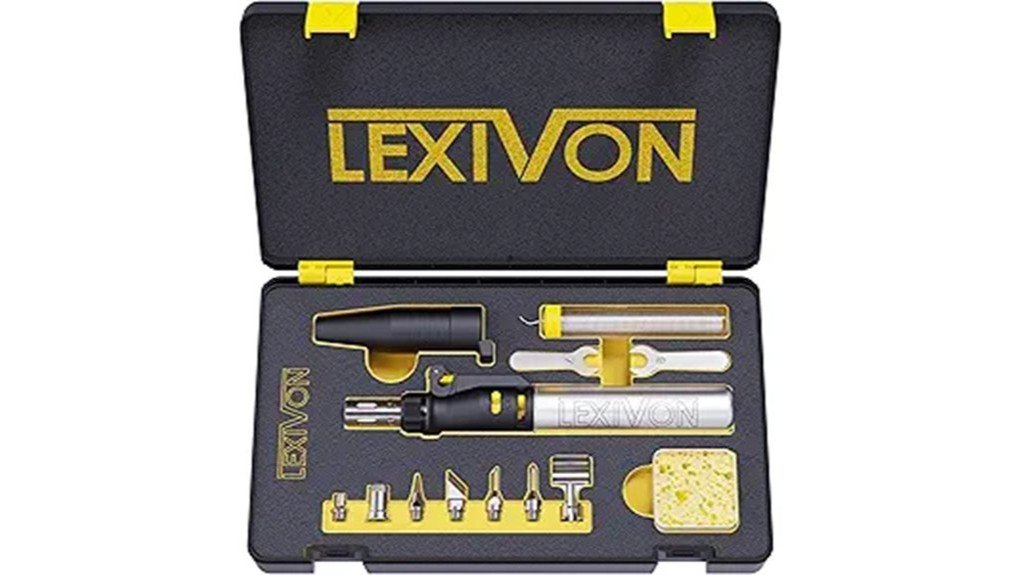
| Kit format | 13-piece set with multiple tips, wrenches, solder, sponge/tray, protective cap, and carrying case |
| Fuel included | No |
What Is the LEXIVON LX-770?
The LEXIVON LX-770 is a cordless butane soldering iron designed for repair work away from mains power. Its pen-style body contains a refillable metal tank, a self-igniting trigger, a safety lock, a flame-lock button, and a flame-control slider. The manufacturer rates it as a 125-watt equivalent tool.
The included attachments let you change the tool from a soldering iron to a hot blower, hot knife, heat-shrink deflector, or small torch. That range is useful when one job involves joining wires, shrinking tubing, trimming synthetic material, and applying controlled heat without carrying separate corded tools.
Key Takeaways
- Portable heat: The butane-powered design is useful in vehicles, equipment bays, trailers, and outdoor work areas without an outlet.
- Wide operating range: The listing states up to 2,400°F as a torch and up to 1,100°F with soldering tips.
- Useful accessory set: The kit supports soldering, hot-air work, heat shrinking, shaping, and cutting.
- Long claimed run time: A full tank is rated for up to 75 minutes, although actual time depends on flame setting and work pattern.
- Important tradeoff: Heat is controlled by fuel flow, not a digital thermostat, so precision is lower than with a regulated soldering station.
Who Should Buy It?
Best For
- Mechanics and installers doing low-voltage wire repairs away from a bench.
- RV, boat, trailer, and equipment owners who need a compact emergency heat tool.
- DIY users who want soldering, heat-shrink, hot-air, and hot-knife functions in one case.
Skip If
- You mainly solder sensitive circuit boards that require stable, repeatable tip temperatures.
- You need a tool for use near fuel vapors, batteries venting gas, or other flammable environments.
- You prefer a rechargeable tool and do not want to buy or store refined butane.
Before You Buy: Butane is not included. The manual calls for high-quality butane refined at least three times, and this tool uses flame adjustment rather than closed-loop digital temperature control.
Design and Build Quality
The LX-770 uses a slim pen-style body that is easier to position inside dashboards, equipment compartments, and other tight work areas than a full soldering gun. The refillable metal tank is a meaningful upgrade over low-cost tools with fragile fuel reservoirs, and the hard case keeps the iron and small attachments organized between jobs.
The controls are simple but require deliberate handling. A safety lock must be moved before the trigger can ignite the tool, while the separate flame-lock button supports continuous operation. The flame-control slider adjusts output from a small flame to a stated maximum length of about 2 1/2 inches.
Heat Output and Control
The tool’s main advantage is rapid, high-output heat without a power cord. LEXIVON lists a maximum open-flame temperature of 2,400°F and a maximum soldering-tip temperature of 1,100°F. This is enough for common wire splices, heat-shrink tubing, hot cutting, and other short field tasks when you select the correct attachment.
The limitation is control accuracy. The slider changes fuel flow, but it does not display or hold a specific tip temperature. Start low, allow the tip to stabilize, and increase the flame only when the joint needs more heat. For small pads, fine-pitch components, or heat-sensitive boards, a regulated electric station is the safer and more repeatable choice.
Accessories and Versatility
The product is sold as a 13-piece kit and a 7-tip set. The operating manual identifies a standard soldering tip, 3 mm diagonal tip, 3 mm chisel tip, hot knife, hot blower, deflector, and head catalyst. It also shows a protective cap, solder wire, 7 mm and 8 mm wrenches, and a sponge with tray.
The three soldering-tip shapes cover general wire work and different contact areas. The deflector spreads hot air around heat-shrink tubing, while the hot knife is intended for heat-sensitive materials. The small wrenches matter because the threaded attachments should be changed only after the tool is fully cool.
Fuel Capacity and Portability
LEXIVON claims up to 75 minutes of operation from a full tank and an approximate 10-second refill. Real run time will vary with the flame setting, ambient conditions, and how often you use continuous-flame mode. For intermittent wiring work, the tank should cover multiple joints without stopping after every connection.
The compact case makes the kit easy to keep in a service vehicle, RV tool compartment, or workshop drawer. Store the iron completely cool, keep the flame lock off, and do not leave the fuel-filled tool in direct sunlight or locations above the temperature limit in the manual.
How It Performs in Real Use
Automotive Wire Repairs
The cordless format is well suited to low-voltage harness repairs where an extension cord is impractical. Disconnect the circuit as required by the vehicle service information, keep the flame and hot exhaust away from insulation and trim, and never use the tool near fuel, solvent, or battery gases.
RV, Boat, and Trailer Work
The kit is useful for lighting circuits, connectors, and heat-shrink work in remote locations. Work in a ventilated area, isolate electrical power, and check for fuel or propane leaks before ignition. Marine users should also protect nearby fiberglass, upholstery, and wire looms from the hot exhaust path.
Heat-Shrink and Hot-Air Tasks
The hot blower and deflector provide a broader heat pattern than a bare flame. Move the tool continuously around the tubing rather than holding it in one spot, and stop as soon as the tubing has recovered. This reduces scorching and helps protect the wire insulation under the sleeve.
Bench and Hobby Use
The LX-770 can handle occasional craft, rope-sealing, hot-cutting, and general soldering work. For long electronics sessions, a corded station is usually more comfortable because it offers a stand, precise temperature settings, and no combustion exhaust near the workpiece.
Setup and Usage Tips
- Fill it correctly: Turn the flame lock to OFF, hold the tool with the filling valve up, and press the butane nozzle straight into the valve. Stop when fuel begins to overflow.
- Wait before ignition: Let the fuel stabilize for at least three minutes after filling. Keep the tool away from the refill can and any spilled gas before lighting it.
- Start at minimum: Set the flame slider to its lowest position, release the safety lock, and press the trigger. Increase heat gradually after the flame is stable.
- Watch the exhaust direction: Butane irons vent hot gases near the tip. Keep that exhaust away from wire insulation, plastic panels, skin, and nearby components.
- Cool before changing tips: Shut off the flame and allow the entire front assembly to cool. Use the supplied wrenches for threaded attachments instead of gripping hot parts by hand.
- Store it safely: Confirm the flame is out, let the tool cool completely, install the protective cap only when safe, and keep it out of children’s reach.
Pro Tip: Practice the flame setting and exhaust direction on scrap wire before working inside a vehicle or device. The lowest stable setting often gives better control and lowers the chance of damaging nearby insulation.
Compatibility and Safety
This is an open-flame butane tool, so safe surroundings matter as much as technique. Do not ignite it near gasoline, propane, solvents, aerosols, charging lead-acid batteries, combustible dust, or any area where flammable vapor may collect. Use ventilation, eye protection, and a heat-resistant work surface.
The official LX-770 operating manual says not to point the tool at your face or body, touch the flame guard while hot, puncture or incinerate the unit, expose it to prolonged sunlight, or store it above 120°F (50°C). It also instructs you to let the tool cool before changing accessories or storing it. Follow the manual and the instructions supplied with your solder, flux, heat-shrink tubing, and vehicle or equipment.
Pros and Cons
Pros
- Cordless pen-style design reaches work areas far from an outlet.
- High heat output supports soldering, hot-air, cutting, and small torch tasks.
- Metal refillable tank and hard case improve durability and storage.
- Multiple tip shapes and attachments reduce the need for separate heat tools.
- Up to 75 minutes of claimed run time suits multi-step field repairs.
Cons
- Butane fuel is not included and refined fuel adds ongoing cost.
- No digital temperature display or closed-loop control for precision electronics.
- Open flame and hot exhaust limit where the tool can be used safely.
Is It Worth the Price?
The LX-770 fits the mid-range portable-tool category. Its value comes from combining a soldering iron, hot-air tool, hot knife, and small torch in one organized kit rather than from precision temperature control. It makes the most sense when portability and attachment variety are more important than bench-station accuracy.
Buyers who already own a regulated station may still find it useful as a field or emergency tool. It is less compelling if most of your work happens at a powered bench or if you only make tiny circuit-board repairs.
How It Compares to Alternatives
The Dremel VersaTip 2000-7 is a close cordless alternative with variable flame control and seven accessories for six applications. The Weller PSI100K Portasol is another 125-watt, self-igniting kit aimed at service work and may appeal to buyers who prefer Weller’s professional soldering ecosystem.
Within LEXIVON’s range, the LX-771 uses a torch-style format, while the LX-770 is the pen-style option. The LX-770 is the better match when you want a slim handheld body and a compact field kit.
Frequently Asked Questions
What comes with the LEXIVON LX-770 kit?
The listing describes a 13-piece kit and a 7-tip set. The manual shows soldering tips, a hot knife, hot blower, deflector, head catalyst, protective cap, solder wire, two small wrenches, a sponge/tray, and a carrying case.
Does the LX-770 include butane?
No. You must buy butane separately. LEXIVON’s manual specifies high-quality fuel refined at least three times to reduce clogging and sputtering.
How do you refill the LX-770 safely?
Set the flame lock to OFF, insert the butane nozzle vertically into the filling valve, and stop when gas begins to overflow. Wait at least three minutes for the fuel to stabilize before ignition, and move away from the refill area first.
Can beginners use this butane soldering iron?
A careful beginner can use it after reading the manual and practicing on scrap material. The open flame, hot exhaust, refill process, and lack of exact temperature control make it less forgiving than a basic temperature-regulated electric iron.
Is the LX-770 suitable for circuit boards?
It can handle basic electronics repairs when you use a small tip and low heat, but it is not the best first choice for fine-pitch or heat-sensitive components. A regulated soldering station gives you more stable and repeatable tip temperature.
Can it shrink heat tubing without an open flame touching the tubing?
Yes. Install the hot blower and deflector so heated air surrounds the tubing. Keep the tool moving and follow the tubing manufacturer’s heat instructions to avoid scorching or damaging the insulation below it.
How long does one tank last?
LEXIVON claims up to 75 minutes from a full tank. High flame settings and continuous operation use fuel faster, so actual run time can be shorter.
Who should skip the LX-770?
Skip it if you need exact digital temperature control, work mainly on delicate boards, or cannot maintain a ventilated and flame-safe workspace. A rechargeable or corded regulated iron is a better fit in those situations.
The Bottom Line
The LEXIVON LX-770 is a strong choice for mechanics, installers, RV owners, and DIY users who need fast cordless heat and several attachments in one portable case. Choose it for field flexibility and high output, but skip it for temperature-critical electronics or any environment where an open flame cannot be used safely.