Disclosure: As an Amazon Associate, we earn from qualifying purchases. If you click a link on this page and make a purchase, we may receive a small commission at no extra cost to you.
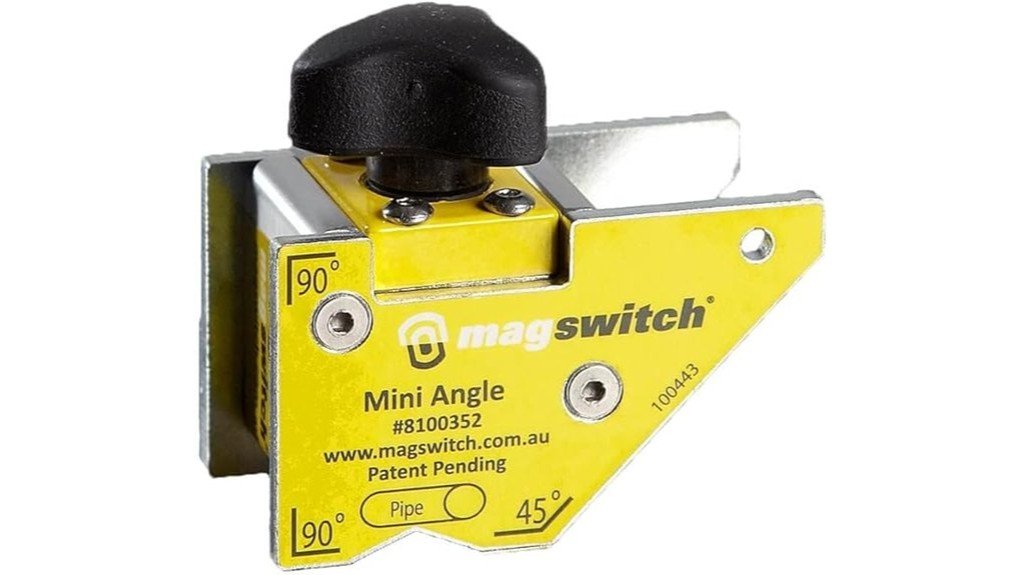
Holding a small steel bracket or frame corner at the right angle can be awkward when a clamp blocks your torch or the part shifts before the first tack. The Magswitch Mini Angle Welding Magnet 8100352 gives you a compact, switchable holder for 45, 90, and 135 degree positions on ferromagnetic steel. Its true ON/OFF control is easier to place and clean than a fixed magnet, but its 6 lb rated shear working load means it is a positioning aid, not a lifting device or heavy structural fixture. This review explains its verified specifications, practical uses, and the limits you should understand before buying.
Quick Verdict
Rating: Recommended with caveats, 8.3/10
Best For: Small steel fabrication, artistic welding, bracket fit-up, pipe positioning, tack welding, and tight work areas.
Bottom Line: The Magswitch Mini Angle is compact, light, and easy to switch on and off, so it works well as a third hand during layout and tack-up. Its main limitation is holding strength in real positions, especially shear, so you still need proper clamps or fixtures for heavy, suspended, overhead, or safety-critical work.
| Specification | Detail |
|---|---|
| Brand | Magswitch |
| Model / part number | 8100352 |
| Amazon ASIN | B01BX8BK4M |
| Product type | Switchable magnetic welding angle and positioning tool |
| Angle faces | 45/135 degrees and 90 degrees |
| Max breakaway | 76 lb (34.4 kg), under the manufacturer’s stated test conditions |
| 2:1 shear working load | 6 lb (2.7 kg) |
| Full saturation thickness | 11 gauge (3.05 mm) |
| Dimensions | 2.3 × 1.3 × 2.1 in (about 58.4 × 33 × 53.3 mm) |
| Weight | 0.4 lb (0.18 kg) |
| Magnetic pole footprint | 59.5 × 32 mm |
| Contact surfaces | Flat and round steel, including pipe and tubing where the shape allows full contact |
| Power source | None required, permanent magnet with manual ON/OFF knob |
| Compatible materials | Ferromagnetic steel. Not suitable for aluminum, copper, brass, or non-magnetic stainless steel. |
| Best use | Small-part positioning, fit-up, layout, tack welding, pipe alignment, and artistic fabrication |
| Safety note | Engage only while the tool contacts a ferrous target. Do not use it for lifting or as the sole support for suspended, overhead, or heavy work. |
What Is the Magswitch Mini Angle Welding Magnet?
The Magswitch Mini Angle 8100352 is a small magnetic workholding tool made for welding and fabrication. You place its angle face against ferromagnetic steel, rotate the black knob to switch the magnet on, and use the hold to position the workpiece for measuring, fitting, or tack welding.
Unlike a fixed welding magnet, this model turns fully off. That makes it easier to set on the work without a sudden snap, move after a tack, and clear steel chips from the contact area. Its compact 2.3 × 1.3 × 2.1 inch body and 0.4 lb weight suit small parts and tight spaces where a larger welding square may block access.
Who Should Buy It?
Best For
- You weld small mild-steel brackets, tabs, frames, sculpture pieces, pipe, or tubing.
- You want quick 45, 90, or 135 degree positioning without a bulky clamp beside the joint.
- You value a true ON/OFF magnet that releases cleanly and sheds metal chips when switched off.
Skip If
- You mainly work with aluminum, copper, brass, or non-magnetic stainless steel.
- You need 60 or 120 degree faces, clamping pressure, or a tool that can pull warped parts together.
- You need to support a heavy, suspended, vertical, or overhead part without a separate fixture.
Before You Buy: Do not confuse the 76 lb maximum breakaway figure with a safe working load in every direction. Magswitch lists a 2:1 shear working load of 6 lb for this model, so use clamps, stops, or fixtures whenever gravity or part movement could pull the work sideways.
Design and Build Quality
The Mini Angle uses a compact metal body with marked angle faces and a manual rotary knob. The design provides 45/135 degree and 90 degree positioning, while the shaped contact areas can sit against flat steel or round stock. The small footprint leaves more room around the joint than many full-size magnetic squares.
At 0.4 lb, the tool is easy to carry in a welding cart or tool bag. That low weight is useful for detail work, but it also tells you what the product is designed to do. It positions small parts; it is not built to apply the pull-down force of a mechanical clamp or the security of a bolted fixture.
Angle Options and Surface Contact
The current manufacturer information for model 8100352 lists 45/135 degree and 90 degree angle faces. These positions cover common frame corners, diagonal braces, tabs, and small gussets. You should still verify the final angle with a square, protractor, or digital angle gauge before you complete the weld.
Magnetic grip depends heavily on contact. Flat, clean steel gives the magnet more area to work with than thin sheet, heavily curved tubing, painted stock, rusty surfaces, or edges with mill scale and spatter. The tool can accommodate round steel, but you should check that the shaped face sits securely before letting go of the part.
ON/OFF Magnetic Control
The switchable magnet is the main reason to choose this tool over a basic fixed square. With the knob in the OFF position, you can place the tool against the work without fighting full magnetic pull. Once the faces are seated, rotate the knob to engage the magnet and check your alignment.
Turning the magnet off also makes cleanup easier. Grinding dust, filings, and small chips can drop away instead of staying stuck to the body. Cleaner contact faces improve grip and reduce the chance of scratching finished steel.
Pro Tip: Set the tool to OFF, clean both contact surfaces, seat the parts fully, then switch it on. Add one light tack, recheck the angle, and move or remove the magnet before a long weld exposes it to unnecessary heat and spatter.
Holding Strength: Breakaway Force vs. Working Load
Magswitch lists a 76 lb maximum breakaway value for the current 8100352 model. Breakaway force is measured under controlled conditions with suitable steel thickness, surface quality, and direct pull. Your actual hold can be much lower when the load acts sideways, the steel is thin, the surface is dirty, or the magnetic footprint does not make full contact.
The more useful safety number for vertical or sliding loads is the manufacturer’s 2:1 shear working load of 6 lb. That figure supports using the Mini Angle as a fit-up aid for small parts, not as a lifting magnet or a substitute for proper workholding. If the part could fall, rotate, or injure someone, add a mechanical clamp, stop, stand, or fixture before welding.
How It Performs in Real Use
For Small Steel Frames
The 90 degree face can hold short pieces during corner fit-up while leaving more of the joint open than a large clamp. Tack one corner lightly, check for square across the frame, then tack the opposite side to control movement. The magnet helps with initial placement, but it cannot prevent heat distortion after welding begins.
For Brackets, Tabs, and Gussets
The 45 degree face is useful for diagonal braces and gussets, while the 135 degree orientation can help with open-angle joints. Small tabs benefit from the compact body because you can keep a hand away from the arc while positioning the part. Thin or narrow pieces may not provide enough contact area for the stated maximum hold.
For Pipe and Round Stock
The shaped contact areas can sit against ferromagnetic pipe or tubing, which is helpful for marking and tack-up. Round surfaces offer less contact than flat plate, so rotate the part gently after engagement to confirm that it will not slip. Use a pipe clamp or dedicated fixture when the joint must carry weight or stay aligned through a full weld.
For Artistic and Tight-Space Welding
The 0.4 lb body is well suited to sculpture work, repair patches, and small assemblies where standard clamps crowd the joint. You can switch it off, move it to the next tack, and clear chips quickly. Keep enough distance from the arc so the knob and magnetic assembly are not exposed to direct heat for longer than necessary.
How to Use It Correctly
Start with the magnet switched off. Remove loose rust, scale, slag, oil, and grinding dust from the steel where the magnetic poles will sit. Confirm that the workpiece is ferromagnetic by testing it before you build the setup around the magnet.
Place the required angle face against both parts and make sure the surfaces sit flat. Turn the knob fully to ON, then test the setup with light hand pressure in the direction the part could move. Check the angle with a measuring tool, add a small tack, and recheck before adding more heat.
Do not operate the magnet in free air. The manufacturer warns that it should be in contact with a ferrous target when switched on. Never use it as a lifting point, and never rely on it as the only support for overhead, suspended, or safety-critical work.
Compatibility and Safety
The Mini Angle works on ferromagnetic metals, including mild steel and many carbon steels. It will not hold aluminum, copper, or brass. Stainless steel varies by grade and condition, so test the actual part rather than assuming every stainless alloy will respond to the magnet.
Keep strong magnets away from pacemakers, implanted medical devices, magnetic storage media, watches, and electronics that may be affected by a magnetic field. Keep your fingers away from pinch points when engaging the tool, and wear the same eye, hand, clothing, and respiratory protection required for the welding and grinding process you are using.
Cleaning, Care, and Storage
Switch the tool off before cleaning it. Wipe away steel chips and abrasive dust with a brush or cloth, then inspect the pole faces for burrs, heavy spatter, or damage that could reduce contact. Do not grind the magnetic faces unless the manufacturer’s service guidance specifically allows it.
Store the magnet dry, switched off, and away from loose steel hardware that could stick to it. Before each setup, check that the knob moves fully between OFF and ON and that the body has no cracks, loose hardware, or heat damage.
Pros and Cons
Pros
- True ON/OFF control makes placement, repositioning, release, and cleanup easier.
- Compact 2.3 × 1.3 × 2.1 inch body fits into tight fabrication areas.
- Light 0.4 lb weight is convenient for small parts and repeated tack-up work.
- Provides 45/135 degree and 90 degree positions for common steel joints.
- Works on both flat and round ferromagnetic steel surfaces.
Cons
- The 6 lb shear working load is far lower than the maximum breakaway figure.
- It does not work on aluminum or other non-ferromagnetic metals.
- It cannot apply clamping pressure or safely support heavy, suspended, or overhead parts by itself.
Is It Worth the Price?
The Magswitch Mini Angle sits above the cheapest fixed welding magnets because you are paying for true ON/OFF control, compact size, and easier cleanup. It offers the most value when you make many small steel assemblies and frequently reposition a holder between tack welds.
It is less compelling if you only need an occasional 90 degree hold or if most of your work requires strong mechanical pressure. A basic fixed magnet costs less, while a clamp or adjustable fixture gives you more control over warped or heavy parts. This model makes the most sense when speed, access, and clean release matter more than high working load.
How It Compares to Alternatives
A fixed arrow magnet is usually cheaper, but it stays magnetic during placement and tends to collect chips. A switchable square from Strong Hand Tools or YESWELDER may offer different angle layouts or higher advertised pull force, but larger bodies can take up more room around a small joint.
A mechanical angle clamp is the better choice when you need pressure to close a gap or resist twisting. The Magswitch Mini Angle is better used as a fast third hand for small ferromagnetic parts that already fit together without force.
Frequently Asked Questions
What angles does the Magswitch Mini Angle 8100352 support?
The current manufacturer information lists 45/135 degree and 90 degree angle faces for model 8100352. Check the markings on the tool and verify the finished setup with a square or angle gauge before final welding.
Is the holding force 76 lb or 80 lb?
The current Magswitch product page lists 76 lb maximum breakaway, while some retailer copy rounds or markets the product at 80 lb. For safe use, follow the current manufacturer data and remember that the listed 2:1 shear working load is only 6 lb.
Can it hold aluminum or stainless steel?
It will not hold aluminum because aluminum is not ferromagnetic. Stainless steel depends on the alloy and processing, so test the actual workpiece before relying on the magnet.
Can it replace a welding clamp?
It can replace a clamp for light positioning when the parts already fit without pressure. Use a mechanical clamp or fixture when you need to close a gap, flatten warped stock, resist twisting, or secure a heavy part.
Can you weld with the magnet left beside the joint?
You can use it during tack-up, but move it when practical before a long weld. Excess heat and spatter can damage the tool, and a magnet placed too close to the arc may affect access or contribute to arc behavior in some setups.
Why does the magnet hold less on thin or dirty steel?
Magnetic force depends on steel thickness, contact area, surface condition, and load direction. Paint, rust, mill scale, gaps, curved contact, and thin stock can all reduce the hold compared with a laboratory breakaway test.
How do you clean the Magswitch Mini Angle?
Turn the tool off, then brush or wipe metal chips from the pole faces and body. Keep the contact surfaces dry and free of spatter so the magnet can sit flat on the next workpiece.
Who should skip this welding magnet?
Skip it if you mostly weld non-magnetic materials, need 60 or 120 degree faces, or work with parts that require substantial clamping pressure. It is also the wrong tool for lifting or for supporting heavy, suspended, or overhead work.
The Bottom Line
The Magswitch Mini Angle 8100352 is a practical third hand for small steel fit-up, especially when you want 45, 90, or 135 degree positioning and a magnet that switches fully off. Buy it for compact access, quick tack-up, and easy cleanup. Skip it when you need non-ferromagnetic compatibility, strong clamping pressure, or secure support for heavy and safety-critical parts.
Ready to Buy?
Check the latest price and confirm the product model before you decide.