Nelyrho 2600°F Triple Burner Propane Forge Review
A single-burner forge can feel limiting when you need to heat longer stock or a wider work area. The Nelyrho triple-burner propane forge uses three burners, a stainless steel shell with plasma surface treatment, and a one-inch insulated chamber. This review explains how those features affect real use, which claims we could verify, and which ones you need to confirm yourself before buying. Its main strength is broad heat coverage across long workpieces; its main friction points are insulation preparation, ventilation, and a shutdown sequence that catches many first-time owners out.
Quick Verdict
Rating: 8.2 / 10 — recommended with safety and setup caveats
Best For: Hobby blacksmiths, knife makers, and workshop users who need more heat coverage than a one-burner forge provides and who have a properly ventilated forging area.
Bottom Line: The three-burner layout, 2600°F rating, and insulated stainless chamber make this a capable option for longer workpieces and varied forging jobs. Before you fire it, apply the rigidizer or refractory coating Nelyrho recommends, sort out ventilation, and read the shutdown instructions — the manufacturer wants the hose disconnected after use, which is the reverse of what many owners assume.
Forge pricing moves often and package contents vary by seller — always confirm on the live listing.
On This Page
Key Takeaways
- The listing for this ASIN confirms three burners, a 0–30 PSI burner nozzle pressure range, a 2600°F ceiling, one-inch insulation, and plasma-treated stainless steel.
- Nelyrho recommends applying refractory material or rigidizer to the fire-resistant insulation before use. Treat this as a required first step, not an optional upgrade.
- Shutdown order matters. Nelyrho instructs owners to disconnect the hose or burner after heating so residual heat does not damage or melt the hose. Leaving it connected through cooldown is the opposite of the manufacturer’s guidance.
- Nelyrho’s guidance is to avoid enclosed areas and use a workshop, garage, or outdoor space with good ventilation. We recommend the most open option available to you, for carbon monoxide reasons explained below.
- Double doors, an included firebrick, and independent per-burner valves are not confirmed in this ASIN’s own bullet points. Verify them on the live listing before you rely on them.
What We Verified — and What We Couldn’t
Nelyrho sells at least six propane forge variants (single, double, triple, and four-burner, with and without doors), and several share near-identical marketing copy. Product titles differ between the Amazon listing, the Nelyrho brand store, and third-party retailers for what appears to be the same hardware. ASIN B0CKSDHBYD currently resolves to a listing titled as a beginner forge kit with a 30 PSI regulator and triple burners.
Because of that overlap, we grade every specification below by how firmly we could source it:
- Confirmed — stated in this ASIN’s own listing bullets.
- Brand-stated — stated by Nelyrho on sibling forge listings or the brand store, but not visible in this ASIN’s bullets. Likely accurate, not guaranteed.
- Not confirmed — we could not source it. Ask the seller or check current listing photos.
Listing content changes without notice. If a detail below matters to your purchase decision, confirm it on the live page on the day you order.
Key Specifications
| Specification | Detail | Status |
|---|---|---|
| Brand | Nelyrho | Confirmed |
| ASIN | B0CKSDHBYD | Confirmed |
| Variant | Triple Burners — check the variant selector, as sibling listings share copy | Confirmed |
| Burner Count | Three propane burners | Confirmed |
| Advertised Max Temperature | Up to 2600°F | Confirmed |
| Burner Nozzle Pressure Range | 0 to 30 PSI | Confirmed |
| Suggested Tank Setting | 20–30 PSI, per Nelyrho’s setup guidance | Brand-stated |
| Time to Temperature | Roughly 10 minutes, per Nelyrho (figure published for smaller variants) | Brand-stated |
| Shell Material | Stainless steel with plasma surface treatment | Confirmed |
| Insulation | One-inch thermal insulation; ceramic fibre secured with stainless hardware | Thickness confirmed; fixing method brand-stated |
| Doors | Safety guidance references keeping one door open, implying more than one opening; a two-door design is marketed across the Nelyrho range | Brand-stated |
| Per-Burner Controls | Independent shutoff or fine adjustment per burner | Not confirmed |
| Included Components | Forge, burners, regulator and hose assembly. Refractory brick appears in sibling kit descriptions | Regulator confirmed; brick brand-stated |
| Tank Compatibility | Fits most standard propane tanks; connector described as CSA-certified and 30 PSIG rated | Brand-stated |
| Chamber Dimensions | Not published in a form we could verify | Not confirmed |
| Replacement Parts | Accessories section of the Nelyrho brand store, or Amazon’s Get Product Support | Brand-stated |
| Warranty | No specific period stated | Not confirmed |
| Primary Safety Notes | Keep one door open during extended high-temperature use; disconnect the hose or burner after heating; never operate in an enclosed area | Confirmed |
What Is the Nelyrho Triple Burner Propane Forge?
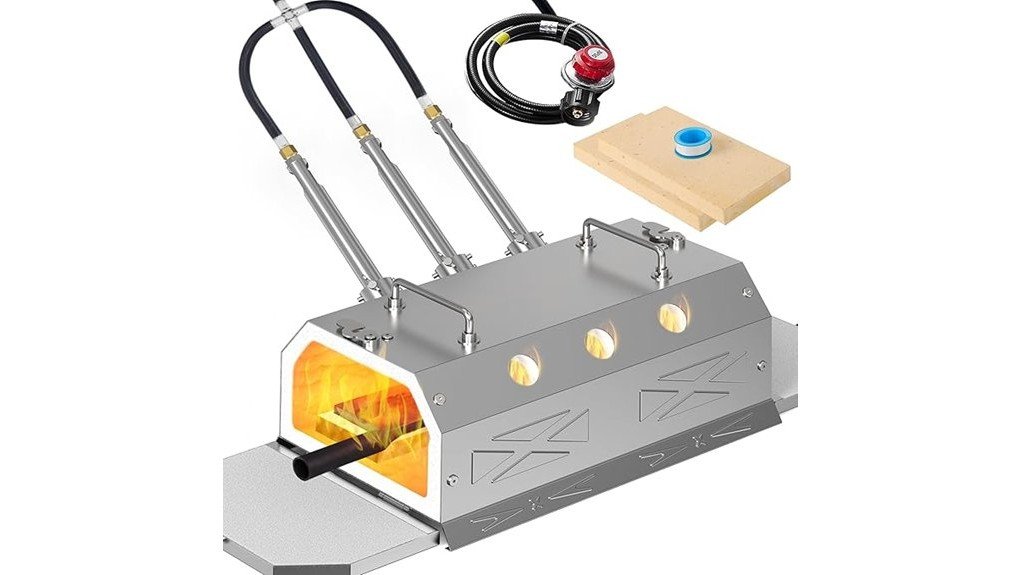
This is a propane-fired gas forge built for heating steel before shaping, drawing, bending, punching, or blade work. Three burners fire into an insulated chamber, and the chamber openings let you retain heat around shorter pieces or pass longer bars straight through.
Compared with a basic one-burner forge, the layout is designed to spread heat across a longer section of metal. That helps with knife blanks, longer bars, tongs, small tools, and any project where you would otherwise be shuffling the workpiece back and forth to bring it up to colour. The trade-offs are real, though: three burners consume more propane than one, the forge takes more bench space, and a larger chamber is slower and more expensive to bring to temperature when you only need to heat two inches of tang.
Who Should Buy It?
Best For
- Hobby blacksmiths who regularly heat medium or longer workpieces.
- Knife makers who want more chamber coverage than a single burner provides.
- Workshop users who can dedicate a properly ventilated, fire-safe forging area.
- Buyers willing to do the rigidizer or refractory prep step before first firing.
Skip If
- You only heat short stock — a smaller forge will cost less to run.
- You cannot provide real ventilation, stable cylinder placement, and a fire-safe zone.
- You need verified chamber dimensions, confirmed per-burner controls, or written warranty terms before ordering.
- You want a forge that works safely straight out of the box with no preparation.
Before You Buy: Do not assume the exposed insulation is ready for repeated firing. Nelyrho recommends applying refractory material or rigidizer to the fire-resistant insulation for safety and durability. Budget for the coating, follow the product instructions, use compatible high-temperature materials, and complete any required drying or curing before you forge.
Feature-by-Feature Review
Three-Burner Heat Distribution
The three-burner layout is the main reason to choose this model. Nelyrho positions the burner arrangement specifically for evenly heating long bars, and that is where the design earns its keep — a broader section of steel comes up to working colour at once, so you reposition the workpiece less often.
The catch is control granularity. The listing confirms a 0–30 PSI nozzle pressure range through the supplied regulator, which gives you one master adjustment for overall gas pressure. It does not confirm that each burner has its own shutoff or fine-adjustment valve. If your work is mostly short pieces and you were hoping to run one burner at a time to save fuel, that is the single most important thing to confirm with the seller before ordering.
Advertised Heat Up to 2600°F
Nelyrho advertises a maximum of 2600°F, which is a common rating across this class of hobby forge and covers the working range for ordinary carbon steel forging and blade heating. A maximum rating is not a guaranteed workpiece temperature, though. Burner tuning, propane pressure, airflow, insulation condition, door position, ambient temperature, and stock size all move the real number.
Nelyrho publishes a figure of roughly ten minutes to reach temperature on its smaller forges. Expect a three-burner chamber to take at least as long, since there is more volume and more lining to heat. There is no calibrated temperature display, so judge by steel colour and use appropriate temperature-reading methods rather than chasing the highest chamber temperature you can produce. Overheating wastes fuel and can damage the metal.
Stainless Steel Shell and Insulated Chamber
The shell is stainless steel with a plasma-treated surface, which Nelyrho positions as a durability and heat-resistance measure. Inside, one inch of thermal insulation reduces heat loss and keeps the chamber up to temperature between heats. Nelyrho describes the ceramic fibre as secured with stainless steel hardware to resist shifting.
Treat the lining as both a performance feature and a consumable. Loose ceramic fibre is easily gouged by tongs and workpieces, which is exactly why the rigidizer or refractory recommendation exists. Inspect the chamber before each session and stop using the forge if the lining is loose, heavily damaged, or shedding fibres.
Doors and Workpiece Access
Nelyrho markets a double-door design across its forge range, with the pitch being that closing both doors heats steel faster and saves propane. The safety guidance on this listing tells you to keep one door open during extended high-temperature use to prevent overheating and maintain airflow — which is the more important instruction of the two, and one that owners chasing maximum temperature tend to ignore.
In practice: close both for fast heat on a short piece, then open one for any sustained session. Keep hoses, clothing, tools, and combustibles clear of the exhaust path, and never put your hands or face in line with an opening.
Regulator, Hose, and Connections
The regulator and hose assembly are included, and Nelyrho describes the propane connector as CSA-certified with a 30 PSIG rating that fits most standard tanks. A refractory brick appears in the brand’s kit descriptions but is not itemised in this ASIN’s bullets, so confirm it rather than counting on it.
One brand instruction worth following exactly: keep the hose and regulator on the same side as the burner connections, and avoid routing the hose anywhere it will sit in hot exhaust air. You still need to supply the propane cylinder, PPE, a noncombustible work surface, and your insulation coating. Do not substitute fittings or regulators unless the manufacturer confirms compatibility.
Check These Five Things on the Listing
- Which variant the selector is actually on
- The current “included components” list
- Whether current photos show per-burner valves
- Chamber dimensions in the photos or Q&A
- Seller identity, return window, and warranty
Confirm the current price and package contents before you commit.
How It Performs in Real Use
For Knife and Blade Blanks
Three burners heat more of a blade blank at once than a compact single-burner forge, which makes drawing, tapering, and general blade shaping less fiddly. The trade-off is efficiency: a large hot chamber is poor value when all you need is a short tang section at colour.
For Longer Bars and Tool Stock
Openings at both ends let you feed stock longer than the chamber straight through and reposition as you work. Even heat still depends on burner alignment and tuning, so check colour along the length of the workpiece rather than assuming the chamber is uniform. Burners that have drifted out of alignment produce a hot centre and cool ends.
For Small Tools and General Blacksmithing
Hooks, punches, tongs, and small hardware are all within scope. For short pieces you can close up to retain heat, provided you reopen a door for any extended run. If these are the only projects you plan to make, a smaller forge will be cheaper to buy and cheaper to feed.
For Extended Sessions
An insulated chamber holds serious residual heat after the burners are off, and this is where the shutdown sequence matters. Close the tank valve, follow the manual’s burner shutdown order, then disconnect the hose or burner as Nelyrho instructs, using heat-resistant gloves. Move the hose and regulator clear of the hot shell and let the forge cool in a protected area where people, pets, cords, and combustibles cannot reach it.
Fuel Use and Running Costs
Nelyrho does not publish a BTU rating or a consumption figure for this forge, and we are not going to invent one. What you can reason about is direction: three burners at a given pressure consume meaningfully more propane per hour than one or two, and a larger insulated chamber takes longer to reach temperature from cold. The insulation works in your favour once you are up to heat, because a well-lined chamber holds temperature between heats and lets you back the pressure down.
Two practical consequences. First, a standard 20 lb barbecue cylinder will empty faster than most first-time buyers expect on a three-burner forge, and cylinders can frost and lose pressure during sustained draw in cold weather — a larger cylinder is the usual fix. Second, because heat-up cost is fixed regardless of workpiece size, this forge rewards batching. Doing an afternoon of forging in one session is far more economical than four separate twenty-minute sessions.
If per-burner valves turn out to be present on your unit, running one or two burners for small work is the single biggest fuel saving available to you. That is another reason it is worth confirming before you buy.
Setup Tips and Common Mistakes to Avoid
- Read the current instructions first. Confirm the insulation coating and curing procedure, regulator connection, lighting sequence, and shutdown steps for your exact package before anything is connected.
- Do the insulation prep before the first firing. Rigidizer and refractory coatings have their own drying and curing requirements. Rushing this step is the most common way owners damage a new lining.
- Inspect the gas system every session. Check the hose, regulator, burner connections, and cylinder valve for wear, heat damage, looseness, or contamination. Leak-test connections with soapy water. Never operate damaged equipment.
- Use a stable, noncombustible surface. Keep the forge level with clear space around the openings, the burners, and the gas line.
- Position the cylinder correctly. Upright, well away from the forge, and outside the hot exhaust path. Route the hose so it cannot touch the forge body, sit in exhaust air, or become a trip hazard — and keep the hose and regulator on the same side as the burner connections.
- Start conservative on pressure. Nelyrho’s setup guidance points at 20–30 PSI at the tank, but follow the manual for your unit and work up rather than opening straight to the regulator’s 30 PSI ceiling.
- Open a door for extended runs. Nelyrho explicitly calls for keeping one door open during extended high-temperature use to prevent overheating and maintain airflow.
- Watch the workpiece, not the flame. Heat steel to the temperature the alloy and process require. Chasing maximum chamber temperature wastes fuel and can ruin the metal.
- Shut down in the right order. Close the tank valve, shut down the burners per the manual, then disconnect the hose or burner as Nelyrho directs so residual heat cannot damage it. Wear heat-resistant gloves, and leave the forge in a protected area to cool.
Pro Tip: Once you have confirmed your burner, hose, regulator, and door setup matches the manual, photograph it. That reference shot makes it obvious later when a hose has shifted into the exhaust path, a connection has loosened, or a burner has moved out of alignment — all things that are easy to miss when you are looking at the setup every week.
Safety, Ventilation, and Insulation Care
A propane forge produces open flame, extreme radiant heat, hot scale, and combustion gases including carbon monoxide.
What Nelyrho says: do not use the forge in enclosed areas, and operate in a workshop, garage, or outdoors with good ventilation.
What we recommend: take the most open option available to you. A closed or attached garage is not adequate ventilation for a three-burner forge, regardless of how the guidance is worded — carbon monoxide is odourless, accumulates faster than most people expect, and an attached garage shares air with living space. If a garage is your only option, work with the main door fully open, position yourself so exhaust moves away from you, and fit a carbon monoxide alarm. Never run a forge in a house, basement, tent, or vehicle.
For PPE: eye or face protection, heat-resistant gloves, natural-fibre or flame-resistant clothing, long trousers, and leather footwear. Tie back long hair and avoid loose cuffs or synthetics that can melt onto skin. Keep a suitable fire extinguisher within reach and follow local fire regulations for propane cylinders and hot work.
For the lining: protect it from direct abrasion and apply the rigidizer or refractory coating Nelyrho recommends. Do not sweep or blow loose ceramic fibres into the air — respirable ceramic fibre is a genuine health hazard, so a damaged lining is a stop-work condition, not something to tidy up with a shop brush. Consult the product instructions or the insulation manufacturer before repairing or reusing damaged lining.
Maintenance and Longevity
The parts that limit a forge like this one are almost always the lining and the hose, not the shell. A stainless body with plasma treatment will outlast both by a wide margin.
- Lining: inspect before each session for compression, gouging, or fibre shedding. Refresh the rigidizer or refractory coating when it starts breaking down. Keep the firebrick floor covered and replace it when it cracks through.
- Hose and regulator: check for stiffening, cracking, abrasion, and heat glazing. Any heat damage means replacement, not repair. This is precisely what Nelyrho’s disconnect-after-use instruction is protecting.
- Burners: check alignment and look for spider webs, rust flakes, or debris in the intake, which is a classic cause of a lazy yellow flame after storage.
- Storage: store dry. Ceramic fibre absorbs moisture, and a damp lining will steam and can spall on the next firing — bring it up slowly after a long layoff.
- Parts: Nelyrho points owners to the accessories section of its brand store or Amazon’s Get Product Support for replacements.
Common Problems and What They Usually Mean
| Symptom | Likely Cause | First Thing to Check |
|---|---|---|
| Never reaches working colour | Pressure too low, both doors open, or a cold wet lining | Tank pressure setting, then door position and preheat time |
| Hot centre, cold ends | Burner alignment drift | Compare against your setup reference photo |
| Lazy yellow flame, sooting | Restricted air intake or debris in the burner | Clear the intake; check for obstructions after storage |
| Pressure fades during a session | Cylinder frosting under sustained draw, common in cold weather | Cylinder size versus your burn rate |
| Hose feels hot or stiff after use | Hose routed through exhaust air, or left connected during cooldown | Stop using it — replace the hose and fix the routing |
| Loose or shedding lining | Uncoated or worn insulation, or tong damage | Stop work. Do not disturb the fibres; consult the instructions |
Pros and Cons
Pros
- Three burners give broad, even heat coverage across long bars and blade blanks.
- Confirmed 0–30 PSI nozzle range gives usable control across light and heavy work.
- Plasma-treated stainless shell with one-inch insulation is a durable, heat-retaining structure.
- Regulator and hose are included, reducing the parts you have to source separately.
- Nelyrho publishes unusually specific setup guidance for this price class, including pressure settings and hose routing.
- Replacement parts are available through the brand store and Amazon product support.
Cons
- Not ready to fire out of the box — the lining needs rigidizer or refractory treatment first.
- Independent per-burner control is not confirmed, which limits fuel savings on small work.
- Chamber dimensions are not published in verifiable form.
- No stated warranty period.
- Multiple near-identical Nelyrho variants share marketing copy, making it easy to order the wrong configuration.
- Higher fuel consumption than one- or two-burner alternatives.
Is It Worth the Price?
This forge earns its place when you need three-burner coverage and pass-through access. Knife blanks, tool stock, and bars that benefit from a longer heated zone are exactly the jobs where the extra burners pay for themselves in reduced repositioning and fewer reheats.
It is a poor fit for occasional small hooks, short blades, or spot heating, where a single- or double-burner model costs less to buy, less to run, and less to store. Value also depends heavily on arriving in good condition, so open the package promptly, inspect the lining, hose, regulator, and burners, and confirm the seller’s current return terms while you are still inside the return window.
How It Compares to Alternatives
| Option | Burners | Best Suited To | Main Trade-Off |
|---|---|---|---|
| Nelyrho (this model) | Three | Long bars, blade blanks, varied hobby work | Fuel use; unconfirmed dimensions and per-burner controls |
| VEVOR two-burner | Two | Mixed hobby work with lower running costs | Less coverage on long stock |
| Simond Store triple-burner | Three | Buyers who want a longer-established forge brand at similar coverage | Often priced above budget imports |
| Single-burner forges | One | Beginners, small projects, localised heating | Constant repositioning on anything long |
The Nelyrho’s distinguishing offer is three-burner coverage with the gas-delivery hardware included at a budget price point. Where it loses ground to more established forge brands is published documentation — chamber dimensions, burner control layout, and warranty terms are all things competitors state plainly and Nelyrho currently does not. Compare on those points, not just on burner count.
Frequently Asked Questions
Can the Nelyrho forge really reach 2600°F?
The listing advertises a maximum temperature of 2600°F, and Nelyrho states its forges reach temperature in roughly ten minutes. Actual chamber and workpiece temperature depend on propane pressure, burner tuning, airflow, door position, insulation condition, stock size, and weather.
Can you control each burner separately?
The listing confirms three burners and a 0 to 30 PSI nozzle pressure range, but it does not confirm independent shutoff or fine adjustment for each burner. Check the current product photos, instructions, and seller response if selective burner use matters to you.
Should you disconnect the hose before or after the forge cools?
Nelyrho instructs owners to disconnect the hose or burner after heating, so residual heat does not damage or melt it. Close the tank valve first, shut the burners down per the manual, then disconnect using heat-resistant gloves and move the hose clear while the forge cools in a protected area.
What comes with the forge?
The listing confirms the forge, burners, and a 30 PSI regulator and hose assembly. A refractory brick appears in Nelyrho’s kit descriptions but is not itemised in this listing’s bullet points. Package contents change, so confirm the live listing and inspect the shipment before connecting propane.
Does the insulation need rigidizer or refractory coating?
Nelyrho recommends applying refractory material or rigidizer to the fire-resistant insulation for safety and durability. Treat it as a required first step. Follow the product and coating instructions, including any drying or curing time, before high-temperature use.
Can you use this propane forge in a garage?
Nelyrho says not to use it in enclosed areas and to operate in a workshop, garage, or outdoors with good ventilation. We recommend the most open space available. A closed or attached garage is not adequate ventilation, because combustion produces carbon monoxide. If a garage is your only option, work with the main door fully open and fit a carbon monoxide alarm. Never use it in a house, basement, tent, or vehicle.
What propane pressure should you run?
Nelyrho’s setup guidance points to a tank setting of 20 to 30 PSI, with the burner nozzle range spanning 0 to 30 PSI. Follow the manual supplied with your unit, start low, and work up rather than opening straight to the maximum. The regulator ceiling is a limit, not a recommended operating point.
Is it suitable for long bars or blades?
Yes. Nelyrho positions the three-burner arrangement specifically for evenly heating long bars, and openings at both ends let you pass stock through. You still need to reposition the workpiece when the section you want to heat is longer than the chamber.
Is this forge a good choice for beginners?
It can suit a committed beginner who has a safe, well-ventilated workspace and is prepared to learn propane-forge setup, insulation preparation, burner adjustment, and shutdown procedure. A single-burner model is easier and more economical for very small starter projects.
Where do you get replacement parts?
Nelyrho directs owners to the accessories section of its Amazon brand store or to the Get Product Support option in Amazon messaging. Confirm parts availability for your specific variant before you need a replacement.
What warranty does Nelyrho provide?
No specific manufacturer warranty period is stated on the listing we reviewed. Check the current seller information, return policy, and any warranty documentation before ordering, and inspect the shipment promptly so any problem falls inside the return window.
The Bottom Line
The Nelyrho triple-burner propane forge is a solid choice when you want broad heat coverage, pass-through access, and a kit that includes the main gas-delivery hardware. Skip it for light short-stock work, or for any workspace that cannot meet real ventilation and propane-safety requirements. Its strongest feature is the three-burner chamber; its biggest limitation is documentation — chamber dimensions, burner controls, and warranty terms all have to be confirmed by you rather than read off the listing.
How We Reviewed This Product
This is a specification and documentation review, not a hands-on test. We have not fired this specific unit. What we have done is read the live listing for ASIN B0CKSDHBYD alongside Nelyrho’s brand store and its sibling forge listings, cross-check the manufacturer’s own safety and setup guidance, and grade every claim by how firmly it could be sourced. Where the manufacturer’s instructions conflict with common assumptions — as with the hose disconnect sequence — we follow the manufacturer and say so.
Our rating weighs heat coverage and build against setup burden, documentation quality, and running cost. Sub-scores: heat coverage 9/10; build and materials 8.5/10; included kit 8/10; documentation and specification transparency 6.5/10; value for the intended user 8.5/10. Overall 8.2/10.
Safety guidance in this article reflects the manufacturer’s published instructions plus general propane and hot-work practice. It does not replace the manual supplied with your forge, and it does not override local fire regulations. If your unit’s instructions differ from anything here, follow your unit’s instructions.
Ready to Buy?
Check the current price, confirm the variant, and read the package contents before you decide.