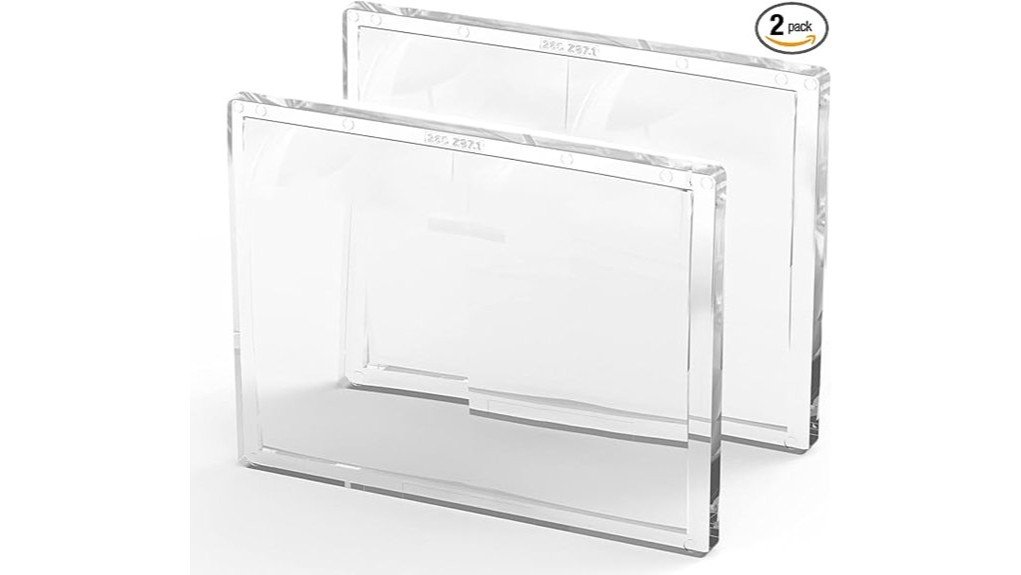
This 2 pack welding helmet magnifying lens set is two polycarbonate magnifier lenses listed at 1.5 magnification and 3.54 x 4.25 inches. A magnifier of this type sits in the helmet, usually behind the filter, and enlarges the weld pool so close work is easier to see. It only works if the size fits your helmet’s lens slot, and the listing does not name helmet brands, so measure first.
This page is based on the Amazon listing, not hands-on testing. Claims such as fitting all helmet types should be checked against your own helmet.
Quick specs at a glance
| Item | Per the listing |
|---|---|
| Pack | 2 lenses |
| Magnification | 1.5 (check whether this means 1.5X or a 1.5 diopter strength) |
| Material | Optical polycarbonate |
| Size | 3.54 x 4.25 inches |
| Listed weight | About 3.52 ounces |
| Not confirmed here | Helmet brands it fits, thickness, impact rating, coating |
Who this magnifying lens suits
- Welders who struggle to see the puddle on fine TIG work or small parts.
- Hobbyists and jewelry or electronics workers who use a helmet for small joints.
- Anyone whose helmet has a lens slot that matches 3.54 x 4.25 inches.
It will not fix a helmet that is the wrong shade or has no room for an inside lens, and it does not replace the shade filter or reading glasses prescribed by an eye doctor.
How to check it fits your helmet
- Find where your helmet takes a cheater or magnifier lens. Many helmets have a slot behind the filter, others have none.
- Measure that slot and compare with 3.54 x 4.25 inches.
- Check that the lens does not touch the filter or the front cover in a way that traps dust or spatter.
- Decide on strength. Lenses are commonly sold in 1.0 to 3.0 strengths, and a mild strength is easier to adapt to.
Pros and limitations
Pros
- Two lenses, so you can keep a spare or use one per helmet.
- Polycarbonate is lighter and less brittle than glass.
- Mild magnification can reduce squinting on small welds.
Limitations
- Fit varies, and the listing does not say which helmets it suits.
- Plastic scratches more easily than glass.
- Stronger magnification narrows your field of view and shifts focus distance.
How to use and care for the lenses
- Seat the lens flat in the slot, with the convex side facing the way the maker shows.
- Check your view before striking an arc. If the weld pool looks distorted, adjust the helmet distance or swap the lens.
- Clean with a soft cloth and lens-safe cleaner, never with abrasive pads.
- Replace the lens when it is scratched or hazy.
Do not weld without the correct shade filter in place. A magnifier lens does not protect your eyes from arc light.
Related guides
- 2-pack magnifying welding lenses review, another pack to compare.
- TRQWH magnifying lens review, with a diopter guide.
- QWORK cheater lens review, a 2.0 option.
Frequently Asked Questions
What does 1.5 magnification mean on a welding lens?
Welding magnifier lenses are usually sold by diopter strength, such as 1.0, 1.5 or 2.0. The listing says 1.5, so check whether that refers to a diopter strength or a 1.5X zoom.
Will this lens fit my welding helmet?
Only if your helmet’s lens slot is about 3.54 x 4.25 inches. Measure it. The listing does not name compatible helmets.
Do magnifying lenses replace the shade filter?
No. They only change how large the view looks. The shade filter still protects your eyes from arc light.
How do I clean a polycarbonate magnifier lens?
Use a soft microfiber cloth and a cleaner made for plastic lenses. Avoid paper towels and abrasive pads, which scratch plastic.
Conclusion
This 2-pack of 1.5 magnification lenses is a low-cost way to see small welds better, provided the size fits your helmet. Measure the slot, start with a mild strength, and keep the shade filter in place.