Disclosure: As an Amazon Associate, we earn from qualifying purchases. If you click a link on this page and make a purchase, we may receive a small commission at no extra cost to you.
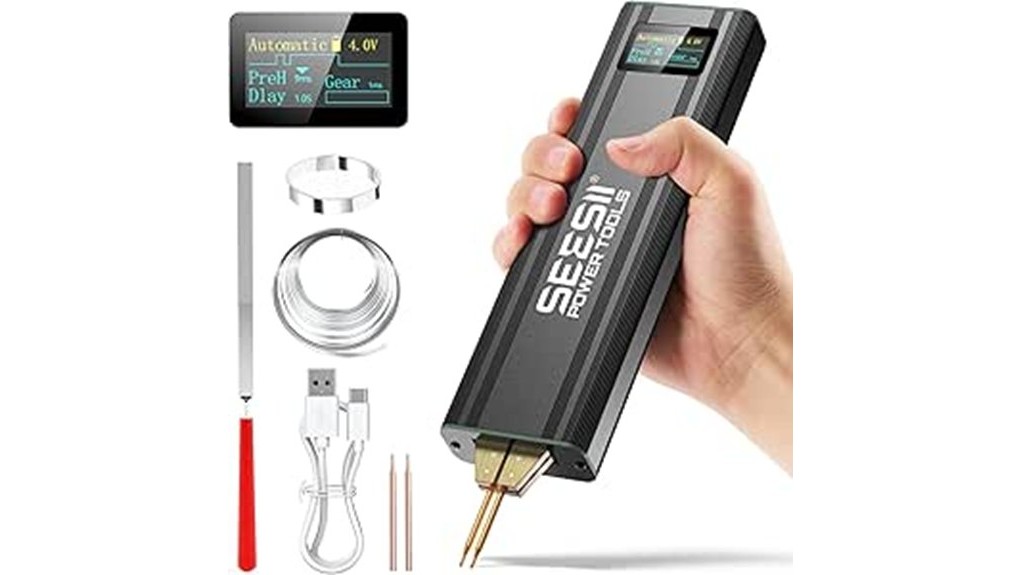
Battery pack work demands steady welds without overheating the cell or burning through thin nickel strip. The SEESII SE209 Battery Spot Welder puts the power supply, controls, display, and welding tips into one cordless handheld unit, which makes it easier to use away from a permanent bench. Its 80 power levels and adjustable preheat give you more control than a basic fixed-output tool. The main limitation is material capacity: it is designed for thin battery tabs, not heavy bus bars, copper, aluminum, or fabrication work.
Quick Verdict
Rating: 8/10, recommended with clear material limits
Best For: DIY battery builders and repairers who weld thin nickel tabs on cylindrical lithium battery packs.
Bottom Line: The SE209 combines cordless operation, 80 power levels, automatic and manual modes, and a useful display in one compact tool. It is a strong fit for nickel-plated strip up to 0.2 mm, but you should choose a higher-output capacitor welder for thicker tabs or demanding production work.
| Specification | Detail |
|---|---|
| Brand | SeeSii |
| Model | SE209 |
| Product Type | Cordless handheld battery spot welder |
| Power Source | Built-in rechargeable battery |
| Maximum Output Current | Up to 800 A |
| Power Adjustment | 80 levels |
| Pulse Controls | Adjustable preheat pulse from 0 to 10 ms plus main welding pulse |
| Welding Modes | Automatic and manual |
| Delay Setting | 0.5 to 2.5 seconds |
| Display Information | Mode, remaining power, preheat, gear, delay, voltage, and welding progress |
| Nickel-Plated Strip Capacity | 0.1 to 0.2 mm |
| Pure Nickel Capacity | Up to 0.15 mm |
| Other Thin Metals | The manual provides settings for thin stainless steel, steel, and brass; copper and aluminum are not recommended |
| Charging Input | USB-C, 5 V / 2 A only |
| Claimed Welds per Charge | More than 800 welds when fully charged |
| Overheat Protection | Automatic stop above 65°C |
| Included Items | Spot welder, two 5 m nickel-plated strip rolls, two replacement needles, file, sandpaper, charging cable, and manual |
| Best Use | Small-batch battery pack assembly, maintenance, and repair |
What Is the SEESII SE209 Battery Spot Welder?
The SeeSii SE209 is a rechargeable handheld resistance spot welder made for joining thin metal tabs to battery terminals. Its integrated design removes the separate power box and long welding leads used by many bench-style machines. You hold one unit, place both needles on the strip, and trigger the weld in automatic or manual mode.
The main selling point is control. You can adjust the primary welding output through 80 levels, change the preheat pulse from 0 to 10 milliseconds, and set a 0.5 to 2.5-second delay. The display shows the current mode and settings before you weld, which helps you repeat a setup after testing it on scrap strip.
The kit also includes basic consumables and maintenance tools. You receive two 5-meter rolls of nickel-plated strip, two replacement welding needles, a file, sandpaper, a USB-C charging cable, and the manual. That package lets you practice and begin a small battery project without buying every accessory separately.
Who Should Buy It?
Best For
- DIY builders making or repairing small cylindrical-cell battery packs.
- Power tool, e-bike, drone, and hobby battery repairs that use thin nickel tabs.
- Beginners who want a visible power setting, a positioning delay, and room to increase output gradually.
Skip If
- You need to weld nickel-plated strip thicker than 0.2 mm or pure nickel thicker than 0.15 mm.
- Your project uses copper, aluminum, thick bus bars, or structural sheet metal.
- You run continuous production and need a bench machine with a documented high-duty-cycle design.
Before You Buy: Match the tool to the tab material, not only the battery size. The listing rates it for nickel-plated strip up to 0.2 mm and pure nickel up to 0.15 mm. Copper and aluminum require different equipment and should not be treated as supported materials.
SEESII SE209 Feature-by-Feature Review
Cordless Design and Build Quality
The SE209 combines the internal battery, control panel, and welding tips in an aluminum-shell body. This layout saves space and avoids cable drag and setup time associated with a separate handheld probe. It is useful when you need to work inside a battery case or move between a bench and a vehicle.
Portability does not make it a universal welder. The integrated battery and compact body are designed for brief, high-current pulses on thin strip. Give the tool time to cool when the housing becomes warm, and rely on the 65°C overheat cutoff as a backup rather than a normal operating target.
Welding Power and Material Capacity
The manufacturer rates the maximum output current at up to 800 A. You can divide that output across 80 selectable levels, which gives you a finer adjustment range than an 11-level or fixed-output handheld welder. Fine adjustment matters because strip composition, thickness, cell condition, tip cleanliness, contact pressure, and remaining battery charge can all change the result.
The verified capacity is clearest for nickel strip. The product listing specifies nickel-plated strip up to 0.2 mm and pure nickel up to 0.15 mm. The manual also provides starting settings for thin stainless steel, steel, and brass, but it does not claim a broad fabrication capacity. For battery work, treat 0.2 mm nickel-plated strip as the ceiling, not the routine starting point.
Preheat Pulse, Main Pulse, and Delay
The SE209 uses a short adjustable preheat pulse before the main welding pulse. You can set preheat from 0 to 10 milliseconds. The first pulse helps establish contact and warm the joint area, while the main pulse delivers the weld energy. This two-stage control can help you tune a cleaner connection when the strip surface and terminal are prepared correctly.
The delay control runs from 0.5 to 2.5 seconds. In manual mode, that pause gives you time to settle both needles on the strip before the weld fires. It is especially useful on rounded cell ends, where one tip can lift if your hand position changes.
Automatic and Manual Modes
Automatic mode triggers after the welding head detects contact with the metal. It is the faster option for repeated connections once you have confirmed a suitable setting. Manual mode waits for you to press the power button after the tips are placed, giving you more control for repairs, awkward positions, and first-time setup.
Neither mode removes the need for a pull test. After you make a test weld on scrap or a noncritical sample, pull the strip with pliers. A good connection should resist separation and usually leaves small pieces of strip attached to the terminal. A strip that lifts cleanly may indicate low power, dirty surfaces, uneven tip pressure, or worn needles.
Display and Controls
The front display shows the operating mode, remaining power, preheat setting, main power level, delay, voltage, and welding progress. This is more useful than a simple numbered dial because you can confirm several variables before each weld. It also helps you record a working setup for a specific strip type.
The controls use short and long presses to change the active setting and switch modes. Spend a few minutes with the manual before your first project. Changing preheat when you intended to change the main power level can produce a different weld than expected.
Charging and Battery Endurance
The SE209 charges through USB-C, but the connector does not mean every USB-C power source is suitable. The manual specifies a 5 V / 2 A input and warns against higher voltage. Use a charger that can provide the stated 5-volt output rather than assuming a high-power laptop adapter is suitable.
SeeSii states that a full charge supports more than 800 welds. Actual endurance will vary with power level, preheat, temperature, and battery condition. The claim suggests enough capacity for a hobby build, but you should fully charge the welder before a large pack and keep an eye on the voltage shown on the display.
How It Performs in Real Use
Building an 18650 Battery Pack
For a new pack, the 80-level adjustment lets you begin with a low setting on spare strip, test the bond, and increase power in small steps. Automatic mode can speed up repeated welds after you find a reliable setting. The cordless body also keeps cables away from loose cells and nickel strip.
Repairing a Power Tool or E-Bike Battery
Repair work often gives you less room than a fresh pack build. The single-piece tool is easier to position inside an opened enclosure than a bench unit with a separate probe. Manual mode and the delay setting help when you need to align a short replacement tab without touching nearby conductors.
Small Electronics and Drone Packs
The SE209 can suit thin-tab repairs where the cell and strip fall within the supported range. Use the lowest setting that passes a pull test and avoid repeated firing on the same cell terminal. Extra heat can damage a cell even when the strip appears intact.
First-Time Practice
A beginner should practice on scrap nickel-plated strip and a noncritical metal sample before working on live cells. Test several power levels, keep the tip angle and pressure consistent, and inspect both the front and back of the strip. This process teaches you how a solid weld looks without risking a finished battery pack.
Setup Tips and Common Mistakes to Avoid
- Charge the tool first. The manual recommends charging the unit to 4.0 V before first use and recharging if the voltage drops below 3.7 V.
- Clean both contact surfaces. Remove oil, corrosion, oxide, and debris from the strip and battery terminal.
- Keep both needles even. Mismatched needle length can create uneven pressure and inconsistent current flow.
- Hold the head at about 45 to 60 degrees. Press both needles onto the strip at the same time with firm, even contact.
- Start below the maximum setting. Higher output is not always better. Increase gradually until the strip passes a pull test without excessive burn marks.
- Clean the tips often. The manual recommends cleaning after about every 20 welds. Carbon buildup raises resistance and changes the result.
- Check the tip screws. Loose welding needles can reduce output and create heat at the connection point.
Pro Tip: Write down the strip material, thickness, preheat, gear, battery voltage, and pull-test result. That simple log makes it much easier to repeat a good setup later.
Battery and Workshop Safety
Spot welding lithium cells carries fire, burn, and short-circuit risks. Wear safety glasses and protective gloves, work on a clean noncombustible surface, and keep conductive scraps away from exposed cell terminals. Do not use damaged, swollen, leaking, corroded, or unusually hot cells.
Confirm cell polarity and pack layout before placing any strip. A misplaced tab can short a cell or connect the pack incorrectly. Use insulating rings and barriers where the battery design requires them, and follow the cell manufacturer’s current, temperature, and assembly guidance.
Keep the SE209 dry, do not disassemble or modify it, and stop using it if the case, charging port, cable, or welding head is damaged. The built-in overheat protection is helpful, but it cannot prevent every battery-building mistake. For high-energy packs used in vehicles, tools, or home storage, have the design and protection system checked by a qualified battery technician.
Pros and Cons
Pros
- 80 power levels provide fine control for different strip thicknesses.
- Adjustable preheat and delay support more careful setup.
- Automatic and manual modes cover repetitive work and awkward repairs.
- Cordless one-piece design is easy to carry and position in tight spaces.
- The display shows the main settings and remaining power before you weld.
Cons
- Nickel-plated strip capacity stops at 0.2 mm, and pure nickel stops at 0.15 mm.
- Copper and aluminum are not recommended, limiting bus-bar options.
- Good results still require surface prep, tip cleaning, pressure control, and trial welds.
Accessories and Maintenance
The included file and sandpaper are functional maintenance items. Use them lightly to remove carbon and flatten small deposits without changing the shape of the tips. Replace a needle when it becomes badly pitted, bent, shortened, or impossible to match with the other tip.
Keep unused nickel strip dry and clean. Label each roll with its material and thickness, especially if you own both nickel-plated steel and pure nickel. They can look similar but may require different power settings and have different current-carrying properties.
For storage, leave the unit in a dry place away from metal chips and loose conductive parts. Recharge it periodically during long idle periods so the internal battery does not remain deeply discharged. A small padded case is worth adding because the package does not list one.
Is It Worth the Price?
The SE209 fits the mid-range handheld spot welder category. Its value comes from control rather than maximum thickness: you get 80 levels, adjustable preheat, a positioning delay, two operating modes, a display, replaceable tips, and starter strip in one package.
It makes the most sense when you build or repair small battery packs often enough to benefit from repeatable settings but do not need a large bench machine. A basic low-cost welder may be enough for occasional single-cell repairs. A capacitor model is the better investment when you need thicker pure nickel, copper capability, foot-pedal operation, or longer production sessions.
How It Compares to Alternatives
A basic 11-level handheld welder can cost less and may be adequate for thin nickel-plated strip, but it gives you fewer steps between weak and excessive output. A bench-style capacitor welder such as a higher-output SeeSii SE223 or a SUNKKO unit can offer more power and production-oriented controls, but it takes more space and usually needs an external power source.
The SE209 makes the most sense when portability, fine adjustment, and a self-contained design matter more than welding thick tabs. It sits between simple entry-level pens and heavier capacitor machines.
Frequently Asked Questions
What thickness can the SEESII SE209 weld?
The listing rates it for nickel-plated strip from 0.1 to 0.2 mm and pure nickel up to 0.15 mm. Treat those figures as material limits and confirm your setup with a pull test before working on a finished pack.
Can it weld copper or aluminum battery tabs?
No. SeeSii does not recommend copper or aluminum because they require much higher power and different welding parameters. Choose equipment specifically rated for those materials.
Does it work with 18650 and 32650 battery packs?
The manual identifies cylindrical lithium battery work, including 18650 and 32650 cells, as a main use. Compatibility still depends on the strip material, strip thickness, cell-terminal condition, and pack design.
What is the difference between automatic and manual mode?
Automatic mode welds after the head detects contact with the strip. Manual mode waits for you to place the needles and press the power button, which gives you more control in tight or delicate locations.
What charger should you use?
Use a USB-C charger that provides 5 V / 2 A. The manual warns against higher voltage, so do not assume that every fast charger is suitable without checking its output behavior.
How often should you clean the welding tips?
The manual recommends cleaning the welding pen after about every 20 welds. Clean sooner if you see carbon buildup, pitting, inconsistent marks, or weaker pull-test results.
How do you know a weld is strong enough?
Test the setup on spare strip, then pull the welded strip with pliers. A solid weld should resist peeling and usually tears or leaves small pieces of strip at the weld points instead of lifting away cleanly.
Is the SE209 suitable for high-volume battery production?
It is better suited to hobby, repair, and small-batch work. Frequent production use may be better served by a bench capacitor welder with a documented duty cycle, larger energy storage, replaceable leads, and foot-pedal control.
The Bottom Line
The SEESII SE209 is a practical 8/10 choice for hobbyists and repairers who need a cordless spot welder for thin nickel battery tabs. Its 80 power levels, adjustable preheat, display, and automatic or manual operation give you useful control, while the 0.2 mm nickel-plated and 0.15 mm pure-nickel limits keep it out of thick-tab and production work.