Disclosure: As an Amazon Associate, we earn from qualifying purchases. If you click a link on this page and make a purchase, we may receive a small commission at no extra cost to you.
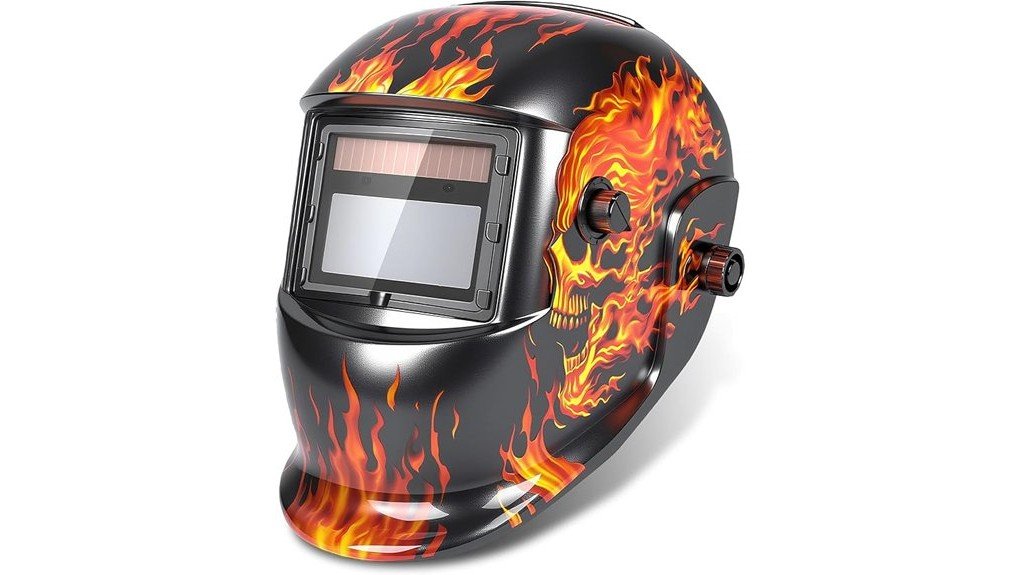
Choosing an auto-darkening welding helmet comes down to more than its graphics. You need a lens that reacts quickly, a useful shade range, dependable arc detection, and a shell that does not become tiring during longer jobs. The AMTAST AST01 Welding Helmet combines a flaming skull design with a 3.66 × 1.69-inch viewing window, two arc sensors, adjustable sensitivity and delay, and DIN 9 to 13 variable dark shades. Its compact viewing area is the main tradeoff, especially if you prefer the wider view and extra sensor coverage found on larger four-sensor helmets.
Quick Verdict
Rating: 8.3/10
Best For: DIY welders, home-shop users, and buyers who want adjustable auto-darkening protection in a lightweight graphic helmet.
Bottom Line: The AST01 gives you fast switching, adjustable DIN 9 to 13 dark shades, two sensors, solar-assisted power, and a 430 g shell. Its smaller viewing window and two-sensor layout are less attractive if you regularly work in awkward positions or want a panoramic field of view.
Key Takeaways
- The AMTAST AST01 uses a 93 × 43 mm viewing area, which is about 3.66 × 1.69 inches.
- Its auto-darkening filter switches from bright to dark in less than 1/25,000 of a second under normal temperature conditions.
- You get a DIN 4 light state and variable DIN 9 to 13 dark shade.
- Two arc sensors, adjustable sensitivity, and an adjustable 0.15 to 0.8 second return delay let you tune the lens for different jobs.
- Power comes from one CR2032 battery plus solar cells, and the helmet includes a low-battery warning and ADF self-check.
- The 430 g PP shell keeps weight moderate, but buyers who want a much larger viewing window or four sensors should compare other helmets.
Product Features and Specifications
| Specification | Detail |
|---|---|
| Brand | AMTAST |
| Model | AST01 |
| Product type | Auto-darkening welding helmet |
| Design | Flaming skull graphic |
| Viewing area | 93 × 43 mm, about 3.66 × 1.69 inches |
| Cartridge size | 110 × 90 mm |
| Arc sensors | 2 |
| Light state | DIN 4 |
| Dark state | Variable DIN 9 to 13 |
| Switching time | Less than 1/25,000 second under normal temperature conditions |
| Return delay | Adjustable from 0.15 to 0.8 second |
| Sensitivity | Adjustable low/high |
| Power | 1 × CR2032 battery plus solar cells |
| Low-battery warning | Yes |
| ADF self-check | Yes |
| UV protection | Level 16 |
| Shell material | PP, polypropylene |
| Weight | 430 g, about 0.95 lb |
| Working temperature | -10°C to 60°C, 23°F to 131°F |
| Storage temperature | -20°C to 70°C, -4°F to 158°F |
| Supported processes | ARC, TIG, MIG, spot, micro, wire, AC, DC, plasma welding and plasma cutting |
| Safety standard | ANSI Z87.1-2020 |
What Is the AMTAST AST01 Welding Helmet?
The AMTAST AST01 is an auto-darkening welding hood designed to let you position your work while the lens is in its DIN 4 light state, then darken automatically when its two sensors detect a welding arc. You can set the dark shade between DIN 9 and DIN 13 and adjust both sensitivity and delay.
The shell uses polypropylene and weighs 430 g. The flaming skull graphics give it a much bolder appearance than a plain black hood, but the more important buying details are inside the auto-darkening filter: two arc sensors, a less-than-1/25,000-second switching time, solar cells, a replaceable CR2032 battery, a low-battery warning, and an ADF self-check function.
Its 93 × 43 mm viewing area is useful for ordinary shop work, but it is not a large panoramic lens. That distinction matters if you frequently weld around tubes, inside frames, underneath vehicles, or in positions where the arc can move partly outside the direct sensor line.
Who Should Buy It?
Best For
- DIY and home-shop welders who use MIG, TIG, ARC, spot welding, or plasma processes.
- Buyers who want adjustable shade, sensitivity, and delay instead of a fixed-setting lens.
- Users who prefer a lightweight 430 g helmet with a distinctive flaming skull shell.
Skip If
- You specifically want a very large viewing window for maximum peripheral visibility.
- You prefer four arc sensors for additional detection coverage in awkward welding positions.
- You need a helmet with a specific employer-required certification beyond the listed ANSI Z87.1-2020 standard.
Auto-Darkening Performance and Controls
The AST01 changes from its bright state to the selected dark state in less than 1/25,000 of a second under normal temperature conditions. That response lets you keep the helmet down as you position the electrode, torch, or gun and begin the weld.
The lens starts at DIN 4 in the light state. For welding, you can select a dark shade from DIN 9 through DIN 13. The correct setting depends on the welding process, current, and applicable safety guidance, so you should select the shade required for your actual job rather than assuming one shade works for everything.
Sensitivity is adjustable from low to high. Higher sensitivity can help the sensors respond to a less intense arc, while lower sensitivity can reduce unwanted triggering from nearby welding or other bright light. The delay control determines how quickly the lens returns to its lighter state after the arc stops, with an adjustable range of 0.15 to 0.8 second.
Pro Tip: Before starting a weld, use the ADF self-check and confirm that both front sensors are clean and unobstructed. Then set the shade, sensitivity, and delay for the process you are using.
Viewing Area, Weight, and Comfort
The AST01’s viewing window measures 93 × 43 mm, or about 3.66 × 1.69 inches. That is large enough to follow a joint and see the immediate work area, but it is smaller than the wide-screen lenses found on some newer four-sensor helmets.
The more compact lens can still be practical for routine bench work, repairs, and fabrication. The limitation becomes more noticeable when you want to see farther around the sides of the weld without moving your head.
At 430 g, or roughly 0.95 lb, the AST01 keeps overall helmet weight moderate. Lower helmet weight can reduce the amount of mass your neck supports during a longer session, although actual comfort also depends on how you adjust the headgear and balance the shell.
Power System and Daily Readiness
The AST01 does not rely on solar cells alone. It combines solar cells with one CR2032 battery, which is a more useful setup than a permanently sealed power source because the battery is replaceable.
A low-battery alarm gives you another useful check before work, while the ADF self-check helps you confirm that the auto-darkening filter is responding. These features are especially important on a helmet that may sit unused between occasional repair or fabrication jobs.
Do not treat the solar panel as a reason to ignore the battery. If the low-battery indicator appears or the lens behaves abnormally, stop using the helmet until you have checked the battery, sensors, lens, and operating instructions.
Protection and Safety Standards
AMTAST lists the AST01 as meeting ANSI Z87.1-2020. The manufacturer also specifies UV protection level 16, with very low stated ultraviolet and infrared transmittance through the filter.
The helmet is listed for ARC, TIG, MIG, spot, micro, wire, AC, DC, and plasma welding, as well as plasma cutting. That broad process compatibility is useful if you work with more than one welding method in the same shop.
The operating range is listed at 23°F to 131°F, while the storage range is -4°F to 158°F. Staying within those limits matters because auto-darkening performance is electronic, and switching speed is specified under normal temperature conditions.
Before You Buy: A welding helmet is only one part of your PPE. Confirm that the AST01’s shade range and listed safety standard meet your welding process, amperage, workplace rules, and applicable eye and face protection requirements before use.
How It Performs in Real Use
For MIG and General Fabrication
The DIN 9 to 13 variable shade range, adjustable sensitivity, and two sensors give you the controls needed for common MIG and general fabrication work. The 3.66 × 1.69-inch view keeps the joint visible without adding the size of an oversized lens cartridge.
For TIG Welding
AMTAST lists the AST01 for TIG use, and the sensitivity adjustment lets you tune the ADF response for different arc conditions. Because this model uses two sensors, careful helmet positioning and unobstructed sensors are especially important when you are welding around corners, tubes, or fixtures.
For Plasma Cutting
The AST01 is also listed for plasma welding and plasma cutting. Its adjustable shade control gives you more flexibility than a fixed-darkness helmet, but you should still choose the correct shade for the cutting current and process rather than selecting a setting by appearance alone.
For Longer Shop Sessions
The 430 g shell is one of the AST01’s practical strengths for repeated shop use. You still need to adjust the headgear correctly so the helmet stays stable when raised or lowered and does not concentrate pressure on one part of your head.
Setup Tips Before First Use
- Inspect the lens and shell: Do not use the helmet if the viewing area, filter, shell, or retaining parts are damaged.
- Check the battery: The AST01 uses one CR2032 battery in addition to its solar cells.
- Run the self-check: Confirm that the auto-darkening filter responds before welding.
- Clean both sensors: Dust, spatter, or other obstruction in front of a sensor can interfere with arc detection.
- Select the correct shade: Use a DIN 9 to 13 setting appropriate for your welding process and current.
- Adjust sensitivity: Tune it to the arc and surrounding lighting instead of leaving the setting unchanged for every job.
- Set the delay: Choose a return delay within the 0.15 to 0.8 second adjustment range based on the work you are doing.
- Fit the headgear: Adjust the helmet so it remains stable and gives you a direct view through the ADF.
Cleaning and Maintenance
Keep the viewing window and both arc sensors clean so the helmet can provide a clear view and detect the arc properly. A soft cloth is appropriate for routine dust removal. Avoid aggressive cleaning that could scratch the viewing surfaces or damage the electronics.
Inspect the helmet before each welding session. Look for cracks in the PP shell, damage to the viewing area, loose headgear parts, and any abnormal ADF behavior. Replace worn or damaged components according to the manufacturer’s instructions.
If the low-battery warning appears, replace the CR2032 battery rather than depending on the solar cells alone. Store the helmet within its specified temperature range and protect the lens from unnecessary scratches when it is not in use.
Pros and Cons
Pros
- Less-than-1/25,000-second bright-to-dark switching time.
- Variable DIN 9 to 13 dark shade with DIN 4 light state.
- Adjustable sensitivity and 0.15 to 0.8 second delay.
- CR2032 battery plus solar-cell power with low-battery warning.
- 430 g PP shell and compatibility with several welding and cutting processes.
Cons
- The 3.66 × 1.69-inch viewing area is smaller than many large-window helmets.
- Two sensors provide less detection coverage than comparable four-sensor designs.
- Published manufacturer specifications do not state a warranty term, so seller warranty details should be checked before purchase.
Is It Worth the Price?
The AST01 makes the strongest case for buyers who want adjustable auto-darkening controls without moving to a much larger helmet. You get a replaceable battery, solar assistance, sensitivity and delay controls, ADF self-check, low-battery warning, and a published ANSI Z87.1-2020 specification.
Its value depends on how much you care about field of view. For ordinary repairs, fabrication, MIG work, and mixed-process hobby use, the feature set is practical. If a very large viewing window, true-color optics, or four arc sensors are priorities, spending more on a different design may make more sense.
How It Compares to Alternatives
The closest same-brand alternative is the AMTAST AST02. AMTAST lists the AST02 with a larger 98 × 53 mm viewing area and four sensors, compared with the AST01’s 93 × 43 mm area and two sensors. The AST02 is therefore worth comparing if wider visibility and additional sensor coverage matter more to you than the AST01’s specific shell design.
The YESWELDER LYG-M800H is another alternative for buyers focused on screen size. It uses a much larger 3.93 × 3.66-inch viewing area and four sensors. The AST01 makes more sense if you are satisfied with a compact viewing window and want its simpler, lighter 430 g format and flaming skull styling.
Frequently Asked Questions
What welding processes can the AST01 handle?
AMTAST lists the AST01 for ARC, TIG, MIG, spot, micro, wire, AC, DC, and plasma welding, plus plasma cutting. You should still select the correct shade and PPE for the exact process and current you are using.
What shade range does the AMTAST AST01 use?
The light state is DIN 4, while the welding dark state is variable from DIN 9 through DIN 13. Choose the shade required for your welding process instead of automatically using the darkest or lightest setting.
How many arc sensors does the AST01 have?
The AST01 uses two arc sensors. Keep both sensors clean and unobstructed, particularly when welding around fixtures or in positions where part of the helmet may be blocked from the arc.
Does the AST01 use a replaceable battery?
Yes. AMTAST specifies one CR2032 battery plus solar cells. The helmet also includes a low-battery warning, so you can identify when the battery needs attention.
How fast does the auto-darkening lens react?
AMTAST specifies a bright-to-dark response time of less than 1/25,000 of a second under normal temperature conditions. The return from dark to light is adjustable from 0.15 to 0.8 second.
Does the AST01 meet a recognized safety standard?
AMTAST lists the AST01 as meeting ANSI Z87.1-2020. If you use the helmet at work, confirm that this specification and the helmet’s shade range satisfy your employer’s PPE requirements and the rules that apply to your welding task.
What warranty comes with the AST01?
A specific warranty period is not stated on the manufacturer’s AST01 specification page used for this review. Check the current Amazon seller or manufacturer warranty terms before purchasing rather than assuming a one-year warranty applies.
The Bottom Line
The AMTAST AST01 Welding Helmet is a solid fit for DIY welders and general shop users who want fast auto-darkening, adjustable DIN 9 to 13 shades, sensitivity and delay controls, a replaceable CR2032 battery, and a relatively light 430 g shell. Skip it if your priority is a very large viewing area or four-sensor coverage, because those are the AST01’s clearest limitations.