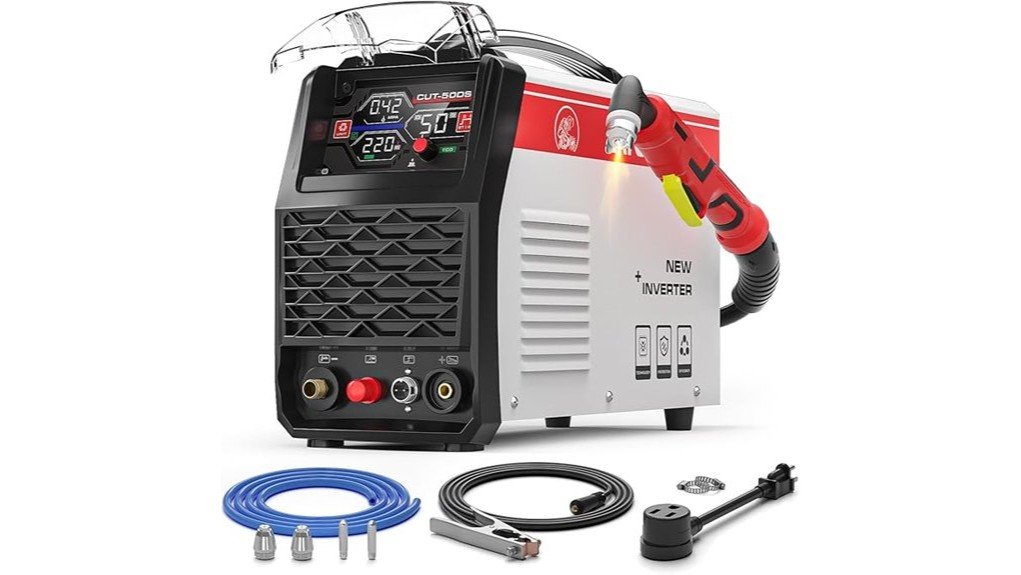
If you are comparing PrimeWeld plasma cutters, the right model depends on more than its advertised amperage. You also need to consider your available voltage, compressor capacity, arc-start system, cutting frequency, and whether you need welding functions in the same machine.
The PrimeWeld CUT60 is the strongest dedicated cutter in this group. The CUT50D is the simpler value choice for clean metal, while the CUT50DP adds pilot arc for painted, rusty, perforated, or expanded material. The CT520D and CT520DP combine plasma cutting with DC TIG and stick welding for buyers who want several processes in one compact unit.
Quick Verdict
Choose the CUT60 for the most cutting power, longer cutting sessions, and a CNC-oriented blowback torch. Choose the CUT50D for occasional work on clean metal. Choose the CUT50DP when pilot arc matters but you do not need welding. Select the CT520D or CT520DP only when their DC TIG and stick functions will save meaningful space or equipment cost.
In a hurry? Jump to the top picks, read the before-you-buy checklist, or use the full comparison table.
Top Picks at a Glance
| Category | Product | Why It Stands Out |
|---|---|---|
| Best Overall | PrimeWeld CUT60 | 60A output on 240V, continuous blowback pilot arc, strong duty cycle, and CNC-oriented features. |
| Best Budget | PrimeWeld CUT50D | Straightforward 50A dedicated cutter for clean metal and occasional garage projects. |
| Best Standalone Pilot Arc | PrimeWeld CUT50DP | High-frequency pilot arc helps start and maintain cuts on difficult surfaces. |
| Best Value 3-in-1 | PrimeWeld CT520D | Combines plasma cutting, DC TIG, and stick welding without charging for pilot arc. |
| Best 3-in-1 With Pilot Arc | PrimeWeld CT520DP | Adds high-frequency pilot-arc cutting to the multiprocess format. |
How We Compared These PrimeWeld Models
Every model in this guide is either a dedicated PrimeWeld plasma cutter or a current multiprocess machine with a built-in plasma-cutting function. The recommendations are based on published specifications and practical buyer considerations rather than unverified numerical scores.
- Available output on each voltage: Dual voltage does not mean full advertised power from a normal 120V outlet.
- Arc-start system: Pilot arc, high-frequency start, blowback start, and contact-style starts affect surface preparation and possible CNC use.
- Clean-cut and severance ratings: A clean-cut rating is more useful for normal buying decisions than an absolute maximum severance claim.
- Duty cycle: This affects how long the machine can operate at a given output before cooling.
- Air requirements: Compressor airflow and pressure must remain stable while the torch is operating.
- Consumable availability: Buyers need the correct tips, electrodes, and cups for the installed torch.
- Process limitations: The combo machines use DC TIG and should not be confused with full AC/DC aluminum TIG welders.
- Warranty and support: PrimeWeld states that its branded products carry a three-year warranty, subject to the company’s terms and exclusions.
Plasma Cutter Basics: What to Know Before Buying
Full output normally requires 240V
All five machines can operate from 120V or 240V power, but output drops on 120V. The CUT60 reaches up to 30A on 120V and 60A on 240V. The CUT50D and CUT50DP reach up to 40A on 120V and 50A on 240V. The CT520D and CT520DP provide up to about 27A of plasma output on 120V and 50A on 240V.
Check the machine manual, plug configuration, circuit capacity, and required breaker before installation. Do not assume that an outlet is suitable only because a plug or adapter physically fits.
Clean cut and severance are not the same
A clean-cut rating describes the thickness the machine is intended to cut with more usable edge quality and travel speed. A severance rating is an upper limit where the torch may separate the material slowly with more dross, bevel, heat, and consumable wear.
The current CUT60 is listed for cutting steel up to 7/8 inch under suitable conditions. The CUT50D and CUT50DP are listed around 12 mm for clean cutting, with higher severance capability under their stronger 240V settings. Real performance varies with metal type, voltage, air quality, amperage, torch height, travel speed, and consumable condition.
Choose the arc-start system carefully
- CUT60: Continuous blowback pilot arc with a non-high-frequency start. This is the clearest option here for buyers considering a compatible CNC table.
- CUT50DP and CT520DP: High-frequency pilot arc. These models can initiate the arc without establishing direct tip contact, but buyers planning CNC use should confirm compatibility with their controls and electronics.
- CUT50D and CT520D: No pilot arc. They use a contact, lift, or scratch-style starting process and work best when the metal and ground connection are clean.
Compressor airflow matters more than tank shape
Do not choose a compressor only by whether it is described as a pancake, portable, or upright model. It must deliver the airflow and pressure required by the exact cutter while maintaining a reasonable duty cycle.
The CUT50D and CUT50DP are listed at approximately 5 CFM at 80 PSI. The CUT60 is listed at approximately 5 CFM at 90 PSI, and PrimeWeld recommends a minimum 20-gallon compressor for sustained use with that model. A smaller compressor that technically meets the airflow requirement may still cycle frequently during long cuts.
Use clean, dry compressed air. A properly installed moisture separator or dryer can help prevent water from reaching the torch and consumables.
Consumables are model-specific
- CUT60: IPT60-style torch consumables.
- CUT50D and CT520D: SG55 scratch-start consumables.
- CUT50DP and CT520DP: AG60 pilot-arc consumables.
Check the torch model and machine generation before ordering replacement parts. Similar-looking nozzles and electrodes are not automatically interchangeable.
Safety Note
Read the owner’s manual before setup. Plasma cutting produces intense light, sparks, hot metal, noise, and fumes. Use suitable eye and face protection, gloves, protective clothing, hearing protection, ventilation, and fire-control precautions. Keep flammable materials away, secure the workpiece, and never cut a sealed, pressurized, or unknown container.

BEST OVERALL
PrimeWeld CUT60
Dedicated dual-voltage plasma cutter with up to 60A output on 240V, continuous blowback pilot arc, an IPT60 torch, and a 60% duty cycle at maximum output.
Best for: Frequent fabrication, thicker steel, longer cutting sessions, expanded metal, and buyers considering CNC-compatible equipment.
Avoid if: You only make occasional cuts in thin, clean sheet metal and do not need the extra capacity.
The CUT60 is the strongest dedicated cutter in this comparison. Its redesigned power system provides a 20A to 60A range on 240V and a reduced 20A to 30A range on 120V. That distinction matters: buyers planning to cut heavier plate should budget for a suitable 240V circuit rather than expecting full performance from a normal household outlet.
PrimeWeld currently lists the CUT60 for cutting steel up to 7/8 inch under suitable conditions. Treat that figure as an upper published capacity rather than a promise of identical edge quality on every metal. Cleaner production work may require lower thickness, correct torch setup, dry air, fresh consumables, and an appropriate travel speed.
The continuous pilot arc automatically restrikes across gaps in perforated, mesh, or expanded metal. Its blowback, non-high-frequency start is also a meaningful advantage for buyers planning to connect the cutter to a compatible CNC table.
CUT60 Key Specifications
| Input | 120V or 240V, single phase |
|---|---|
| Output range | 20–30A on 120V; 20–60A on 240V |
| Arc start | Continuous blowback pilot arc, non-HF |
| Maximum-output duty cycle | 60% |
| Published cutting capacity | Up to 7/8-inch steel under suitable conditions |
| Air requirement | Approximately 5 CFM at 90 PSI; operating range varies by setup |
| Torch family | IPT60 |
Why You May Like It
- Highest plasma output in this comparison.
- Full 60% duty cycle at maximum output.
- Continuous pilot arc works well across gaps and expanded metal.
- Blowback start is more suitable around CNC controls than a high-frequency pilot system.
- Adjustable post-flow can help cool the torch after a cut.
- Current model includes a front pressure gauge and digital controls.
Limitations to Know
- Full 60A output requires 240V.
- Maximum output falls to 30A on 120V.
- Its air demand can overwhelm an undersized compressor during sustained work.
- It costs more than the 50A dedicated cutters.
- The published maximum thickness should not be confused with guaranteed production-quality cuts on every material.

BEST BUDGET
PrimeWeld CUT50D
Portable 50A dedicated plasma cutter with dual-voltage input, contact-style arc starting, and a 60% duty cycle at maximum rated output.
Best for: Beginners, occasional garage repairs, sheet metal, clean plate, and buyers who do not need pilot arc.
Avoid if: You regularly cut expanded, rusty, heavily painted, or perforated metal.
The CUT50D is the simplest and usually the most economical dedicated cutter in the group. It provides up to 40A on 120V and the full 50A on 240V. That makes it useful for lighter portable work while still giving buyers room to move to thicker material when a suitable 240V circuit is available.
Unlike the CUT50DP and CUT60, the CUT50D does not have pilot arc. Its torch must establish the start according to the contact or lift-start procedure. That is not a major disadvantage on properly cleaned solid metal, but it is less convenient on rust, paint, mesh, and expanded material.
PrimeWeld lists approximately 12 mm of clean-cut capacity and up to 16 mm severance under suitable higher-output conditions. A severance cut will normally be slower and rougher than a clean production cut.
CUT50D Key Specifications
| Input | 120V or 240V |
|---|---|
| Output range | 20–40A on 120V; 20–50A on 240V |
| Arc start | Contact, lift, or scratch-style start; no pilot arc |
| Maximum-output duty cycle | 60% |
| Published capacity | Approximately 12 mm clean cut; up to 16 mm severance under suitable 240V conditions |
| Air requirement | Approximately 5 CFM at 80 PSI |
| Consumable family | SG55 scratch-start consumables |
Why You May Like It
- Lower-cost entry into PrimeWeld’s dedicated plasma-cutter range.
- Full 50A output is available on 240V.
- 60% duty cycle at maximum rated output.
- Compact format is easier to move around a garage or workshop.
- Good fit for clean sheet metal and occasional plate cutting.
Limitations to Know
- No pilot arc for expanded, perforated, painted, or heavily oxidized surfaces.
- Maximum output is limited to 40A on 120V.
- A clean ground and suitable torch-start technique are important.
- SG55 consumables are not interchangeable with CUT60 or pilot-arc AG60 parts.

BEST STANDALONE PILOT ARC
PrimeWeld CUT50DP
Dual-voltage 50A cutter with a high-frequency no-touch pilot arc, front pressure gauge, and a 60% duty cycle at maximum output.
Best for: Painted steel, weathered parts, expanded metal, grating, restoration work, and frequent manual starts.
Avoid if: You only cut clean solid metal or need the CUT60’s higher output and blowback CNC-oriented start.
The CUT50DP shares much of the CUT50D’s power profile but adds a high-frequency pilot arc. It can initiate the plasma arc without requiring the tip to establish the start directly against the workpiece. This makes it more convenient on rough, painted, rusty, perforated, or expanded material.
Output reaches up to 40A on 120V and 50A on 240V. PrimeWeld lists approximately 12 mm of clean cutting and up to 16 mm severance under suitable higher-output conditions.
The pilot arc is the main reason to pay more than the CUT50D. However, it is a high-frequency system rather than the CUT60’s blowback start. Buyers planning to connect a cutter to CNC electronics should verify compatibility before choosing it solely for automated use.
CUT50DP Key Specifications
| Input | 120V or 240V |
|---|---|
| Output range | 20–40A on 120V; 20–50A on 240V |
| Arc start | High-frequency no-touch pilot arc |
| Maximum-output duty cycle | 60% |
| Published capacity | Approximately 12 mm clean cut; up to 16 mm severance under suitable 240V conditions |
| Air requirement | Approximately 5 CFM at 80 PSI |
| Consumable family | AG60 pilot-arc consumables |
Why You May Like It
- Pilot arc reduces the need to establish the start directly against the metal.
- Better suited than the CUT50D to mesh, expanded metal, paint, and surface oxidation.
- Full 50A output on 240V.
- 60% maximum-output duty cycle.
- Dedicated cutting design avoids the added controls and connections of a combo machine.
Limitations to Know
- Costs more than the CUT50D primarily because of the pilot-arc system.
- Maximum output falls to 40A on 120V.
- High-frequency starting may require more care around sensitive electronics.
- It does not provide the CUT60’s 60A output or blowback CNC-oriented torch.

BEST VALUE 3-IN-1
PrimeWeld CT520D
Multiprocess machine with a 50A plasma cutter, up to 200A DC TIG output, and up to 160A stick output on 240V.
Best for: Small workshops that need plasma cutting, DC TIG, and stick welding but do not need pilot arc.
Avoid if: You primarily need a dedicated cutter, high-duty-cycle plasma performance, or AC TIG for aluminum.
The CT520D is designed for buyers who would otherwise need separate plasma, TIG, and stick machines. On 240V, it provides up to 50A plasma output, 200A DC TIG output, and 160A stick output. On 120V, maximum output falls to approximately 27A plasma, 120A TIG, and 120A stick.
The plasma side does not have pilot arc. It is best used on solid material with a clean ground and a properly prepared starting area. The maximum-output plasma duty cycle on 240V is also lower than the 60% rating of the dedicated CUT50D and CUT50DP, so the combo format is not automatically the better choice for long cutting sessions.
The TIG process is DC only. It is useful for steel, stainless steel, and other suitable DC-TIG materials, but it is not a substitute for an AC/DC TIG machine when conventional aluminum TIG welding is the main goal. An optional compatible foot pedal is available for TIG control.
CT520D Key Specifications
| Input | 120V or 240V |
|---|---|
| Plasma output | Up to 27A on 120V; up to 50A on 240V |
| TIG output | Up to 120A on 120V; up to 200A on 240V, DC only |
| Stick output | Up to 120A on 120V; up to 160A on 240V |
| Plasma arc start | High-frequency contact-style start; no pilot arc |
| Published plasma capacity | Up to approximately 1/2-inch steel under suitable conditions |
| Plasma air pressure | Approximately 40–70 PSI; adjust while air is flowing according to the manual |
| Consumable family | SG55 scratch-start consumables |
Why You May Like It
- Combines three useful metalworking processes in one enclosure.
- Reduces the space needed for separate hobby machines.
- Provides up to 200A DC TIG output on 240V.
- Optional foot-pedal compatibility adds TIG control.
- Good fit for repair and fabrication projects that alternate between cutting and welding.
Limitations to Know
- No pilot arc on the plasma process.
- Maximum stick output is 160A on 240V, not 200A.
- DC-only TIG is not the normal choice for conventional TIG welding of aluminum.
- Plasma output falls to approximately 27A on 120V.
- Maximum-output plasma duty cycle is lower than the dedicated 50A cutters.
- Changing processes may require lead, polarity, gas, and selector adjustments according to the manual.

BEST 3-IN-1 WITH PILOT ARC
PrimeWeld CT520DP
Multiprocess machine with pilot-arc plasma cutting, up to 200A DC TIG, and up to 160A stick output on 240V.
Best for: Restoration and home-shop buyers who need cutting and welding in one unit and frequently work with imperfect surfaces.
Avoid if: You mainly need a dedicated high-duty-cycle cutter or an AC TIG system for aluminum.
The CT520DP adds high-frequency pilot-arc plasma cutting to the CT520D’s three-process format. That upgrade is useful when the work includes painted frames, weathered parts, expanded metal, or other surfaces where a non-pilot cutter may require extra preparation.
Its output profile is similar to the CT520D. On 240V, it provides up to 50A plasma output, 200A DC TIG output, and 160A stick output. On 120V, maximum output falls to approximately 27A plasma, 120A TIG, and 120A stick.
The TIG function remains DC only. It is a practical option for steel and stainless work, but buyers who primarily want high-control aluminum TIG welding should choose an AC/DC TIG machine. PrimeWeld offers an optional compatible foot pedal for the CT520DP.
CT520DP Key Specifications
| Input | 120V or 240V |
|---|---|
| Plasma output | Up to 27A on 120V; up to 50A on 240V |
| TIG output | Up to 120A on 120V; up to 200A on 240V, DC only |
| Stick output | Up to 120A on 120V; up to 160A on 240V |
| Plasma arc start | High-frequency no-touch pilot arc |
| Published plasma capacity | Up to approximately 1/2-inch steel under suitable conditions |
| TIG control | Compatible with an optional foot pedal |
| Consumable family | AG60 pilot-arc consumables |
Why You May Like It
- Pilot arc improves starting on rough, painted, perforated, and weathered metal.
- Combines plasma cutting, DC TIG, and stick welding.
- Provides up to 200A DC TIG output on 240V.
- Optional foot pedal is available for TIG control.
- Useful for restoration work that requires cutting damaged material and welding replacement sections.
Limitations to Know
- Costs more than the non-pilot CT520D.
- Maximum stick output is 160A on 240V.
- DC-only TIG is not a substitute for an AC aluminum TIG system.
- Plasma output is limited to approximately 27A on 120V.
- Maximum-output plasma duty cycle is lower than the dedicated CUT50D and CUT50DP.
- High-frequency starting may require care around CNC controls or sensitive electronics.
CUT60 vs CUT50D vs CUT50DP
The three dedicated cutters are usually better choices than the combo machines when plasma cutting is your main priority.
- Choose the CUT50D for occasional clean-metal work. It provides the core 50A cutting function without charging extra for pilot arc.
- Choose the CUT50DP for manual work on difficult surfaces. Its high-frequency pilot arc is useful on rust, paint, perforated material, and expanded metal.
- Choose the CUT60 for higher output, sustained work, and CNC-oriented features. It offers 60A on 240V, a continuous blowback pilot arc, a 60% maximum-output duty cycle, and a higher published cutting capacity.
Simple Decision Rule
Buy the CUT50D when price matters most and your material is normally clean. Buy the CUT50DP when pilot arc is the feature you need. Buy the CUT60 when cutting performance is more important than minimizing the initial equipment cost.
Dedicated Cutter or 3-in-1 Combo?
A combo machine can save space and purchase cost, but it also requires more setup knowledge and introduces process compromises.
Choose a dedicated cutter when:
- Plasma cutting is your main task.
- You expect long or frequent cutting sessions.
- You want the simplest controls and consumable setup.
- You already own suitable welding equipment.
- You want the CUT60’s blowback start and CNC-oriented features.
Choose a combo machine when:
- You genuinely need plasma, DC TIG, and stick processes.
- Workshop space is limited.
- Your cutting workload is moderate rather than continuous.
- You mainly weld steel or stainless steel.
- You understand that the TIG process is DC only.
Before You Order
- Confirm whether you have a correctly installed 240V circuit if you expect full output.
- Check the required breaker size and plug type in the manual for the exact machine generation.
- Verify that your compressor can maintain the required CFM and pressure while cutting.
- Add a suitable moisture separator or air dryer when needed.
- Identify the correct consumable family before buying spares.
- Decide whether pilot arc is necessary for your normal material.
- Choose the CUT60 rather than an HF-start model when CNC compatibility is a priority.
- Do not buy a CT520D or CT520DP as a replacement for an AC aluminum TIG welder.
- Check the current Amazon listing for the included torch, regulator, adapter, leads, and accessories because package contents can change.
Frequently Asked Questions
What metals can PrimeWeld plasma cutters cut?
Plasma cutters work on electrically conductive metals. These PrimeWeld machines can cut materials such as mild steel, stainless steel, aluminum, copper, and compatible alloys. The achievable thickness and edge quality depend on the machine, input voltage, material, air supply, consumables, and cutting technique.
Do PrimeWeld plasma cutters produce full power on 120V?
No. Full advertised output generally requires 240V. The CUT60 reaches up to 30A on 120V and 60A on 240V. The CUT50D and CUT50DP reach up to 40A on 120V and 50A on 240V. The CT520D and CT520DP provide approximately 27A plasma output on 120V and 50A on 240V.
Which PrimeWeld plasma cutters have pilot arc?
The CUT60 has a continuous blowback pilot arc. The CUT50DP and CT520DP use high-frequency pilot arc. The CUT50D and CT520D do not include pilot arc.
What compressor do I need?
Use a compressor that meets the airflow and pressure specification in the exact model manual. The CUT50D and CUT50DP are listed at approximately 5 CFM at 80 PSI. The CUT60 is listed at approximately 5 CFM at 90 PSI, and PrimeWeld recommends at least a 20-gallon compressor for sustained use with that model.
A small compressor may support brief cuts if it meets the airflow requirement, but it may cycle heavily or lose pressure during longer work. Compressor duty cycle, hose size, restrictions, moisture control, and storage capacity all affect performance.
Which PrimeWeld plasma cutter is easiest for a beginner?
The CUT50D is the simplest value choice for clean metal and occasional projects. The CUT50DP is more forgiving when a beginner expects to work on rusty, painted, perforated, or expanded material because pilot arc makes starting and restriking easier.
Can the CT520D and CT520DP TIG weld aluminum?
Their TIG process is DC only. These machines are better suited to steel, stainless steel, and other materials compatible with DC TIG. Buyers who primarily need conventional aluminum TIG welding should select an AC/DC TIG machine. The plasma function can still cut conductive aluminum.
Do all PrimeWeld plasma cutters use the same consumables?
No. The CUT60 uses IPT60-style consumables. The CUT50D and CT520D use SG55 scratch-start consumables. The CUT50DP and CT520DP use AG60 pilot-arc consumables. Always confirm the torch model before ordering replacements.
How long do plasma consumables last?
There is no reliable universal lifespan. Consumable wear changes with amperage, material thickness, air quality, moisture, torch height, piercing technique, travel speed, and the number of arc starts. Clean, dry air and correct setup can reduce premature wear.
Does every PrimeWeld model include a three-year warranty?
PrimeWeld currently states that its branded products carry a three-year warranty covering qualifying defects, subject to its warranty terms, proof-of-purchase requirements, exclusions, and regional shipping conditions. Consumables and damage caused by misuse or insufficient maintenance may not be covered.
Final Verdict
- Best overall: PrimeWeld CUT60. Choose it for 60A output on 240V, continuous blowback pilot arc, stronger published cutting capacity, sustained work, and CNC-oriented features. Check CUT60 details on Amazon →
- Best budget dedicated cutter: PrimeWeld CUT50D. Choose it for occasional work on clean metal when pilot arc is not necessary. Check CUT50D details on Amazon →
- Best dedicated pilot-arc value: PrimeWeld CUT50DP. Choose it for manual cutting on paint, oxidation, perforated metal, and expanded material. Check CUT50DP details on Amazon →
- Best value multiprocess option: PrimeWeld CT520D. Choose it when you need plasma, DC TIG, and stick welding but do not need pilot arc. Check CT520D details on Amazon →
- Best multiprocess option with pilot arc: PrimeWeld CT520DP. Choose it when you want all three processes and regularly cut imperfect surfaces. Check CT520DP details on Amazon →
For most buyers focused primarily on cutting, the decision comes down to the CUT50D, CUT50DP, or CUT60. The combo machines make the most sense only when their DC TIG and stick functions will be used often enough to justify the added setup and process compromises.
Full PrimeWeld Model Comparison
| Product | Image | Best For | Maximum Plasma Output | Pilot Arc | Published Cutting Capacity | Welding | Amazon |
|---|---|---|---|---|---|---|---|
| PrimeWeld CUT60 |
|
Frequent cutting, thicker steel, expanded metal, CNC-oriented use | 30A on 120V 60A on 240V |
Yes, continuous blowback | Up to 7/8-inch steel under suitable conditions | No | Check Price |
| PrimeWeld CUT50D |
|
Budget buyers and clean metal | 40A on 120V 50A on 240V |
No | Approximately 12 mm clean; up to 16 mm severance on suitable 240V setup | No | Check Price |
| PrimeWeld CUT50DP |
|
Manual cutting on painted, rusty, perforated, or expanded metal | 40A on 120V 50A on 240V |
Yes, high-frequency | Approximately 12 mm clean; up to 16 mm severance on suitable 240V setup | No | Check Price |
| PrimeWeld CT520D |
|
Value-focused multiprocess workshop | 27A on 120V 50A on 240V |
No | Up to approximately 1/2-inch steel under suitable conditions | DC TIG + stick | Check Price |
| PrimeWeld CT520DP |
|
Multiprocess work with pilot-arc cutting | 27A on 120V 50A on 240V |
Yes, high-frequency | Up to approximately 1/2-inch steel under suitable conditions | DC TIG + stick | Check Price |
Cutting figures are manufacturer-published ratings, not guaranteed results for every metal or setup. Actual performance depends on voltage, material type, air pressure and airflow, consumable condition, torch setup, and travel speed.
Last reviewed: July 23, 2026