Disclosure: As an Amazon Associate, we earn from qualifying purchases. If you click a link on this page and make a purchase, we may receive a small commission at no extra cost to you.
Choosing a replacement welding lens is not just about getting a darker view. You need a lens that fits your helmet, reacts quickly, gives you enough shade control, and helps protect your eyes during different welding tasks. The 2×4.25 Auto Darkening Welding Lens is designed for welders who want adjustable shade control in a standard-size lens format. This review breaks down its fit, protection claims, controls, daily usability, and the limits you should check before buying.
Quick Verdict
Rating: 8.1/10
Best For: Welders who need a 2×4.25-inch auto darkening replacement lens with adjustable shade, sensitivity, and delay controls.
Bottom Line: This lens is worth considering if your helmet accepts a 2×4.25-inch cartridge and you want shade 5 to 13 adjustment for more flexible welding work. The main tradeoff is that brand, certification, battery, and warranty details are not clearly supported in the source article, so you should confirm those on the product page or packaging before use.
| Specification | Detail |
|---|---|
| Product type | Auto darkening welding lens |
| Lens size | 2×4.25 inches |
| Thickness | 0.33 inches |
| Shade range | Adjustable shade 5 to 13 |
| Activation time | Listed as 0.01 milliseconds |
| Material | High-density polycarbonate |
| Controls | Sensitivity, delay, and shade adjustment knobs |
| Compatibility | Designed to fit most standard 2×4 welding helmets, based on the article description |
| Protection claim | Article states it blocks over 99.9% of harmful UV and IR radiation |
| Best use | Welding tasks where adjustable darkness, glare reduction, and helmet compatibility matter |
What Is the 2×4.25 Auto Darkening Welding Lens?
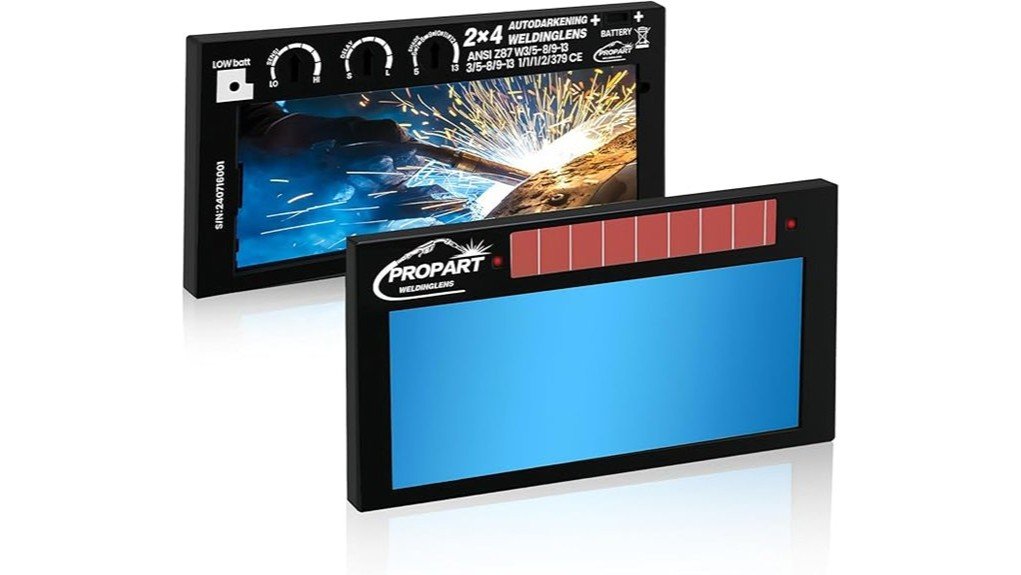
The 2×4.25 Auto Darkening Welding Lens is a replacement-style lens made for compatible welding helmets that accept a 2×4.25-inch cartridge. Instead of using one fixed shade, it gives you an adjustable shade range from 5 to 13, so you can tune the lens for different welding conditions.
The article describes the lens as using high-density polycarbonate for durability, scratch resistance, and optical clarity. It also lists three manual controls: sensitivity, delay, and shade. Those controls matter because not every welding job produces the same arc brightness, work angle, or stop-start rhythm.
Before You Buy: Confirm that your helmet accepts a 2×4.25-inch lens with a 0.33-inch thickness. Also check the product listing or packaging for safety standards, power details, and warranty terms before using it for welding protection.
Key Takeaways
- The 2×4.25-inch size makes this lens a potential fit for many standard 2×4 welding helmets.
- The shade range of 5 to 13 gives you more flexibility than a fixed-shade lens.
- The listed 0.01-millisecond activation time is meant to darken the lens quickly when the arc starts.
- The high-density polycarbonate construction supports durability and scratch resistance in shop use.
- The sensitivity, delay, and shade knobs let you fine-tune the lens for different work conditions.
- You should verify helmet fit, certification details, and power requirements before relying on it for daily welding work.
Who Should Buy It?
Best For
- Welders replacing a lens in a helmet that accepts a 2×4.25-inch cartridge.
- Users who want adjustable shade 5 to 13 instead of one fixed darkness level.
- Shop, hobby, and repair users who need sensitivity and delay controls for changing tasks.
Skip If
- Your helmet uses a different cartridge size or does not support replacement lenses.
- You need verified certification details before purchase and cannot confirm them on the listing or package.
- You prefer a complete auto darkening helmet instead of a replacement lens insert.
Product Features and Specifications
The biggest practical feature is the adjustable shade range from 5 to 13. A lower shade can help with setup, lighter work, or positioning, while darker settings are used when the arc is brighter. You should always match the shade to the welding process, amperage, and the lens instructions.
The 2×4.25-inch footprint is another key detail. Many passive and auto darkening helmets use this common lens format, but “most standard helmets” does not mean every helmet. Before ordering, measure your current lens opening and compare the depth as well as the length and width.
The lens is listed with a 0.33-inch thickness. That matters because some helmet retainers or lens holders have tight spacing. A lens that is the right length and width can still fit poorly if the holder cannot secure its thickness.
Performance and Eye Protection
The article states that the lens blocks over 99.9% of harmful UV and IR radiation. That is an important claim for welding safety, but you should still confirm safety markings, documentation, and product instructions before relying on any welding lens for regular work.
The listed activation time is 0.01 milliseconds. In daily use, a fast switching speed helps reduce the moment between arc start and lens darkening. This is especially useful when you tack weld, restart often, or work in positions where your eyes stay close to the arc zone.
The lens also aims to reduce glare and improve clarity. Clear viewing helps you see the puddle, joint line, and workpiece edge without fighting heavy distortion. Better visibility can make your welds more consistent, but it does not replace proper training, fit, shade selection, or safe welding habits.
Controls and Customization Options
The lens includes three adjustable controls: sensitivity, delay, and shade. These are more useful than they may sound because the best setting can change between indoor welding, outdoor work, low-amperage tasks, and brighter arcs.
| Control | What It Does | Why It Matters |
|---|---|---|
| Sensitivity | Adjusts how readily the lens reacts to light | Helps reduce missed triggers or unwanted darkening |
| Delay | Controls how long the lens stays dark after the arc stops | Useful when the weld area remains bright after stopping |
| Shade | Selects shade levels from 5 to 13 | Lets you match darkness to the task and comfort level |
Build Quality and Materials
The source article describes the lens as made from high-density polycarbonate. That material choice supports impact resistance and helps the lens handle normal shop handling better than a fragile insert. It also helps the lens resist scratches, which matters because a scratched lens can reduce visibility and create distracting glare.
Even with scratch-resistant construction, you should treat the lens as protective equipment. Store it where grinding dust, metal chips, and loose tools cannot damage the viewing surface. If the lens becomes deeply scratched, cloudy, cracked, or slow to react, replace it instead of trying to work through poor visibility.
Fit and Compatibility
Fit is the first thing to check before you compare controls or shade range. The article lists the lens as 2×4.25 inches and says it fits most standard 2×4 welding helmets. That is useful, but you still need to check your helmet’s holder, retaining clips, and cover plate setup.
If your helmet uses a proprietary cartridge, rounded housing, or unusual retaining frame, this lens may not seat correctly. A loose lens can shift during work, while a lens that is too thick may not lock into place. Both issues can affect comfort and safety.
Pro Tip: Remove your current lens and measure the actual cartridge, not just the viewing window. Check length, width, thickness, and how the retaining frame holds the lens before you order.
How It Performs in Real Use
For Bench and Shop Welding
In a shop setting, the adjustable shade range can help when you move between setup, tacking, and longer weld beads. The sensitivity and delay controls also let you tune the lens when lighting changes inside the workspace.
For Repeated Tack Welding
The listed 0.01-millisecond activation time is useful for stop-start work. When you tack repeatedly, you want the lens to darken quickly each time the arc starts and return to a usable view after the arc stops.
For Outdoor Use
The article describes the lens as suitable for outdoor visibility, but outdoor work can be harder on auto darkening lenses. Sunlight, reflections, and changing angles may affect sensitivity settings, so test the lens before starting the weld and adjust the controls carefully.
For Long-Term Use
The lens can stay useful longer when you keep it clean and store it safely. Watch for scratches, reduced clarity, slower response, or inconsistent darkening. Those signs mean the lens may need replacement before your next serious welding task.
Setup Tips Before First Use
Start by checking helmet compatibility. The lens should sit flat, lock securely, and stay aligned with the helmet’s viewing area. Do not force it into a holder that is too tight, because pressure can damage the lens or prevent correct seating.
Next, test the shade, sensitivity, and delay settings before welding on an important workpiece. Start with conservative settings, follow the lens instructions, and adjust based on the process, amperage, lighting, and your comfort. If the lens flickers, fails to darken, or behaves inconsistently, stop using it until you identify the issue.
Compatibility and Safety
Auto darkening lenses are safety equipment, so the buying decision should go beyond comfort and convenience. The article supports key protection claims, including UV and IR blocking, but it does not provide verified certification, battery, solar-assist, or warranty details. Check the product page, user manual, and packaging for those details before use.
You should also inspect the lens before every welding session. Look for cracks, loose fit, contamination, delayed response, or weak darkening. If anything seems wrong, do not weld with it. Use another properly rated lens or ask a qualified welding safety professional for guidance.
Pros and Cons
Pros
- Adjustable shade range from 5 to 13 supports different welding conditions.
- 2×4.25-inch size may fit many standard 2×4 welding helmets.
- Listed 0.01-millisecond activation time supports quick darkening at arc start.
- Sensitivity, delay, and shade knobs give you more control than a basic fixed lens.
- High-density polycarbonate construction supports durability and scratch resistance.
Cons
- Not guaranteed to fit every helmet that uses a similar viewing size.
- Certification, power source, battery life, and warranty details are not confirmed in the source article.
- Requires correct setup and adjustment to avoid poor visibility or inconsistent performance.
Is It Worth the Price?
The 2×4.25 Auto Darkening Welding Lens is worth considering if you already own a compatible helmet and want adjustable darkening without buying a full new helmet. The strongest value comes from its shade 5 to 13 range, three adjustment controls, and common replacement-lens size.
It is a smarter buy for users who can verify fit and safety details before use. It is not the best fit if you need a complete helmet, a confirmed certification listed in the article, or a cartridge with clearly stated battery and warranty information.
How It Compares to Alternatives
Compared with a fixed-shade lens, this auto darkening lens gives you more control because you can adjust shade, sensitivity, and delay. That makes it more flexible for changing tasks, especially when you move between setup work and active welding.
Compared with buying a full auto darkening helmet, this lens may make more sense if your current helmet is comfortable and compatible. A full helmet may be better if you also need a larger viewing area, new headgear, verified safety markings, or a more complete upgrade.
Frequently Asked Questions
Will this lens fit every 2×4 welding helmet?
No. The article says it fits most standard 2×4 welding helmets, but you should confirm the exact 2×4.25-inch size and 0.33-inch thickness against your helmet holder. Also check how your retaining clips or frame secure the lens.
What shade range does it offer?
The listed shade range is 5 to 13. That range gives you flexibility for different welding conditions, but you should choose the shade based on your process, amperage, instructions, and comfort.
How fast does the lens darken?
The article lists an activation time of 0.01 milliseconds. A fast switching time helps when the arc starts, especially during tack welding or frequent restarts.
What do the sensitivity and delay knobs do?
The sensitivity knob adjusts how readily the lens reacts to light from the arc. The delay knob controls how long the lens stays dark after the arc stops, which can help when the weld area remains bright.
Can you use it outdoors?
The article describes it as suitable for outdoor use, but outdoor lighting can affect auto darkening behavior. Test the lens before welding and adjust sensitivity carefully when sunlight or reflections are strong.
How should you clean the welding lens?
Use a soft cloth and a mild cleaning solution when cleaning is needed. Avoid harsh chemicals, abrasive towels, and loose metal dust because they can scratch or cloud the viewing surface.
How long does the lens last before replacement?
The original article gives a general range of two to five years depending on use intensity. Replace it sooner if you notice deep scratches, weak clarity, inconsistent darkening, or slower response.
What should you do if the lens malfunctions?
Stop welding and check the settings, fit, lens condition, and any power-related instructions from the product documentation. If the lens still fails to darken correctly, do not use it for welding protection.
The Bottom Line
The 2×4.25 Auto Darkening Welding Lens is a good option for welders who need a compatible replacement lens with shade 5 to 13 adjustment, quick activation, and manual control over sensitivity and delay. Skip it if you cannot confirm helmet fit, safety documentation, or power details before use. Its main strength is flexible control in a standard lens size, while its main limitation is the lack of verified brand, certification, battery, and warranty details in the source article.