Awgem Battery Spot Welder SH2 Review
Building or repairing a battery pack requires enough welding control to secure the strip without overheating the cell. The Awgem Battery Spot Welder SH2 addresses that problem with 99 adjustable power levels, automatic and manual operation, a color LCD, and a compact one-handed design. Its verified 0.1–0.2 mm nickel-plated sheet range makes it suitable for light battery work, but it is not a substitute for a high-output bench welder. This review is based on current product-listing details and buyer-use analysis, not a hands-on laboratory test.
Quick Verdict
Awgem SH2 Quick Verdict
Editorial Rating: 7.8/10, recommended with caveats
Best For: Hobby battery-pack assembly, occasional cell-tab repair, and users who value one-handed control.
Bottom Line: The Awgem SH2 combines fine power adjustment, clear status information, and replaceable welding needles in a portable body. Its main limitation is the verified 0.1–0.2 mm nickel-plated sheet range, along with the lack of published battery-capacity and duty-cycle details.
Key Takeaways
- The SH2 provides 99 adjustable power levels and automatic or manual triggering.
- Amazon lists it for welding 0.1–0.2 mm nickel-plated sheet on small battery projects.
- The LCD displays temperature, welding mode, preheat time, trigger time, and power level.
- The 8.4-ounce, one-handed design is easier to position than a separate pen-and-base setup.
- Replaceable welding needles and starter materials are included in the package.
- Battery capacity, tested runtime, duty cycle, and detailed warranty terms are not clearly published.
Key Specifications
| Specification | Detail |
|---|---|
| Brand | Awgem |
| Model | SH2 |
| Part Number | SH2-US |
| ASIN | B0FBXTQ42B |
| Product Type | Handheld battery spot welder |
| Power Adjustment | 99 adjustable levels |
| Operating Modes | Automatic and manual |
| Verified Sheet Range | 0.1–0.2 mm nickel-plated sheet |
| Advertised Cell Formats | 18650, 26650, and 36650 cylindrical batteries |
| Display | Color LCD showing temperature, mode, preheat time, trigger time, and power level |
| Dimensions | 0.6 × 1.5 × 6 inches |
| Weight | 8.4 ounces |
| Housing Material | Plastic |
| Power Source | Included lithium-polymer battery |
| Welding Tips | Replaceable needle design |
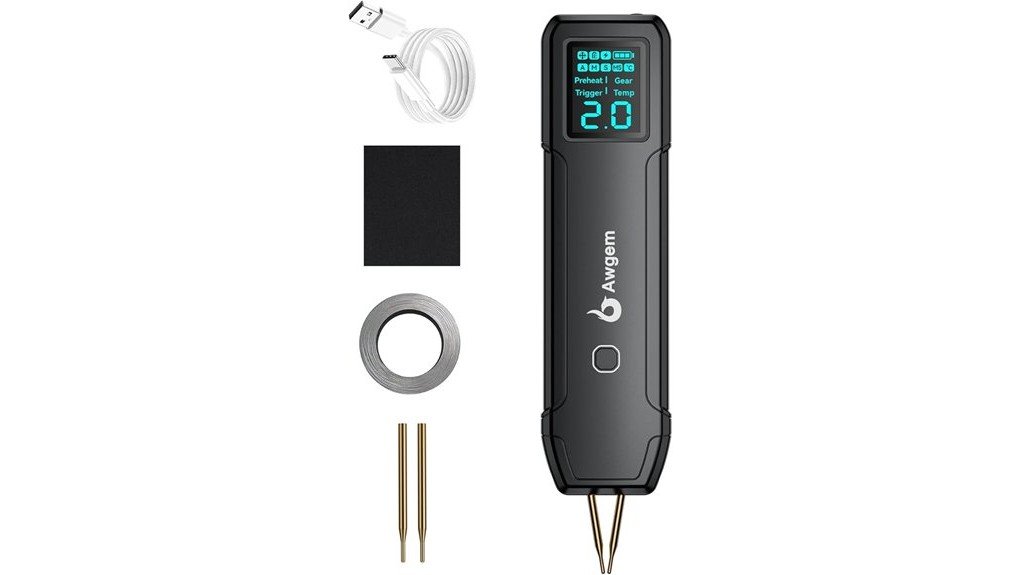
| Included Components | Spot welder, two pairs of welding needles including the installed pair, 2 meters of nickel-plated sheet, charging cable, user manual, and sandpaper |
| Low-Voltage Alert | Red warning when internal battery voltage falls below 3.2 V |
| Overheat Protection | Welding output stops and a blue warning appears at 65°C or higher |
| Unconfirmed Details | Battery capacity, tested runtime, duty cycle, and detailed warranty coverage |
What Is the Awgem Battery Spot Welder SH2?
The Awgem SH2 is a rechargeable handheld spot welder designed to join thin metal battery tabs to cells. Unlike a bench unit with a separate power base and welding pen, the SH2 places the controls, battery, display, button, and welding needles in one compact body.
Awgem markets the SH2 for small DIY battery packs and repairs involving cylindrical cells such as 18650, 26650, and 36650 batteries. The product listing also mentions small electronic battery applications, but you should verify the chemistry, tab material, and required welding energy before working on an unfamiliar pack.
Its main selling point is control in a portable format. You receive 99 power levels, two triggering modes, real-time display information, and replaceable welding tips without moving to a larger bench machine.
Who Should Buy It?
Best For
- Hobbyists assembling or repairing occasional small battery packs
- Users welding 0.1–0.2 mm nickel-plated sheet
- Beginners who want adjustable output and visible status information
Skip If
- You need to weld thick strip, structural steel, or continuous production batches
- You require verified performance on pure nickel thicker than the listed range
- You need published battery capacity, duty-cycle, or professional warranty specifications
Before You Buy: The verified listing specifies 0.1–0.2 mm nickel-plated sheet. Do not assume the SH2 will produce the same results on thicker material, pure nickel, copper, or other metals without confirmation from the manual.
Feature-by-Feature Review
99 Adjustable Power Levels
The SH2 provides 99 output levels, which gives you smaller adjustment steps than a basic welder with only a few settings. This is useful when a low level produces a loose weld but the next major setting on a simpler tool would add too much heat.
More settings do not guarantee a good weld on every material. Cell condition, tab thickness, surface cleanliness, electrode pressure, battery charge, and contact angle also affect the result. Treat the setting number as one part of the process rather than a universal recipe.
0.1–0.2 mm Nickel-Plated Sheet Range
Amazon lists the SH2 for 0.1–0.2 mm nickel-plated sheet. That range fits light battery-pack work and small tab repairs, but it places a clear limit on the product. Buyers working with thicker strip or high-current packs may need a stronger capacitor-based or bench-style welder.
Nickel-plated steel and pure nickel do not behave identically during welding. Confirm the strip material instead of selecting a power level based only on thickness.
Automatic and Manual Modes
Automatic mode triggers when the welding needles make proper contact, which can speed up repeated tab placement. Manual mode lets you trigger the weld with the thumb-positioned button, giving you more control while aligning a small or awkward connection.
Manual mode may be easier while learning because you can position both needles before firing. Automatic mode becomes more useful once your work surface, hand position, and contact pressure are consistent.
Color LCD and Controls
The LCD displays the selected power level, operating mode, tool temperature, preheat time, and trigger time. This gives you more feedback than a welder that uses only numbered lights or an unmarked dial.
The display can help you catch an incorrect mode or rising temperature before the next weld. It cannot tell you whether the finished joint has enough mechanical strength, so you still need to inspect and test each weld.
One-Handed Design
At 8.4 ounces and 6 inches long, the SH2 is small enough to hold directly over a battery layout. The integrated design removes the cable between a base unit and separate welding pen, which can make compact projects easier to reach.
The tradeoff is that the internal battery, electronics, and electrodes are all inside the tool you are holding. A larger bench unit may provide better heat management and steadier output for high-volume work.
Replaceable Welding Needles
The needles are replaceable, and the package includes two pairs counting the installed set. Replaceable tips extend the usable life of the tool because worn or damaged contact points do not require replacing the full welder.
Inspect the needle ends regularly. Dirt, oxidation, deformation, or uneven tip height can lead to inconsistent current flow and poor weld placement.
Included Starter Accessories
The listed package contains the SH2, two pairs of welding needles, 2 meters of nickel-plated sheet, a charging cable, a user manual, and sandpaper. This is enough to test the tool without separately buying every small accessory.
The included sheet should be treated as practice or starter material until you confirm its dimensions and suitability for your intended pack. A battery pack must use conductors sized for its actual current load, not simply whatever strip came in the box.
How It Performs in Real Use
The following assessment is based on the verified design and specifications rather than hands-on measurement.
For Small Battery-Pack Assembly
The 99 output levels and compact body should make the SH2 easier to tune for occasional 18650-style pack work than a basic fixed-output tool. Its verified sheet range is best aligned with light-duty tabs rather than thick, high-current conductors.
For Individual Tab Repairs
Manual triggering is useful when you need to place one careful weld near an existing connection. The thumb button lets you align the needles first, but the cell and strip still need stable support to prevent movement during the pulse.
For Repeated Welds
Automatic mode can reduce button presses during a series of similar connections. However, Awgem does not publish a verified duty cycle or detailed runtime in the accessible listing, so allow cooling breaks and watch the temperature display instead of assuming unlimited continuous use.
For Portable or Occasional Use
The rechargeable one-piece design is easier to store and carry than a larger bench machine. It can suit a hobby drawer, repair kit, or small workbench, although loose battery cells and conductive tools still require careful transport and storage.
Setup Tips Before Your First Weld
- Read the included manual. Confirm the supported strip material, charging procedure, operating modes, and warning indicators.
- Inspect every cell. Do not weld a swollen, leaking, corroded, overheated, dented, or otherwise damaged battery.
- Prepare a clean, flat surface. The strip should sit flush against the cell terminal without a visible gap.
- Make contact with both needles. The listing states that both welding points must touch the material before current is delivered.
- Start at a low setting. Test on representative scrap or a safe practice piece, then increase output gradually.
- Check the weld mechanically. A good tab should resist a gentle peel test without tearing loose immediately.
- Watch the temperature display. Pause between groups of welds and let the tool cool before an overheat warning occurs.
- Keep polarity and nearby conductors controlled. An accidental short circuit across a lithium cell can produce extreme heat and fire.
Pro Tip: Record the strip type, thickness, power level, battery charge, and result during practice. That gives you a repeatable starting point when you return to the same material later.
Compatibility and Battery Safety
Spot welding lithium battery cells involves more risk than ordinary craft work. Use eye protection, remove conductive jewelry, keep metal tools organized, and work on a clean nonflammable surface away from fuel, paper, solvents, and loose metal parts.
Do not weld a cell with a damaged insulating wrap or missing terminal insulator. The metal can of many cylindrical lithium cells is electrically live, so a misplaced strip or tool can create a direct short. Replace damaged wraps and insulators using the correct parts before assembling a pack.
The SH2 includes a red low-voltage warning below 3.2 V and a blue overtemperature warning with output interruption at 65°C or higher. These protections help protect the welder’s internal battery and electronics, but they do not detect every unsafe condition in the battery pack you are building.
Use cells of the same chemistry, model, capacity, condition, and state of charge when building a pack. Pack design, conductor sizing, insulation, fusing, battery-management systems, and enclosure requirements should be reviewed by a qualified battery technician when failure could cause injury or property damage.
What Buyers Are Saying
Buyer Feedback Check
The accessible Amazon page did not expose enough detailed written feedback to identify reliable long-term praise or complaint patterns. One customer-review video characterized the welder as compact and feature-rich, but that single summary is not enough to judge battery longevity, durability, or consistency. Check the newest verified-purchase reviews for reports about weak welds, charging, heat buildup, needle wear, and seller support.
Pros and Cons
Pros
- 99 power levels provide fine adjustment for light tab welding
- Automatic and manual modes support repetitive and precise placement
- Color LCD shows settings, mode, timing, and temperature
- Replaceable needles reduce the need to replace the entire tool
- Compact 8.4-ounce body and starter accessories suit occasional DIY use
Cons
- Verified range is limited to 0.1–0.2 mm nickel-plated sheet
- Battery capacity, tested runtime, and duty cycle are not clearly published
- Not designed for thick metal, production welding, or structural work
Is It Worth the Price?
The Awgem SH2 belongs to the consumer handheld category rather than the professional bench-welder category. Its value comes from combining 99 settings, two operating modes, a detailed LCD, replaceable tips, and useful starter accessories in one compact tool.
It is worth considering when you make occasional small battery packs and the current price is close to other rechargeable handheld welders. It offers less value when your projects require thick pure nickel, long production runs, published duty-cycle data, or serviceable high-capacity power components.
Because Amazon did not display a stable featured offer during verification, compare the current seller, return terms, package contents, and final checkout price before deciding.
How It Compares to Alternatives
The Awgem SH1 is the simpler same-brand option. Amazon’s comparison information lists 11 power levels for the SH1 versus 99 for the SH2, while both are marketed for 0.1–0.2 mm nickel-plated sheet and one-handed operation.
Awgem’s SK1 models are larger-step alternatives for buyers who need more capability. The listed SK1 versions offer 100 power levels and thicker advertised sheet ranges, with automatic or foot-pedal control depending on the version. SEESII also sells handheld 1–99-level spot welders that are worth comparing for output specifications, battery capacity, replacement-tip availability, and warranty support.
The SH2 makes the most sense when your priority is compact one-handed use with more adjustment than the entry-level SH1.
Frequently Asked Questions
Which battery sizes can the Awgem SH2 work with?
Awgem advertises the SH2 for cylindrical batteries including 18650, 26650, and 36650 cells. Cell diameter alone does not confirm a safe setup, so verify the battery chemistry, terminal design, strip material, and pack requirements before welding.
Can it weld pure nickel strip?
The verified Amazon specification covers 0.1–0.2 mm nickel-plated sheet. Pure nickel has different electrical and thermal properties, so do not assume equal performance without confirmation from Awgem or the user manual.
Is the internal battery rechargeable or replaceable?
The listing confirms that a lithium-polymer battery and charging cable are included. It does not clearly state that the battery is user-replaceable, so treat it as an internal rechargeable component unless the manual says otherwise.
How long does the SH2 run on one charge?
A dependable runtime was not published in the accessible Amazon technical details. Actual use will vary with the selected output, number of welds, temperature, battery condition, and time between pulses.
What comes in the package?
The listing includes the SH2 welder, two pairs of welding needles counting the installed pair, 2 meters of nickel-plated sheet, a charging cable, a user manual, and sandpaper. Confirm the package list on the seller page because bundles can change.
Is the Awgem SH2 suitable for beginners?
The display, manual mode, and adjustable output make it more approachable than a fixed-output tool. Beginners still need to understand lithium-cell safety, practice on representative material, and inspect every connection before using a finished pack.
Can it replace a full-size metal welder?
No. The SH2 is a small resistance spot welder for thin battery-tab material. It is not designed for structural steel, automotive body panels, thick fabrication stock, or general arc-welding work.
What is the most common setup mistake?
A common mistake is increasing power before checking contact. Both needles should touch clean, flat material at the same time, with the strip held firmly against the terminal and no visible gap.
The Bottom Line
The Awgem Battery Spot Welder SH2 is a practical option for hobbyists who need fine output adjustment, one-handed control, and a clear LCD for light battery-tab work. Buyers who need thick-material capability, continuous production performance, or fully published battery and duty-cycle specifications should choose a more powerful bench-style model.
Its strongest features are the 99 levels, dual operating modes, replaceable needles, and compact package. Its main limitation remains the verified 0.1–0.2 mm nickel-plated sheet range.
Ready to Buy?
Check the latest seller, price, package contents, and product details before you decide.