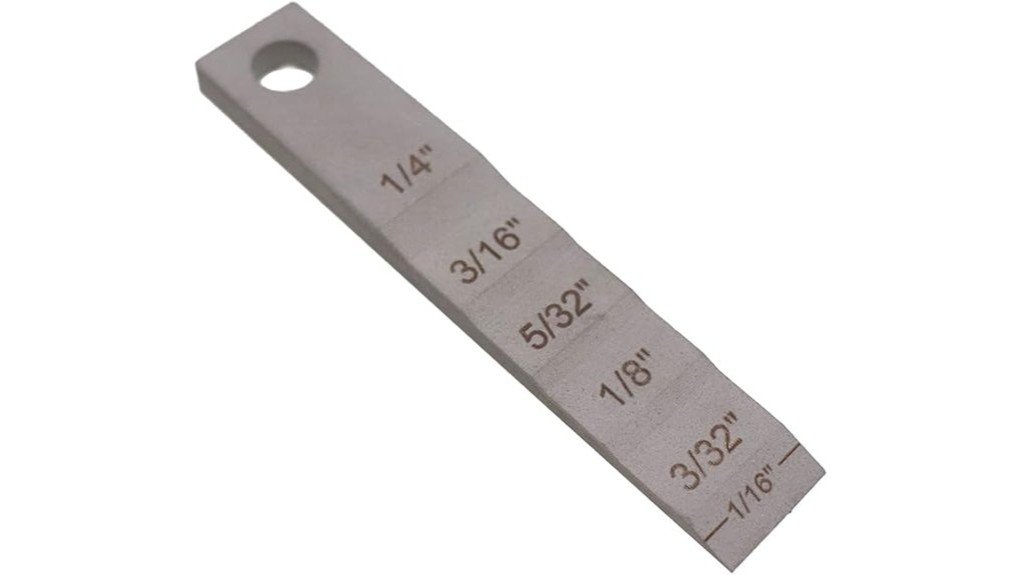
The B&B Pipe 2130 is a brass stepped pipe wedge about 4 in long and 3/4 in wide, with steps from 1/16 in to 1/4 in that act as a root-gap gauge during pipe fit-up. This B&B Pipe 2130 stepped pipe wedge review is based on the Amazon listing, not on hands-on testing.
It is worth considering if you fit up pipe or tube and want a simple way to set and repeat a consistent gap before tacking. Skip it if you only weld flat plate, or need a wedge for leveling heavy equipment.
Quick specs at a glance
| Item | Details |
|---|---|
| Product type | Stepped wedge / gap gauge for pipe fit-up |
| Material (per listing) | Brass |
| Size (per listing) | About 4 in long x 3/4 in wide |
| Gauge steps (per listing) | Roughly 1/16 in to 1/4 in |
| Extra feature (per listing) | Hole for a lanyard or retrieval |
Confirm the exact step sizes and any markings on the listing photos. Your weld procedure sets the root gap, not the tool.
What the B&B Pipe 2130 stepped pipe wedge does
When two pipes are fitted for a groove weld, the gap between them (root gap) affects penetration. A stepped wedge has several thickness steps. You slide it into the gap until it fits snugly on a step, which shows you the gap and lets you hold it while you tack.
Brass is used because it is softer than steel, less likely to mark pipe edges, and spatter does not fuse onto it as easily. It suits pipe fitters, fab-shop welders and students working through root pass practice.
How to check it suits your work
- Gap range: compare 1/16 to 1/4 in with the root gap in your procedure or code. Many open-root joints use something in this range, but follow your welding procedure specification.
- Pipe wall: the wedge sits between bevelled ends. Check the land and bevel on your pipe so the wedge seats properly.
- Size: 4 in long suits larger pipe; for small tube, a smaller gauge may be easier to place.
- Number: one wedge sets one position. Many fitters use two or three around the pipe, so consider buying more.
- Material of pipe: brass is fine for steel and stainless, but clean it before use on stainless to avoid contamination.
Pros and limitations
Pros
- Gives a quick, repeatable gap.
- Brass resists spatter sticking.
- Hole lets you attach a lanyard to avoid loss.
- Light and pocketable.
Limitations
- It measures gap, not hi-lo or alignment. Use alignment clamps for that.
- Soft brass can wear and bend under hammering.
- Not for leveling or supporting loads.
- You must remove it before the weld reaches that area.
How to use it in pipe fit-up
- Bevel and clean the pipe ends to bright metal.
- Bring the pipes together and slip the wedge into the gap at one point.
- Choose the step that matches your required root gap and tap or slide it in lightly.
- Tack the joint on both sides of the wedge and at other positions, keeping alignment checked.
- Remove the wedge before welding that section, and check the gap again after tacks cool, since tacks can pull the joint closed.
Wear gloves; edges and hot tacks can burn. Follow your WPS for root gap, and ask a qualified inspector if you are working to code.
Alternatives and related guides
- Pipe alignment clamp review – handles hi-lo alignment that a wedge does not
- Metal wedge shims review – plain steel shims for packing and leveling
- Fillet gauge set review – for checking fillet weld size after welding
Frequently Asked Questions
What is a stepped pipe wedge used for?
It sets and holds a consistent root gap between two pipe ends during fit-up. You slide it into the gap, match the step to the gap you need and tack the pipe.
Is brass a good material for a gap gauge?
Brass is softer than steel, so it is gentler on pipe edges and spatter does not stick as easily. It is also not as stiff as steel, so avoid hard hammering.
What root gap should I use?
Use the root gap in your welding procedure specification or code. The wedge only helps you set it; the right gap depends on process, pipe thickness, bevel and position.
Does it replace a pipe alignment clamp?
No. A wedge sets the gap, while an alignment clamp or fixture controls hi-lo and keeps the pipes concentric. Many fitters use both.
Final verdict
The B&B 2130 is a simple brass root-gap gauge for pipe fitters. Match the steps to your procedure, buy extras if you want several gap points and pair it with an alignment clamp.