As an Amazon Associate I earn from qualifying purchases. Buying through these links costs you nothing extra.
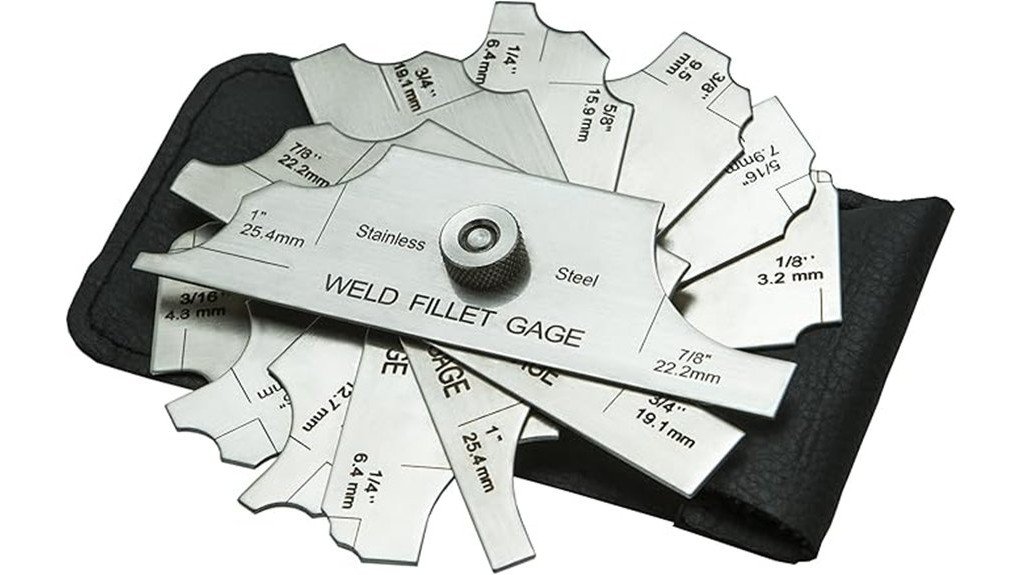
The Ally Tools 7 piece fillet gauge set is a stainless steel weld inspection tool for checking fillet weld leg size, with etched markings in inches and millimeters. It is worth considering if you weld brackets, frames and tabs and want a quick size check, and it is not a replacement for a formal weld inspection. This Ally Tools fillet gauge set review is based on the Amazon listing, not hands-on testing.
Ally Tools fillet gauge set at a glance
| Item | What the listing says |
|---|---|
| Type | Fillet weld inspection gauge set, 7 pieces |
| Material | Stainless steel with etched markings |
| Range quoted | 1/8 in to 1 in, 3.2 mm to 25.4 mm |
| Packed size | About 5.75 x 3.54 x 0.75 in |
| Use | Checking fillet weld leg size on plate and sections |
Confirm the exact size steps and any case or pouch on the current listing.
What it is and who it suits
Fillet gauges are blades with notches or cutouts that match common weld sizes. You press the correct blade against the base metal and the weld face to see if the weld is oversized, undersized or on target.
They are handy for hobbyists learning to hit a target size, students practicing joints and fabricators who need quick checks before they hand work off. For practice material, see the Therwen 9-piece welding practice kit and the welding coupons review.
How to check it suits your work
- Check size steps. Make sure the sizes you weld most, such as 3/16 in and 1/4 in, are in the set.
- Know which dimension you need. A drawing may call for leg size or throat. Make sure the gauge measures the one specified.
- Look at the markings. Etched marks are less likely to wear than printed ones. Check readability in your shop lighting.
- Consider other tools. A bridge cam gauge or a weld measuring tool can cover butt weld reinforcement and misalignment, which this set does not.
- Ask about code needs. If you work to a code, check which tools your procedure allows.
Pros and limitations
Pros
- Stainless steel resists rust and is easy to wipe clean.
- Imperial and metric markings help with mixed drawings.
- Small enough to keep in a pocket or drawer.
Limitations
- Measures fillets only, not groove welds, undercut or porosity.
- Seven pieces will not cover every size step, so welds may fall between sizes.
- Readings can vary with weld shape and operator technique.
- Not a calibrated certified instrument unless stated by the seller.
How to use a fillet gauge
- Let the weld cool and wire brush off slag and spatter so the gauge sits flat.
- Pick the blade for the specified size.
- Place the gauge square against the base metal and the toe of the weld.
- Check that the weld face meets the leg size without large gaps, and note whether it is convex or concave.
- Repeat along the weld at several points, since size can vary along the joint.
- Record results on a part or weld log if required.
A weld that is too small may be weaker than required, and one that is too large wastes time and adds distortion. Practice helps you judge size by eye, and a gauge confirms your estimate.
Alternatives and related guides
- Fillet weld size rule of thumb to pick a target size.
- How to calculate fillet weld strength once you know the leg size.
- Zonon point-to-point measuring tool for layout measurement.
- Double-pointed scriber to mark metal accurately.
- Welding practice kit for something to weld and measure.
Frequently Asked Questions
What does a fillet weld gauge measure?
A fillet gauge checks the leg size of a fillet weld, the distance along each joined plate from the corner to the toe of the weld. Many sets also check throat size or concavity and convexity. Lay the matching blade against the plates and the weld face to see if the weld meets the required size.
What size range does the Ally Tools set cover?
The listing quotes sizes from 1/8 inch to 1 inch, with metric markings from 3.2 mm to 25.4 mm, on seven stainless steel pieces. Because the listing is the source for these figures, check the current page for the exact size steps and for any case included.
Can a fillet gauge replace weld inspection by a certified inspector?
No. It is a quick measuring tool for self-checks and shop QC. Structural, pressure or code work usually needs inspection to the applicable code by a qualified inspector, using the procedure and acceptance criteria that apply.
How do I keep a stainless gauge accurate?
Keep the gauges clean and dry, avoid prying or hammering with them, and do not use them as a scraper on hot or spatter-covered welds. Check them against a known-size item periodically, and replace any bent or worn blade.
Conclusion
The Ally Tools fillet gauge set looks like a simple, compact way to check fillet leg size. Check the size steps against your work, treat it as a shop check rather than formal inspection, and keep it clean.