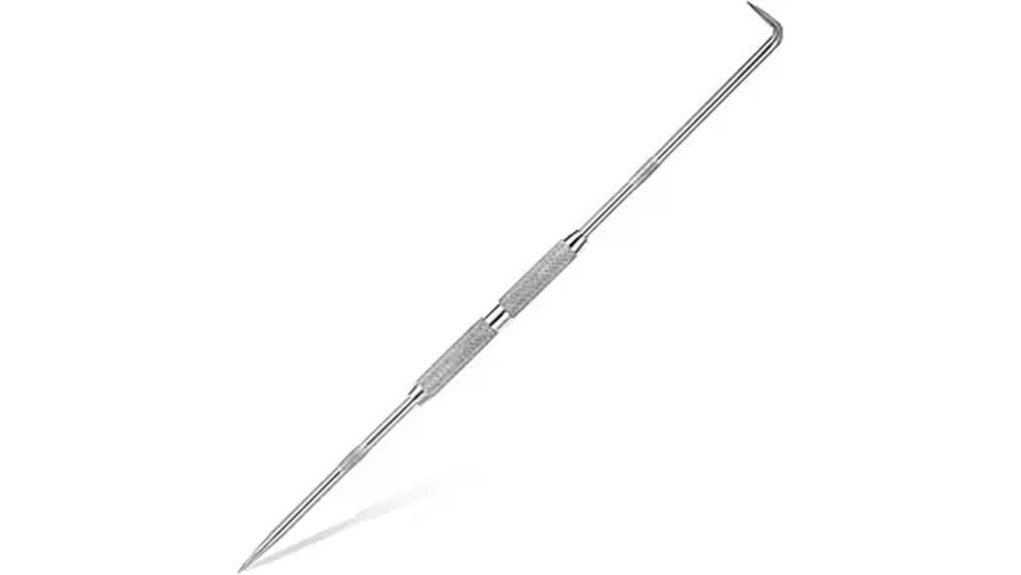
The double pointed scriber is a 22.5 cm steel scribe for marking fine layout lines on metal before you cut, drill or weld. Per the listing it is made of 45# steel, makes a roughly 0.5 mm line, has a knurled grip, a hexagonal head that stops it rolling, and a reversible point that stores inside the handle. It is a good shop basic, but it does not replace a carbide-tipped scriber for hard or coated surfaces.
Quick specs at a glance
| Item | Detail |
|---|---|
| Product | Double pointed scriber, 22.5 cm long |
| Material | 45# steel, per the listing |
| Line width | About 0.5 mm, per the listing |
| Grip | Knurled grip, hexagonal head to prevent rolling |
| Storage | Reversible point that locks inside the handle |
| Weight | About 35 g, per the listing |
Specs are from the seller listing. The maker lists steel, brass, glass and similar materials; harder surfaces may need a carbide scriber.
What the double pointed scriber is and who it suits
A scriber scratches a thin, permanent line into the surface, which is more accurate than a pencil or marker for metal layout. Welders use them to mark cut lines, hole centers and joint positions on steel, aluminum and brass.
The double-pointed design gives you a spare tip, and the reversible storage protects the point in a tool bag. At about 35 g it is light, though some buyers prefer a heavier handle for control.
How to check it fits your work
- Material: great on mild steel, aluminum and brass, but a steel point will not scratch hardened steel or glass reliably. Check the listing.
- Line width: a 0.5 mm line suits most fabrication. Fine instrument work may need a finer or carbide scribe.
- Length: 22.5 cm fits a pocket or tool roll; check it suits your hand.
- Surface: on painted or coated metal, you may need a layout fluid so the line is visible.
Pros and limitations
Pros
- Fine, permanent lines for accurate layout.
- Spare tip on the other end.
- Hexagonal head stops it rolling off the bench.
- Reversible point protects the tip and your pocket.
Limitations
- Not carbide, so it dulls and cannot scribe hard materials.
- Scribed lines can be hard to see on shiny stainless without layout dye.
- Scratches stay in the surface, which matters on finished parts.
- Grip comfort is subjective.
Using and caring for a scriber
- Use a straightedge or square and pull the scriber toward you at a slight angle.
- Apply light layout fluid or marker first to make the line stand out.
- Do not press hard on thin sheet since you can mark deeply.
- Touch up a dull point with a fine stone, and keep the tip covered when not in use.
Wear eye protection around grinding and cutting, and store the scriber point-in so it does not stab hands or other tools.
Alternatives and related guides
- Zonon Point-2-Point measuring tool: for finding the centers you want to mark
- soapstone pencil refills: a visible marker for dark steel
- PAGOW 70A pocket scriber: another pocket marking tool to compare
- tungsten carbide tip scriber: for hard surfaces a steel point cannot mark
Frequently Asked Questions
What is a scriber used for in welding?
A scriber marks fine, permanent layout lines on metal for cuts, holes and joint positions. It gives more accuracy than a pencil or marker, which matters when parts must fit cleanly before tacking. Many welders pair it with layout fluid on shiny metal.
Can a steel scriber mark hardened steel or glass?
Not reliably. A plain steel point may skate or dull on very hard surfaces. For hardened steel, ceramics or glass, use a carbide-tipped or diamond-tipped scriber. The listing lists glass among materials, but test on scrap first.
How do I sharpen a scriber?
Use a fine oil stone or fine file and keep the taper consistent while rotating the tool. Stop when the point is sharp and clean. Avoid overheating, and wear eye protection when using a grinding wheel.
Why would I want a double-ended scriber?
A second point gives you a spare tip when one dulls or breaks. On this tool, the points reverse and lock inside the handle, which also protects the sharp end when you carry it in a pocket or tool bag.
Final verdict
This double pointed scriber is an inexpensive, light layout tool for clean marking on mild steel and softer metals. Buy a carbide scriber if you work with hard surfaces. Check the current listing for details.