Disclosure: As an Amazon Associate, we earn from qualifying purchases. If you click a link on this page and make a purchase, we may receive a small commission at no extra cost to you.
Low-amperage TIG work exposes small setup mistakes quickly. The wrong tungsten can cause weak starts, arc wander, early tip wear, or repeated stops to regrind. The CK Worldwide T1167GTM is a 1/16-inch by 7-inch LaYZr tungsten electrode that combines lanthanum, zirconium, and yttrium oxides in a non-radioactive, chartreuse-coded EWG blend. It is a strong match for welders who want stable low-amperage starts across AC and DC work, but its small diameter and specialized blend will not suit every torch or high-current job.
Quick Verdict
Rating: 8/10
Best For: TIG welders using a 1/16-inch tungsten for low to medium amperage AC or DC work, especially on aluminum, magnesium, steel, stainless steel, nickel, copper, or titanium alloys.
Bottom Line: The T1167GTM offers very stable tip geometry, strong low-amperage starts, and a versatile non-radioactive LaYZr blend. Its main limits are the fixed 1/16-inch diameter and the need to confirm that your torch parts, current range, and preferred tungsten chemistry match the job.
| Specification | Detail |
|---|---|
| Brand | CK Worldwide |
| Model | T1167GTM |
| Product Type | Tungsten electrode for TIG welding |
| Electrode Family | CK Worldwide LaYZr rare-earth blend |
| Classification | AWS A5.12 EWG |
| Principal Oxides | 1.5% lanthanum, 0.08% zirconium, and 0.08% yttrium oxides |
| Color Code | Chartreuse |
| Diameter | 1/16 inch, 1.6 mm |
| Length | 7 inches, 175 mm |
| Package Quantity | 10 electrodes |
| Polarity | AC or DC TIG applications |
| Power Source Compatibility | Inverter or transformer-based constant-current TIG power sources |
| Best Use | Low to medium amperage work, including automated or robotic applications |
| Compatible Materials | Low-alloy steel, stainless steel, aluminum, magnesium, titanium, nickel, and copper alloys |
| Safety Note | Non-radioactive, but grinding dust still requires proper ventilation and cleanup |
What Is the CK Worldwide T1167GTM Tungsten Electrode?
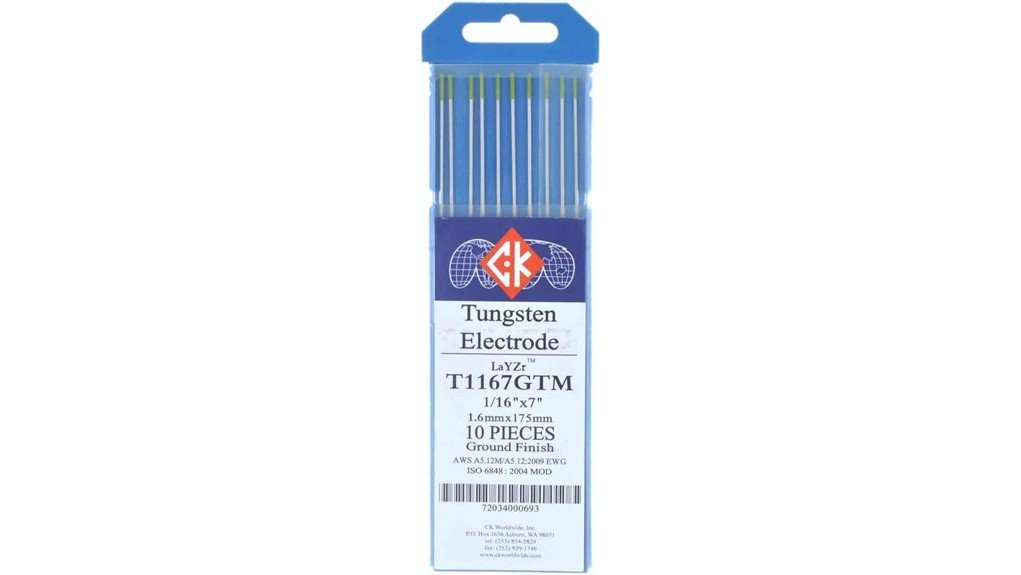
The CK Worldwide T1167GTM is a chartreuse-coded LaYZr tungsten electrode for gas tungsten arc welding, better known as TIG welding. It measures 1/16 inch in diameter and 7 inches long, and the reviewed Amazon package contains 10 electrodes.
This model is not the same as CK Worldwide’s gold 1.5% lanthanated tungsten. The T1167GTM uses an EWG rare-earth blend with 1.5% lanthanum, 0.08% zirconium, and 0.08% yttrium oxides. CK Worldwide positions the blend for AC or DC welding with inverter or transformer-based constant-current power sources.
Its main selling points are very stable tip geometry, cooler operation than 2% thoriated tungsten, long service life, and strong low-amperage starts. Those traits make it useful for precision fabrication, repeated starts, and automated or robotic TIG work where a small change in arc behavior can affect consistency.
Who Should Buy It?
Best For
- Welders who need a 1/16-inch tungsten for controlled low-amperage TIG starts.
- Shops that switch between AC and DC work on aluminum, magnesium, steel, stainless, nickel, copper, or titanium alloys.
- Automated, robotic, or repeat-production setups that benefit from stable tip geometry and consistent arc behavior.
Skip If
- Your torch, collet, or amperage range requires 3/32-inch or 1/8-inch tungsten.
- You specifically need a standard EWLa-1.5 gold electrode rather than an EWG rare-earth blend.
- You want a manufacturer-stated warranty term or a machine-specific amperage chart included with the listing.
Before You Buy: Confirm both the diameter and the tungsten classification. T1167GTM is a chartreuse EWG LaYZr electrode, not CK Worldwide’s gold 1.5% lanthanated model. Your torch collet, collet body, welding current, polarity, and procedure must match a 1/16-inch electrode.
Key Features and Benefits
LaYZr Rare-Earth Blend
The T1167GTM combines lanthanum, zirconium, and yttrium oxides instead of relying on a single principal additive. This gives you a non-radioactive alternative to thoriated tungsten while retaining the stable arc behavior needed for detailed TIG work.
The blend is classified as EWG, which covers tungsten electrodes with other oxide additions. That distinction matters when you organize tungsten by color or chemistry, because treating this model as a standard gold lanthanated electrode can lead to setup mistakes or inconsistent purchasing.
Strong Low-Amperage Starts
CK Worldwide highlights low-amperage arc starting as one of this electrode’s main strengths. A 1/16-inch tungsten is already suited to lighter work, and the LaYZr blend is designed to support clean ignition and re-ignition without needing excessive current.
This is useful on thin sheet, small components, edge welds, and jobs where you need controlled heat input. It does not remove the need for correct high-frequency settings, clean workpieces, or a properly prepared tip.
Stable Tip Geometry and Cooler Operation
A stable tip helps keep the arc directed where you intend, especially during repeated starts or mechanized movement. The product description also states that the blend runs cooler than 2% thoriated tungsten and offers longer service life.
Actual tip life still depends on current, electrode extension, shielding gas, grind quality, accidental puddle contact, and how often you change between AC and DC procedures. A contaminated electrode can lose its advantage quickly.
AC and DC Versatility
The T1167GTM is intended for AC or DC TIG applications with inverter or transformer-based constant-current machines. That gives it broader use than tungsten types aimed mainly at one polarity.
For AC aluminum or magnesium work, your waveform, balance, frequency, and tip preparation still control how the electrode behaves. For DC steel, stainless, nickel, copper, or titanium work, the grind angle and gas coverage remain just as important as the tungsten chemistry.
Ten-Electrode Package
The reviewed listing is a 10-pack, which is practical for a shop that wants matched electrodes ready for production, training, or separate stations. It also gives you replacements when a tip becomes contaminated or too short for safe torch use.
CK Worldwide also lists a separate T1167GTM-3 three-pack. Check the exact model suffix and seller description before ordering so you do not confuse the 10-piece T1167GTM package with the three-piece version.
Applications and Material Compatibility
The manufacturer lists the T1167GTM for low-alloy steel, non-corroding steel, aluminum alloys, magnesium alloys, titanium alloys, nickel alloys, and copper alloys. That broad range makes it useful when one shop handles several TIG processes, but it does not mean one grind or one machine setting works for every metal.
- Steel and stainless steel: A pointed, longitudinally ground tip can support a focused DC arc when the welding procedure calls for it.
- Aluminum and magnesium: The electrode can be used on AC, but you still need suitable AC balance, frequency, current, and shielding gas.
- Nickel and titanium alloys: Clean preparation and complete shielding are critical because these materials are sensitive to contamination and oxidation.
- Copper alloys: High heat conductivity may require a different current strategy even though the electrode chemistry is compatible.
- Automated or robotic welding: Stable geometry and tolerance for small tip-to-work distance changes can help repeatability in a controlled process.
How It Performs in Real Use
For Thin Steel and Stainless Parts
The 1/16-inch diameter is a practical match for lighter DC TIG work where a large electrode can make low-current starts feel less responsive. The LaYZr blend’s stable point can help you direct heat into small joints, corners, and visible seams with less arc wandering.
For AC Aluminum and Magnesium
The T1167GTM can handle AC applications, which makes it more flexible than a DC-focused tungsten. You still need to watch the tip under your chosen waveform. Too much current, too much electrode extension, or an unsuitable balance setting can overheat or deform a 1/16-inch electrode.
For Automated or Robotic Cells
This is one of the product’s clearest use cases. CK Worldwide describes the LaYZr blend as well suited to automated or robotic applications because it tolerates small changes in tip-to-work distance and maintains stable geometry. That can reduce process variation when the rest of the cell is correctly calibrated.
For Repeated Starts in a Fabrication Shop
Frequent tacks and short welds put extra emphasis on ignition and re-ignition. The T1167GTM’s low-amperage starting behavior can save time compared with an electrode that needs repeated pedal input or touchups to establish a clean arc. The benefit is strongest when every electrode is ground consistently and stored without contamination.
How to Use It Correctly
Match the Torch Parts
Use a 1/16-inch collet and matching collet body or gas-lens components. A mismatched collet may fail to grip the electrode securely, while the wrong torch setup can cause gas leaks, unstable stick-out, or poor electrical contact.
Grind in the Correct Direction
Prepare the tip on a dedicated tungsten grinder or a clean grinding wheel reserved for tungsten. Grind lengthwise along the electrode, not around its circumference. Longitudinal grind marks help keep the arc aligned with the electrode instead of encouraging it to wander across circular scratches.
Choose a Tip Profile for the Procedure
Use the grind angle, flat, or rounded profile required by your machine manual and welding procedure. A sharper point can concentrate the arc at lower current, while a blunter point can handle more heat. Do not copy one tip shape across every metal, polarity, and current level.
Regrind After Contamination
If the tungsten touches the weld puddle or filler rod, stop and inspect it. Remove the contaminated section and prepare a clean tip before continuing. Welding through contamination can cause an unstable arc and may introduce tungsten or other impurities into the weld.
Store Each Type Separately
Keep unused electrodes in a clean, dry tube labeled with the diameter, color code, and model. Separate chartreuse LaYZr tungsten from gold lanthanated, blue 2% lanthanated, red thoriated, gray ceriated, and green pure tungsten.
Pro Tip: Prepare several electrodes with the same verified grind before a long job. When one becomes contaminated, you can swap it immediately and regrind the used electrodes together later, which improves consistency and reduces downtime.
Compatibility and Safety Notes
The T1167GTM is non-radioactive, but grinding any tungsten electrode creates fine dust and sharp fragments. Use local dust collection or good ventilation, wear suitable eye and respiratory protection, and clean the grinding area instead of blowing dust into the shop.
Follow your TIG welder manual, torch limits, welding procedure, and workplace safety program. Wear an appropriate welding helmet, gloves, protective clothing, and footwear. Shielding gas can displace oxygen in enclosed areas, so ventilation matters even when the electrode itself is non-radioactive.
The Amazon listing displays a California Proposition 65 warning. Do not assume that a non-radioactive tungsten is free from every workplace or material-handling concern. California users can review the official Proposition 65 guidance, and all users should follow the product label and local disposal rules.
Store full-length and used electrode pieces in a rigid container. Short tungsten pieces can puncture skin, damage hoses, contaminate benches, or become lost in scrap. Recycle them through an appropriate welding supplier or metal-recycling program when available.
Performance Comparison With Other Electrodes
| Electrode Type | Best Buying Difference | Main Tradeoff |
|---|---|---|
| CK T1167GTM LaYZr | Chartreuse EWG blend for AC/DC, very stable geometry, and strong low-amperage starts | Not the same chemistry as standard gold or blue lanthanated tungsten |
| CK 2% Lanthanated, Blue | General-purpose AC/DC option with a familiar EWLa-2 classification | Different starting and current-range behavior from the LaYZr blend |
| 2% Thoriated, Red | Established DC performance on steel, stainless, nickel, and titanium | Contains radioactive thorium and requires stricter dust-control practices |
| Pure Tungsten, Green | Traditional AC choice for some transformer-based aluminum and magnesium setups | Lower current capacity and less versatility than modern rare-earth blends |
| 2% Ceriated, Gray | Non-radioactive option known for easy starting and low-current control | May not offer the same tip-life or application balance you want for repeated AC/DC work |
The closest same-size CK alternative is the T1167GL2, a blue 2% lanthanated electrode. Choose that model when you specifically want EWLa-2 chemistry. Choose the T1167GTM when stable low-current starts, chartreuse EWG identification, and the LaYZr blend better match your procedure.
Pros and Cons
Pros
- LaYZr rare-earth blend supports stable AC and DC TIG performance.
- Very good low-amperage starts suit precise 1/16-inch applications.
- Stable tip geometry can improve repeatability in manual, automated, or robotic work.
- Non-radioactive alternative to 2% thoriated tungsten.
- Ten-electrode package provides matched replacements for ongoing shop use.
Cons
- The 1/16-inch diameter is not suitable for every current range or torch setup.
- The chartreuse EWG blend can be confused with standard 1.5% lanthanated tungsten if you buy by percentage alone.
- The listing does not provide a detailed machine-specific amperage chart or a clear product warranty term.
Is It Worth the Price?
The T1167GTM offers strong value for the price when you need a specialized 1/16-inch tungsten with consistent low-current starts and broad AC/DC compatibility. The 10-pack is most useful for fabrication shops, training programs, production cells, or welders who prefer to keep several identically prepared electrodes ready.
You get the most value when your procedure already calls for the LaYZr EWG blend. Buying it only because the description mentions 1.5% lanthanum may lead to the wrong choice, since CK Worldwide also sells separate gold EWLa-1.5 electrodes and blue EWLa-2 electrodes.
It is not the best fit if you need a larger diameter, a single trial electrode, or a published amperage chart tied to your exact machine and waveform. Confirm the current Amazon offer, package quantity, and seller terms before ordering.
How It Compares to Alternatives
The CK Worldwide T1167GL2 is the clearer alternative when you want a conventional blue 2% lanthanated electrode in the same 1/16-inch by 7-inch size. A gray 2% ceriated electrode may also be worth comparing for low-current DC starting, while red 2% thoriated tungsten remains common for DC work but carries additional radiation and grinding-dust concerns.
The T1167GTM makes the most sense when you want CK Worldwide’s chartreuse LaYZr EWG chemistry, very stable tip geometry, and AC/DC flexibility in a 10-pack. Choose by your welding procedure, not by color preference or a single percentage in the oxide blend.
Frequently Asked Questions
Is the T1167GTM a standard 1.5% lanthanated tungsten?
No. It contains 1.5% lanthanum oxide, but it is CK Worldwide’s chartreuse LaYZr EWG blend with added zirconium and yttrium oxides. CK’s standard 1.5% lanthanated electrode is a separate gold-coded product.
How many electrodes come in the package?
The reviewed T1167GTM listing is a 10-pack. CK Worldwide also uses the T1167GTM-3 model number for a separate three-pack, so check the suffix and seller description before buying.
Can I use it for both AC and DC TIG welding?
Yes. CK Worldwide lists the LaYZr blend for AC or DC applications with inverter or transformer-based constant-current power sources. Your current, waveform, polarity, and tip preparation still need to match the metal and procedure.
What metals can the T1167GTM weld?
The listed materials include low-alloy steel, stainless steel, aluminum, magnesium, titanium, nickel, and copper alloys. Tungsten compatibility does not replace correct filler metal, shielding gas, cleaning, or machine settings.
What amperage range should I use with 1/16-inch tungsten?
The product description identifies low to medium amperage use but does not provide one machine-specific range. Follow your welder manual and procedure because AC waveform, polarity, tip shape, gas type, and electrode extension can change the safe current capacity.
Is this tungsten radioactive?
No. CK Worldwide identifies the LaYZr blend as non-radioactive. You should still control grinding dust, wear suitable protection, and store sharp electrode pieces safely.
How should I grind and store it?
Use a dedicated tungsten grinder or clean wheel, grind lengthwise, and prepare the tip for your specific polarity and welding procedure. Store the electrodes dry in a labeled rigid tube so the chartreuse LaYZr type does not get mixed with other tungsten chemistries.
Who should skip the CK Worldwide T1167GTM?
Skip it if your torch requires another diameter, your procedure specifies a different AWS tungsten classification, or your work routinely exceeds the practical range of a 1/16-inch electrode. It is also a poor choice if you want only one or three electrodes instead of a 10-pack.
The Bottom Line
The CK Worldwide T1167GTM earns an 8/10 rating for welders who need a chartreuse 1/16-inch LaYZr EWG electrode with strong low-amperage starts, stable tip geometry, and AC/DC flexibility. Skip it when your torch needs a larger diameter or your welding procedure calls for standard gold or blue lanthanated chemistry instead.
Its strongest advantage is repeatable arc behavior across a broad material range. Its main limitation is that good results still depend on correct sizing, current, tip preparation, shielding, and careful control of contamination.
Ready to Buy?
Check the latest price, seller, package quantity, and product details before you decide.