
Struggling with arc stability on stainless sheet metal can be frustrating. Even with clean joints, correct filler metal, and steady torch movement, the arc may wander, the tip may overheat, or starts may feel inconsistent. The tungsten electrode is often part of the problem, but choosing the right one involves more than matching a diameter to the base-metal thickness.
The best tungsten size depends mainly on your peak welding current, AC or DC output, electrode alloy, power-source design, and torch setup. A diameter that works well at 120 amps DC may behave differently at the same displayed setting on AC, especially when the machine uses more electrode-positive current for oxide cleaning.
This guide explains how to select the right tungsten electrode size, prepare the tip correctly, match the torch hardware, and diagnose common tungsten problems without relying on one-size-fits-all rules.
Quick Answer
Choose tungsten by peak welding current, not metal thickness alone. Use 0.040 inch for very low current, 1/16 inch for roughly 70–150 amps DCEN, 3/32 inch for about 150–250 amps DCEN, and 1/8 inch above that. AC limits vary, so always check your welder’s manual.
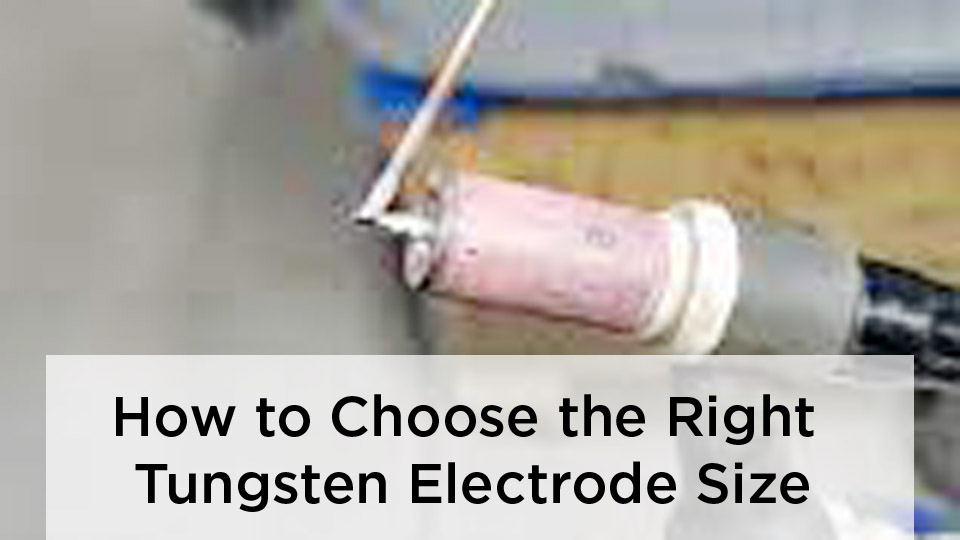
Tungsten diameter, alloy, and tip preparation all affect TIG arc starting and stability.
Key Takeaways
- Select the smallest tungsten that can safely carry your peak current without overheating.
- A 1/16-inch electrode is useful for many jobs up to about 150 amps DCEN, while 3/32 inch is a common general-purpose size for higher current.
- AC capacity changes with electrode alloy, AC balance, waveform, and power-source design; do not apply a universal percentage reduction.
- Modern inverter machines commonly use pointed or truncated lanthanated or ceriated tungsten on AC instead of a large balled pure-tungsten tip.
- Use a dedicated grinder, grind lengthwise, and match the collet and collet body to the tungsten diameter.
- Control grinding dust, especially when working with radioactive thoriated tungsten.
At a Glance
| Time Required | About 10–15 minutes to select, cut, grind, and install an electrode |
| Difficulty | Beginner to intermediate |
| Tools Needed | Welder manual, amperage chart, dedicated tungsten grinder or cutoff wheel, matching collet and collet body, safety glasses, and dust control |
| Cost | Low; normally one electrode plus matching torch parts if you change diameter |
What Is a Tungsten Electrode, and Why Does Its Size Matter?
A tungsten electrode is the nonconsumable conductor inside a TIG, or gas tungsten arc welding, torch. It carries current to the arc but is not intended to melt into the weld. Tungsten is used because it tolerates extremely high temperatures while maintaining a stable tip.
According to Miller Electric’s tungsten-selection guidance, common electrode diameters range from 0.020 inch to 1/4 inch. A larger diameter can carry more current, while a smaller diameter normally produces easier starts at very low amperage.
An electrode that is too small for the peak current can overheat, split, form an oversized ball, or release tungsten particles into the puddle. An electrode that is much larger than needed may start poorly at low amperage and produce a less responsive arc.
The practical goal is to use the smallest electrode that starts reliably and carries the job’s peak current without overheating.
Tungsten diameter does not determine penetration by itself. Weld current, arc length, polarity, travel speed, joint design, material, tip geometry, and shielding gas all affect the puddle. Changing tungsten size cannot compensate for a poor amperage setting or excessive heat input.
How to Choose Tungsten Electrode Size in Five Steps
- Find the peak current. Use the machine’s maximum welding setting or pulse peak current, not only the average current shown during the weld.
- Identify the output. Determine whether the job uses DCEN or AC. Normal DC TIG welding of steel, stainless steel, titanium, and many other metals uses direct current electrode negative, or DCEN.
- Check the power-source design. An inverter AC machine may support a pointed rare-earth electrode at currents that would require different preparation on an older transformer machine.
- Select an electrode alloy. Lanthanated and ceriated tungsten are common nonradioactive choices. Zirconiated and pure tungsten are mainly associated with specific AC applications, while thoriated tungsten remains in some qualified DC procedures.
- Choose a diameter and verify the torch parts. Select the smallest diameter that covers the peak current, then install the matching collet and collet body. Confirm the torch itself has enough current and duty-cycle capacity.
Pro Tip: When a job sits near the upper end of an electrode’s range, consider arc time as well as amperage. A larger electrode may run cooler and last longer during sustained production welding even when the smaller size can briefly carry the current.
Warning: Do not use DCEP as a normal substitute for DCEN. Electrode-positive current concentrates much more heat in the tungsten and can quickly melt an electrode that would operate normally on DCEN.
Common Tungsten Electrode Sizes and Typical Uses
The following diameter descriptions are practical starting points. They are not universal limits, because electrode alloy, gas, torch cooling, AC balance, waveform, and machine design can change current capacity.
- 0.020 inch: Used for extremely low-current work such as thin foil, delicate stainless parts, instruments, and some precision repair work. It can overheat quickly if current rises beyond its narrow operating range.
- 0.040 inch: Useful for low-amperage sheet metal, small tubing, edge welds, and precision fabrication. It starts more readily at low current than a large electrode.
- 1/16 inch: A versatile choice for light and medium fabrication. Typical alloyed-tungsten DCEN guidance places it around 70–150 amps, although it can also operate below that range when the machine and tip preparation allow.
- 3/32 inch: A common general-purpose shop size. It provides a broad working range and is often used from moderate current through roughly 250 amps DCEN, depending on the electrode and equipment.
- 1/8 inch: Intended for higher-current work, long arc-on time, and larger torches. It is usually unnecessary for light automotive, hobby, or sheet-metal fabrication.
- 5/32 inch and larger: Used mainly for high-current industrial welding. Exact limits should come from the electrode manufacturer, torch rating, and welding procedure.
For a small shop, 1/16-inch and 3/32-inch lanthanated tungsten cover many common jobs. A 0.040-inch size is useful when low-current sheet-metal work is frequent, while 1/8 inch becomes relevant for sustained high-amperage applications.
Products Worth Considering

BLUE-2% LANTHANATED: Lanthanated electrodes are popular due to the relative ease of striking an arc and lower amperage required. They perform exceptionally well in both AC and DC applications.
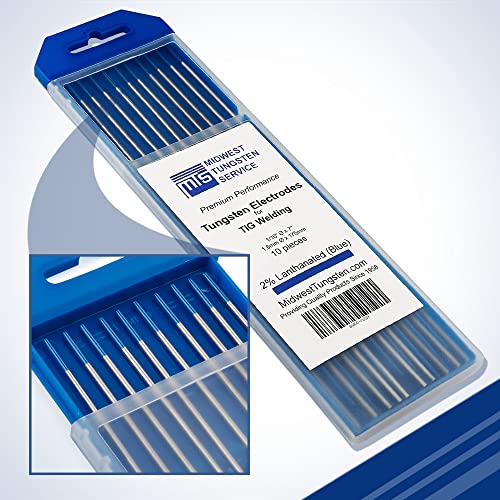
PREMIUM ten (10) pack of 1/16" tungsten electrodes for TIG welding for the beginner, intermediate, and professional TIG welder. From students to industrial and artistic users, these fit your use
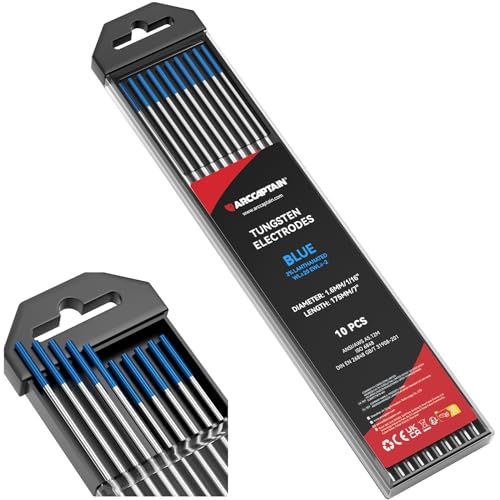
TOP QUALITY: This 10-pack of 2% Lanthanated tig tungsten electrodes 1/16"x7"(Blue, WL20/EWLa-2) adhere to Standard AWS A5.12M/A5.12:2009 and DIN EN 26848 GB/T 31908-201. All our tungsten has 100% traceability.
Tungsten Electrode Size and Amperage Chart
This chart combines common manufacturer ranges into a practical selection guide. The DC column reflects typical alloyed-tungsten use on DCEN. The broad AC column accounts for the large differences between electrode alloys and AC balance settings.
| Diameter | Typical DCEN Range | Broad AC Starting Range | Common Applications | Main Limitation |
|---|---|---|---|---|
| 0.020 inch | About 5–20 amps | About 5–20 amps | Foil, instruments, jewelry, and extremely thin sheet | Very limited current capacity |
| 0.040 inch | About 15–80 amps | About 10–80 amps | Low-amperage sheet, small tubing, and precision work | Overheats on higher-current work |
| 1/16 inch | About 70–150 amps | About 30–150 amps | Light fabrication, tubing, exhaust work, and thin-to-medium sections | May overheat near its upper limit during long welds |
| 3/32 inch | About 150–250 amps | About 60–235 amps | General fabrication, repair, pipe, aluminum, and moderate plate work | Less responsive than smaller tungsten at extremely low current |
| 1/8 inch | About 250–400 amps | About 100–325 amps | High-current, heavy-section, and sustained industrial work | Poor choice for low-amperage starts and small torches |
| 5/32 inch and larger | Manufacturer-specific | Manufacturer-specific | Very high-current industrial production | Requires compatible high-capacity torch hardware |
The detailed CK Worldwide TIG technical guide lists different AC limits for electrode alloy, 70% electrode-negative AC, and 50/50 balanced AC. That is why one universal AC derating percentage is unreliable.
Note: These values are selection windows, not guaranteed machine limits. Your welder’s manual and tungsten manufacturer take priority, particularly near the top of a range.
Products Worth Considering

BLUE-2% LANTHANATED: Lanthanated electrodes are popular due to the relative ease of striking an arc and lower amperage required. They perform exceptionally well in both AC and DC applications.

TOP QUALITY: This 10-pack of red tig tungsten electrodes 1/16"x7"(Red, WL20/EWLa-2) adhere to Standard AWS A5.12M/A5.12:2009 and DIN EN 26848 GB/T 31908-201. All our tungsten has 100% traceability.

TOP QUALITY: This 10-pack of red tig tungsten electrodes 3/32"x7"(Red, WL20/EWLa-2) adhere to Standard AWS A5.12M/A5.12:2009 and DIN EN 26848 GB/T 31908-201. All our tungsten has 100% traceability.
Factors That Change the Correct Tungsten Size
Two welds at the same displayed amperage may require different tungsten because the electrode does not experience the same heat in every setup.
Peak Current and Pulse Settings
When pulse TIG is active, size the tungsten for the peak amperage rather than the average current. A machine pulsing between 40 and 180 amps still exposes the electrode to 180-amp peaks.
AC Balance
AC alternates between electrode-negative and electrode-positive portions of the cycle. More electrode-positive time improves oxide cleaning on aluminum but also puts more heat into the tungsten. A high cleaning setting can therefore require a larger electrode, a lower peak current, or different tip preparation.
Inverter Versus Transformer Machines
Modern inverter machines use fast-switching square-wave output and adjustable AC balance or frequency. They can often maintain a focused, pointed rare-earth electrode. Traditional transformer machines are more likely to use a rounded or balled tip on compatible pure or zirconiated tungsten.
Electrode Alloy
Two electrodes of the same diameter may have different starting behavior, erosion rate, and current capacity. Lanthanated, ceriated, thoriated, pure, zirconiated, and mixed-oxide electrodes should not be treated as interchangeable solely because their diameters match.
Torch and Collet Hardware
Changing from 1/16 inch to 3/32 inch normally requires a matching collet and often a matching collet body. The torch must also have enough current capacity and duty cycle. A large tungsten does not prevent an undersized air-cooled torch from overheating.
Shielding Gas and Cup Setup
Pure argon is a common TIG shielding gas. Typical flow may begin around 10–25 cubic feet per hour, but the correct setting changes with cup size, gas lens, tungsten extension, joint shape, and drafts. Excessive flow can pull surrounding air into the shield instead of improving coverage.
Material and Joint Design
Material thickness helps estimate required welding current, but it does not directly specify electrode diameter. An outside corner, fillet, open root, heavy heat sink, or beveled multi-pass joint can require a different current than a simple bead on plate of the same thickness.
Matching Tungsten Size to Common Materials
Mild Steel and Stainless Steel
Steel and stainless steel are normally TIG welded on DCEN with a pointed or slightly truncated lanthanated, ceriated, or qualified thoriated electrode. Use 0.040 inch for very-low-current sheet work, 1/16 inch for many light-to-medium jobs, and 3/32 inch as current approaches or exceeds the upper end of the 1/16-inch range.
For thin stainless tubing, the correct current may be far below 100 amps. Do not select 1/16 inch and automatically set the machine to 100 amps; begin with the machine manufacturer’s calculator or chart and control heat with travel speed, pulse settings, and a remote amperage control where available.
Aluminum and Magnesium
Most general-purpose shop TIG welding of aluminum and magnesium uses AC. On a modern inverter, 2% lanthanated or another machine-approved rare-earth electrode is commonly used with a pointed or truncated tip. Miller notes that advanced square-wave equipment can use smaller, sharper electrodes to produce a more focused arc.
Older transformer equipment may specify pure or zirconiated tungsten with a rounded end. Follow the power-source manual rather than forming a large ball automatically. A ball larger than the electrode diameter can become unstable and spit tungsten into the weld.
Titanium, Nickel Alloys, and Precision Work
These materials are commonly welded on DCEN with a clean, pointed electrode and strict shielding control. A small, stable electrode is useful at low current, but it must still carry the peak amperage without erosion. Because tungsten contamination may be unacceptable in critical work, stop and regrind immediately after touching the puddle or filler rod.
Heavy Plate and Pipe
Thick material does not always require one high-current pass. Beveling, root geometry, preheat rules, and multi-pass procedures may allow a 3/32-inch electrode to complete work that appears to require 1/8 inch based on thickness alone. Code work must follow the approved welding procedure specification rather than a general chart.
Types of Tungsten Electrodes and Their Color Codes
Use the classification printed on the package whenever possible. Color systems have changed over time, and some legacy or manufacturer-specific products do not match the color a welder expects.
- Pure tungsten, EWP, green: Has the lowest current capacity and traditionally maintains a balled tip on compatible transformer AC machines. It is not recommended for many modern inverter setups.
- 2% thoriated, EWTh-2, red: Offers reliable DC starting and good current capacity but contains radioactive thorium. Nonradioactive alternatives are preferred unless a qualified procedure requires thoriated tungsten.
- 2% ceriated, EWCe-2: Performs well at low-to-medium amperage and offers easy starts. Current charts often identify it as gray, although legacy products may use another color.
- 1.5% lanthanated, EWLa-1.5, gold: A versatile AC/DC choice with good arc starting, stability, and service life.
- 2% lanthanated, EWLa-2, blue: A widely used all-purpose, nonradioactive option for AC and DC welding, especially on inverter machines.
- Zirconiated, EWZr, commonly white in current charts: Designed mainly for AC welding where a rounded tip and strong resistance to contamination are useful.
- Mixed rare-earth or mixed-oxide tungsten, EWG: Formulations and colors vary. Purple and chartreuse are both encountered, so verify the manufacturer’s classification rather than relying on color alone.
Pro Tip: Store each tungsten alloy in a labeled tube and keep cut pieces with the original package. Once the painted end has been removed, visually identifying the alloy may be impossible.
How to Prepare a Tungsten Electrode
- Turn off the power source. Isolate the torch before changing the electrode or torch parts.
- Cut the electrode correctly. Seven inches is a common full length. Use an abrasive cutoff wheel or a tungsten-cutting tool when a shorter electrode is needed. Do not bend, snap, or use wire cutters because hidden fractures can produce an erratic arc.
- Use a dedicated grinding surface. A wheel used for steel, aluminum, or other shop materials can embed contamination in the tungsten.
- Grind lengthwise. Grinding marks should run parallel to the electrode centerline. Radial or spiral scratches can encourage arc wandering.
- Create the correct taper. A taper about two to three electrode diameters long is a practical starting point for many DC and inverter-AC applications. A sharper taper tends to spread the arc more, while a broader included angle tends to produce a narrower, deeper arc.
- Truncate the point when needed. A small flat at the tip improves current capacity and reduces the risk of the point melting into the weld at higher current.
- Prepare AC tips for the machine. Use a pointed or truncated tip when the inverter manual calls for it. Form a controlled rounded tip only when required by the electrode and transformer-machine instructions.
- Clean the finished electrode. Handle it with clean gloves or a lint-free wipe. If acetone is used, keep it away from ignition sources and allow it to evaporate fully before welding.
Manufacturer guidance commonly calls for a dedicated diamond or aluminum-oxide wheel of about 60 grit or finer. The exact finish and geometry should follow the machine manual or qualified welding procedure rather than an unsupported surface-finish number.
Warning: Grinding creates fine airborne particles. Use an enclosed grinder or local dust extraction, wear eye protection, and never blow grinding dust across the shop with compressed air.
Common Tungsten Size and Preparation Mistakes
| Problem | Likely Cause | Correction |
|---|---|---|
| Tip melts or forms an oversized ball | Electrode too small, excessive current, too much electrode-positive AC, DCEP, or unsuitable alloy | Reduce current or cleaning action, confirm polarity, use the correct alloy, or increase diameter |
| Arc is difficult to start at low current | Electrode too large, blunt or contaminated tip, poor ground, or incorrect start setting | Try a smaller electrode, regrind the tip, clean the work connection, and verify lift-arc or high-frequency settings |
| Arc wanders | Radial grinding marks, contaminated tungsten, excessive extension, unstable gas flow, or magnetic arc blow | Grind lengthwise, regrind contamination, shorten extension, correct gas flow, and reposition the work lead if needed |
| Tungsten turns blue, purple, gray, or black | Insufficient post-flow, gas leak, empty cylinder, draft, or withdrawing the hot tungsten from shielding too soon | Increase post-flow, inspect connections, verify gas supply, and keep the torch in place while the electrode cools |
| Tungsten splits after preparation | Electrode was snapped, cut with pliers, overheated during grinding, or contained a hidden fracture | Cut with an abrasive wheel, use light grinding pressure, and replace damaged material |
| Tungsten appears in the weld | The tip touched the puddle or filler, or overheated and released particles | Stop, remove the defective area when required, regrind the tungsten, and correct torch or filler position |
| Cup and tungsten show poor gas coverage | Flow too low or too high, wrong cup, damaged O-ring, excessive stick-out, or a draft | Leak-test the system, adjust flow, use a suitable cup or gas lens, and shield the work from drafts |
Do not automatically upsize when an arc will not start. Upsizing is appropriate when the electrode overheats at the required current. At very low amperage, however, a smaller electrode usually provides a more reliable start.
Tungsten Extension, Cup Size, and Gas Flow
With standard collet-body parts, a practical general-purpose tungsten extension is about three electrode diameters beyond the cup. A gas lens can support greater extension—sometimes up to about six diameters in a draft-free area—because it produces more orderly shielding-gas flow.
Those values are starting points rather than absolute limits. Deep joints, inside corners, outside wind, cup diameter, gas-lens design, and torch angle all affect usable extension. The farther the electrode extends, the more easily shielding can be disturbed.
A small electrode does not always require a tiny cup. Cup size should provide enough gas coverage for the puddle, heat-affected zone, and hot filler tip. Stainless steel, titanium, and nickel-alloy work often benefits from a gas lens and broader shielding coverage.
Safety When Handling and Grinding Tungsten
TIG welding exposes the operator to electrical energy, ultraviolet and infrared radiation, hot metal, shielding gas, and grinding particles. OSHA’s welding hazard guidance identifies eye injury, burns, electrical shock, fumes, and other physical hazards that require suitable work practices and personal protective equipment.
- Wear a welding helmet with an appropriate filter shade, safety glasses with side protection, dry welding gloves, and flame-resistant clothing.
- Secure shielding-gas cylinders upright and protect the valve and regulator from impact.
- Do not weld in an unventilated confined space. Argon has no warning odor and can displace breathable air.
- Keep solvent containers and solvent-soaked wipes away from the welding area.
- Capture grinding dust at its source with an enclosed grinder or local exhaust.
- Follow the tungsten manufacturer’s safety data sheet and workplace exposure-control procedures.
Special Precautions for Thoriated Tungsten
Red EWTh-2 tungsten contains thorium and is mildly radioactive. The intact electrode presents a different exposure concern from the fine dust created during grinding. The main avoidable risk is inhaling or ingesting contaminated particles.
The CDC/ATSDR tungsten health statement identifies electrode pointing as an occupational source of airborne tungsten exposure. ESAB’s thoriated-tungsten guidance recommends controlling grinding dust and notes that nonradioactive alloys have replaced thoriated tungsten in many applications.
Prefer lanthanated, ceriated, or another approved nonradioactive electrode when the welding procedure allows it. When thoriated tungsten is required, use enclosed grinding or effective local extraction, prevent dust from spreading, keep collected material in a closed labeled container, and follow the supplier’s instructions and applicable local disposal requirements.
Warning: A disposable mask is not automatically suitable for every workplace exposure. When respiratory protection is required, it must be selected for the hazard and used under the applicable respiratory-protection requirements.
Real-World Applications for Different Tungsten Sizes
- 0.020 or 0.040 inch: Fine instrument work, foil, jewelry, razor-thin stainless, sensor components, and delicate repair.
- 1/16 inch: Exhaust tubing, brackets, bicycle components, kitchen fixtures, small aluminum parts, and general light fabrication.
- 3/32 inch: Shop repair, pipe, moderate plate, machinery parts, aluminum fabrication, and many jobs performed by 200-amp-class machines.
- 1/8 inch: Sustained high-current work, heavy aluminum, thick sections, large water-cooled torches, and industrial production.
- 5/32 inch and larger: Specialized high-current automated or heavy industrial applications.
These examples describe typical use, not guaranteed material limits. A joint that acts as a large heat sink may need more current than expected, while a beveled multi-pass joint may be completed with less peak current and a smaller electrode.
Conclusion
Choosing the right tungsten electrode size starts with peak current. Use a smaller diameter for clean low-amperage starts and increase the diameter when the electrode overheats, erodes, or cannot carry the required current. For many shops, 1/16-inch and 3/32-inch lanthanated tungsten provide the most useful coverage.
Do not rely on diameter alone. Check the electrode alloy, AC balance, machine type, tip geometry, torch rating, collet hardware, gas coverage, and duty cycle. When the chart and machine manual differ, follow the manual or qualified welding procedure.
Frequently Asked Questions
What size tungsten electrode should I use for aluminum welding?
A 3/32-inch electrode is a common starting choice for moderate-current aluminum TIG welding, while 1/16 inch suits lower current and 1/8 inch suits sustained high current. On modern inverter machines, use a machine-approved lanthanated or rare-earth electrode and follow the manual’s AC preparation instructions.
Can I use the same tungsten size for AC and DC welding?
Often, yes, but its usable current range may change. AC balance, electrode alloy, and power-source design affect how much heat enters the tungsten. Verify both the AC and DC limits in the welder or electrode manufacturer’s chart.
How do I know if my tungsten electrode is too small?
It may melt back, split, form an oversized ball, erode rapidly, or release tungsten into the puddle at the required current. Confirm polarity and AC balance before increasing the diameter because DCEP or excessive cleaning action can overheat even a correctly sized electrode.
What is the best tungsten electrode type for beginners?
Two-percent lanthanated tungsten is a practical nonradioactive choice for many AC and DC inverter applications. A 1/16-inch and 3/32-inch supply covers a wide working range, but the welder manual should confirm compatibility.
Why does my tungsten electrode keep breaking?
The electrode may have been snapped, cut with pliers, overheated during grinding, or damaged by excessive current. Cut it with an abrasive wheel, grind with light pressure, and replace any piece that shows lengthwise splitting or hidden fractures.
Can a 3/32-inch tungsten handle 200 amps?
Yes, many alloyed 3/32-inch electrodes are rated for approximately 200 amps and may reach about 235–250 amps under suitable conditions. For long welds near the upper limit, a 1/8-inch electrode may run cooler and provide longer service life.
Should I choose 1/16-inch or 3/32-inch tungsten?
Choose 1/16 inch for low-to-moderate current and easier low-amp starts. Choose 3/32 inch when the job regularly approaches or exceeds the upper range of 1/16 inch, or when longer welds cause the smaller electrode to overheat.
How far should tungsten extend past the TIG cup?
About three tungsten diameters is a practical starting point with standard torch parts. A gas lens may support up to roughly six diameters in a draft-free area. Use less extension when gas coverage becomes unstable.
Sources
- Miller Electric: All About Tungsten in TIG Welding — electrode diameter, cutting, sharpening, and low-amperage starting guidance
- CK Worldwide TIG Technical Guide — current ranges, color classifications, gas flow, tip preparation, and tungsten extension
- Miller Electric: Choosing Tungsten for AC Inverter TIG — inverter AC electrode and tip-selection guidance
- Occupational Safety and Health Administration: Welding Hazards and Solutions — welding PPE, radiation, electrical, fume, and physical hazards
- CDC/ATSDR: Tungsten Public Health Statement — occupational exposure associated with grinding tungsten electrodes
- ESAB: Thoriated Tungsten Safety Guide — thorium characteristics, grinding-dust controls, and nonradioactive alternatives

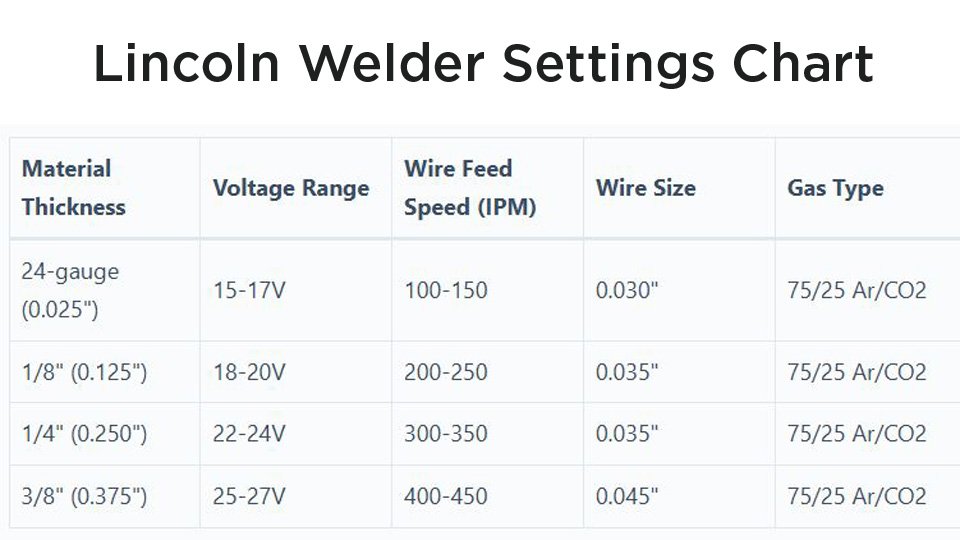
[…] welding, or shielded metal arc welding, uses a consumable electrode coated in flux to create an arc that melts your base metal and filler. The amperage controls the […]