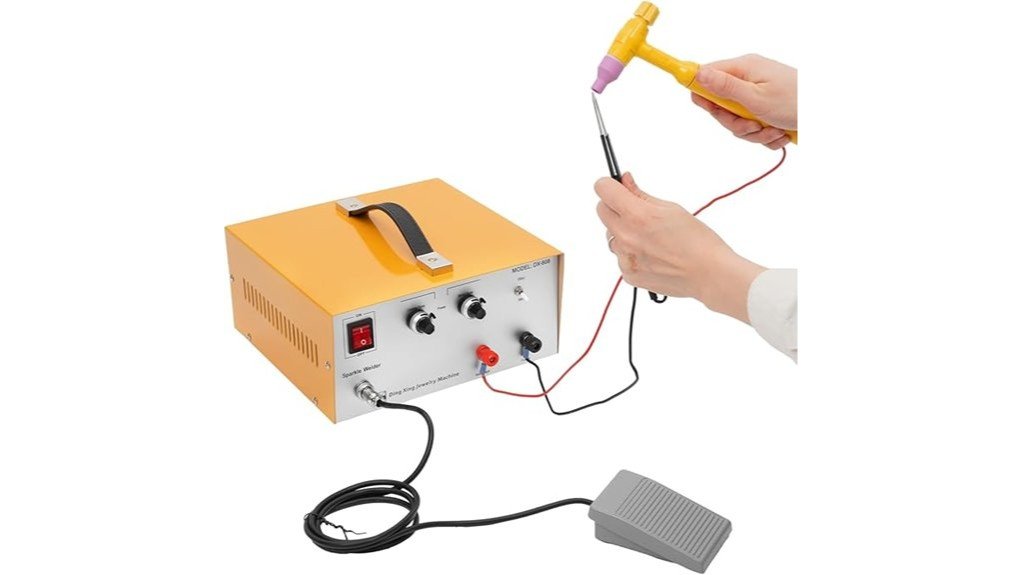
This jewelry welder is a 110 V pulse spark welder with a foot pedal and both tabletop and handheld modes, aimed at jewelers and hobbyists who join thin gold, silver or iron pieces. Based on the listing, it is worth considering if you do small repairs or custom chain work on 0.5 to 1 mm metal. Skip it if you need to weld thick stock or you want a ready-to-use professional laser welder.
Quick specs at a glance
| Item | Per the listing |
|---|---|
| Type | Portable pulse spark (sparkle) jewelry spot welder |
| Power supply | 110 V, listed at 600 W and 80 A |
| Metal thickness | About 0.5 to 1 mm |
| Metals named | Gold, K-gold, silver, iron |
| Modes | Tabletop base and handheld torch |
| Controls | Adjustable welding power, foot pedal |
| Size and weight | About 10.03 x 9.84 x 5.11 inches, 11.13 lb |
Check Current Price on Amazon →
What this welder does and how it differs from soldering
A pulse spark welder passes a short burst of current through a small contact point. The metal melts in a tiny spot and fuses, so you get a join with little heat spread. In jewelry this helps when a part has stones, a nearby solder joint or a thin chain that a torch would overheat.
Soldering still has a place for larger joins and strong seams. The advantage of spark welding is speed and heat control on small links and wire. It does not replace laser welding on very delicate work, but it costs far less.
Who it suits
- Hobby jewelers repairing chains, rings and findings.
- Small shops that want a handheld pen for hard-to-reach spots.
- Makers experimenting with permanent jewelry, where a related guide is our permanent jewelry welder page.
Heavy fabrication, thick steel and structural work are outside its scope.
How to check it suits your workbench and metal
- Power supply: it runs on 110 V. Check that your outlet and breaker can handle the listed 600 W draw, and avoid long thin extension cords.
- Metal and thickness: compare your pieces to the listed 0.5 to 1 mm range. Plated, filled or heat-sensitive pieces may behave differently.
- Mode: decide whether you prefer a tabletop setup with a foot pedal or the handheld torch for awkward pieces.
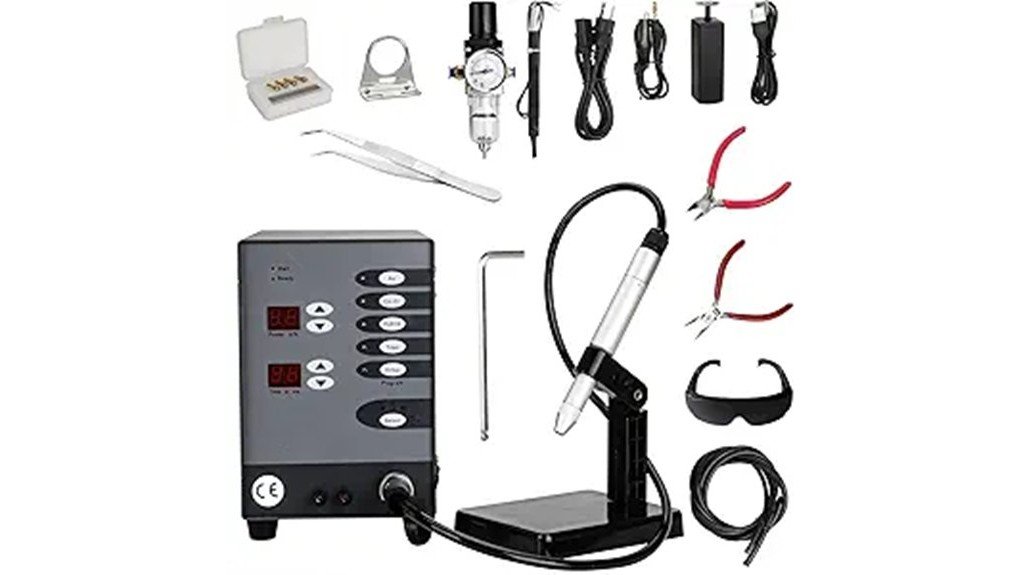
- Fixtures and tweezers: check what is included, such as electrodes, tweezers or grounding accessories, and whether spares are sold separately.
- Support: read the listing for warranty details and look for manuals or instruction videos.
Pros and limitations
Pros
- Small heat-affected zone compared with torch soldering.
- Two operating modes and a foot pedal for steadier control.
- Adjustable power helps tune the weld to the piece.
- Roughly 11 lb and compact enough for a bench.
Limitations
- Limited to thin metal; the seller lists about 0.5 to 1 mm.
- Reflective precious metals take practice and may not weld as easily as steel.
- Not a laser welder; precision depends on your technique and electrodes.
- Mains-powered, so it is less portable than the “portable” label suggests.
Safety and good practice
- Wear safety glasses with side shields. Sparks and bright flashes are part of the process.
- Work in a ventilated area, because plated metals and alloys can produce harmful fumes.
- Keep flammable cleaners, polish and cloth away from the bench.
- Use a stable work surface and insulating mat. Keep wet hands and fluids away from the unit.
- Unplug before changing electrodes or accessories.
- Test power settings on scrap of the same metal first, starting low.
Alternatives and related guides
- Welder for permanent jewelry for a guide focused on chain jewelry.
- Battery spot welder if you need to join nickel strip rather than jewelry.
- Brazing torch kit if torch soldering is more your style.
Frequently Asked Questions
What is a pulse spark jewelry welder used for?
It delivers short, controlled bursts of electrical energy to fuse thin metal, so jewelers can join links, fix broken chains, resize rings or repair small parts without large heat spread. Compared with torch soldering, the heat zone is smaller. Results depend on the metal, thickness and settings.
What metals does this jewelry welder work on?
Per the listing, it is intended for gold, K-gold, silver and iron at roughly 0.5 to 1 mm thickness. Reflective metals such as silver and pure gold can be harder to weld than steel, and plated or stone-set pieces can be damaged. Practice on scrap pieces first.
Do I need shielding gas or a respirator?
The listing does not describe gas as part of the package, so check what accessories are included. Spark welding still makes sparks, bright flashes and some metal fumes, especially on plated or alloyed pieces. Use eye protection, good ventilation and follow the manual for any gas or fume recommendations.
Can beginners use a jewelry spot welder?
Beginners can learn it, but expect a practice period. Start with scrap wire or chain, low power and short pulses, and increase settings gradually. Setting up good grounding, clean contact surfaces and steady hands matters more than raw power. Read the instructions fully before touching a real piece.
Conclusion
This pulse spark welder fits small jewelry repairs and custom links on thin metal. Match the power supply, thickness and metal type to your work, practice on scrap, and wear eye protection.
See This Jewelry Welder on Amazon →