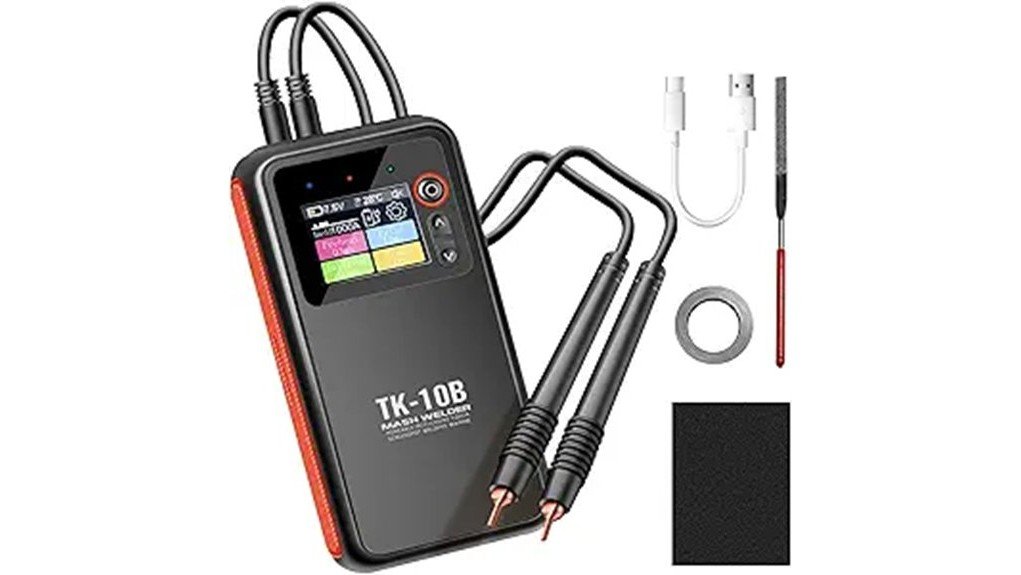
The Battery Spot Welder is a specialized tool designed for quick and effective battery repairs, particularly in mobile devices. It utilizes advanced dual pulse welding technology, which enhances precision and efficiency during operation. Weighing only 1.28 pounds, this welder is both portable and user-friendly, featuring an LCD interface for easy control. However, its average rating of 3.7 stars and limited warranty may raise questions about its overall value. So, is it truly the right choice for your needs?
Key Takeaways
- The Battery Spot Welder is user-friendly with an easy-to-read LCD display, making it suitable for both beginners and experienced users.
- Its advanced dual pulse technology ensures strong and precise welds, ideal for delicate battery connections.
- Weighing only 1.28 pounds, it is highly portable and convenient for on-the-go battery repairs.
- While it excels with materials between 0.1mm to 0.25mm, it may struggle with thicker materials, limiting its versatility.
- The average rating of 3.7 stars suggests mixed user experiences, indicating it may not meet everyone’s expectations.
What Exactly Is a Battery Spot Welder and How Does It Work?
A battery spot welder is a specialized tool designed for the precise welding of battery connections, particularly useful in applications like mobile phone battery repairs and welding nickel strips.
This device employs advanced welding techniques to create strong, durable connections essential for effective battery maintenance. By utilizing a dual pulse system, it guarantees minimal heat transfer, preserving the integrity of sensitive components.
The welder accommodates materials ranging from 0.1mm to 0.25mm, making it versatile for various battery types.
With its compact design, it enhances user control, empowering individuals to confidently repair and maintain batteries, promoting self-sufficiency and liberation from costly replacements.
Key Features of the Battery Spot Welder
The Battery Spot Welder boasts several key features that enhance its functionality and usability for various applications.
It includes a 1.8-inch LCD screen, providing real-time data on power, temperature, and welding times, which improves user experience.
The device employs advanced dual pulse welding technology, ensuring welding efficiency through high conductivity with its red copper welding pen.
Additionally, precision adjustment allows it to adapt to different materials, accommodating nickel-plated sheets from 0.1mm to 0.25mm, and various battery types.
Its smart temperature control protects against overheating, promoting safe operation while maximizing performance across diverse welding tasks.
Advantages and Disadvantages of the Battery Spot Welder for Battery Repairs
Efficiency in battery repairs is greatly enhanced by the advantages and disadvantages of the Battery Spot Welder, a versatile tool designed for a range of applications.
Pros:
- Easy-to-use interface with a smart LCD display.
- Dual pulse welding for precise connections.
- Compact design; weighs only 1.28 pounds.
- Functions as a portable power bank.
Cons:
- Limited user feedback, averaging 3.7 stars.
- Short warranty period of 30 days.
- May struggle with thicker materials.
- Requires careful handling to avoid overheating.
Understanding these pros and cons helps users make informed decisions about this innovative device for battery repairs.
Real-World Applications of the Battery Spot Welder
In various practical settings, the Battery Spot Welder proves to be an invaluable tool, particularly for tasks such as mobile phone battery repairs and welding nickel strips.
Its precision adjustment capabilities allow users to adapt to different materials, enhancing the effectiveness of various welding techniques. The device supports nickel-plated sheets ranging from 0.1mm to 0.25mm, making it suitable for intricate mobile repairs.
Additionally, the advanced dual pulse welding technology guarantees high conductivity, reducing resistance.
With a compact design measuring 7.13 by 4.18 by 2.25 inches, the welder combines portability with functionality, empowering users in their repair endeavors.
Comparing the Battery Spot Welder to Other Welding Tools
When comparing the Battery Spot Welder to other welding tools, it becomes evident that this device offers unique advantages tailored for specific applications.
Its portability and user-friendly features make it appealing in various settings. In a spot welder comparison, consider:
- Miniaturized design at 7.13 x 4.18 x 2.25 inches, ideal for tight spaces.
- Hand-powered operation with a built-in 5000mAh battery, enhancing mobility.
- Precision adjustment for different materials, ensuring quality.
- Smart dual pulse technology provides efficiency and low resistance.
While welding tool alternatives exist, the Battery Spot Welder excels in specific tasks, particularly in mobile device repairs and lightweight applications.
Frequently Asked Questions
How Long Does the Built-In Battery Last on a Full Charge?
With a battery capacity of 5000mAh, the built-in battery lasts several hours on a full charge, typically requiring a few hours of charging time. This empowers users, liberating them from the constraints of frequent recharging.
Can It Weld Materials Thicker Than 0.25mm?
It cannot weld materials thicker than 0.25mm, as its design specifically caters to welding thicknesses within that range. Material compatibility includes nickel-plated sheets, lithium batteries, and other lightweight metals, emphasizing its specialized functionality.
Is the LCD Screen Easy to Read in Bright Light?
The LCD visibility in bright conditions is reportedly adequate, allowing users to monitor essential information easily. Its color display enhances clarity, providing a user-friendly experience even under challenging lighting situations, promoting efficiency during operations.
Does It Come With Additional Welding Accessories?
The Battery Spot Welder arrives like a lone knight, equipped solely for battle. It does not include additional welding accessories, but a user guide provides guidance, empowering users to commence on their welding quests independently.
What Is the Maximum Temperature It Can Handle?
The device can handle a temperature range of up to 60℃/140°F, ensuring thermal stability during operation. This feature allows users to engage confidently in their projects, promoting a sense of liberation in their creative endeavors.