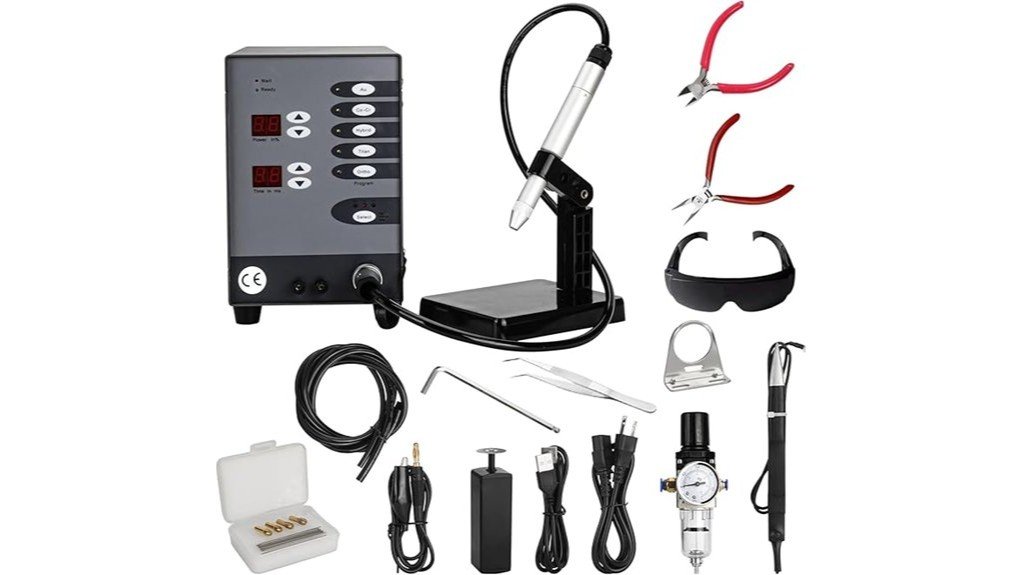
This permanent jewelry welder is a 110V, 100A pulse arc machine that the listing says works on pieces from 0.8 to 3 mm, with ten welding needles and four copper collets included. This review is based on the Amazon listing, not hands-on testing. It is a reasonable starting point for someone setting up a small permanent jewelry or chain-welding business. It is a poor fit if you do not want to buy an argon cylinder and regulator or learn proper arc safety.
Quick specs at a glance
| Item | Detail |
|---|---|
| Type | Pulse arc jewelry welder (small TIG-style arc) |
| Input | 110V |
| Output rating | 100A (listed) |
| Work range | 0.8 to 3 mm workpieces, per listing |
| Included | 10 welding needles and 4 copper collets |
| Shielding gas | Argon bottle required and not included, per listing |
| Weight | About 16.7 lb (per listing text) |
| Manual | English only, per the listing |
Specs are taken from the seller listing and may change; confirm them on the current listing before you buy.
Check the current price on Amazon →
What a permanent jewelry welder does
Permanent jewelry means a bracelet, anklet or necklace chain is fitted to the wearer and a jump ring or clasp is welded shut, so it can only be removed by cutting it. A pulse arc welder makes a tiny controlled arc that melts the ends of the ring in a split second, using argon to shield the molten metal from oxygen.
It works best on small gauge chain and jump rings in sterling silver, gold-filled and solid gold, subject to the metals you choose. The listing range of 0.8 to 3 mm covers many jump-ring sizes, but check your chain wire thickness.
What you need to get started (checklist)
- Argon cylinder, regulator and hose. The listing says an argon bottle is required. Plan for a small cylinder, a flow-metering regulator and a hose that fits the unit.
- Compatible power. A 110V outlet on a suitable circuit; check that the unit’s fuse and plug match your local supply.
- Needle preparation. The listing recommends grinding the welding needle to a point. Use a dedicated grinder and keep needles clean.
- Workholding. Tweezers, a grounding clip or a mat to hold rings and protect skin.
- Eye protection. Even small arcs are bright. Use suitable eye protection or a shaded viewing filter.
- Materials. Chain and jump rings in the thickness range the welder can melt cleanly.
- Training. Look for permanent jewelry courses or maker guides, and practise on scrap.
Check the current price on Amazon →
Safety for jewelry welding
- Argon displaces air. Use in a ventilated room, secure the cylinder upright and use a regulator rated for argon.
- Protect the client. The work happens next to skin. Keep the arc point away from skin, use protective gear intended for the process and follow the maker’s guidance for grounding.
- Protect your eyes. Arcs can hurt unprotected eyes.
- Fume and dust. Metal fume from gold-filled and plated materials should be extracted or ventilated away, especially if cadmium-containing solders are ever involved.
- Hygiene. Clean and sanitise tools between clients where you work with the public.
Setup and troubleshooting
| Symptom | Likely cause | What to check |
|---|---|---|
| Weak or black weld | Poor gas shielding | Cylinder valve, regulator flow, hose leaks |
| Arc is erratic | Dull or dirty needle | Re-grind a clean point and check the collet |
| Ring will not close | Gap too wide or mismatched ends | Align ends flush before pulsing |
| Metal splatters | Setting too high | Lower power or shorten the pulse |
Pros and limitations
- Compact and plugs into 110V power
- Includes 10 needles and 4 collets to get you started
- Targeted at small-diameter jewelry work
- Requires an argon cylinder, regulator and extra spending
- 0.8 to 3 mm work range limits it to small items
- Not for general fabrication or repairing thick parts
- Heavier than some handheld units at around 16.7 lb per listing
Check the current price on Amazon →
Related guides and alternatives
- Faiuot dual-farad spot welder review for a spot welder aimed at small battery work.
- Copper spoon welder review a different small-weld tool to compare.
- Pure nickel strips review for battery pack strips, a different type of micro-welding.
- Battery spot welder review for a spot welder for cells rather than jewelry.
Frequently Asked Questions
What does a permanent jewelry welder do?
It uses a small pulse arc, shielded by argon, to melt and close jump rings so a chain or bracelet is permanently attached to the wearer. The welded ring has to be cut off to remove the piece.
Do I need argon gas?
The listing says an argon bottle is required. Plan for a cylinder, a regulator and a hose, and keep it ventilated. Argon is not toxic but it can displace oxygen in an enclosed space.
What metals and sizes can it weld?
The listing gives a work range of 0.8 to 3 mm. It is meant for jewelry-scale rings, and chains in sterling silver, gold-filled and gold are the usual use. Confirm the machine settings with the maker.
Is it suitable for general welding?
No. A 110V jewelry pulse arc unit is for tiny items. For fabrication use a MIG, TIG or stick welder with the right capacity and safety equipment.
Bottom line
This 100A, 110V permanent jewelry welder is aimed at small-scale chain welding and needs an argon setup and practice. Check the current listing for included parts, support and manual details before you buy.