Disclosure: As an Amazon Associate, we earn from qualifying purchases. If you click a link on this page and make a purchase, we may receive a small commission at no extra cost to you.
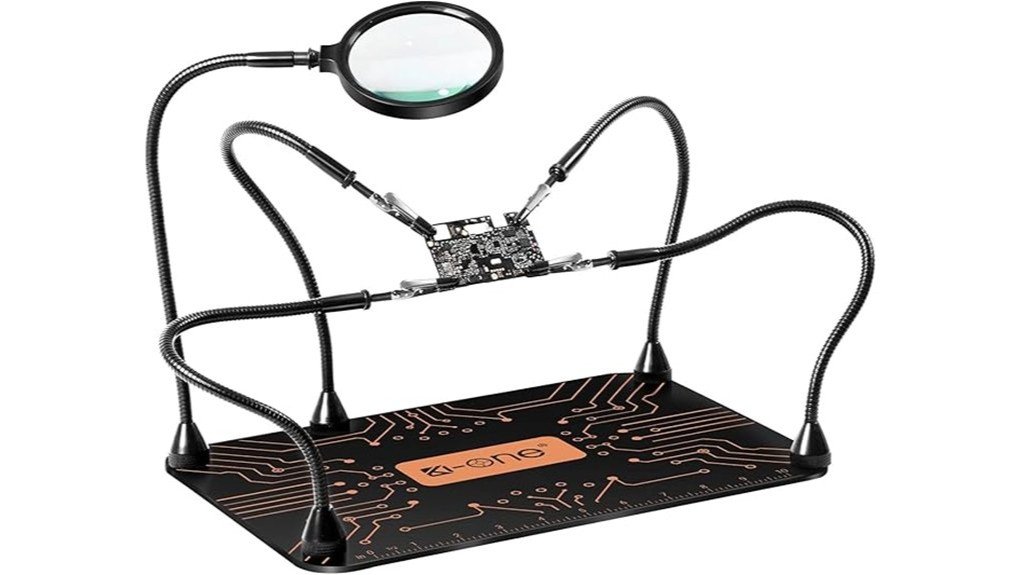
Holding a small PCB, wire, connector, or jewelry component steady while you solder can be harder than making the joint itself. The KOONE Helping Hands Soldering Station addresses that problem with four repositionable magnetic arms, a large metal work base, and a magnifying lens for close-detail work. Its main strength is flexibility because you can move the holders around the base instead of working around fixed clips. The tradeoff is that it is a bench aid rather than a complete soldering system, so your results still depend on correct setup and the size of the workpiece.
Quick Verdict
Rating: Recommended with caveats
Best For: Electronics repair, PCB soldering, jewelry work, crafts, and other small bench projects that need several adjustable holding points.
Bottom Line: The four magnetic arms and 13 × 9-inch metal base give you more positioning freedom than a simple fixed helping-hands stand. It makes the most sense for small to medium detail work, not oversized parts that need a vise or purpose-built fixture.
KOONE Helping Hands Soldering Station Specifications
| Specification | Detail |
|---|---|
| Brand | KOONE |
| Product type | Magnetic helping-hands soldering station |
| Base size | 13 × 9 inches |
| Base construction | Heavy-duty, rust-resistant metal with anti-skid padding |
| Helping arms | 4 adjustable metal gooseneck arms |
| Arm adjustment | 360° positioning |
| Arm mounting | Magnetic |
| Magnification | Listed as 2~5X, with up to 5X magnification |
| Work surface | Magnetic, scratch-resistant surface |
| Best use | PCB soldering, electronics repair, jewelry making, crafts, and detailed bench work |
What Is the KOONE Helping Hands Soldering Station?
The KOONE is a third-hand style work holder designed to keep small components in position while you use your own soldering iron or other hand tools. Instead of relying on one or two fixed clips, it gives you four flexible magnetic arms that can be placed around its metal base.
Each arm can rotate and bend to bring a component closer to your preferred working angle. This design is useful when you need one holder for a circuit board, another for a wire, and additional support for a connector or small part.
The included magnifying lens adds another layer of assistance for inspecting small solder pads, wire ends, jewelry components, and similar details. It does not replace good task lighting, but magnification can make precise positioning easier when the workpiece is small.
Who Should Buy It?
Best For
- You regularly solder PCBs, wires, connectors, or other small electronics.
- You want several independently adjustable holding points on one work surface.
- You also work on jewelry, models, crafts, or other detailed bench projects.
Skip If
- You mainly hold large or heavy workpieces that require a vise or rigid fixture.
- You need a complete soldering station with an iron, temperature control, and iron holder.
- Your work needs powered illumination built directly into the magnifier.
Before You Buy: This product is a helping-hands holder, not the soldering iron itself. It is designed to position smaller parts during detailed work, so do not treat the magnetic arms as a substitute for a vise when a heavy or high-force workpiece needs rigid clamping.
Features and Benefits
Four Magnetic Gooseneck Arms
The biggest advantage is the four-arm layout. Each metal gooseneck arm can rotate through 360° and can be repositioned on the magnetic work surface. That lets you build a holding arrangement around the job instead of forcing the job into a fixed stand.
For example, one arm can stabilize a PCB while a second positions a wire close to its solder pad. The remaining arms can support another lead or keep a small component from shifting. This is especially useful when a task would normally require another pair of hands.
Large 13 × 9-Inch Metal Base
The 13 × 9-inch base gives the magnetic arms room to spread out. A larger surface is useful when several holders need to approach the same part from different angles.
The base is described as heavy-duty, rust-resistant metal and includes anti-skid padding. Those features help keep the station planted on your workbench as you reposition the arms. Its scratch-resistant work surface also gives you a dedicated area for small assembly tasks.
Magnifying Lens for Detail Work
The included lens is listed with 2~5X magnification, with product listings describing magnification up to 5X. Magnification can help when you are inspecting small pads, component leads, fine wires, or jewelry details that are difficult to see clearly at normal viewing distance.
The lens is most useful as an inspection and positioning aid. You may still want separate bench lighting, especially when shadows from your hands, tools, or arms fall across the work area.
Flexible Workpiece Positioning
The magnetic design lets you change the location of an entire arm before fine-tuning its bend. This gives you two types of adjustment: move the arm across the base for large changes, then bend the gooseneck for precise positioning.
That approach can be more convenient than repeatedly loosening and tightening a fixed mechanical stand. It also makes the station adaptable to workpieces of different shapes.
Performance and Usability
The KOONE station is most useful when the task involves several small parts that must remain aligned. Its four arms give you more choices than a basic two-clip holder, while the broad base helps keep those arms organized around the work.
Usability depends on how you arrange the holders. If every arm approaches the component from the same side, they can crowd your soldering iron and block your view. Spacing them around the base usually gives you better access.
Pro Tip: Position the workpiece and magnifier before heating your soldering iron. Give the iron a clear path to the joint and keep unnecessary arms away from the hot working area.
How It Performs in Real Use
PCB Soldering and Repair
For circuit-board work, you can use two arms to support the board while another holds a wire or connector. This leaves your hands free for the soldering iron and solder. The magnifying lens can also help you check alignment before making the joint.
Wire and Connector Work
Joining two wires is a simple job that becomes frustrating when both ends keep moving. The independent arms allow you to bring two conductors together at the angle you need while keeping the joint accessible from above or from the side.
Jewelry and Craft Projects
The same adjustable layout works for small non-electronic parts. You can support jewelry pieces, model components, or craft materials when you need both hands for a tool. The main limitation remains workpiece size, since very large or heavy objects are better handled by a vise or dedicated clamp.
Repeated Bench Projects
If you move between different small projects, the magnetic layout is convenient because you are not locked into one clip arrangement. You can spread the arms apart for a wider board, bring them together for a tiny component, or temporarily move an unused arm out of your working area.
Setup Tips Before First Use
Start by placing the base on a flat, stable workbench. Arrange only the arms you need for the first task, then position the workpiece near the center of your comfortable working area.
Bend each arm gradually instead of forcing a sharp angle into the gooseneck. Once the component is supported, check that you can reach the intended joint without touching another arm or the magnifier with your soldering iron.
Move the magnifier into place after the component is secured. This prevents you from setting your work around the lens and later discovering that your hands or tools cannot reach the joint comfortably.
Compatibility and Safety
This station is intended for detailed bench work involving electronics, PCBs, crafts, and similar small parts. It does not provide heat control, electrical protection, fume extraction, or the other functions of a complete soldering workstation.
Keep the soldering iron tip away from the magnifier, arm coverings, work surface, and anything else that can be damaged by heat. Use your soldering equipment according to its manufacturer instructions and follow normal ventilation and eye-protection practices for the material you are working with.
Before applying heat, gently test that the workpiece is secure. If an item can slip or rotate with light pressure, reposition the arms rather than relying on them to hold something beyond the setup’s practical limits.
Pros and Cons
Pros
- Four independently adjustable gooseneck arms provide multiple holding points.
- Magnetic arm mounting allows quick repositioning across the work surface.
- Large 13 × 9-inch metal base provides useful room for arranging components.
- Anti-skid padding helps keep the station stable on the bench.
- Magnification up to 5X can make small details easier to inspect.
Cons
- It is a work holder, not a complete soldering station with an iron or temperature control.
- Large or heavy components may need a more rigid vise or fixture.
- The magnifier does not replace dedicated bench lighting when you need strong illumination.
Is It Worth the Price?
The KOONE makes the most sense as a step up from a simple fixed helping-hands holder. You get four movable arms, a comparatively spacious metal base, and magnification in one bench accessory instead of relying on a basic two-clip arrangement.
That gives it strong practical value if you frequently work with small boards, wires, connectors, jewelry, or craft pieces. You are paying for positioning flexibility rather than electronics or powered features.
It is less compelling if you only solder occasionally and need to hold one component at a time. It is also not the best fit when your main requirement is rigid clamping for heavy work.
How It Compares to Alternatives
Other helping-hands systems from brands such as M-T, NOEVSBIG, and Kaisiking use similar multi-arm concepts, with some alternatives emphasizing different magnifiers, powered lighting, or additional holders. Those models are worth comparing if integrated illumination or a different clamp arrangement matters more to you.
The KOONE’s clearest appeal is its combination of a 13 × 9-inch magnetic work surface, four movable arms, and magnification. It is a sensible choice when flexible component positioning matters more than extra powered features.
Frequently Asked Questions
What is the KOONE Helping Hands Soldering Station used for?
It holds small components in position while you solder, assemble, inspect, or repair them. Typical uses include PCB work, wires and connectors, jewelry making, crafts, and other detailed bench projects.
How many adjustable arms does it include?
The station uses four adjustable metal gooseneck arms. Each offers 360° positioning and mounts magnetically to the metal work surface, allowing you to rearrange your setup for different projects.
How large is the base?
The metal base measures 13 × 9 inches. That gives you room to spread the magnetic arms around a PCB or other small workpiece instead of crowding all of the holders into one spot.
How powerful is the magnifying lens?
The product information describes a 2~5X magnifying lens, with listings referring to magnification up to 5X. It is intended to help you inspect and position small components during detailed work.
Can the arms hold heavy objects?
A specific maximum load capacity was not reliably established, so you should not assume the arms are designed for heavy objects. Use the station for small components and move to a proper vise or rigid fixture when the workpiece needs substantial clamping force.
Does this replace a complete soldering station?
No. The KOONE is a component-holding and magnifying aid. You still need your own soldering iron or soldering station, along with the appropriate soldering accessories and safety equipment for your project.
The Bottom Line
The KOONE Helping Hands Soldering Station is worth considering when you want four independently adjustable holders, a generous magnetic work surface, and magnification for small bench projects. Its strongest advantage is flexible positioning, while its main limitation is that it is intended for detailed components rather than large workpieces requiring rigid clamping.
For PCB repair, wire soldering, electronics assembly, jewelry, and similar tasks, it earns a Recommended with caveats verdict. Skip it if you actually need a heavy-duty vise or an all-in-one powered soldering system.