Quick Take
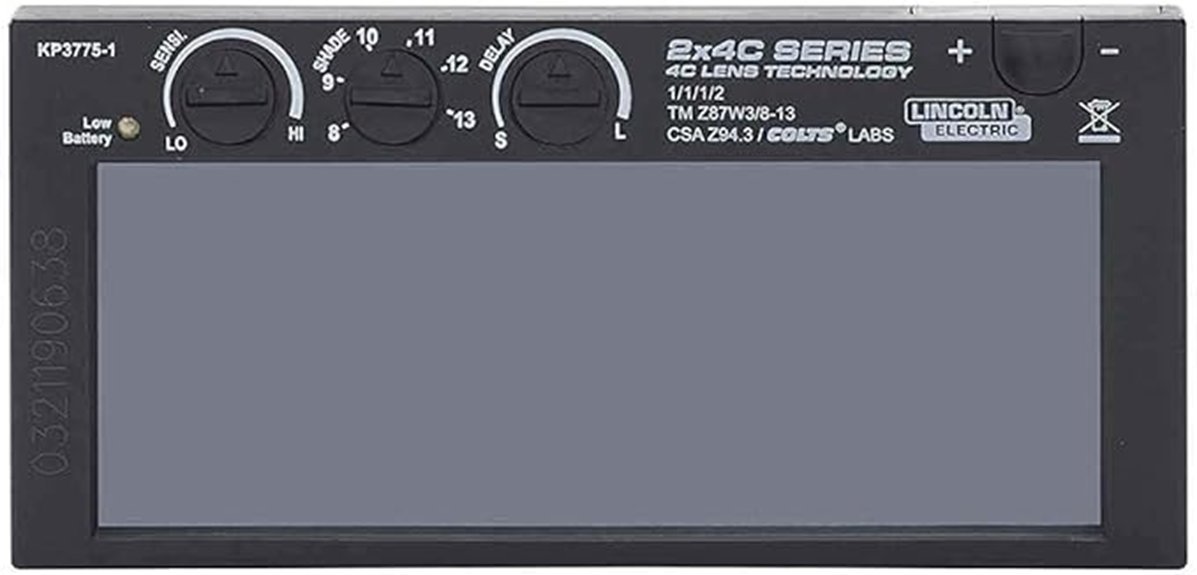
A standard 2×4 lens opening does not guarantee that every auto-darkening cartridge will fit your hood. The Lincoln Electric VIKING 2x4C Variable Shade Auto-Darkening Lens, model KP3775-1, combines a 4.25 x 2-inch cartridge with shade 8-13 control, adjustable sensitivity, delay control, and Lincoln Electric’s 4C lens technology. Its strongest points are clear color separation and flexible controls, while its 0.32-inch cartridge thickness and compact viewing area require a careful fit check. This review uses the current Amazon listing and Lincoln Electric product literature, not hands-on testing, to help you decide whether it suits your helmet and welding work.
Quick Verdict
Editorial Rating: 8/10, recommended with fit caveats
Best For: Welders who want variable shade control in a compatible pipeline, pancake, or construction-style hood
Bottom Line: The KP3775-1 gives you strong control, clear 4C optics, and replaceable batteries in a traditional 2×4 format. The main tradeoffs are the smaller 3.63 x 1.38-inch viewing area and the need to confirm cartridge thickness, lens-box fit, and cheater-lens clearance.
Key Specifications
| Specification | Detail |
|---|---|
| Brand | Lincoln Electric |
| Series / Model | VIKING 2x4C Series, KP3775-1 |
| Amazon ASIN | B07TMQRTX1 |
| Product Type | Variable-shade auto-darkening filter cartridge |
| Lens Technology | 4C liquid crystal lens technology |
| Optical Clarity | 1/1/1/2 |
| Light State | Shade 3 |
| Dark Shade Range | Variable shade 8-13 |
| Controls | Adjustable shade, sensitivity, and delay |
| Switching Speed | 1/10,000 second |
| Arc Sensors | 2 |
| TIG Rating | Greater than 5 amps |
| Cartridge Size | 4.25 x 2.00 x 0.32 inches |
| Viewing Area | 3.63 x 1.38 inches |
| Power | Solar cell with two replaceable CR1025 batteries |
| Housing | High-temperature ABS housing |
| Operating Range | 14°F to 131°F (-10°C to 55°C) |
| Standards | ADF lens meets ANSI Z87.1 and CSA Z94.3 |
| Warranty | 2 years for covered internal defects, subject to manufacturer terms |
Before You Buy: The advertised 2×4 format describes the cartridge’s face size, not universal helmet compatibility. The KP3775-1 is 0.32 inch thick, so confirm the lens-box depth, retention system, cover-plate setup, and cheater-lens clearance before ordering.
What Is the Lincoln Electric 2x4C KP3775-1?
The KP3775-1 is an auto-darkening replacement cartridge for welders who prefer a traditional 2 x 4.25-inch hood format. It is not a complete helmet, headgear assembly, or face shield. You install it only in a helmet shell that physically accepts the cartridge and provides the protection required for your work.
Lincoln Electric’s 4C technology is designed to reduce color saturation, blur, and distortion so the base metal, arc, and puddle are easier to distinguish. The variable version adds shade 8-13 control, sensitivity adjustment, delay control, a shade 3 light state, two arc sensors, a low-battery indicator, solar assistance, and replaceable batteries.
The result is a feature-rich cartridge for welders who want more control than a fixed-shade 2×4 filter provides. You still give up the wider field of view found in many full-size auto-darkening helmets.
Who Should Buy It?
Best For
- Welders with a confirmed-compatible pipeline, pancake, or construction-style helmet
- Users who switch between processes or amperage ranges and need shade 8-13 adjustment
- Buyers who want 4C color clarity without replacing a familiar traditional hood
Skip If
- Your helmet cannot accept a 4.25 x 2.00 x 0.32-inch cartridge
- You need a complete helmet, a grind mode, side windows, or a wide panoramic view
- You regularly TIG weld below the stated greater-than-5-amp rating
Feature-by-Feature Review
4C Color and Optical Clarity
The 1/1/1/2 optical rating and 4C lens design are the main reasons to consider this model. Lincoln Electric says the liquid crystal system broadens the visible color range in both light and dark states and reduces color saturation. In practical terms, that can help you separate the joint, arc, and puddle instead of seeing a flat, heavily tinted image.
The limitation is physical size. Although the cartridge measures 4.25 x 2 inches, the actual viewing area is 3.63 x 1.38 inches. You may appreciate the familiar narrow format in tight positions, but it offers less peripheral visibility than a large-window helmet.
Shade, Sensitivity, and Delay Controls
The variable shade range covers 8 through 13, giving you more flexibility than Lincoln Electric’s fixed-shade 9, 10, and 11 versions. Sensitivity adjustment lets you change how readily the cartridge reacts to an arc, while delay control changes how quickly it returns from the dark state after the arc stops.
These controls are useful when ambient light, nearby welders, amperage, or welding process changes. They also add setup time. You should test your settings according to the product instructions before beginning production work.
Switching Speed, Sensors, and TIG Use
The cartridge uses two arc sensors and lists a switching speed of 1/10,000 second. Keep both sensor areas clean and unobstructed because blocked sensors can reduce reliable arc detection.
Lincoln Electric rates the variable cartridge for TIG work above 5 amps. That makes it suitable for many common TIG jobs, but it is not the best match for repeated ultra-low-amperage starts below that threshold. Compare a lower-rated TIG filter if that is central to your work.
Power and Service Life
A solar cell assists the power system, and two replaceable CR1025 batteries support the variable controls. Replaceable cells are a practical advantage because a depleted battery does not automatically end the cartridge’s service life. The low-battery indicator gives you a warning before battery condition becomes a job-site surprise.
Battery life depends on storage, use, temperature, and light exposure, so avoid promising yourself a fixed runtime. Keep spare compatible batteries available and follow Lincoln Electric’s replacement instructions.
Housing, Temperature Range, and Warranty
The cartridge uses a high-temperature ABS housing intended to reduce failures from heat deformation. Its listed operating range is 14°F to 131°F, with a wider storage range of -4°F to 158°F. Those limits matter if your gear sits in a cold truck, hot gang box, or direct sun.
Lincoln Electric lists a two-year warranty covering internal defects, subject to its warranty terms and proof-of-purchase requirements. Physical damage, incorrect installation, damaged cover plates, and misuse should not be assumed to qualify.
How It Performs in Real Use
In a Pipeline or Pancake Hood
The compact cartridge keeps the familiar profile of a traditional hood while adding auto-darkening operation. This is the product’s clearest use case, but the 0.32-inch thickness means you should verify the exact helmet model rather than relying on the phrase “2×4 compatible.”
When Switching Processes or Amperage
Shade 8-13 control is helpful when your work changes enough that one fixed shade feels limiting. You can also tune sensitivity and delay instead of accepting a single factory response.
For TIG Work
The greater-than-5-amp TIG rating supports many TIG applications. For very low-amperage work, unstable detection may be a concern, so compare the rating with your normal start and welding current before buying.
For Setup and Inspection
The shade 3 light state provides a brighter view for positioning and checking the joint between welds. It does not turn the cartridge into general-purpose safety eyewear or a grinding shield, so keep using the protection required for each task.
Fit and Setup Tips Before First Use
- Measure all three dimensions: Confirm the lens opening, 4.25 x 2-inch face size, and 0.32-inch cartridge depth.
- Check the retention system: Make sure the cartridge, front cover plate, rear cover plate, and retaining hardware seat securely without force.
- Verify cheater-lens space: Some compatible hoods may lose clearance when a magnifying lens is installed.
- Set shade before striking an arc: Match the shade to your process and amperage using the product manual and workplace safety guidance.
- Tune sensitivity and delay: Test the response in your actual work area, especially around other arcs or bright sunlight.
- Inspect before each shift: Replace scratched cover plates, check for cracks or loose fit, and confirm that the low-battery indicator is not active.
Pro Tip: Trace the outline and thickness of your current cartridge on paper, then compare it with the KP3775-1 dimensions and your helmet’s retention depth. This catches fit problems that a simple “2×4” label can miss.
Compatibility, Safety, and Maintenance
Lincoln Electric states that the KP3775-1 auto-darkening filter meets ANSI Z87.1 and CSA Z94.3 for the lens itself. That does not certify every helmet shell in which it might physically fit. Your complete helmet assembly must be suitable for the task, properly assembled, and used according to the helmet and cartridge instructions.
Do not weld with a cracked cartridge, damaged cover plate, loose retention system, blocked sensors, or uncertain battery condition. Choose the correct shade for the process and current, and do not treat the shade 3 light state as eye protection for grinding or other hazards unless the complete equipment is specifically rated for that use.
Clean the lens and cover plates with a soft, nonabrasive cloth and a cleaner approved for the material. Avoid harsh solvents, abrasive pads, and soaking the electronic cartridge. Store it dry and within the stated temperature range.
Pros and Cons
Pros
- Variable shade 8-13 covers more situations than a fixed-shade cartridge
- 4C technology and 1/1/1/2 optics support clearer color and shape definition
- Adjustable sensitivity and delay let you tune the response to the job
- Two replaceable CR1025 batteries extend serviceability
- Two-year manufacturer warranty for covered internal defects
Cons
- The 0.32-inch cartridge is thicker than the fixed-shade 2x4C versions and will not fit every 2×4 hood
- The 3.63 x 1.38-inch view is narrow compared with modern large-window helmets
- No dedicated grind mode, and the greater-than-5-amp TIG rating may not suit ultra-low-amp work
Is It Worth the Price?
The KP3775-1 is best viewed as a premium upgrade for a compatible traditional hood, not a budget replacement filter. You are paying for 4C color clarity, a variable shade range, sensitivity and delay controls, solar assistance, replaceable batteries, and a documented two-year warranty.
It offers the most value when you already like your pipeline or pancake hood and would otherwise need several fixed-shade lenses. It offers less value when you must buy a new shell, need a larger viewing area, or frequently work below its TIG rating. Confirm fit and the seller’s return terms before ordering.
How It Compares to Alternatives
If you want a simpler 2×4 setup, Lincoln Electric’s fixed-shade 2x4C cartridges in shades 9, 10, or 11 are thinner and remove the need to adjust shade, sensitivity, and delay. They make more sense when your process and amperage stay consistent.
ArcOne Singles HD 2×4 auto-darkening filters are also worth comparing if you prefer a fixed or narrower shade choice in a retrofit format. A full-size VIKING auto-darkening helmet is the better direction when a wider field of view, integrated headgear, or additional helmet features matter more than keeping a traditional hood.
Frequently Asked Questions
Will the Lincoln Electric KP3775-1 fit every 2×4 welding hood?
No. The cartridge face is 4.25 x 2 inches, but it is also 0.32 inch thick. Confirm your exact helmet model, lens-box depth, retaining system, cover plates, and any cheater-lens setup before buying.
Is this a complete welding helmet?
No. The KP3775-1 is an auto-darkening filter cartridge. You still need a compatible helmet shell, secure retention hardware, and the correct cover plates.
What shade range does the variable 2x4C lens provide?
It has a shade 3 light state and an adjustable dark range of shade 8-13. Select the shade required for your process, amperage, and workplace procedure rather than choosing only by comfort.
Can you use it for TIG welding?
Lincoln Electric lists a TIG rating greater than 5 amps. It can suit many TIG jobs, but welders who often work below 5 amps should compare filters designed for lower-amperage arc detection.
Does the lens use replaceable batteries?
Yes. The variable-shade cartridge uses a solar cell with two replaceable CR1025 batteries and includes a low-battery indicator. Follow the manufacturer procedure and use the specified battery type.
Does it meet welding eye-protection standards?
Lincoln Electric states that the KP3775-1 auto-darkening lens meets ANSI Z87.1 and CSA Z94.3. That statement applies to the lens, not automatically to every helmet shell that can physically hold it.
Can you use a cheater lens with it?
That depends on the helmet and available lens-box depth. Lincoln Electric’s compatibility information warns that some otherwise compatible models may not work when a cheater lens is installed.
How should you clean and store the cartridge?
Use a soft, nonabrasive cloth and a cleaner approved for the lens or cover-plate material. Keep liquids and harsh solvents away from the electronic cartridge, then store it dry and within the stated temperature range.
The Bottom Line
The Lincoln Electric VIKING 2x4C KP3775-1 is a strong choice when you want 4C clarity, shade 8-13 adjustment, and serviceable batteries in a compatible traditional hood. Skip it when you need a full helmet, a wider view, grind mode, ultra-low-amp TIG performance, or guaranteed fit without measuring. Its controls and optics earn an 8/10 recommendation, with helmet compatibility as the deciding limitation.
Ready to Buy?
Check the current seller details, return terms, and helmet compatibility before you decide.