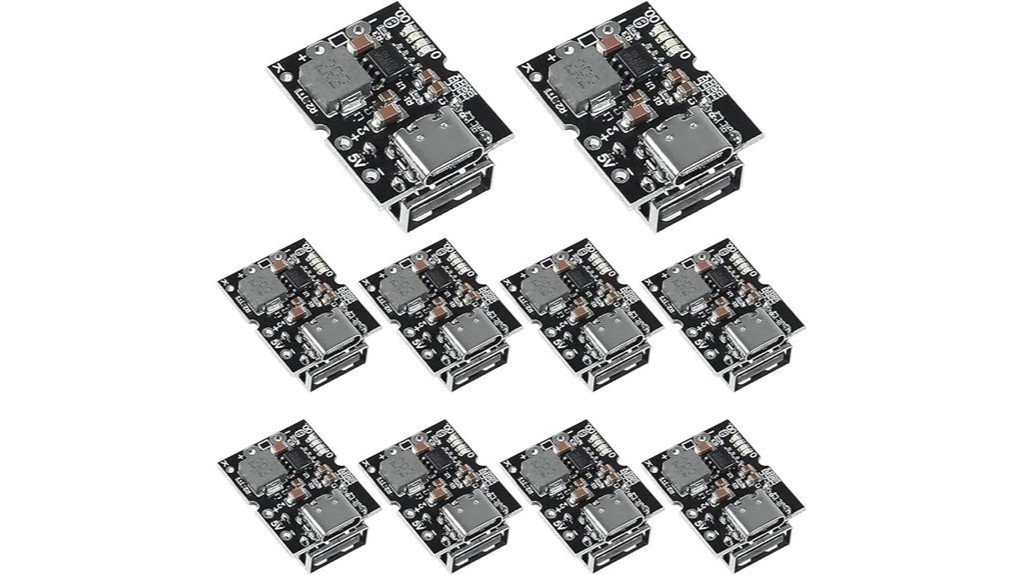
This 10-piece Type-C USB boost converter is a small DIY electronics module that steps a lithium battery up to a 5V USB output, rated by the listing at up to 2A, with an LED display and a Type-C port. It is off-topic for welding; it is a hobby electronics part for power-bank and battery projects. Check the exact input range and wiring on the listing before connecting a battery. This Type-C USB boost converter module steps up voltage for small electronics projects.
Quick Facts
| Item | Detail (per the listing) |
|---|---|
| Pack | 10 modules |
| Output | 5V, up to 2A |
| Interface | Type-C, LED display |
| Use | Lithium battery charging and boost output, DIY power projects |
| Auto shutdown | Reported to cut off below about 50 mA load |
| Size and weight | Listing gives 4.88 x 3.5 x 1.06 in and 0.634 oz, which is probably the package |
| Not stated | Input voltage range, cutoff voltages, protection, chip type |
What a Type-C USB Boost Converter Does
A boost converter takes a lower voltage, such as the 3.0 to 4.2V of a single lithium cell, and raises it to 5V for USB devices. Modules sold as Type-C boost converters often combine this with a charging circuit so you can charge the cell through the Type-C port. They are common in DIY power banks and portable electronics.
The listing for this product does not clearly state the input range or battery protection, so confirm those details before you connect a cell.
Before You Connect a Battery
- Check the module’s input voltage range and what battery chemistry it is designed for.
- Check polarity and wire gauge. Reverse connection can destroy the module or the cell.
- Add a protection board or fuse if the module does not include over-discharge and short-circuit protection.
- Do not exceed the module’s rated output of 2A, and give it airflow.
- Lithium cells can catch fire if damaged, shorted or overcharged. Use only cells you trust.
Pros and Limitations
Pros
- Ten modules suit batches of DIY builds.
- Type-C input and a display are convenient for small builds.
- Compact.
Limitations
- Specs on the listing are limited and partly unclear.
- Safety features are not described.
- Not a welding product.
Related Reading
For other bench electronics gear, see our 60W adjustable temperature soldering iron review and the soldering flux guide.
Frequently Asked Questions
What does a USB boost converter do?
It raises a lower battery voltage to 5V so a battery can power USB devices.
Can it charge a lithium battery?
Many Type-C boost modules also include a charging circuit, but confirm that on the listing before connecting a cell.
What is the maximum output?
The listing says 2A at 5V. Do not exceed it.
Is it safe for any battery?
No. Match the battery chemistry and voltage range to the module, and add protection if the module has none.
Bottom Line
A cheap module for hobby power projects. Confirm the input range and protection first, and treat it as an electronics part rather than a tested product.