Disclosure: As an Amazon Associate, we earn from qualifying purchases. If you click a link on this page and make a purchase, we may receive a small commission at no extra cost to you.
Fiber splicing work leaves little room for slow setup, weak alignment, or guesswork in the field. The SM&MM Ai-9 Fiber Fusion Splicer, listed under the D YEDEMC brand, is built for technicians who need fast fusion splicing, built-in testing tools, and a portable kit for FTTH and fiber repair jobs. This review helps you decide whether the Ai-9 gives you the right balance of speed, accuracy, accessories, and value. Its strongest appeal is the 5-second splicing time and 3-in-1 fiber holder, but you still need clean fiber prep and proper calibration to get consistent results.
Quick Verdict
Rating: 8.4/10
Best For: Fiber technicians, FTTH installers, and field crews who want a fast, app-supported fusion splicer with built-in testing tools.
Bottom Line: The Ai-9 is a strong option if you want quick splicing, a 5-inch touchscreen, VFL, power meter functions, and a complete accessory kit. It is not the best fit if you need a lighter pocket-size tool, a premium enterprise-grade splicer, or guaranteed results without careful fiber cleaning and cleaving.
Key Takeaways
- The Ai-9 is listed as a six-motor core alignment fusion splicer for fiber optic welding and FTTH work.
- It supports fast operation with a listed 5-second splicing time and 15-second heating time.
- The 3-in-1 fiber holder supports SM, MM, bare fiber, pigtail, rubber-insulated fiber, and multi-fiber cable use.
- The built-in power meter supports common wavelengths, including 850nm, 1300nm, 1310nm, 1490nm, 1550nm, and 1625nm.
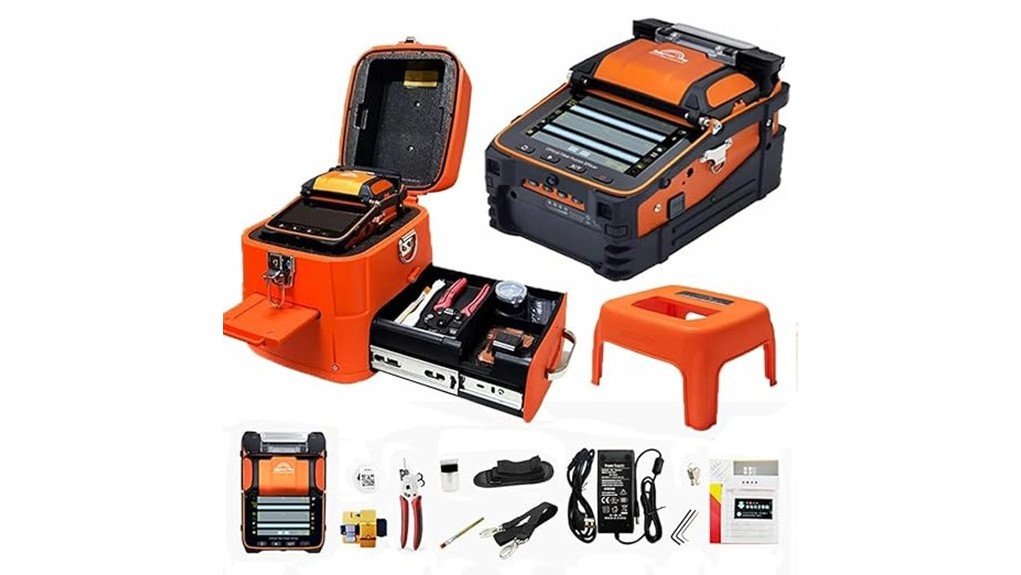
- The kit includes the fusion splicer, fiber cleaver, stripper, spare electrode, tools, adapter, bottles, straps, and carrying cases.
Key Specifications and Included Accessories
| Specification | Detail |
|---|---|
| Brand | D YEDEMC |
| Model / Style | Ai-9 |
| Product type | Six-motor core alignment fiber fusion splicer |
| Power source | Battery powered, with AC 100-240V input adapter listed |
| Battery | 7800mAh listed battery capacity, up to 260 splicing and heating cycles listed |
| Splicing time | 5 seconds listed |
| Heating time | 15 seconds listed |
| Splicing loss | 0.025dB SM, 0.01dB MM, 0.04dB DS/NZDS listed in the main product bullets |
| Fiber holder | 3-in-1 holder for SM, MM, bare fiber, pigtail, rubber-insulated fiber, and multi-fiber cable |
| Fiber types | SMF, MMF, DSF, G.654, NZ-DSF, BIF, bare fiber, pigtail, drop fiber, patch cord, and invisible fiber listed |
| Cladding diameter | 80-150μm listed |
| Coating diameter | 100-1000μm listed |
| Display | 5-inch 800 x 480 high-resolution screen with up to 300x focus magnification listed |
| Built-in test tools | Power meter and visual fault locator |
| Power meter wavelengths | 850nm, 1300nm, 1310nm, 1490nm, 1550nm, and 1625nm listed |
| Item weight | 8.17 kilograms listed |
| Operating environment | -15°C to +50°C, humidity under 95% RH with no condensation, altitude 0-5000m, wind speed under 15m/s listed |
| Specification met | UL 61010-1 and IEC 61010-2-030 listed in product information |
| Included accessories | Fusion splicer, fiber cleaver, spare electrode, 4-in-1 fiber stripper, hex key, straps, power adapter, alcohol bottle, brush, blue toolbox, and yellow toolbox listed |
What Is the SM&MM Ai-9 Fiber Fusion Splicer?
The SM&MM Ai-9 is a fiber fusion splicer made for joining optical fibers through arc fusion. It is listed as a six-motor core alignment model, which means it is built to align fiber ends before the arc joins them.
This model targets fiber technicians, FTTH installers, low-voltage contractors, and service teams that need a complete field kit. The built-in power meter and visual fault locator help you test and troubleshoot without carrying as many separate tools.
The Ai-9 is not just a bare splicer body. The listing describes a full kit with a cleaver, stripper, spare electrode, power adapter, straps, alcohol bottle, brush, and carrying boxes, which makes it more practical for fieldwork and mobile jobs.
Before You Buy: This tool still depends on clean fiber prep, a good cleave, correct fiber settings, and regular maintenance. Do not expect stable low-loss splices if the fiber ends are dirty, poorly cut, or not matched to the correct mode.
Who Should Buy It?
Best For
- FTTH installers who need fast 5-second splicing and 15-second heating.
- Field technicians who want one kit with a splicer, cleaver, stripper, VFL, and power meter.
- Buyers working with several fiber types, including SM, MM, pigtail, drop fiber, and bare fiber.
Skip If
- You need a very lightweight pocket-size splicer for minimal tool bags.
- You want a premium enterprise splicer from a long-established telecom tool brand.
- You do not want to learn fiber preparation, cleaning, calibration, and electrode care.
Design and Build Quality
The Ai-9 uses a six-motor core alignment design, which is important when you need more precise fiber positioning than a simple cladding-only approach. The listing also notes 0.1μm fiber alignment accuracy, which supports its use for medium to long-distance trunk fiber optic cable projects.
The 5-inch color touchscreen gives you a larger working view than small-display splicers. That matters when you need to inspect fiber ends, watch alignment, and reduce mistakes during repeat splicing.
At a listed 8.17 kilograms, this is a portable field kit rather than an ultra-light handheld tool. The weight makes more sense when you consider the included accessories and carrying boxes, but buyers who climb ladders or walk long routes should factor that in.
Splicing Performance and Fiber Compatibility
The strongest spec is speed. The Ai-9 lists 5-second fast splicing and 15-second fast heating, which can save time on jobs with many terminations or repairs.
Compatibility is also a major benefit. The 3-in-1 fiber holder supports single-mode, multi-mode, bare fiber, pigtail, rubber-insulated fiber, and multi-fiber cable. The broader product description also lists SMF, MMF, DSF, G.654, NZ-DSF, and BIF support.
The listed cladding diameter range is 80-150μm, and the coating diameter range is 100-1000μm. That range gives you flexibility, but you should still confirm your exact cable type and sleeve size before a job.
Built-In Power Meter and VFL
The Ai-9 includes a built-in optical power meter with listed wavelength support for 850nm, 1300nm, 1310nm, 1490nm, 1550nm, and 1625nm. These wavelengths cover common fiber testing needs, especially for installation, troubleshooting, and link verification.
The visual fault locator supports 2Hz and constant bright modes. This helps you identify breaks, bends, and continuity issues during field service without needing a separate VFL for every basic check.
These built-in tools add value if you want a compact kit. They may not replace high-end standalone test equipment for certification work, but they make quick field checks easier.
Display, App, and Controls
The 5-inch 800 x 480 display gives you a clear interface for splicing and monitoring. The listing also describes up to 300x focus magnification, which helps you inspect the fiber image before and during fusion.
The Ai-9 also supports phone app operation and software updates through a mobile app. The listing notes multiple language options, including English, French, Russian, Italian, Portuguese, Polish, Spanish, Thai, and Arabic.
App-enabled control can help teams manage settings and records, but you should test the workflow before using it on a deadline. Field tools work best when you already know the menu, fiber mode, heating sleeve setting, and cleaning steps.
Battery Life and Field Use
The listed 7800mAh battery supports up to 260 splicing and heating cycles. That gives the Ai-9 practical field appeal for service calls, small network expansions, and repair routes.
The power setup also lists AC 100-240V input and DC 13.5V/4.8A output through the adapter. This is useful when you can charge from a workbench, truck inverter, or jobsite power source.
The listed work environment covers -15°C to +50°C, humidity under 95% RH without condensation, altitude from 0 to 5000m, and wind speed under 15m/s. Use those limits as a guide, and protect the tool from water exposure, dust buildup, drops, and heavy vibration whenever possible.
Pro Tip: Before a long job, charge the battery fully, clean the V-groove and lens area, check the cleaver blade, and run a test splice on scrap fiber that matches the cable you plan to install.
How It Performs in Real Use
For FTTH Installation
The Ai-9 makes sense for FTTH work because it supports drop fiber, pigtails, patch cords, bare fiber, and common fiber modes. The 5-second splice and 15-second heater can help when you repeat the same process across several customer drops.
For Field Repairs
For repair calls, the built-in VFL and power meter help you identify a fault, splice the fiber, and perform a basic check after the repair. This reduces the need to unpack several separate tools for simple troubleshooting.
For Mixed Fiber Work
The 3-in-1 holder is useful when you move between single-mode, multi-mode, pigtail, and drop cable tasks. You still need to select the proper splice mode and sleeve setting, but the holder design reduces tool changes.
For Longer Work Sessions
The listed 7800mAh battery and up to 260 cycle capacity help with longer work sessions. The main limitation is weight, since an 8.17 kg listed item weight can feel heavy if you carry the full kit across multiple job areas.
Setup Tips Before First Use
- Read the user manual before using the splicer on live customer work.
- Charge the battery fully and confirm the adapter works before leaving for a job.
- Use clean fiber, a sharp cleaver, and the correct strip length for the coating size.
- Choose the right fiber mode for SM, MM, DSF, NZ-DSF, or other supported fiber types.
- Keep dust, alcohol residue, and fiber scraps away from the splicing area.
- Inspect the heat shrink sleeve size before starting, especially if you switch between 60mm, 50mm, 40mm, and 25mm sleeves.
Compatibility and Safety Notes
The Ai-9 is an electrical and optical fiber tool, so you should follow the manual, use proper eye safety practices, and handle fiber shards carefully. Small glass fiber scraps can be sharp and hard to see, so collect and dispose of them safely.
The product information lists UL 61010-1 and IEC 61010-2-030 under specifications met. Do not treat that as a reason to skip basic safety steps. Use the correct power adapter, avoid wet handling, and keep the tool within its listed operating conditions.
For professional telecom, data center, or carrier-grade work, confirm that the splice result meets your project standard. Built-in readings are useful, but certification jobs may still require dedicated test equipment and documented loss testing.
Pros and Cons
Pros
- Fast listed 5-second splicing and 15-second heating support efficient fieldwork.
- 3-in-1 fiber holder works with several fiber formats without constant fixture changes.
- Built-in power meter and VFL reduce the need for separate basic test tools.
- 5-inch touchscreen and high magnification help with fiber viewing and operation.
- Complete kit includes cleaver, stripper, spare electrode, adapter, tools, bottles, straps, and carrying boxes.
Cons
- Listed 8.17 kg item weight may feel heavy for long carry routes.
- Splice quality still depends on clean prep, correct cleaving, and proper settings.
- Not a replacement for high-end certification test equipment on demanding professional jobs.
Is It Worth the Price?
The Ai-9 sits best in the value-focused professional tool category. It offers a strong mix of speed, fiber compatibility, display size, battery capacity, app support, and built-in test tools for buyers who do not want to assemble a kit piece by piece.
You get the most value if you regularly perform FTTH installation, field repairs, small network expansions, or mixed fiber jobs. The included cleaver, stripper, spare electrode, adapter, and cases add practical value because they help you start with a more complete setup.
It is not the best fit if you only need a splicer for one small job or if your work requires a premium carrier-approved platform. For those buyers, renting a tool or comparing higher-end splicers may make more sense.
How It Compares to Alternatives
Compared with basic entry-level splicers, the Ai-9 stands out because it includes six-motor core alignment, a 5-inch touchscreen, a built-in power meter, a VFL, and a large accessory kit. Compared with premium brands such as Fujikura or Sumitomo, it focuses more on value and bundled features than brand reputation in enterprise fiber environments.
Signal Fire AI-9 models are worth comparing if you want another Ai-9-style option, while Komshine FX39 models may appeal if you want to compare similar fast-splicing fiber tools. The SM&MM Ai-9 makes the most sense if you want a complete kit with built-in test functions and broad fiber support.
Frequently Asked Questions
Is the Ai-9 good for FTTH fiber work?
Yes, it is a good match for many FTTH tasks because it supports drop fiber, pigtails, patch cords, bare fiber, SM, and MM fiber. The 5-second splicing and 15-second heating specs also help when you need to complete repeated field splices.
What fiber types does the Ai-9 support?
The listing supports single-mode, multi-mode, bare fiber, pigtail, rubber-insulated fiber, multi-fiber cable, drop fiber, patch cord, and invisible fiber. It also lists SMF, MMF, DSF, G.654, NZ-DSF, and BIF fiber compatibility.
Does it include a cleaver and stripper?
Yes, the listed package includes a fiber cleaver and a 4-in-1 optical fiber stripper. It also includes a spare electrode, hex key, power adapter, alcohol bottle, brush, straps, and carrying boxes.
Can it replace a separate optical power meter and VFL?
For many quick field checks, the built-in power meter and VFL can reduce the number of tools you carry. For formal certification, documentation, or advanced troubleshooting, you may still need dedicated test equipment.
How long does the battery last?
The listing states a 7800mAh battery with up to 260 splicing and heating cycles. Real runtime can vary with temperature, battery age, heating use, settings, and how often the screen and test functions stay active.
Can it work in outdoor conditions?
The listing gives an operating range of -15°C to +50°C, humidity under 95% RH with no condensation, altitude from 0 to 5000m, and wind speed under 15m/s. You should still protect the tool from rain, heavy dust, drops, and moisture during field use.
What is the biggest mistake to avoid with this splicer?
The biggest mistake is blaming the splicer when the fiber prep is the real issue. Dirty fiber, poor stripping, a dull cleaver, wrong fiber mode, or incorrect sleeve placement can all lead to weak or inconsistent results.
Who should skip the Ai-9?
Skip it if you need a very light tool, a premium carrier-standard splicer, or a simple one-time solution with no learning curve. It is better for users who will learn the workflow and use the included tools regularly.
The Bottom Line
The SM&MM Ai-9 Fiber Fusion Splicer is recommended with caveats for technicians who want fast splicing, broad fiber compatibility, built-in test tools, app support, and a complete field kit. Its main strength is the combination of speed and accessories, while its main limitation is that consistent results still depend on proper prep, maintenance, and technique. Skip it if you need a lighter tool or a premium enterprise-grade splicer from a top-tier telecom brand.