Disclosure: As an Amazon Associate, we earn from qualifying purchases. If you click a link on this page and make a purchase, we may receive a small commission at no extra cost to you.
A passive welding lens must do three things well: match your welding shade needs, fit your hood securely, and give you a usable view of the puddle. The Ridge Products Welding King 2-Tone Lens is a gold and light-blue fixed passive filter sold in several shade options, with this review focused on the shade 10 variant. It uses the common 2×4 hood format and needs no batteries, sensors, or controls. Its main appeal is a distinctive view and simple operation, but the fixed shade is less flexible than an auto-darkening lens.
Quick Verdict
Rating: 8.2/10
Best For: Welders who already know shade 10 suits their work and want a passive 2×4 lens with a gold front and light-blue angle shift.
Bottom Line: The King 2-Tone is a strong specialty choice for a compatible traditional hood because it combines simple fixed-shade use with a distinctive color-changing appearance. Its tradeoff is limited flexibility, since the reviewed shade 10 lens cannot adjust when your process, amperage, or lighting changes.
| Specification | Detail |
|---|---|
| Brand | Ridge Products Welding |
| Product name | The King 2-Tone Gold / Light Blue Fixed Passive Lens |
| Reviewed variant | Fixed shade 10 |
| Other manufacturer-listed shades | Shade 9, shade 11, and shade 12 |
| Product type | Fixed passive welding filter lens |
| Hood format | Designed for standard 2″ x 4.25″ lens openings |
| Manufacturer-listed plate size | Approximately 2″ x 4.05″ x 0.12″ |
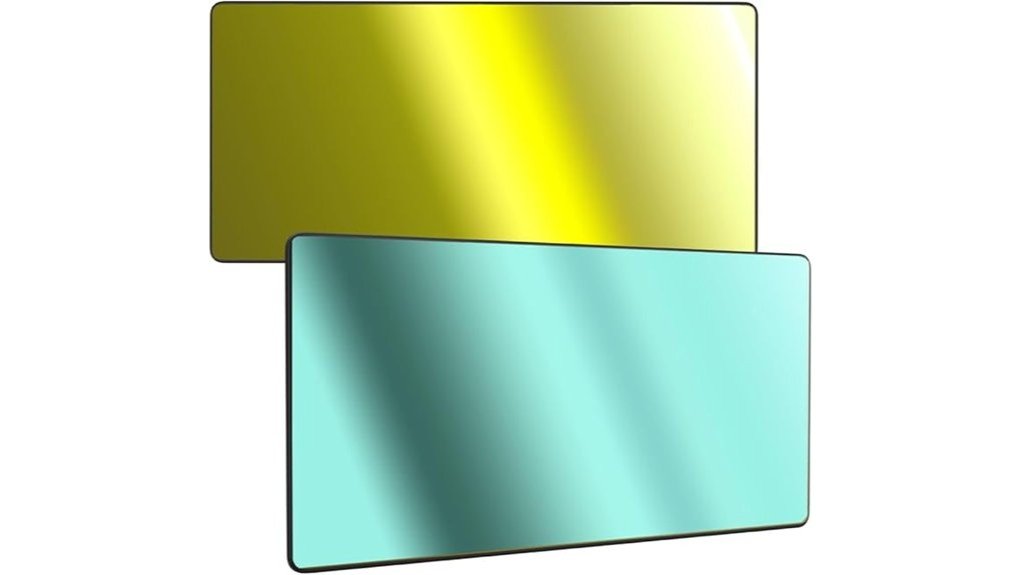
| Color effect | Gold when viewed straight on, shifting toward light blue at an angle |
| Power requirements | None, no batteries or solar cells |
| Compatibility note | Measure the holder and confirm the retainer, gasket, and cover-lens stack before buying |
| Manufacturer support | Manufacturer site lists a 12-month replacement policy for manufacturer-related issues and a 90-day money-back guarantee; confirm Amazon purchase terms |
| Care note | Use clean cover plates, wipe with a soft clean cloth, and protect the lens from grinding dust and scratches |
| Safety note | Choose shade by welding process, amperage, electrode size, and workplace requirements |
What Is the King 2-Tone Welding Lens?
The King 2-Tone is a fixed passive filter lens from Ridge Products Welding. It stays dark at the selected shade all the time, unlike an auto-darkening filter that changes when you strike an arc. The shade 10 version reviewed here is intended for welders who repeatedly work within a range where shade 10 is appropriate.
The manufacturer sells the King 2-Tone in shades 9, 10, 11, and 12. That distinction matters because the product family offers several fixed choices, but each individual lens remains one shade. You need to select the correct variant before ordering rather than expecting one lens to cover every task.
The visual feature is the two-tone coating. The front looks gold when viewed directly and shifts toward light blue as the viewing angle changes. This affects the appearance of the lens and the character of the view, but it does not change the shade number or add electronic adjustment.
Before You Buy: Confirm that the Amazon listing is set to shade 10 and that shade 10 meets the minimum requirement for your exact process and amperage. Also measure your hood, since “2×4” describes a common format and does not guarantee every retainer or flip-front holder will fit the same plate thickness.
Who Should Buy It?
Best For
- Welders who already use shade 10 for repeat work and do not need variable settings.
- Owners of pancake, sugar-scoop, flip-front, or other hoods built around a standard 2×4 lens opening.
- Buyers who value a gold exterior, a light-blue angle shift, and battery-free operation.
Skip If
- You switch frequently between low- and high-output welding processes.
- You need auto-darkening, sensitivity, delay, grind mode, or adjustable shade controls.
- Your hood uses a non-standard opening or has a shallow retainer that may not accept the plate securely.
Key Takeaways
- The reviewed lens is a passive shade 10 filter, not an auto-darkening lens.
- Ridge Products Welding also lists shade 9, 11, and 12 versions, so check the selected variant before checkout.
- The lens is sold for standard 2″ x 4.25″ hood openings, while the manufacturer lists the plate itself at about 2″ x 4.05″ x 0.12″.
- The gold-to-light-blue effect changes with viewing angle, but the protective shade remains fixed.
- The lens needs no batteries or electronics, but you must match the shade and physical fit to your work and hood.
Design and Viewing Character
The King 2-Tone is designed to look different from a plain green filter plate. The gold front gives a traditional reflective appearance, while the color shifts toward light blue when the lens is viewed from an angle. The exact appearance can vary with shop lighting, sunlight, and the angle of your hood.
The two-tone finish is not a variable tint system. You cannot turn a dial or change the shade while working. The shade 10 filter remains shade 10, so the color effect should be treated as a viewing and style feature rather than a substitute for correct shade selection.
The passive design also keeps the lens simple. There are no sensors to block, no reaction-time specification to compare, and no battery condition to monitor. That simplicity is useful for repeat jobs, but it also means you lower the hood before striking the arc and keep it down while welding.
Performance and Puddle Visibility
Visibility is the main reason to spend more on a specialty passive lens instead of a basic filter plate. The King 2-Tone produces a gold and blue viewing character rather than the familiar dark-green look of many low-cost lenses. Some welders prefer that color balance because edges, joint lines, and the puddle may appear easier to separate from the surrounding plate.
Clarity is still affected by the complete lens stack. A dirty outer cover, scratched inner cover, loose retainer, or glare entering around the hood can reduce the benefit of a clear filter. Use clean cover plates and make sure the lens sits flat before judging the view.
The fixed shade is the main performance limit. Shade 10 can be suitable for some arc-welding ranges, but it is not a universal setting. If your work moves from low-amperage TIG to brighter MIG, flux-core, stick, plasma, or air-carbon tasks, one fixed filter may be too light for one job and too dark for another.
Fit and Compatibility
Ridge describes the King 2-Tone as fitting standard 2″ x 4.25″ hoods. The manufacturer also lists the physical plate at about 2″ x 4.05″ x 0.12″, which is consistent with a filter made to sit inside a nominal 2×4 holder rather than fill the entire opening edge to edge.
Do not rely on the words “standard 2×4” alone. Remove your current filter and compare its actual length, width, and thickness. Check that the retaining clip closes fully, the gasket is not pinched, and the clear cover plates remain flat without leaving a light gap.
Compatibility can also depend on the hood design. Pancake and sugar-scoop hoods often use the 2×4 format, but some flip-front holders, custom retainers, and older helmets may have less clearance. A secure fit matters because a loose filter can shift during use.
Pro Tip: Photograph the order of your current outer cover, filter lens, inner cover, gasket, and retainer before removing them. Reinstall the new filter in the same approved stack so you do not accidentally omit a protective cover plate.
Build Quality and Care
The exact product page does not publish a material specification for the passive plate, so you should not assume it is glass or polycarbonate. What matters in daily use is protecting the filter surface and keeping the viewing area clean.
Use the clear cover plates required by your hood manufacturer. They take the wear from spatter, grinding dust, fingerprints, and routine cleaning so the specialty filter does not need frequent replacement. Replace a cover plate when scratches or haze begin to distort the view.
Clean the filter only with a soft, clean cloth and a method approved by the lens or hood maker. Avoid wiping it with dirty gloves, shop towels carrying metal grit, or abrasive cleaners. Store a spare lens in a rigid sleeve or case rather than loose in a toolbox.
Compatibility and Safety Notes
A shade number is a safety specification, not a personal style choice. OSHA guidance selects welding filter shades by the process, arc current, electrode size, and other operating conditions. Review the official OSHA filter-lens shade table and follow your employer, hood manufacturer, and site requirements.
Do not continue welding if the arc is painfully bright, the filter is cracked, the lens stack is loose, or direct light can enter around the holder. Stop, inspect the setup, and move to an appropriate shade or helmet before restarting.
A welding hood and filter are not the only eye protection needed in a fabrication area. Wear approved safety glasses or goggles under the hood when you face slag, grinding fragments, wire-wheel bristles, or other flying particles. Replace damaged eye protection instead of trying to work around it.
How It Performs in Real Use
For Repetitive Shop Welding
The King 2-Tone is easiest to live with when your process and amperage stay within a range where shade 10 is already your normal choice. You install it once, lower the hood before striking the arc, and get the same view on each weld without adjusting controls.
For Outdoor and Field Work
The passive filter does not depend on sensors seeing the arc, which removes one concern when your body, pipe, or structure blocks part of the light. Bright sun and reflections can still enter around the hood, so check the seal, cover plates, and visibility before starting a long weld.
For Mixed-Process Fabrication
This is where the fixed shade becomes less convenient. A shop that moves between TIG, MIG, flux-core, stick, cutting, and grinding may need several passive lenses or an adjustable auto-darkening filter. The King 2-Tone is better as a dedicated setup than as a one-lens solution for every station.
For Hood Customization and Long-Term Use
The gold and light-blue shift gives a traditional 2×4 hood a custom appearance without adding electronics. Long-term value depends on preserving the filter with clean cover plates and careful storage. A scratched specialty lens can become an expensive replacement even when the shade itself still functions.
How to Use It Correctly
First, verify the selected shade on the listing and compare it with the shade required for your process and amperage. Then measure the existing lens and inspect the holder for damage, bent clips, worn gaskets, or missing cover plates.
Install the King 2-Tone in the same orientation and approved stack used by your hood. The plate should sit flat, the retainer should close without excessive force, and no direct light should pass around the edge. Do not grind, cut, or force the lens to fit unless the hood manufacturer specifically permits that modification.
Before welding, test the hood position and visibility in a safe setup. Lower the passive lens before striking the arc. After use, inspect the outer cover for spatter and scratches, clean the assembly carefully, and store the hood where the filter will not be hit by tools or loose metal.
Pros and Cons
Pros
- Passive fixed-shade operation has no sensors, batteries, menus, or reaction-time settings.
- Designed around the widely used 2″ x 4.25″ hood format.
- Gold front and light-blue angle shift give the lens a distinctive appearance.
- Shade 9, 10, 11, and 12 options let you choose a fixed variant that matches your common work.
- Manufacturer site lists a 12-month replacement policy for manufacturer-related issues.
Cons
- Each lens has one fixed shade, so it cannot adapt to a wide range of welding conditions.
- The specialty coating costs more than a basic passive green filter and needs careful protection from scratches.
- Nominal 2×4 compatibility does not guarantee a perfect fit in every retainer, flip-front holder, or custom hood.
Is It Worth the Price?
The King 2-Tone sits in the specialty-lens tier rather than the budget replacement tier. You are paying for the two-tone gold and light-blue appearance, the passive simplicity, and the option to build a dedicated fixed-shade hood around your preferred setting.
It offers the best value when you weld often, already know shade 10 suits your usual work, and protect the filter with replaceable cover plates. In that situation, the lens can give you a consistent view without the controls or electronic parts of an auto-darkening filter.
It is harder to justify if you need only an inexpensive spare or regularly change processes and amperage. An adjustable auto-darkening lens may cost more, but it can reduce the need to swap filters or keep several dedicated hoods.
How It Compares to Alternatives
A basic option such as the Harris 1024100 shade 10 glass filter uses the same common 2″ x 4.25″ format at a much simpler price point. It makes sense when you only need a conventional fixed filter and do not care about the King’s two-tone appearance.
Ridge’s King Single 2.0 auto-darkening lens is the more flexible step-up when you want shade 10 with electronic darkening, while the King 1.0 adjustable model covers a wider shade range. The King 2-Tone remains the better fit when you specifically want a passive filter, a dedicated shade, and no electronics.
Frequently Asked Questions
Is the King 2-Tone Welding Lens auto-darkening?
No. It is a fixed passive lens that stays at the selected shade. It has no sensors, reaction time, batteries, or electronic controls.
Is shade 10 the only available option?
No. Ridge Products Welding lists the King 2-Tone in shades 9, 10, 11, and 12. This review covers the shade 10 variant, so check the selected option before ordering.
Will it fit every standard 2×4 welding hood?
It is designed for standard 2″ x 4.25″ openings, but holders can differ in thickness, gasket design, and retainer clearance. Measure your existing plate and confirm that the lens stack closes securely.
Why is the listed plate shorter than 4.25 inches?
The 2″ x 4.25″ measurement usually describes the nominal hood format. Ridge lists the plate at about 2″ x 4.05″ x 0.12″, allowing it to sit inside the holder rather than match the opening edge to edge.
Is shade 10 safe for every welding process?
No. Required shade depends on the process, arc current, electrode size, and workplace rules. Use the OSHA shade table and your employer or equipment instructions instead of treating shade 10 as universal.
Does the gold and light-blue color shift change the shade?
No. The color changes with the viewing angle, but the protective shade remains fixed. It is a visual and viewing-character feature, not a variable-shade function.
What warranty does the manufacturer list?
The Ridge product page lists a free replacement for manufacturer-related issues within 12 months and a 90-day money-back guarantee. Confirm how those terms apply to an Amazon order before relying on them.
Does the lens replace safety glasses?
No. The filter protects against welding radiation as part of a complete hood setup, but it does not replace primary eye protection from slag, grinding debris, or flying particles. Wear approved safety glasses or goggles when those hazards are present.
The Bottom Line
The Ridge Products Welding King 2-Tone is worth considering when you want a dedicated shade 10 passive lens, a common 2×4 hood format, and a distinctive gold-to-light-blue appearance. Skip it when you need automatic darkening, adjustable shades, or guaranteed compatibility with a non-standard retainer.
Its main strength is simple battery-free viewing in a specialty passive filter. Its main limitation is that one fixed shade cannot adapt to every welding process or amperage.
Ready to Buy?
Confirm the shade 10 variant, hood fit, and current product details before you decide.