Disclosure: As an Amazon Associate, we earn from qualifying purchases. If you click a link on this page and make a purchase, we may receive a small commission at no extra cost to you.
Choosing an entry-level TIG welder is difficult because a low purchase cost can hide limits in power, controls, accessories, and support. The S7 TIG-200 200A HF Start TIG Welder combines DC TIG, Pulse TIG, and Stick welding in a compact dual-voltage machine. Its strongest points are simple controls, non-touch HF TIG starts, and 110V/220V flexibility. Its main tradeoffs are light-duty positioning, no AC TIG for aluminum, and limited published detail about duty cycle and pedal support.
Quick Verdict
Rating: 7.8/10, recommended with caveats
Best For: Beginners, hobby welders, and garage users working mainly with mild steel, stainless steel, and carbon steel.
Bottom Line: The S7 TIG-200 gives you DC TIG, Pulse TIG, and Stick modes in an easy-to-carry 110V/220V unit. It offers useful entry-level flexibility, but it is not the right machine for AC aluminum TIG or production welding.
Key Specifications
| Specification | Detail |
|---|---|
| Brand | S7 |
| Model / Style | TIG-200 |
| ASIN | B083HZGYCP |
| Product Type | Portable inverter welder for DC TIG, Pulse TIG, and ARC/Stick welding |
| Listed Current Range | 20 to 200 amps |
| Input Voltage | 110V / 220V dual voltage |
| TIG Arc Start | HF non-touch start |
| Compatible Metals | Stainless steel, mild steel, carbon steel, copper, alloy steel, and other suitable ferrous metals |
| Aluminum TIG | Not supported as a standard AC TIG process; this is a DC TIG machine |
| Dimensions | 17 x 10 x 13 inches |
| Weight | About 18 lb; the current Amazon technical details list 18.01 lb |
| Housing Material | Metal |
| Controls | LED current display, amperage control, Pulse TIG adjustment, hot start, arc force, and anti-stick features listed by the seller |
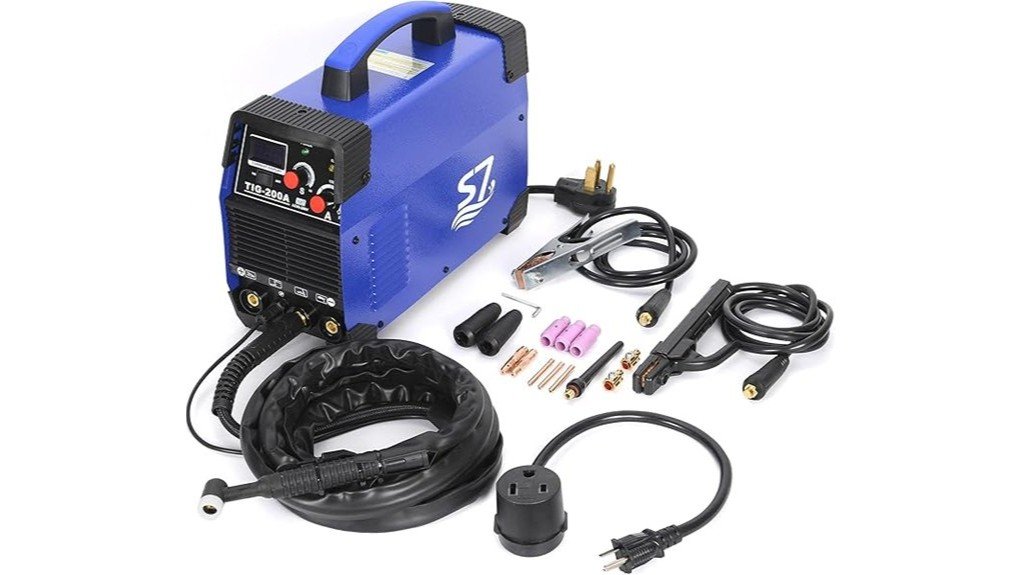
| Referenced Accessories | WP-17 TIG torch, torch consumables, voltage adapter, ground clamp, and electrode holder; confirm the current seller bundle before ordering |
| Best Use | TIG practice, home repair, brackets, tools, small frames, farm maintenance, and light shop projects |
What Is the S7 TIG-200?
The S7 TIG-200 is a compact 3-in-1 inverter welding machine. It lets you switch among DC TIG, Pulse TIG, and ARC/Stick welding without buying three separate units. The 110V/220V input gives you a practical way to practice on a household circuit and move to 220V when a job needs more available output.
The current product information identifies S7 as the brand, TIG-200 as the style, and Win-Win as the manufacturer. The machine is aimed at garage, DIY, farm, and light workshop use rather than continuous industrial production. This review is based on the current product listing and available documentation, not on a hands-on bench test.
Who Should Buy It?
Best For
- Beginners who want to learn DC TIG and Stick welding on common steel types.
- Garage and farm users who need a portable machine for brackets, tools, frames, and routine repairs.
- Hobby welders who value dual-voltage input and HF non-touch TIG starts.
Skip If
- You need AC TIG for aluminum.
- You need a documented production-duty cycle, strong dealer support, or a clearly verified foot-pedal connection.
- You expect full 200A performance from a standard 110V household circuit.
Before You Buy: Dual-voltage input does not mean AC/DC TIG output. The S7 TIG-200 uses DC TIG, so it is suited to steel and other compatible metals but is not designed for conventional AC TIG welding on aluminum. The current listing also does not clearly verify a foot-pedal input or a detailed duty-cycle chart.
Feature-by-Feature Review
DC TIG and Pulse TIG Modes
DC TIG is the main reason to consider this machine. The HF non-touch start lets you initiate the arc without dragging the tungsten across the workpiece, which can reduce tungsten contamination and make practice starts more consistent. The listing names stainless steel, mild steel, and carbon steel as primary uses, while the documentation also lists copper and alloy steel.
Pulse TIG gives you another way to manage heat and bead rhythm on suitable material. It can be helpful when you are learning to control travel speed or working on thinner metal, but your result still depends on clean material, correct polarity, gas coverage, tungsten preparation, and proper amperage.
Stick Welding and 200A Output
ARC/Stick mode makes the S7 more useful for repair work where perfect TIG cleanliness is not practical. The seller lists hot start, arc force, and anti-stick functions to help establish the arc and reduce electrode sticking. These aids can make starts less frustrating, but they do not replace correct rod choice and technique.
The machine is marketed at up to 200A, with a listed range of 20 to 200A. Treat that figure as the machine’s maximum setting, not a promise of continuous full-output welding. Available current, electrode size, material thickness, input circuit, ambient heat, and cooling time all affect real performance.
110V and 220V Power
Dual-voltage input is valuable because it gives you more options in a garage or small shop. A 110V outlet can suit practice, thinner material, and lighter repairs when the circuit is correctly rated. A proper 220V circuit gives the welder more electrical headroom for higher settings and longer work periods.
Do not assume every household outlet or extension cord is suitable. Check the machine label and manual, use the correct adapter, and match the branch circuit to the manufacturer’s requirements. Have a qualified electrician install or inspect a 220V circuit when needed.
Controls, HF Start, and Auto Memory
The front panel uses an LED current display and simple knobs rather than a complex menu system. That keeps basic setup approachable. The current listing also describes an auto-memory function that restores saved settings after the machine is powered off.
Simple controls are useful for a beginner, but they also mean fewer advanced adjustments than you may find on a more expensive TIG welder. The available information does not clearly confirm remote amperage control by foot pedal, so verify that feature before buying if on-the-fly current control matters to you.
Portability and Included Gear
At roughly 18 pounds and 17 x 10 x 13 inches, the S7 TIG-200 is easy to carry between a shelf, bench, garage bay, or repair area. Its compact size is a real advantage when floor space is limited or you do not want a large cart-mounted machine.
The available manual lists a WP-17 TIG torch, torch consumables, a 220V-to-110V adapter, a ground clamp, and an electrode holder. Seller bundles can change, and TIG welding still requires suitable tungsten, shielding gas, a regulator or flowmeter, filler metal when needed, and proper protective equipment.
How It Performs in Real Use
For TIG Practice
The HF start, current display, and Pulse TIG mode create a useful entry point for learning on clean mild steel or stainless steel coupons. You will still need argon, correctly prepared tungsten, and enough practice to control torch angle, arc length, filler timing, and travel speed.
For Garage Repairs
Stick mode is practical for brackets, tools, small frames, and general steel repairs where speed matters more than a TIG-finished bead. Clean the joint, attach the ground clamp to bare metal, and select an electrode that matches the material and available current.
For Farm or Mobile Work
The compact body is easier to move than a full-size shop welder. Stick welding can be useful outdoors because it does not need shielding gas, but the machine and electrical connections must stay dry. Wind can disrupt TIG shielding gas, so TIG work needs a protected area.
For Occasional Higher-Output Jobs
A suitable 220V supply is the better choice when you need more output than a standard 110V circuit can comfortably provide. Even on 220V, allow cooling time, keep the vents clear, and stop if the overheat indicator activates. This machine is better suited to intermittent projects than continuous production.
Setup Tips Before First Use
- Confirm the power source. Match the outlet, adapter, breaker, and wiring to the machine label and manual before switching it on.
- Inspect every cable. Check the torch, ground clamp, electrode holder, plug, and gas hose for loose fittings, damaged insulation, or worn connectors.
- Prepare the workpiece. Remove rust, oil, paint, plating, and mill scale from the weld area and the ground-clamp contact point.
- Complete the TIG gas setup. Connect a suitable argon cylinder, regulator or flowmeter, and hose. Check for leaks before striking an arc.
- Start with the manual’s range. Use the electrode or tungsten maker’s guidance, then adjust in small steps for the metal and joint.
- Protect airflow. Keep the machine upright with open space around its vents. Do not cover it or grind directly into the cooling intake.
Pro Tip: Practice on clean scrap that matches your project metal and thickness. Record the voltage input, amperage, pulse setting, tungsten or rod, and gas flow that produced the best bead so you can repeat the setup.
Safety, Electrical, and Ventilation Notes
The machine lists protection against over-current, over-voltage, overheating, and overload. These protections help guard the equipment, but they do not make welding risk-free. Wear an approved welding helmet with the correct shade, flame-resistant clothing, dry welding gloves, and suitable eye and hearing protection.
Work in a dry, ventilated area and remove fuel, solvents, sawdust, paper, and other combustibles. Keep a fire extinguisher nearby and watch the area after welding for hidden sparks. Never weld a closed container, unknown coated metal, or a safety-critical structure without the correct training and procedures.
Disconnect input power before moving, inspecting, or servicing the machine. Do not pull the unit by its cables. Internal cleaning and electrical repairs should be handled by a qualified technician, and structural, pressure-vessel, vehicle-frame, or life-safety welds should be completed or inspected by a qualified welder.
Pros and Cons
Pros
- Combines DC TIG, Pulse TIG, and Stick welding in one compact machine.
- HF non-touch start helps you begin a TIG arc without scratch starting.
- 110V/220V input supports both light practice and higher-output shop use.
- About 18 pounds, so it is easy to carry and store.
- Simple LED display and basic controls reduce setup complexity.
Cons
- DC TIG output does not provide conventional AC TIG welding for aluminum.
- The current listing does not clearly document foot-pedal support or a detailed duty-cycle chart.
- The accessory bundle and warranty terms should be confirmed with the current seller before purchase.
Is It Worth the Price?
The S7 TIG-200 makes the most sense as an entry-level value machine. You get three welding modes, dual-voltage input, an HF TIG start, and a compact body without moving into a larger professional system. Buyers who mainly want to practice DC TIG and complete occasional steel repairs receive the clearest value.
It is less attractive when your work depends on aluminum TIG, verified remote amperage control, detailed duty-cycle documentation, or local dealer service. Compare the current bundle and support terms, because a lower machine cost can be offset by a gas cylinder, regulator, tungsten, filler rod, consumables, PPE, and electrical work.
How It Compares to Alternatives
The YESWELDER TIG-205P is worth comparing if you want another entry-level DC TIG, Pulse TIG, and Stick option with a more modern control layout. The Forney Easy Weld 140 MP is a better comparison when MIG and flux-core versatility matter more than dedicated HF TIG features.
If aluminum TIG is required, compare an AC/DC machine such as the PRIMEWELD TIG225X instead. The S7 TIG-200 remains the simpler choice when your priority is affordable DC TIG and Stick capability for steel-focused garage projects. Confirm each alternative’s current specifications and included accessories before deciding.
Frequently Asked Questions
Is the S7 TIG-200 an AC/DC TIG welder?
No. It accepts 110V or 220V AC input power, but its TIG welding output is DC. That distinction matters because dual-voltage input does not provide the AC TIG output normally used for aluminum.
Can the S7 TIG-200 weld aluminum?
It is not designed for conventional AC TIG welding on aluminum. Choose an AC/DC TIG welder when aluminum is a core requirement rather than relying on an unsupported workaround.
Does TIG welding require a gas cylinder?
Yes. DC TIG normally requires shielding gas, commonly argon, plus a suitable regulator or flowmeter and hose. Stick welding uses flux-coated electrodes and does not require a separate shielding-gas cylinder.
What accessories come with the S7 TIG-200?
Available documentation lists a WP-17 TIG torch, torch consumables, a voltage adapter, a ground clamp, and an electrode holder. Seller bundles can change, so compare the current package photos and contents list before ordering.
Can you run it on a standard 110V outlet?
The machine supports 110V input, which is useful for practice and lighter work on a correctly rated circuit. Use 220V when you need more electrical headroom, and do not expect the same maximum output from a standard household circuit.
Is the S7 TIG-200 suitable for beginners?
Its HF start, simple current display, and basic controls are approachable for a beginner. TIG still has a steep skill curve, so take a class or get help from an experienced welder before working on important joints.
How thick can the S7 TIG-200 weld?
Available documentation lists a TIG range of about 0.3 to 4.8 mm, but practical capacity changes with the metal, joint, input voltage, settings, and operator skill. Use the exact machine label and current manual as the final guide.
Does it support a TIG foot pedal?
The current listing and available documentation do not clearly confirm foot-pedal support. Assume it is not included or supported until the seller verifies the exact connector and compatible pedal for the unit you will receive.
The Bottom Line
The S7 TIG-200 is a sensible entry-level choice for you when you want portable DC TIG, Pulse TIG, and Stick welding for steel-focused garage or hobby projects. Skip it when you need AC aluminum TIG, production-duty documentation, or confirmed foot-pedal control. Its main strength is flexible dual-voltage, multi-mode operation, while its main limitation is the gap between a basic hobby machine and a fully documented professional TIG system.
Ready to Buy?
Check the latest price, seller bundle, warranty information, and product details before you decide.