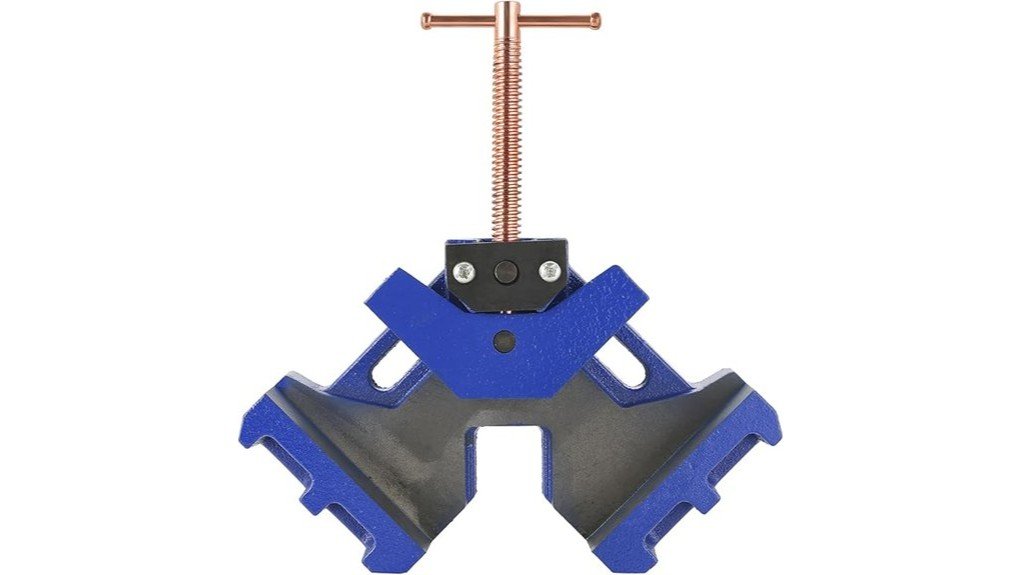
The DASBET 90 degree welding clamp is a cast iron, two-axis corner clamp for holding two pieces square while you tack them. The listing gives a maximum jaw opening of 2.1 inches and a jaw width of about 4 inches, with sliding T-handles. It is a sensible buy for light to medium fabrication and frames, but it is not for thick stock or for holding anything while you weld on the clamp itself. The DASBET cast iron 90 degree welding clamp holds parts square for welding.
Quick specs at a glance
| Item | Detail |
|---|---|
| Product | DASBET two-axis 90 degree welding clamp |
| Material | Cast iron and steel, per the listing |
| Max jaw opening | About 2.1 in, per the listing |
| Jaw width | About 4 in, per the listing |
| Handle | Sliding T-handle |
| Jaws | Adjustable, rotating or swinging jaws that adapt to different thicknesses, per the listing |
Specs come from the seller listing. It is sold as a welding corner clamp, though the same design can help with light woodworking or sheet jobs.
What the DASBET 90 degree welding clamp is and who it suits
A 90 degree corner clamp holds two flat or square stock pieces at a right angle, so you can tack the joint without a square in one hand and a clamp in the other. The two-axis design clamps both pieces at once.
It is aimed at people building frames, boxes, gate or table corners and tube or bar joints. With a 2.1 inch maximum opening it fits common flat bar, angle and light tube, and it can double for wood or sheet work in the shop.
If you need to hold thick plate or large sections, a wider-capacity clamp or fixture table is a better bet.
How to check it fits your project
- Stock thickness: measure your material. Anything over about 2 inches will not fit the jaw opening.
- Stock shape: flat bar, plate and square tube seat best. Round tube may need extra support.
- Weld access: check that the clamp body does not block the joint you need to weld.
- Fixture table: some corner clamps rest flat on a table, so make sure the footprint suits your surface.
- Weight: cast iron is heavy, so confirm you are happy with the bulk for repeated moves.
Pros and limitations
Pros
- Holds two pieces square without a separate square.
- Cast iron body is stiff and resists flexing.
- T-handles give leverage for a firm hold.
- Adjustable jaws handle different thicknesses.
Limitations
- Cast iron is brittle, so don’t hammer or drop it.
- Clamp screws collect spatter if you weld close; use anti-spatter or cover the threads.
- Not suited to thick or large work.
- Squareness depends on casting accuracy, so check with a square before tacking.
Using it for welding
- Clean the contact faces and stock edges to bare metal.
- Seat both pieces against the clamp faces and tighten both T-handles evenly.
- Check squareness with a framing or machinist square.
- Tack in two or three spots, then check again before the final weld.
- Brush the threads clean after each job and add a drop of oil to the screws.
Keep the arc away from the screw threads, and let the part cool before loosening, since heat can distort a tight clamp setup.
Alternatives and related guides
- DASBET angle clamp 2-pack: two heavy cast iron angle clamps for repeated 90 degree assembly
- Turnirace welding table clamps: for holding parts to a fixture table
- V-type magnetic welding clamps: magnetic angle holders for quick tacking
- VCT 3-piece locking grip clamp set: locking clamps for general fabrication
- welding anti-spatter compound: helps keep clamp screws clean
Frequently Asked Questions
What is a 90 degree welding clamp used for?
It holds two pieces at a right angle so you can tack them accurately. Welders use it for frames, boxes, gates and tables. It saves time compared with a separate square and clamps, especially when working alone on small fabrication projects.
What thickness will this clamp hold?
The listing gives a maximum jaw opening of about 2.1 inches. That covers most flat bar, angle and square tube used in home projects. Measure your stock and leave a little room, and use a different clamp for thicker material.
Can I weld close to the clamp?
You can weld nearby, but spatter damages threads and the clamp can heat up. Cover the screws with a spatter guard or anti-spatter, avoid welding directly on the clamp, and let it cool before loosening so you do not shift the joint.
Is cast iron a good clamp material?
Cast iron is stiff and resists flex, which helps keep corners square, but it is brittle compared with forged steel. Avoid impact or drops, and do not over-tighten with a wrench or cheater bar. Inspect for cracks occasionally.
Final verdict
The DASBET 90 degree welding clamp is a simple way to hold square corners for tacking, with a stiff cast iron body and a 2.1 inch opening. It suits light to medium fabrication, not thick plate. Check the current listing for details.