As an Amazon Associate, Garage Welding may earn from qualifying purchases. This does not change the price you pay.
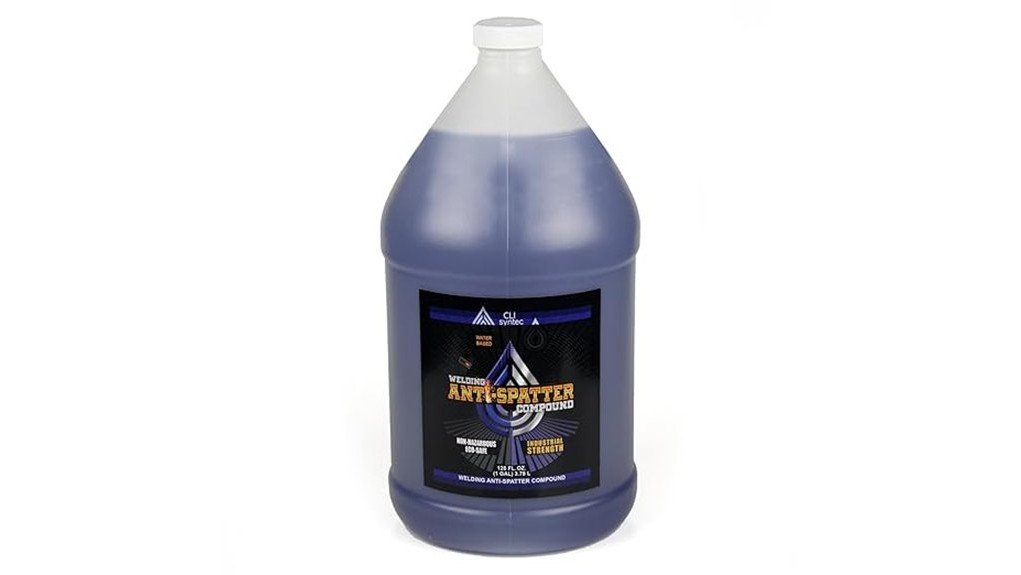
This welding anti-spatter compound is a water-based, 1 gallon (128 oz) coating that you apply to workpieces, fixtures and nozzles so spatter does not fuse as hard and cleans up faster. This review is based on the Amazon listing and common anti-spatter practice, not on hands-on testing.
It is worth considering if you do a lot of MIG or flux-core welding and spend time grinding spatter off. Skip it if you mainly TIG weld, where there is little spatter, or if you need a specific silicone-free grade for painted or coated parts.
Quick specs at a glance
| Item | Details |
|---|---|
| Product type | Water-based anti-spatter coating |
| Container (per listing) | 128 oz (1 gallon) |
| Formula (per listing) | Described as fully synthetic and non-hazardous; read the safety data sheet |
| Application (per listing) | Spray, brush, roller or dip |
| Cleanup (per listing) | Rinses off with water |
Brand, exact chemistry and temperature limits are not stated in the text we reviewed. Check the listing and the SDS.
What anti-spatter does and who needs it
When you weld with MIG or flux-core wire, small molten droplets (spatter) fly off and stick to nearby metal. An anti-spatter coating makes a thin barrier so these droplets sit on the surface and can be wiped or brushed off instead of welding on.
It is useful on fixtures, tables, clamps, jigs and the area next to a weld. A 1 gallon container suits a busy shop or school more than a casual hobbyist, who may find a small aerosol enough.
How to check it suits your work
- Process: most helpful for MIG and flux-core. It does not make spatter disappear; it reduces how hard it sticks.
- Base metal: the listing text we reviewed talks about steel. Check the manufacturer data sheet before using on aluminum or stainless, because coating residue can matter on those metals.
- Painting or coating after welding: residues can interfere with paint adhesion. Choose a silicone-free product if you will paint, and wash the part before coating.
- Applicator: a gallon jug usually needs a separate sprayer or pump bottle. Check whether one is included.
- Gun nozzles: never put water-based coatings into the torch or on a hot nozzle unless the manufacturer says it is okay. Follow your MIG gun manufacturer’s guidance.
Pros and limitations
Pros
- Water-based formula, so cleanup uses water and it is not a flammable solvent per the listing.
- Large 1 gallon size gives a lot of coverage for fixtures and tables.
- Can be applied by several methods.
Limitations
- It does not stop spatter, it only reduces adhesion.
- Residue left on the weld zone may affect finish or coating.
- Wet coating on the joint can cause porosity, so let it dry fully before welding.
- Packaging this large needs its own sprayer.
How to apply it
- Clean the surface of oil and dirt so the coating covers evenly.
- Keep the coating off the joint. Apply it on the surrounding area, fixtures and clamps.
- Spray or brush a thin film and let it dry completely before striking an arc.
- After welding, wipe or rinse spatter with water or a brush. Chip stubborn spots with a chipping hammer and wear eye protection.
- Re-coat fixtures periodically as the film wears off.
Safety and storage
Even non-hazardous products can irritate eyes and skin, so wear gloves and safety glasses. Read the SDS. Keep the lid closed, store the container above freezing and keep it away from children. Do not weld through wet coating, and do not breathe fumes from burned residue.
If you keep your torch tips clean, see our cutting torch tip cleaner review. For protecting people from spatter, see the welding blanket review.
Alternatives and related guides
- Fireproof welding blanket review – protects surfaces from spatter that anti-spatter cannot stop
- Wire scratch brush set review – for cleaning spatter and prep before you coat
- HNBun C-clamp set review – clamps that benefit from anti-spatter on the thread
Frequently Asked Questions
Does anti-spatter work on TIG welding?
TIG makes little spatter, so anti-spatter is rarely needed. It is mainly for MIG and flux-core, where droplets are thrown. Avoid putting coating near a TIG joint, because contamination can hurt weld quality.
Can I spray it on a hot nozzle or tip?
Follow your torch maker instructions. Many shops use nozzle gel designed for MIG nozzles rather than a general water-based coating. Never spray into the gun body or onto live electrical parts.
Is it safe for painted parts?
It depends on the formula. Residue can affect paint adhesion, so wash and abrade the parts before painting. For painted jobs, ask the seller for the technical data sheet or pick a silicone-free product.
How long does a coating last?
The listing does not give a life figure. Expect to re-coat after cleaning, wiping or after the coat burns away from heavy spatter. Reapply on fixtures regularly.
Final verdict
This 1 gallon water-based anti-spatter coating is a sensible shop-sized supply for fixtures and tables. Check the data sheet for your base metal, keep it off the joint and let it dry before you weld.