Disclosure: As an Amazon Associate, we earn from qualifying purchases. If you click a link on this page and make a purchase, we may receive a small commission at no extra cost to you.
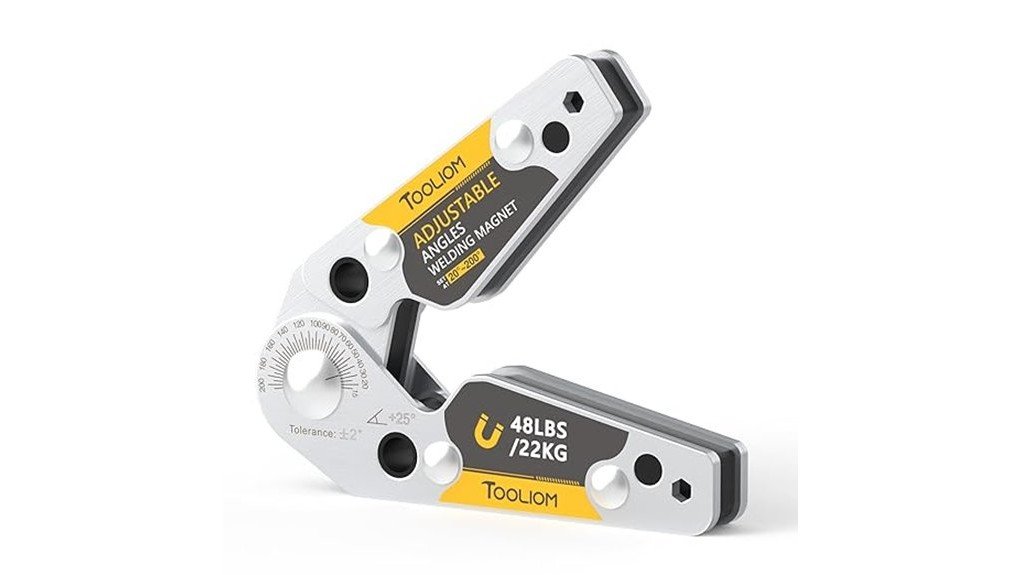
Keeping two steel pieces steady at the right angle can slow down even a simple welding job. The TOOLIOM Adjustable Angle Welding Magnets are made to help with that setup work by holding ferrous metal parts while you tack, mark, align, or assemble. Their main appeal is the combination of a 48 lb magnetic pull force and an adjustable 20° to 200° angle range.
This review helps you decide whether this TOOLIOM magnet fits your shop, garage, or fabrication workflow. It performs best on clean steel surfaces and light to medium workpieces, but it is not a substitute for heavy clamps, fixtures, or industrial lifting tools.
Quick Verdict
Rating: 8/10
Best For: Welders, garage fabricators, and DIY metalworkers who need adjustable angle support for small to medium steel projects
Bottom Line: The TOOLIOM Adjustable Angle Welding Magnets give you useful angle flexibility and hands-free steel positioning. The main tradeoff is that the 48 lb hold depends heavily on clean, flat contact, so heavy or uneven workpieces still need stronger support.
| Specification | Detail |
|---|---|
| Brand | TOOLIOM |
| Product Type | Adjustable angle welding magnet |
| Magnetic Pull Force | 48 lbs (22 kg) |
| Angle Range | 20° to 200° |
| Adjustment Tool | Hexagonal wrench included |
| Compatible Materials | Ferrous metals such as steel and iron |
| Not Designed For | Aluminum, copper, stainless grades with weak magnetic response, or non-ferrous materials |
| Best Use | Tack welding, layout work, frame building, assembly, marking, drilling alignment, and small fabrication projects |
| Safety Note | Use as a positioning aid only. Do not treat it as a lifting device or a replacement for clamps on heavy steel. |
What Is the TOOLIOM Adjustable Angle Welding Magnet?
The TOOLIOM Adjustable Angle Welding Magnet is a magnetic positioning tool for holding ferrous metal pieces during welding, fabrication, and assembly. It is designed for steel and iron workpieces, not aluminum or other non-magnetic materials.
The main feature is its adjustable angle system. Instead of locking you into common fixed angles, it adjusts from 20° to 200°, which helps when you build frames, brackets, angled joints, or custom fixtures.
The included hexagonal wrench lets you tighten the selected angle before you start work. That matters because a loose angle setting can shift during layout, tack welding, or repositioning.
Key Features and Build Quality
48 lb Magnetic Pull Strength
The 48 lb pull force gives you useful holding power for light to medium welding tasks. It can help steady steel plates, tubing, and small sections while you tack weld or check alignment.
This rating does not mean it will hold every 48 lb workpiece in every position. Magnetic hold changes with surface contact, workpiece shape, paint, rust, mill scale, vibration, and the direction of the load.
20° to 200° Adjustable Angle Design
The 20° to 200° range gives you more freedom than a fixed 45°, 90°, or 135° welding magnet. That makes it useful for custom frames, angled brackets, pipe layouts, and non-standard joint setups.
The built-in scale helps you repeat the same angle across multiple pieces. You should still confirm critical angles with a square, gauge, or measuring tool when precision matters.
Hex Wrench Locking System
The included hexagonal wrench locks the angle once you set it. This gives the magnet more control than a loose swivel design, especially when you are moving pieces into position.
The tradeoff is speed. You need to loosen, adjust, and tighten the mechanism each time you change the angle, so fixed-angle magnets may feel faster for simple 90° jobs.
Ferrous-Metal Compatibility
This magnet works on ferrous metals such as steel and iron. It will not grip aluminum, copper, brass, or other non-magnetic materials, and some stainless steel grades may not respond strongly enough for dependable holding.
For best results, both contact surfaces should be clean, flat, and free from thick coatings. Paint, rust, weld spatter, oil, or uneven edges can reduce the magnetic connection.
Who Should Buy It?
Best For
- Welders doing small to medium steel fabrication projects
- DIY metalworkers building frames, brackets, shelves, fixtures, or shop jigs
- Users who need adjustable angle alignment instead of only fixed-angle magnets
Skip If
- You need industrial-grade lifting, rigging, or heavy clamping power
- You work mainly with aluminum or other non-ferrous metals
- You need fixed, high-precision production fixturing with no angle checking
How It Performs in Real Use
For Tack Welding Setup
The magnet helps hold steel pieces at a chosen angle while you prepare tack welds. This can reduce the awkward one-hand holding that often leads to small alignment mistakes.
You still need to check your joint before welding. Heat, vibration, and pulling force from the workpiece can move lighter magnets if the contact area is small.
For Frame and Bracket Fabrication
The adjustable 20° to 200° range is useful when you build frames, angled supports, shop brackets, and repair pieces that do not use standard angles. You can set the angle, tighten it with the wrench, and repeat the setup on matching pieces.
For heavy steel sections, treat the magnet as a helper, not the only support. Add clamps or a fixture when the part can tip, slide, or fall.
For Marking, Drilling, and Layout Work
You can use the magnet before welding to hold parts during marking, drilling alignment, or test fitting. This makes it helpful even when you are not ready to strike an arc.
It works best when the workpiece has enough flat steel surface for the magnet to grab. Round, oily, rusty, or painted surfaces may need extra prep.
For Repetitive Workshop Tasks
When you repeat the same angle across several parts, the built-in scale and locking system can save setup time. You can also reduce measuring errors by confirming the first piece, then using that setting as your reference.
For production-level precision, use it alongside squares, stops, clamps, or a dedicated jig. The magnet improves positioning, but it should not replace final measurement.
Before You Buy: Magnetic strength depends on clean, flat steel contact. Paint, rust, mill scale, weld spatter, oil, curved tubing, or uneven edges can reduce the hold and cause slipping.
Setup Tips Before First Use
Before you use the TOOLIOM Adjustable Angle Welding Magnet, wipe the magnet faces and the steel surface. Small metal chips, dust, or spatter can create a gap that weakens the grip.
Set your angle first, tighten the wrench lock, then place the workpieces. After the parts are positioned, confirm the angle with a square, angle finder, or layout tool before you tack weld.
Keep the magnet clear of the direct weld puddle and avoid using it where heat can damage the tool or pull the joint out of position. Follow the product instructions and use proper welding safety gear.
Pro Tip: Tack one side lightly, recheck the angle, then add the next tack. This helps you catch movement before the joint becomes harder to correct.
Compatibility and Safety Notes
This magnet is best used as a positioning aid for ferrous metal. It should not be used for lifting steel, supporting suspended loads, or holding parts where a slip could cause injury.
Non-ferrous metals such as aluminum and copper will not hold to the magnet. Some coated, painted, rusty, or irregular steel pieces may also reduce grip enough that you need clamps instead.
Welding magnets can collect metal dust and grinding debris. Clean the contact faces often so the magnet sits flat and does not scratch or shift against the workpiece.
Pros and Cons
Pros
- 48 lb magnetic pull force supports many light to medium steel positioning tasks
- 20° to 200° adjustable range works for more than standard fixed-angle joints
- Included hexagonal wrench helps lock the selected angle before use
- Useful for tack welding, layout, marking, drilling alignment, and frame setup
- Helps free one hand during setup when parts are clean and properly supported
Cons
- Not suitable for aluminum or other non-ferrous materials
- Needs clean, flat steel contact for best holding strength
- May require clamps or fixtures for heavy, long, curved, or awkward workpieces
Is It Worth the Price?
The TOOLIOM Adjustable Angle Welding Magnet fits the budget to mid-range category for welding setup tools. It offers strong value for the price if you often need adjustable positioning for steel parts.
You will get the most value if you work on small fabrication, garage repairs, brackets, frames, or occasional custom angles. It is less useful if your work is mostly heavy structural steel, aluminum fabrication, or high-volume production fixturing.
Compared with buying several fixed-angle magnets, this one gives you more angle flexibility in one tool. The limitation is that you must adjust and lock it correctly each time.
How It Compares to Alternatives
Compared to fixed-angle welding magnets, the TOOLIOM model gives you more flexibility for non-standard joints. Fixed 90° welding magnets may still be quicker when you only make square corners.
Compared to heavy-duty welding squares or dedicated fabrication fixtures, this magnet is easier to adjust and store. Those heavier tools may be better when you need maximum holding power, repeatable production accuracy, or support for large steel sections.
Frequently Asked Questions
How strong is the TOOLIOM Adjustable Angle Welding Magnet?
It has a rated 48 lb magnetic pull force. That is suitable for many light to medium steel positioning jobs, but real holding strength depends on surface contact, part shape, and load direction.
What angles can it hold?
It adjusts from 20° to 200°. That range helps when you need angled frames, brackets, supports, or layouts that do not match common fixed welding magnet angles.
Does it work on aluminum?
No. This type of welding magnet is made for ferrous metals such as steel and iron, so aluminum, copper, and brass will not hold to it.
Can it replace clamps?
It can replace a helping hand for some setup tasks, but it should not replace clamps on heavy, unstable, or safety-critical workpieces. Use clamps or fixtures when the part can slide, tip, or fall.
Why does the magnet feel weaker on some steel?
The hold can drop when the steel is rusty, painted, oily, curved, thin, or covered with mill scale. Cleaning the surface and increasing flat contact usually improves grip.
Is it good for beginners?
Yes, it can help beginners keep steel pieces steady during basic layout and tack welding. Beginners should still measure the angle, use proper PPE, and avoid relying on the magnet as the only support for heavy parts.
How should you clean and store it?
Wipe metal dust, chips, and spatter from the magnet faces after use. Store it away from loose metal debris so the contact surfaces stay flat and ready for the next setup.
The Bottom Line
The TOOLIOM Adjustable Angle Welding Magnets are worth considering if you need a flexible, hands-free positioning aid for light to medium steel fabrication. The 48 lb pull force and 20° to 200° range make them practical for angled setups, frames, brackets, and layout work.
You should skip them if you mainly work with aluminum, heavy structural steel, or precision fixtures that need stronger mechanical clamping. For garage welding and small shop projects, the 8/10 rating is fair because the tool is useful, but only when you use it on clean ferrous surfaces and support heavier parts safely.