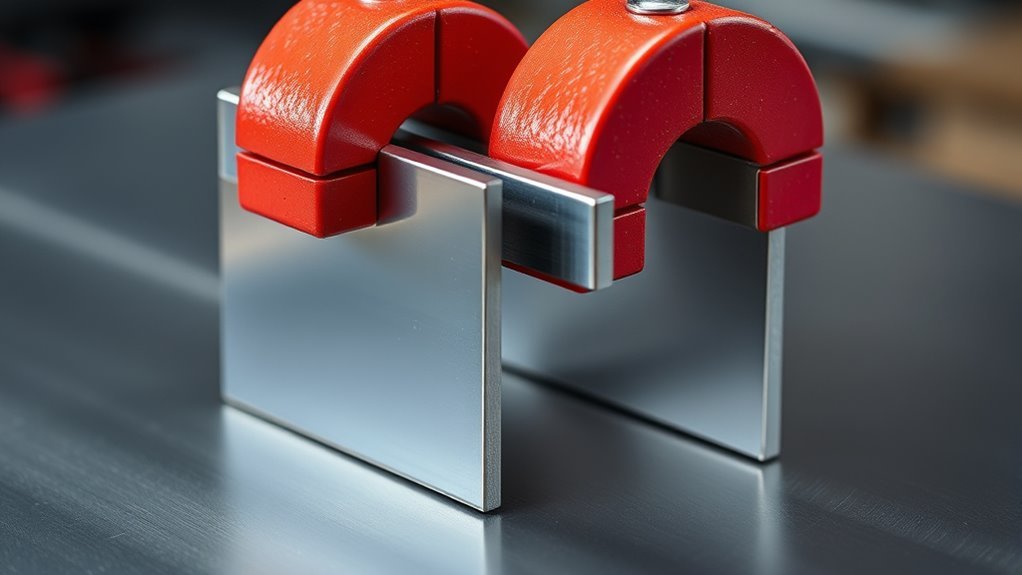
Welding magnets can make panel fit-up faster, but they are positioning aids rather than substitutes for measuring tools, mechanical clamps, or sound welding technique. You need clean magnetic contact, the correct holder for the joint, a controlled tack sequence, and repeated alignment checks. You also need to keep the magnet away from excessive heat and move it if the welding arc begins to wander.
Quick Answer
Use welding magnets only on clean ferromagnetic metal, place them where they hold the joint without sitting in the weld path, and verify angle, flushness, and gap with measuring tools. Make several small tacks, recheck alignment, then remove or move the magnets before the full weld to limit heat damage and magnetic arc interference.
Key Takeaways
- Choose a magnet by joint angle, material, steel thickness, contact area, and the manufacturer’s actual working limits.
- Do not treat an advertised pull-force figure as the amount a magnet can safely resist in every direction.
- Use a square, straightedge, gap gauge, shims, or diagonal measurements to verify the fit before and after tacking.
- Remove or move the magnet before long welds if heat or magnetic arc blow could affect the tool or weld.
- Use mechanical clamps or a dedicated fixture when the metal is nonmagnetic, coated, very thin, heavy, spring-loaded, or safety-critical.
At a Glance
| Time Required | About 10 to 20 minutes for cleaning, fit-up, measurement, and initial tacking, excluding final welding time |
| Difficulty | Beginner to intermediate fit-up work; suitable welding training and process knowledge are still required |
| Tools Needed | Welding magnets, square, straightedge, gap gauge or shims, mechanical clamps, cleaning tools, welder, work lead, and suitable welding PPE |
| Cost | Low to moderate if you already own welding PPE, clamps, and measuring tools; adjustable switchable magnets generally cost more than basic fixed-angle holders |
Warning: Welding creates electric-shock, burn, arc-radiation, fume, fire, and flying-particle hazards. Wear a suitable welding helmet over approved safety glasses or goggles, welding gloves, protective clothing, and footwear. Remove or protect combustibles, provide suitable ventilation and fire protection, identify coatings before heating them, and follow your welder and magnet manufacturers’ instructions.
How Welding Magnets Improve Panel Alignment
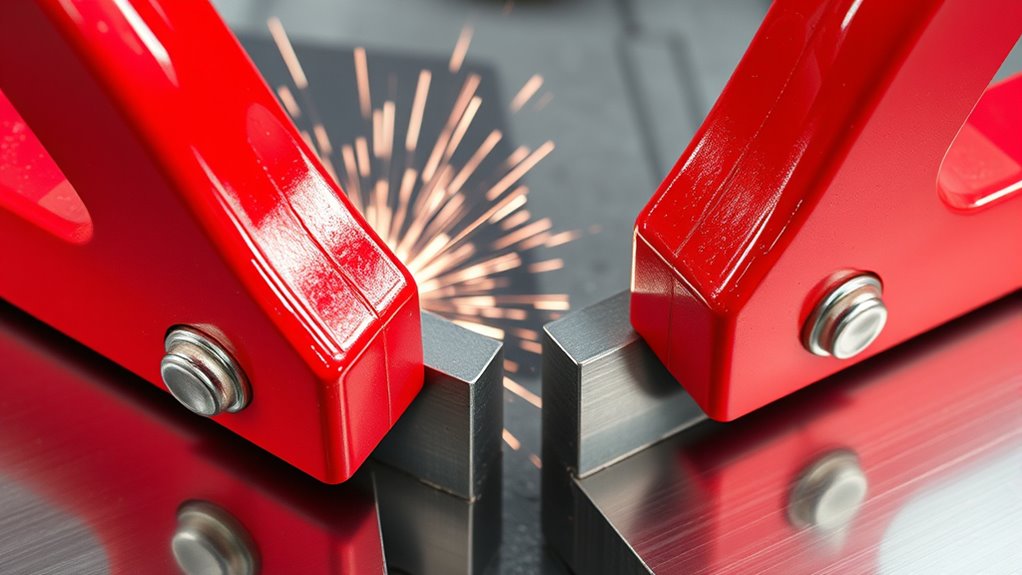
Welding magnets hold ferromagnetic parts in a temporary position while you measure, adjust, and tack the joint. Fixed-angle holders are useful for common 45-degree, 90-degree, and 135-degree setups. Adjustable switchable models can handle a wider range of angles and are easier to reposition because their magnetic circuit can be turned on and off.
The magnet does not prove that the joint is square or properly gapped. It only supplies holding force. You still need a square, straightedge, level, template, gap gauge, or diagonal measurements to confirm the geometry.
Contact quality also matters. Rust scale, welding spatter, paint, mill scale, oil, curved surfaces, thin steel, and trapped debris can reduce the effective hold. An advertised magnetic-force figure normally represents a defined laboratory condition, not every real workshop setup.
A welding magnet holds the parts while you measure them. It does not replace the measurement.
Manufacturer specifications may also distinguish between maximum breakaway force and a lower working load when the part is trying to slide across the magnet. For example, the Magswitch Pivot Angle 200 specifications list separate breakaway and shear values under stated plate conditions. Always follow the figures for your exact tool rather than applying one force rating to every welding magnet.
Select the Best Welding Magnet for Your Project
The best holder depends on the material, joint shape, panel thickness, required angle, access around the weld, and the amount of force trying to move the parts. Start with the joint instead of choosing a magnet only by its advertised pull strength.
Products Worth Considering
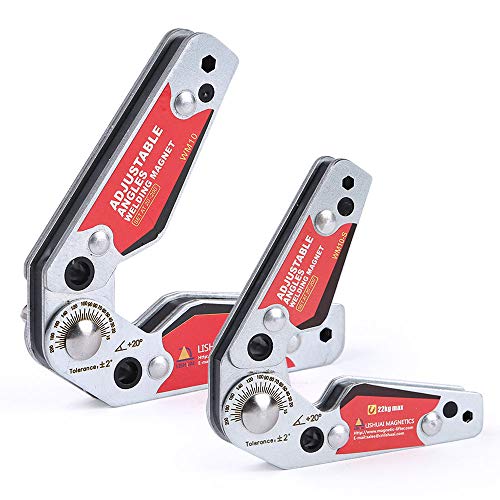
Used as a welding holder in the line of hardware processing and construction industry.

POWERFUL HOLDING FORCE: Featuring robust magnets embedded in the welding holder, these durable magnets boasts a strong magnetic holding force of up to 77lbs/35kg, ensuring reliable performance.
This adjustable angle magnet offer clear secale display,hold metal 25°-200° for welding and fabrication.
Types of Welding Magnets
- Fixed-angle magnets: Simple holders with preset edges, commonly used for square corners, miters, frames, and light fabrication.
- Adjustable switchable magnets: Useful for unusual angles, repetitive fabrication, and situations where you need to turn the holding force on and off for easier positioning.
- Sheet-metal holding magnets: Compact holders designed to stabilize flat steel panels. They can help with automotive fit-up, but thin sheet may still need backing, clamps, or temporary fasteners.
- Magnetic work clamps: Tools intended to connect the welding work lead to suitable steel. They provide electrical contact and are not substitutes for angle holders.
- Mechanical clamps and fixtures: A 4-in-1 clamp, locking pliers, panel clamp, pipe clamp, spreader, cleco-style fastener, or dedicated jig may be a better choice when magnetic holding is weak or when the joint is under spring pressure.
Consider Project Requirements
Check the following before selecting a magnet:
- Material: Mild steel is normally suitable. Aluminum and copper are not held by ordinary welding magnets. Stainless steel varies by grade and condition, so test it before relying on the magnet.
- Steel thickness: Very thin sheet may not provide enough material for the magnet to develop its advertised force.
- Joint angle: Choose a fixed holder for a common angle or an adjustable model for an unusual angle.
- Load direction: A magnet may resist a direct pull better than a sliding or peeling force.
- Surface condition: Paint, rust, scale, curvature, and debris create gaps and reduce the hold.
- Heat exposure: Check the exact temperature rating in the tool manual.
- Weld access: The holder should not block the torch, electrode, gas nozzle, inspection view, or planned tack locations.
Note: A higher pull-force number does not automatically make a magnet better for sheet metal. An oversized magnet may be awkward, may pull a flexible panel out of shape, and may leave too little room for the torch or tack welds.
When Not to Rely on a Welding Magnet
Use mechanical clamps, temporary fasteners, or a dedicated fixture instead when:
- The metal is aluminum, copper, or nonmagnetic stainless steel.
- The joint is carrying significant weight or spring pressure.
- The panel is very thin, flexible, or easily distorted.
- The surface is heavily painted, coated, rusty, curved, or uneven.
- The work is overhead or could fall and injure someone.
- The fit-up is safety-critical, structural, pressure-retaining, or governed by a welding procedure.
- The magnet would have to remain directly beside the arc for the entire weld.
How to Prepare Panels for Optimal Magnet Alignment
1. Confirm Material Compatibility
Test the magnet on each panel before setting up the joint. It should make solid contact without rocking or sliding. Do not assume that every stainless-steel panel will respond the same way.
2. Clean the Contact Areas
Remove loose rust, mill scale, dirt, oil, welding spatter, and metal chips from the magnet face and the contact points on the workpiece. A wire brush, scraper, or suitable abrasive may be used, but keep fresh grinding dust away from the magnet because it can collect on the poles.
Clean the planned weld area according to the welding process and material requirements. Do not strike an arc through unknown paint, galvanizing, plating, sealant, or other coating without identifying the material and following appropriate fume-control procedures.
3. Establish the Required Fit-Up
Place the panels on a stable, noncombustible work surface. Use shims, spacers, panel-gap tools, or a fixture to establish the required joint opening. For a square frame or rectangular panel assembly, compare diagonal measurements as well as checking each corner with a square.
4. Perform a Dry Run
Position the magnets without welding. Press lightly on the panel in the directions it may move during tacking. If the joint slips, rotates, or closes its gap, add a mechanical clamp or fixture before continuing.
Pro Tip: Mark two or three reference points across the joint with a soapstone or suitable marker. After each tack, compare the marks and recheck the gap. Small movement is easier to correct before additional tacks lock the assembly in place.
Guide to Using Magnets for Tack Welding
- Set the panels on a stable surface. Support both pieces so their weight is not hanging from the magnet.
- Place the welding magnets. Position them where they resist the expected movement but do not cover the joint or sit directly in the planned weld path.
- Set the angle and gap. Use a square, straightedge, level, template, gap gauge, or shims. Do not use the magnet’s outer edge as your only reference unless the manufacturer specifies that it is a precision reference surface.
- Add secondary restraint when needed. Use a mechanical clamp, stop block, backing bar, or fixture if the panel can slide, bow, or spring away.
- Connect and inspect the work lead. Attach it firmly to clean metal on the workpiece or approved fixture. OSHA requires mechanically strong, electrically adequate connections and clean contact surfaces on magnetic work clamps. Follow your machine manual and the guidance for welding work-lead connections.
- Make the first small tack. Place it where it will hold the joint without preventing later adjustment. Avoid making a large, hot tack that immediately pulls thin sheet out of alignment.
- Recheck the fit. Verify the angle, gap, flushness, straightness, and diagonals before adding more tacks.
- Add balanced tacks. Move between separated points rather than concentrating heat at one end. On a long seam, use short, spaced tacks and keep checking the panel.
- Remove or move the magnets. Once the tacks can hold the joint safely, move the holders away from the arc and heat-affected area before completing the weld.
- Complete the weld using the approved sequence. For thin sheet, short staggered welds may help limit distortion, but the correct method depends on the joint, material, process, and required procedure.
Warning: Never let the positioning magnet carry an unsupported panel that could fall. Unless the manufacturer specifically rates the tool for lifting, treat it only as a fit-up aid and support the work independently.
Products Worth Considering
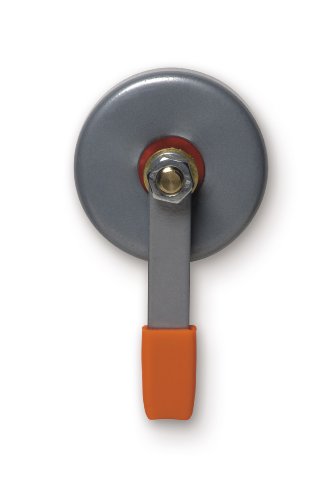
Allows you to ground your work piece with ease.

POWERFUL HOLDING FORCE: Featuring robust magnets embedded in the welding holder, these durable magnets boasts a magnetic holding force of up to 25 lbs, suitable for light welding tasks.

Streamlined Magnetic Welding Ground Setup:Easily set your magnetic welding ground point without delays. Improve workflow and welding speed with this quick-to-place welder ground clamp on any metal surface
How to Control Arc Blow and Heat Distortion
A strong magnetic field near a DC welding arc can cause magnetic arc blow. The arc may bend away from the joint, wander from side to side, produce irregular penetration, or create excess spatter. The effect depends on the joint geometry, current path, magnetic field, welding process, and magnet position.
If the arc becomes unstable:
- Stop welding and let the joint cool enough to handle safely.
- Remove the positioning magnet or move it farther from the weld.
- Recheck the work-lead position and electrical contact.
- Try welding toward an existing tack or change the direction of travel if permitted by the procedure.
- Reduce current only when the lower setting remains suitable for the electrode, wire, metal thickness, and approved procedure.
- Use AC only if the process, consumable, machine, material, and welding procedure allow it.
Lincoln Electric’s guidance on preventing arc blow explains how magnetic fields and welding-current paths can deflect the arc.
Heat distortion is a separate problem. A tack shrinks as it cools, which can pull a thin panel or close the joint gap. Use small tacks, spread them across the assembly, allow cooling time, and remeasure frequently. Do not continue adding tacks to a joint that has already moved out of position.
Common Mistakes With Welding Magnets
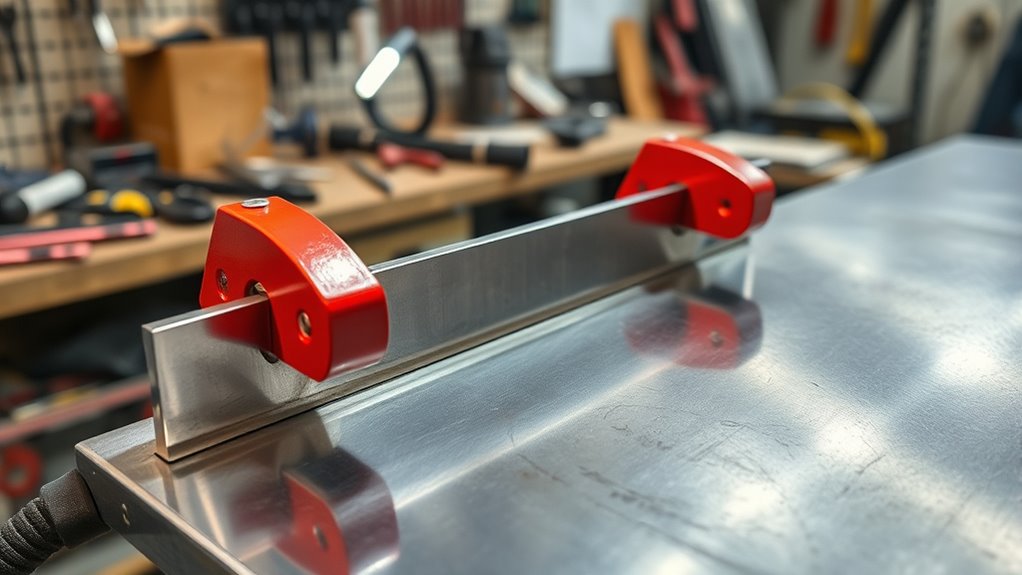
- Trusting the advertised force without reading the conditions: Maximum pull or breakaway force may not represent shear resistance on thin, painted, rusty, or uneven steel.
- Using a magnet on nonmagnetic material: Aluminum, copper, and many stainless-steel grades require clamps or fixtures.
- Skipping alignment measurements: The magnet can hold a joint that is consistently out of square.
- Tacking only one end: The first tack can act as a hinge and pull the opposite end out of position.
- Leaving the magnet in the full-weld zone: Heat can damage the magnet, and its field may contribute to arc wander.
- Allowing debris under the poles: Metal chips create gaps, reduce contact, and may scratch finished surfaces.
- Using cloth or ordinary tape beside the arc: A temporary thin barrier may be acceptable for cold layout, but it reduces holding force and must be removed before welding.
- Welding through unidentified paint or coating: Coatings may create harmful fumes, contaminate the weld, burn, or interfere with the work-lead connection.
- Using a positioning magnet for lifting: Unless specifically rated for lifting, it should not support a suspended load.
- Removing a magnet by striking or prying it: Impact can damage the housing, switch, pole faces, or internal magnet assembly.
Troubleshooting Welding Magnet Alignment Problems
| Problem | Likely Cause | Practical Fix |
|---|---|---|
| Magnet slides or releases | Thin steel, paint, scale, oil, debris, curved contact, or excessive shear load | Clean the contact area, use a larger suitable contact face, add a stop or mechanical clamp, and reduce the unsupported load |
| Panel gap closes after tacking | Tack shrinkage, inadequate spacers, or too much heat in one area | Use proper gap shims, smaller separated tacks, a balanced sequence, and cooling time |
| Corner is not square | Magnet angle tolerance, uneven panel edges, or setup measured from the wrong reference | Check with a trusted square, compare diagonals, correct the edge fit, and add a rigid fixture or clamp |
| Arc wanders or bends | Magnetic arc blow or an unfavorable welding-current path | Remove or move the magnet, inspect work-lead placement, and follow the approved arc-blow correction procedure |
| Paint becomes scratched | Metal chips trapped under the magnet or movement across the finish | Clean both surfaces, avoid sliding the tool, and use a nonmagnetic fixture or protected clamp when preserving the finish is essential |
| Magnet feels weaker after use | Excessive heat, damaged pole faces, trapped debris, or internal damage | Stop using the tool, let it cool, clean and inspect it, and consult the manufacturer if its holding performance has changed |
How to Keep Your Welding Magnets in Great Shape
Allow magnets to cool naturally before cleaning or storing them. Never place a hot magnet in plastic, foam, or a closed container. Check the manufacturer’s temperature limit because magnet material, housing design, and heat resistance vary by model. As one documented example, standard Magswitch tools are rated for sustained exposure up to 80°C or 176°F, while special high-temperature versions have different limits.
After the tool is cool:
- Remove metal chips, grinding dust, rust particles, and welding spatter from the pole faces.
- Inspect the housing, fasteners, switch, pivot, handle, and contact surfaces for damage.
- Do not grind, drill, weld, or modify the magnet unless the manufacturer specifically permits it.
- Store it in a dry drawer, rack, or dedicated container where the contact faces will not strike other tools.
- Keep strong magnets away from magnetic storage media, sensitive electronics, and other items identified in the tool manual.
- For switchable magnets, follow the manufacturer’s storage instructions regarding the on or off position.
- Retire the tool from service if it has overheated, cracked, become difficult to switch, or lost noticeable holding force.
OSHA also requires magnetic welding work clamps to be kept free of adhering metal particles on their contact surfaces. Although an alignment magnet is not the same tool, the same cleanliness principle helps maintain reliable contact and prevents scratching.
Frequently Asked Questions
Can welding magnets be used on non-ferrous metals?
Ordinary welding magnets do not hold aluminum, copper, brass, or other non-ferromagnetic metals. Use mechanical clamps, temporary fasteners, or a dedicated jig. Stainless steel should be tested because its magnetic response varies by grade and manufacturing condition.
What is the weight limit for a welding magnet?
There is no universal weight limit. Use the exact manufacturer’s breakaway, shear, working-load, steel-thickness, and contact-condition specifications. Support the panel independently and test the fit-up before welding. Do not use a positioning magnet for lifting unless it is expressly rated for that purpose.
How do temperature changes affect welding magnets?
Heat is the main concern during welding. Excessive temperature can temporarily reduce holding force or permanently damage some magnet materials. Keep the tool away from the weld pool, remove it after secure tacking, and follow the temperature limit in its manual.
Are there safety concerns when using welding magnets?
Yes. Strong magnets can pinch fingers, attract sharp metal debris, release if the contact is poor, damage sensitive items, and contribute to magnetic arc blow. Keep hands clear when positioning the tool, support the work independently, wear suitable welding PPE, and follow the magnet and welder manuals.
Can welding magnets damage painted surfaces?
They can scratch or mark paint when debris is trapped underneath or the magnet slides. Paint also creates a gap that reduces holding force. A thin temporary barrier may help during cold layout, but remove combustible material before welding and use clamps or a protected fixture when finish preservation is critical.
How far should a welding magnet be from the weld?
There is no single safe distance for every magnet and process. Place it as far from the arc and heat path as practical while maintaining alignment. After the tacks can hold the joint, remove or relocate the magnet before completing the weld.
Can welding magnets be used with MIG, TIG, and stick welding?
They can be used as fit-up aids with these processes when the workpiece is magnetic and the holder is kept outside the weld path. If a DC arc wanders, bends, or becomes unstable, remove the magnet and inspect the work-lead position before continuing.
Conclusion
Welding magnets are most useful during fit-up and early tacking. Choose a holder that matches the metal, angle, contact conditions, and expected load. Clean the contact surfaces, support the work, establish the required joint gap, and verify alignment with proper measuring tools. Make small balanced tacks, check the joint again, and remove or move the magnets before the full weld if heat or magnetic arc blow could become a problem.
For flexible sheet metal, coated panels, nonmagnetic material, heavy assemblies, or critical welds, combine magnets with mechanical clamps or a purpose-built fixture. The result is a safer setup, more predictable panel alignment, and less corrective work after welding.
Sources
- OSHA 29 CFR 1910.254: Arc Welding and Cutting – supports work-lead connection, magnetic work-clamp cleanliness, equipment inspection, and manufacturer-instruction guidance.
- OSHA 29 CFR 1910.252: General Welding Requirements – supports fire prevention, protective clothing, ventilation, and coating-related precautions.
- OSHA Eye and Face Protection Guidance – supports using appropriate welding face protection with primary eye protection.
- Lincoln Electric: Prevent Arc Blow – supports the explanation of magnetic fields, arc deflection, and corrective actions.
- Magswitch Magnetic Tooling in High-Heat Applications – supports model-specific heat limits and the risk of heat-related magnetic degradation.
- Magswitch Pivot Angle 200 Specifications – demonstrates the distinction between maximum breakaway force, shear working load, plate thickness, and model-specific ratings.