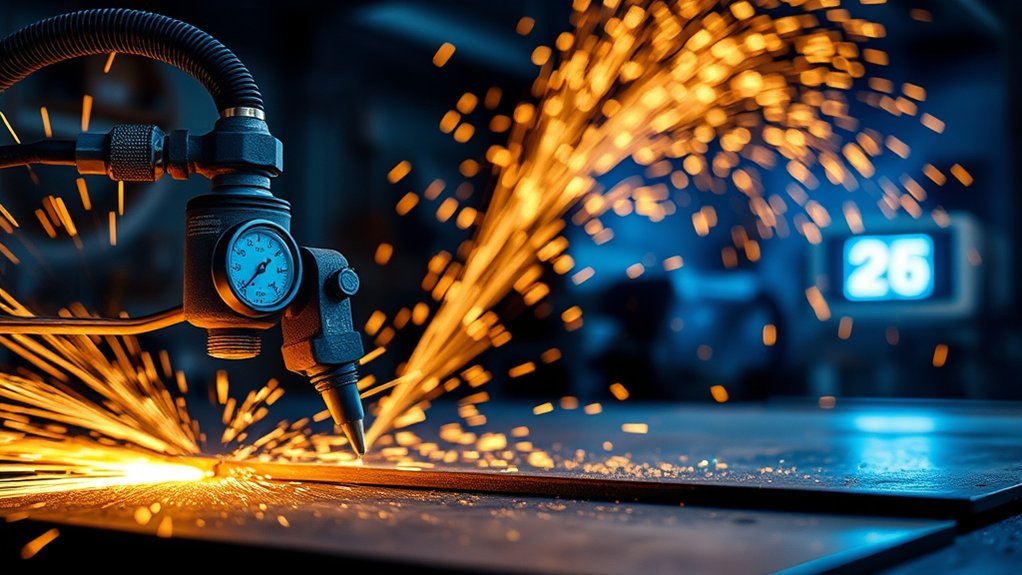
Yes, some plasma cutters can run on nitrogen, but nitrogen is not a universal replacement for compressed air. The power supply, torch, gas console, regulator, consumables, and cut chart must all support the process. When approved by the manufacturer, nitrogen can reduce cut-face oxidation and improve edge appearance on stainless steel and aluminum.
The best gas still depends on the metal, thickness, equipment, and required finish. Clean, dry compressed air remains the practical choice for most manual cutting. Mechanized multi-gas systems may use nitrogen, oxygen, F5, H-35, water, or a proprietary gas mixture for specific materials and thicknesses.
Quick Answer
You can run a plasma cutter on nitrogen only if the manufacturer approves it. Nitrogen is most useful for reducing oxidation on stainless steel and aluminum. It is not always faster than air, and it is rarely the best gas for mild steel. Follow the exact cut chart for pressure, flow, consumables, and thickness.
Key Takeaways
- Confirm that your plasma cutter, torch, gas console, and consumables are approved for nitrogen before connecting a cylinder or generator.
- Nitrogen can produce a cleaner, less-oxidized cut face on stainless steel and aluminum, but results vary by system and thickness.
- Clean, dry compressed air is usually the least expensive and simplest gas for a manual plasma cutter.
- Oxygen is commonly preferred for high-quality mechanized cutting of mild steel, while H-35 or other specialized processes may be used for thick stainless and aluminum.
- Nitrogen can displace oxygen, and aluminum cutting over water can produce hydrogen. Ventilation and manufacturer-approved controls are essential.
At a Glance
| Time Required | About 10–20 minutes for compatibility checks, connection, leak testing, and a test cut |
| Difficulty | Intermediate; advanced for dual-gas or multi-gas mechanized systems |
| Tools Needed | Compatible plasma system, approved consumables, nitrogen supply, rated regulator and hose, leak-test solution, ventilation, PPE, and scrap material |
| Cost | Usually higher than shop air because of cylinders, refills, rental, delivery, regulators, or generator equipment |
Warning: Never connect nitrogen merely because the fitting appears to match. An unapproved gas, pressure, consumable set, or torch configuration can cause poor cuts, equipment damage, fire, injury, or loss of shielding and cooling. Use only the process listed in the manual for your exact system.
How Plasma Cutting Works
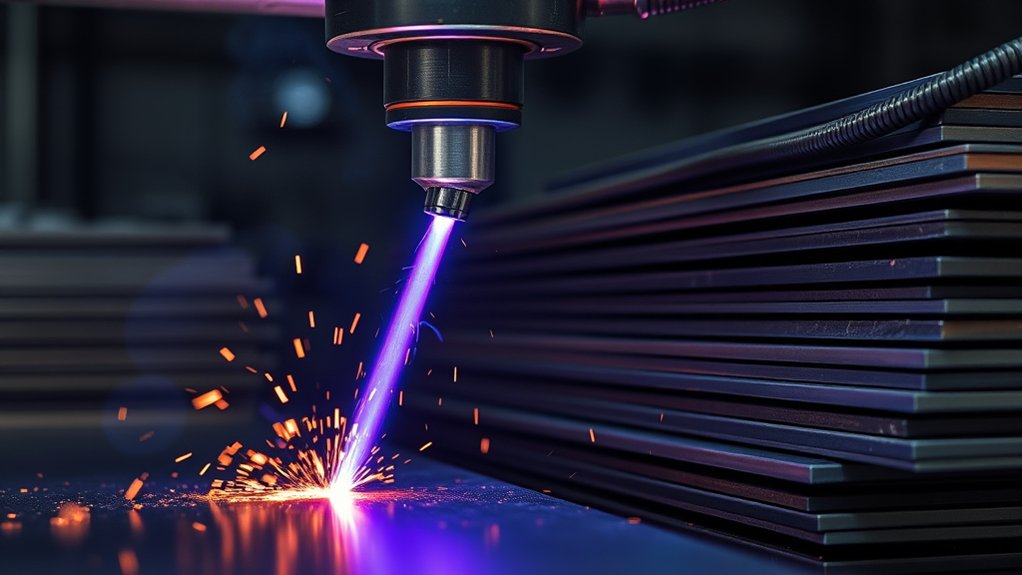
A plasma cutter sends an electric arc through a fast-moving gas. The arc adds enough energy to ionize part of the gas, creating an electrically conductive plasma jet. That jet melts the workpiece while the gas stream blows molten metal out of the kerf.
Amperage, gas composition, gas flow, torch height, travel speed, consumable condition, and material thickness all affect the result. A setting that works well on thin stainless steel may perform poorly on thick aluminum, even when the same nitrogen supply is used.
On many manual air-plasma cutters, one gas supply forms the plasma and cools the torch. Advanced mechanized systems may independently control a primary plasma gas and a separate shield or secondary gas. The shield surrounds the plasma jet, protects the consumables, and can change edge color, dross, and surface finish.
Gas choice affects the cut, but the manufacturer’s cut chart—not a universal pressure or thickness rule—defines the correct process.
Keep the torch square to the work, use the specified cut height, and maintain a steady speed. Incorrect torch height or speed often causes more bevel and dross than the choice between air and nitrogen.
Common Gases Used in Plasma Cutting
Common plasma gases include compressed air, nitrogen, oxygen, F5, and argon-hydrogen. Water, air, nitrogen, and carbon dioxide may also be used as shield media on systems designed for them.
The correct choice is not based on the metal alone. It also depends on whether the machine is a basic air-plasma cutter or a dual-gas or multi-gas mechanized system.
Primary Plasma Gas Options
| Gas | Typical Use | Main Trade-Off |
|---|---|---|
| Clean, dry air | General manual cutting of mild steel, stainless steel, and aluminum | Lowest supply cost, but it can leave more oxidation or discoloration on stainless and aluminum |
| Nitrogen | Approved stainless and aluminum processes where a less-oxidized cut face is valuable | Higher gas cost; speed and dross are process-dependent |
| Oxygen | High-quality mechanized mild-steel cutting | Not normally recommended as the plasma gas for stainless steel or aluminum |
| F5 | Certain stainless-steel processes; normally 95% nitrogen and 5% hydrogen | Requires an approved system and may cut more slowly than other options |
| H-35 | Thick stainless steel and aluminum on compatible high-amperage systems | Expensive and hydrogen-containing; requires a purpose-built gas console and procedure |
Hypertherm’s gas-selection guide identifies air as the most economical general-purpose option, nitrogen as a strong choice for many stainless and aluminum processes, oxygen as the preferred plasma gas for high-quality mild-steel cutting, and H-35 as an option for thick nonferrous and stainless plate.
Material-Specific Gas Choices
The following table gives a practical starting point. It does not replace the cut chart for your machine.
| Material and System | Practical Starting Point |
|---|---|
| Mild steel with a manual air-plasma cutter | Use clean, dry air and the specified air consumables |
| Mild steel with a compatible mechanized multi-gas system | Oxygen plasma with an approved shield gas commonly provides the best speed and cut quality |
| Stainless steel with a manual air-plasma cutter | Air is economical; nitrogen may improve edge appearance if the system approves it, although dross can increase on some machines |
| Thin stainless with a compatible multi-gas system | Nitrogen plasma with nitrogen or water shield may be specified |
| Middle-range or thick stainless | The cut chart may call for F5, H2Mix, H-35, nitrogen, or a water-injection process rather than nitrogen alone |
| Aluminum with a manual air-plasma cutter | Use clean, dry air unless the manual lists an approved nitrogen process |
| Thin or middle-range aluminum with a multi-gas system | Nitrogen with air, carbon dioxide, nitrogen, or water shield may be used according to the cut chart |
| Thick aluminum on a compatible high-amperage system | H-35 with an approved shield process may provide more cutting power than nitrogen alone |
Note: Thickness breakpoints are not universal. For example, Hypertherm’s stainless-steel guidance changes its recommended process across thin, middle-range, and thick material. Another manufacturer or torch may use different breakpoints.
Cost and Performance Tradeoffs
Nitrogen usually costs more than compressed air because it requires cylinder rental or ownership, gas refills, delivery, a suitable regulator, or an on-site generator. The extra cost may be worthwhile when a cleaner stainless or aluminum edge reduces grinding, pickling, sanding, or rejected parts.
Compressed air remains economical because most shops already have a compressor. However, the air must meet the machine’s pressure, flow, cleanliness, and dryness requirements. Moisture, oil, and dirt can reduce cut quality and shorten consumable life.
Do not compare gas price alone. Compare the total cost of producing an acceptable part:
- Gas consumed per part
- Cutting and piercing time
- Electrode, nozzle, and shield-cap wear
- Grinding, sanding, or edge-cleaning labor
- Rejected or recut parts
- Machine downtime and cylinder changes
When to Choose Nitrogen
Consider nitrogen when all of the following are true:
- Your machine manual lists an approved nitrogen process.
- You are cutting stainless steel, aluminum, or another material covered by that process.
- Reduced oxidation or a cleaner-looking edge matters more than the lowest gas cost.
- You have the correct regulator, fittings, hoses, consumables, shield gas, and cut chart.
- Your work area has enough ventilation to control fumes and prevent oxygen displacement.
Nitrogen is less attractive when you are making ordinary mild-steel cuts, using an air-only machine, working far from a cylinder supplier, or producing parts that will be ground or cleaned regardless of the gas used.
Best Materials and Thicknesses
Nitrogen is commonly useful on thin to middle-range stainless steel and aluminum, but there is no reliable universal maximum thickness. A small manual plasma cutter and a high-amperage mechanized system have very different capabilities.
On some advanced systems, nitrogen alone is mainly a thin-material process. F5, H2Mix, H-35, or water injection may provide better results as stainless or aluminum becomes thicker. The machine’s recommended cut capacity is also different from its maximum severance capacity. A cutter may be able to separate a thick plate while producing an edge that is too rough for normal production.
Pro Tip: Make three test cuts before changing an established process. Mark each coupon with the gas, amperage, cut height, and speed. Compare dross, bevel, edge color, roughness, and cleanup time rather than judging the top surface alone.
Cost and Cut Quality
Nitrogen may justify its higher cost when the cut face will remain visible, when post-cut cleaning is expensive, or when oxidation can interfere with a later finishing process. Its value is smaller when the edge will be machined, heavily ground, or hidden.
Do not assume that nitrogen will always reduce dross. On some manual stainless processes, it can produce a cleaner-colored edge but more bottom dross than clean, dry air. Travel speed, height control, consumable condition, and shield-gas choice can be more important than the primary gas.
Consumable life can be excellent on a properly tuned nitrogen process. Manufacturer literature for some industrial systems reports more than 1,000 starts, but that figure is not a guarantee for every cutter. Track actual starts per set in your own shop.
Nitrogen vs. Compressed Air
Compressed air is the standard gas for most portable and manual plasma cutters. It is easy to supply and cuts any electrically conductive metal within the machine’s capacity. Nitrogen is a specialized alternative for approved processes where edge appearance on stainless or aluminum is important.
| Factor | Nitrogen | Compressed Air |
|---|---|---|
| Compatibility | Only where listed by the manufacturer | Standard on most manual air-plasma machines |
| Stainless and aluminum edge | Often less oxidized and cleaner-looking | Good general cut, but more discoloration or oxide may remain |
| Cut speed | Depends on the approved process and shield gas | Often the fastest and simplest approved process on a manual air machine |
| Supply cost | Cylinder, bulk supply, or generator cost | Usually lower if suitable shop air already exists |
| Supply quality | Must meet the required purity, pressure, and flow | Must be clean, dry, oil-free, and able to maintain flowing pressure |
| Main safety concern | Oxygen displacement and compressed-gas handling | Stored pressure, noise, contaminants, and normal plasma-cutting hazards |
ESAB’s manual plasma-cutting guidance describes clean, dry compressed air as the standard choice for most manual applications. It identifies nitrogen as an option when reduced oxidation and cut-face appearance on stainless or aluminum are more important.
Nitrogen vs. Oxygen for Different Metals
Oxygen and nitrogen serve different purposes in plasma cutting.
For mild steel: Oxygen plasma is widely used on compatible mechanized systems because oxygen reacts with the carbon steel and helps produce a fast cut with low dross. Portable air-plasma cutters normally use compressed air instead because they are not equipped with a separate oxygen process.
For stainless steel and aluminum: Oxygen plasma is generally not the preferred choice because it can create a heavily oxidized cut face. Approved nitrogen, F5, H2Mix, H-35, air, or water-based processes may produce a more useful finish, depending on the machine and thickness.
Nitrogen does not automatically provide the fastest possible cut. Its main practical advantage is its non-oxidizing character compared with air or oxygen. Use the speed listed in the cut chart and adjust only after checking torch height, gas flow, and consumables.
Argon-Hydrogen and Other Gas Mixes
H-35 contains approximately 65% argon and 35% hydrogen. It creates a high-energy plasma jet and is commonly used for thick stainless steel and aluminum on compatible industrial systems.
H-35 is not a drop-in gas for a basic air-plasma cutter. The torch, gas console, hoses, valves, ventilation, consumables, and operating procedure must be approved for a hydrogen-containing mixture.
Warning: Never create H-35 by connecting separate argon and hydrogen cylinders to an improvised mixer. Use only a listed premixed supply or an OEM-approved gas-mixing system. Never cut aluminum underwater with H-35 or another hydrogen-containing plasma mixture unless the system manufacturer provides a specific approved process.
H-35 Mix Benefits
On a system designed for it, H-35 can provide:
- More cutting energy for thick stainless steel and aluminum
- A straight kerf and smooth cut face
- Better thick-plate capability than nitrogen alone
- Stable performance at the high current levels listed in the cut chart
Bottom-edge dross can still occur, and H-35 is usually more expensive than air or nitrogen. Its value is greatest when thick-plate capability and surface finish justify the additional equipment and gas cost.
Shield Gas Options
The plasma gas creates the cutting jet. The shield gas or shield fluid surrounds that jet and affects cooling, edge finish, cut angle, and consumable protection.
Depending on the system, nitrogen plasma may be paired with air, carbon dioxide, nitrogen, or water. H-35 is commonly paired with nitrogen shield gas. These combinations are not interchangeable. Each requires the specified swirl ring, nozzle, shield, flow, pressure, and torch height.
A water shield is also different from a water table. A supported water-shield process meters water through the torch or shield assembly. A water table is the cutting-table system below the plate. One does not automatically require the other.
Thick-Plate Performance
Thick plate requires more arc energy and a system with enough amperage, duty cycle, gas capacity, and pierce capability. H-35 may be selected for thick stainless and aluminum, while modern systems may offer proprietary hydrogen, nitrogen, argon, or water-injection processes.
Do not use a thickness figure from another machine. Check:
- Recommended production-cut capacity
- Maximum pierce capacity
- Maximum edge-start or severance capacity
- Required gas and shield combination
- Required inlet pressure and flow
- Pierce height, delay, cut height, and speed
A rough severance cut at the machine’s maximum limit is not the same as a production-quality cut.
Equipment Setup for Nitrogen Plasma
Set up nitrogen only after confirming that the manufacturer lists a nitrogen process for the exact power supply and torch.
- Read the nitrogen cut chart. Confirm the material, thickness, amperage, consumables, plasma gas, shield gas, pressure, flow, cut height, and speed.
- Identify the required supply. Determine whether the machine accepts a cylinder, manifold, bulk supply, or nitrogen generator.
- Use compatible hardware. Install a regulator, hose, fittings, valves, and flashback or safety devices specified for the gas system. Do not force or adapt mismatched cylinder connections.
- Secure the cylinder. Keep a compressed-gas cylinder upright and restrained. Protect the valve from impact and replace its protective cap during transport when the cylinder design uses one.
- Inspect before pressurizing. Check the regulator, hose, seals, torch, and fittings for damage, contamination, or loose connections.
- Open and adjust as directed. Set the inlet and flowing pressure to the exact OEM value. Do not use a generic 100 psi setting.
- Perform an approved leak test. Use a compatible commercial leak-detection solution. Never use a flame.
- Run the purge or gas-test cycle. Confirm that pressure and flow remain stable while gas is moving, not merely while the system is idle.
- Make a test cut. Use scrap of the same alloy and thickness. Inspect the edge before starting production.
Note: A bottled-nitrogen system does not need compressor CFM to push gas from the cylinder. A nitrogen generator does require a suitable compressed-air supply, and the generator must maintain the required nitrogen purity and flow at the same time.
Products Worth Considering
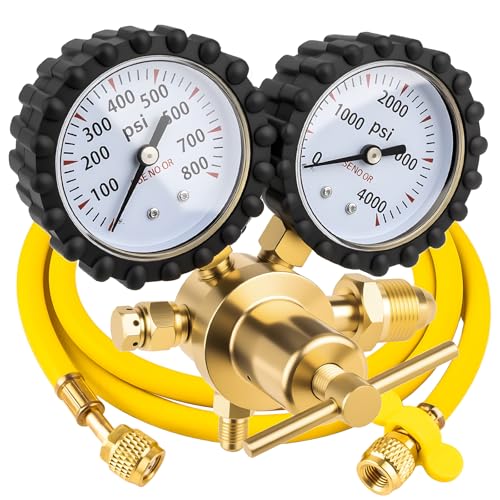
HVAC Essential: Siasky Nitrogen Regulator is a must-have for HVAC professionals, ensuring accurate pressure testing and leak detection in AC systems

CGA580 Inlet Connection, 1/4" SAE Male Flare Outlet Connection and Easy to Read 2 Inch Gauges with Protective Rubber Gauge Boots

Hybrid design-Regulator and Flowmeter
Nitrogen Purity and Supply Considerations
Use the nitrogen purity grade specified in the manual for your machine. There is no single minimum that applies to every plasma cutter. Some industrial systems require high-purity nitrogen, while another approved process may have a different gas-quality requirement.
Contamination can change arc behavior and shorten consumable life. Keep moisture, oil, dirt, and incompatible thread sealants out of the gas path.
The main supply options are:
- High-pressure cylinder: Simple for occasional or moderate use, but production can stop when the cylinder empties.
- Manifolded cylinders or bulk supply: Better for sustained high flow, but installation and storage require professional planning.
- Nitrogen generator: Produces nitrogen from compressed air. It must meet both the required purity and the required flow during peak demand.
Check dynamic pressure while gas is flowing. A regulator can show an acceptable static reading and still fall below the required pressure during a cut because of an undersized regulator, restrictive hose, nearly empty cylinder, frozen regulator, clogged filter, or inadequate generator capacity.
Products Worth Considering

Nitrogen CGA-580 tool-less connection

Parameters: Preset purge 23-35 cfh, braze 3-6 cfh, pressure test 650 psi settings

50 PSI Inlet Pressure: Designed to function optimally with a 50 PSI inlet pressure, while accommodating a maximum inlet pressure of 200 PSI, ensuring effective purging and brazing operations
Cut Quality, Speed, and Consumable Life
On a compatible process, nitrogen can reduce oxidation and produce a smoother-looking cut face on stainless steel and aluminum. Actual edge quality still depends on cut height, speed, current, gas flow, consumables, alloy, and table motion.
Use the following symptoms to troubleshoot the process:
| Symptom | Likely Causes | What to Check |
|---|---|---|
| Heavy bottom dross | Travel speed too slow, incorrect gas process, low torch, worn nozzle, or low flowing pressure | Return to the cut-chart speed and height; inspect consumables and verify dynamic pressure |
| Incomplete cut or top dross | Speed too high, amperage too low, excessive height, or inadequate flow | Confirm thickness, amperage, speed, work connection, and gas delivery |
| Excessive bevel | Torch not square, incorrect height, worn orifice, wrong cutting direction, or speed outside the process window | Square the torch, check height control, and replace damaged consumables |
| Rough or dark edge | Wrong gas combination, contaminated supply, worn consumables, or unsuitable alloy setting | Verify gas purity, cut chart, consumable part numbers, and alloy |
| Unstable arc or gas fault | Restricted hose, undersized regulator, leak, low cylinder pressure, or insufficient generator output | Run the system gas test and measure pressure while gas is flowing |
| Short consumable life | Wrong consumables, low pierce height, contaminated gas, incorrect pressure, excessive starts, or improper shutdown | Check part numbers, pierce procedure, gas quality, cooling, and start-stop technique |
Track starts per consumable set rather than relying on a published maximum. Record the reason for every change. A sudden decline often points to contaminated gas, a damaged torch, incorrect pierce height, or unstable pressure.
Safety Tips for Aluminum and Water Tables
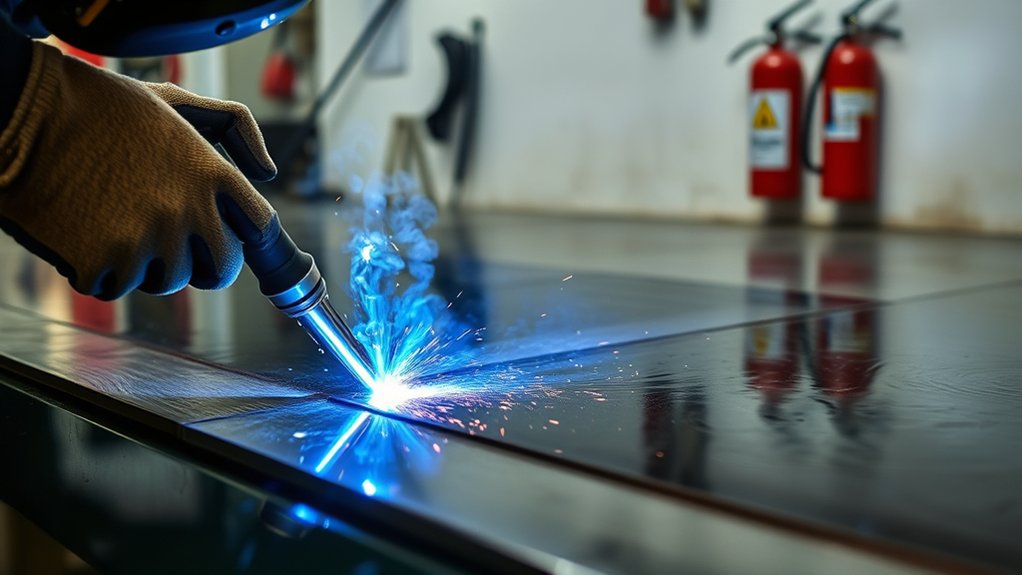
Plasma cutting combines high voltage, ultraviolet radiation, molten metal, compressed gas, noise, and hazardous fumes. Wear the eye, face, hand, hearing, foot, and body protection required by the machine manual and workplace assessment. Remove nearby combustibles and provide effective local exhaust or mechanical ventilation.
OSHA’s welding and cutting requirements address fire prevention, ventilation, confined-space work, and hazardous fumes. Stainless-steel cutting needs particular attention because fumes may contain chromium compounds.
Warning: Nitrogen is colorless and odorless. A leak can lower the oxygen level without giving a sensory warning. OSHA identifies nitrogen as a simple asphyxiant where it can displace enough air to create an atmosphere below 19.5% oxygen. Do not use cylinders in an unventilated pit, tank, enclosure, or confined space without a formal atmospheric-control program.
Aluminum creates a separate hazard when it is cut over or under water. Fine aluminum and aluminum-oxide particles can react in the table and release hydrogen. If hydrogen collects in a pocket, chamber, void, or beneath a large plate, an arc or spark can ignite it.
- Confirm that the table manufacturer permits aluminum cutting and provides an engineered hydrogen-control method.
- Complete a risk assessment before changing alloys, water level, table configuration, ventilation, or operating method.
- Keep manufacturer-approved aeration or ventilation equipment operating whenever required.
- Remove accumulated aluminum sludge and clean inaccessible chambers at the specified interval.
- Do not rely on visible bubbles as proof that all hydrogen is escaping.
- Do not use a torch pass, open flame, or spark to “burp” or test the table.
- Do not cut aluminum underwater with H-35 or another hydrogen-containing plasma process unless the manufacturer supplies a specific approved procedure.
- Never cut aluminum-lithium alloys in the presence of water.
Hypertherm’s aluminum water-table guidance says users must prevent hydrogen accumulation, consult the table manufacturer, and ensure the table and extraction system were designed for aluminum cutting.
Cost and Productivity Considerations
The least expensive gas does not always produce the least expensive part. Nitrogen may cost more at the regulator but save time if it reduces edge cleaning on stainless or aluminum. Air may remain the better value when the cut is acceptable as-is or when every edge will be ground later.
Calculate cost per accepted part with this basic method:
Gas cost + consumable cost + cutting labor + cleanup labor + machine time + rejected-part cost = total cost per accepted part
Run several parts with each approved process and record:
- Total cut and pierce time
- Gas consumption or cylinder pressure change
- Dross-removal and edge-cleaning time
- Consumable starts and operating minutes
- Bevel, roughness, edge color, and dimensional results
- Rejected or recut parts
Do not assume a fixed productivity improvement such as 10% or 20%. A shop cutting thin decorative stainless may save substantial cleanup time, while a shop cutting mild-steel brackets may gain nothing from nitrogen.
Frequently Asked Questions
Do plasma cutters use nitrogen?
Some do. Nitrogen is an approved plasma or shield gas on many industrial systems and certain manual systems. Check the manual for your exact power supply and torch. Do not assume that an air inlet automatically makes the machine compatible with bottled nitrogen.
What kind of gas do plasma cutters use?
Common plasma gases include compressed air, oxygen, nitrogen, F5, and H-35. Advanced systems may also use proprietary mixtures. Shield gases or fluids can include air, nitrogen, carbon dioxide, or water. The approved combination depends on the metal, thickness, torch, and consumables.
Why use nitrogen instead of compressed air?
Nitrogen can reduce oxidation and improve cut-face appearance on stainless steel and aluminum. It may also provide long consumable life on a properly designed process. The disadvantages are higher supply cost, cylinder handling, oxygen-displacement risk, and the possibility of more dross on some machines.
Can you plasma cut without gas?
No. A plasma cutter needs a gas or approved process fluid to form and constrict the plasma jet, remove molten metal, and cool or shield torch components. Even an “air plasma” machine uses compressed air as its process gas.
Can I connect a nitrogen bottle to an air-plasma cutter?
Only when the manufacturer lists nitrogen as an approved gas for that machine and torch. You must also use the specified regulator, pressure, flow, consumables, and procedure. A matching thread or hose size does not prove compatibility.
Is nitrogen always better for stainless steel?
No. Nitrogen can produce a less-oxidized edge, especially on thin stainless, but air may be faster and cheaper on a manual cutter. Middle-range or thick stainless may cut better with F5, H2Mix, H-35, water injection, or another process listed by the system manufacturer.
Conclusion
You can run a plasma cutter on nitrogen when the manufacturer has designed and documented the system for it. Nitrogen is most useful when reduced oxidation and a cleaner-looking stainless or aluminum edge justify the added gas cost.
Do not treat nitrogen as a universal upgrade. Clean, dry air is still the best all-purpose option for most manual plasma cutters. Oxygen is commonly preferred for mechanized mild-steel cutting, while F5, H2Mix, H-35, or water-based processes may be better for particular stainless and aluminum thicknesses.
Start with the exact OEM cut chart, use approved gas hardware and consumables, verify flowing pressure, make a test cut, and measure total cost per accepted part. Provide effective fume extraction, protect against nitrogen leaks, and never cut aluminum over water unless the table has a manufacturer-approved method for preventing hydrogen accumulation.
Sources
- Hypertherm: Gas Selection Guide for Plasma Cutting — gas combinations for mild steel, stainless steel, and aluminum
- Hypertherm: Plasma Cutting Stainless Steel — thickness- and system-specific stainless gas guidance
- Hypertherm: Cutting Aluminum on a Water Table — hydrogen accumulation and aluminum-lithium safety guidance
- ESAB: Complete Guide to Plasma Cutting — manual plasma gases, air quality, and nitrogen trade-offs
- OSHA 29 CFR 1910.252 — welding and cutting fire, ventilation, fume, and confined-space requirements
- OSHA: Inert Gases and Oxygen-Deficient Atmospheres — nitrogen’s simple-asphyxiant and oxygen-displacement hazard