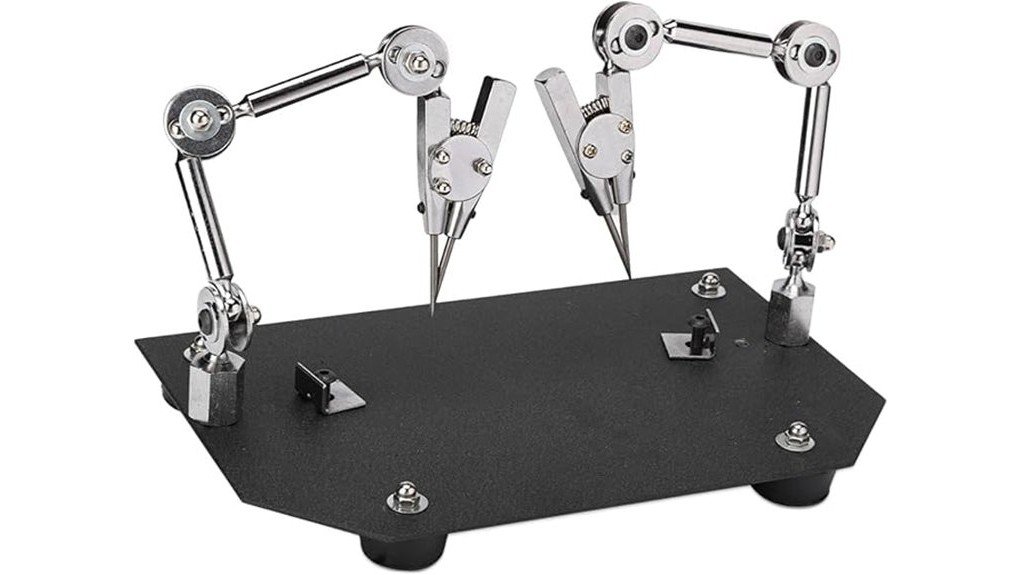
The Rosvola set sold as “welding table clamps” is really a third hand tool: a steel plate base with rubber feet and adjustable steel clips that hold small parts while you solder, tack or assemble. It is a sensible pick for jewelry, electronics and light craft work that needs both hands free, and the wrong tool for holding heavy plate or fixture parts for arc welding. Treat the “welding” name on the listing as a category label, not a guarantee.
Rosvola Third Hand Clamps at a Glance
| Item | Per the listing |
|---|---|
| Type | Third hand / helping-hands holder |
| Base | Steel plate with rubber feet |
| Holders | Adjustable steel clips (angle adjustable) |
| Size | About 10.71 x 6.69 x 3.23 in |
| Weight | About 3.1 lb |
| Suggested uses | Soldering, jewelry work, small maintenance and assembly |
Check Current Price on Amazon →
What It Is and Who It Suits
A third hand tool does what its name suggests: it holds the work for you. You position the clips around the part, tighten the joints and leave both hands free for a soldering iron, solder wire and tweezers.
This model uses a metal base for weight, rubber feet to stop sliding, and clips that angle in several directions. That makes it more stable than a light plastic helping-hands stand, and it is suited to bench-top soldering of wires, small brackets and craft projects.
It suits hobbyists, electronics repairers, jewelers and anyone who solders small pieces. It does not replace welding table clamps, magnets or C-clamps for steel fabrication. For that work, see the clamp reviews linked below.
How to Check It Fits Your Work
- Match the part size. Check clip opening and reach against the biggest part you plan to hold.
- Consider weight. A 3.1 lb base resists tipping, but heavier parts can still tip the arm. Hold balanced parts near the clip.
- Look at the clip tips. Metal tips can scratch soft metals and finished jewelry. Add heat-resistant pads if needed.
- Think about heat. Clips conduct heat. Hold parts away from the hottest zone, and avoid touching clips right after soldering.
- Check the work surface. Rubber feet can soften with heat, so use a mat that tolerates soldering temperatures.
Pros and Limitations
Pros
- Frees both hands for soldering and detail work
- Weighted steel base with rubber feet is more stable than light stands
- Adjustable clips let you set angles for awkward parts
- Compact enough to leave on a bench
Limitations
- Not a structural clamp for welding fixtures
- Clips and joints may loosen with heavier parts
- Bare metal clips conduct heat and can mark finishes
- Specs and capacity come from the seller, so check the images
How to Use a Third Hand Tool Safely
- Set the base on a heat-resistant, flat bench or soldering mat.
- Tighten the joints before you apply heat so parts do not shift.
- Use a fume extractor or good ventilation. Solder flux fumes irritate the lungs.
- Wear safety glasses; hot solder can spit.
- Do not hold parts with clips that carry current from a spot welder or battery unless the tool is rated for it.
- Let hot parts cool before you release them.
Alternatives and Related Guides
- For general soldering gear, see the soldering iron kit review.
- Protect your bench with a soldering mat.
- For feeding wire while you work, check the solder wire holder stand.
- For steel fabrication, read the heavy-duty C clamps review or the V-type magnetic welding clamps review.
Frequently Asked Questions
Are these welding table clamps or a third hand tool?
Despite the listing name, the description points to a third hand (helping hands) tool: a weighted steel base with adjustable clips for holding small parts. It is not a heavy table clamp for welding fixtures. Use real table clamps for structural fixturing.
What can a third hand tool hold?
Small parts such as wires, jewelry, circuit boards and small brackets while you solder or glue them. The listing says the clips handle larger items than typical helping hands, but check the clip opening and your part weight before relying on it.
Can I use it for arc welding?
It is better for soldering and light assembly. Arc welding creates heat, spatter and strong magnetic or electrical effects that can mar clips and rubber feet, so use dedicated welding clamps or magnets for arc welding.
How do I stop the base from moving while I solder?
Place it on a flat, clean, heat-resistant surface and keep tools and cables from tugging the clips. The rubber feet help grip, but a soldering mat under the base protects your bench from hot solder and flux.
Final Thoughts
This is a stable helping-hands tool for soldering and small assembly, not a clamp for arc welding fixtures. If your work is small and needs steady hands-free holding, it is worth a look.
View Current Listing on Amazon →
See Latest Price and Details →