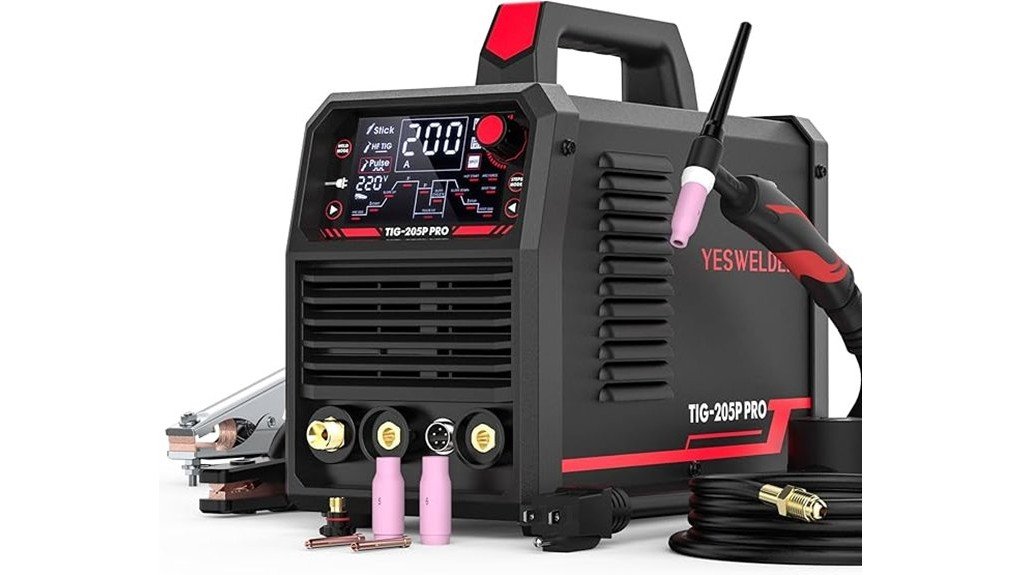
Choosing a compact TIG welder gets harder when similar model names hide a major difference: some machines can weld aluminum, while others cannot. The YESWELDER TIG-205P is a dual-voltage DC TIG, pulsed TIG, and Stick welder built mainly for carbon steel and stainless steel. It gives you useful heat and arc controls in a portable package, but its DC-only TIG output rules out aluminum TIG work. This review explains the verified specifications, setup needs, practical strengths, and limits so you can decide whether it fits your projects.
Quick Verdict
Editorial Rating: 8.2/10, recommended with caveats
Best For: DIY fabricators, garage users, and small-shop welders working with mild steel or stainless steel
Bottom Line: The TIG-205P combines HF-start DC TIG, adjustable pulse TIG, Stick welding, and 110V/220V input in a machine that weighs about 10 pounds. Its biggest tradeoff is simple and important: it does not provide AC TIG output, so it is not the right machine for aluminum.
At a Glance
- Processes: Stick/MMA, DC TIG, and pulsed DC TIG.
- Power: Auto-sensing 110V/220V input, with higher output available on 220V.
- Best materials: Carbon steel and stainless steel.
- Main controls: HF start, 2T/4T, spot timing, pulse settings, gas timing, slope settings, hot start, arc force, and anti-stick.
- Major limitation: No AC TIG mode and no aluminum TIG capability.
- Pedal note: A 5-pin foot pedal is supported, but you should verify whether your selected bundle includes one.
Key Specifications
| Specification | Detail |
|---|---|
| Brand | YESWELDER |
| Amazon model name | TIG-205P, ASIN B0BVYHBQZ6 |
| Current manufacturer naming | TIG-205P-PRO on the current YESWELDER product page |
| Product type | Portable inverter TIG and Stick welder |
| Welding processes | Stick/MMA, DC TIG, and pulsed DC TIG |
| Input power | 110V/220V, single phase, 60Hz |
| DC TIG output range | 10 to 160A on 110V; 10 to 200A on 220V |
| Stick output range | 10 to 140A on 110V; 10 to 160A on 220V |
| Compatible metals | Carbon steel and stainless steel |
| Aluminum TIG support | No, this is a DC-only TIG machine |
| Arc start | High-frequency non-touch TIG start |
| Trigger modes | 2T, 4T, and TIG spot timing |
| Remote current control | Compatible with a 5-pin foot pedal or supported remote-control torch |
| Machine dimensions | 12.60 × 5.51 × 11.42 inches on the current retail manufacturer page |
| Machine weight | About 10.1 to 10.7 pounds, depending on the current source |
| Included equipment | WP-17 TIG torch, electrode holder, earth clamp, argon hose, and basic TIG torch consumables; verify the live bundle before ordering |
| Best use | Garage fabrication, repair work, practice, and light shop projects involving steel or stainless steel |
What Is the YESWELDER TIG-205P?
The YESWELDER TIG-205P is a compact inverter machine that combines three processes: Stick/MMA, conventional DC TIG, and pulsed DC TIG. The Amazon listing uses the TIG-205P name, while the current YESWELDER product page calls the updated line TIG-205P-PRO. The core specifications align closely, but you should still compare the live product photos, model label, and selected bundle before checkout.
Its main selling point is control. In TIG mode, you can adjust peak current, base current, pulse frequency, pulse width, pre-flow, post-flow, start current, finish current, and slope timing. Stick mode adds hot start, arc force, and anti-stick adjustments. That control gives you more room to tune the arc than a basic entry-level Stick or lift-TIG machine.
Who Should Buy It?
Best For
- DIY welders who mainly work with mild steel or stainless steel.
- Garage and small-shop users who want TIG precision plus Stick versatility.
- Learners who want HF start, digital controls, and adjustable pulse settings.
Skip If
- You need AC TIG for aluminum.
- You expect a foot pedal to be included without checking the selected bundle.
- You need an industrial production machine for continuous high-output work.
Before You Buy: Do not confuse the TIG-205P with YESWELDER’s TIG-200P AC/DC model or another aluminum-capable variant. The TIG-205P uses DC TIG output and cannot TIG weld aluminum. Also check whether your selected offer is the welder-only package or a bundle with a foot pedal or other accessories.
Feature-by-Feature Review
DC TIG, Pulse TIG, and Stick in One Machine
The three-process layout suits a mixed garage workload. DC TIG gives you clean, controlled welds on steel and stainless steel. Pulsed TIG cycles between peak and base current to manage heat input, while Stick mode handles repair work where TIG preparation or shielding gas would be less convenient.
This is still not a universal multi-process machine. It does not include MIG welding, plasma cutting, or AC TIG. Buyers who need those functions should compare a different product class rather than expecting add-on accessories to provide them.
Pulse Controls for Heat Management
The pulse menu lets you adjust peak current, base current, pulse frequency, and pulse width. Those settings can help you limit average heat input on thin sheet, small tubing, and stainless parts that are more likely to warp or discolor. Pulse does not replace correct joint preparation, travel speed, filler selection, or practice, but it gives you another way to control the puddle.
HF Start, 2T/4T, and Spot Timing
High-frequency start initiates the TIG arc without touching the tungsten to the workpiece. This helps reduce accidental tungsten contamination and makes repeated starts easier. The 2T mode suits short welds, while 4T can reduce trigger fatigue on longer passes. Spot timing is useful when you want repeatable short tacks or temporary positioning.
Dual-Voltage Input
The machine accepts 110V and 220V input. On 110V, TIG output is listed up to 160A and Stick output up to 140A. On 220V, TIG output rises to 200A and Stick output to 160A. The 110V option improves portability, but the 220V connection is the better choice when you need the machine’s full rated output range.
Large LED Display and Memory
The front panel displays current and process settings more clearly than a machine that relies on small analog scales. The current Amazon listing also describes an automatic memory function that restores saved settings after power-off. This can save setup time when you return to a familiar material and joint, but you should still verify every setting before striking an arc.
Foot Pedal and Remote-Control Options
A 5-pin interface supports a compatible foot pedal for arc on/off control and amperage adjustment. That matters when you want to reduce current near the end of a weld or react to changing heat buildup. The pedal is not guaranteed in every offer. YESWELDER currently shows separate welder-only and pedal-bundle options, so read the package description before buying.
Portability and Included Accessories
At roughly 10 pounds and about 12.6 inches long, the power source is easy to move between a garage bench, service area, or job setup. The current manufacturer package lists a 13-foot WP-17 TIG torch, 10-foot electrode holder, 10-foot earth clamp, argon hose, and basic torch consumables. You still need an appropriate shielding-gas cylinder, regulator or flowmeter, tungsten, filler rod, PPE, and a suitable electrical circuit before TIG welding.
Setup Tips Before First Use
- Confirm the model and bundle. Check the machine label, included leads, torch, adapter, and pedal contents against the live listing.
- Read the operator’s manual. Follow the stated input-circuit, grounding, duty-cycle, gas, polarity, and maintenance requirements.
- Use the correct power source. A properly installed 220V circuit is needed for the full TIG and Stick output range. Do not improvise wiring or use an underrated extension cord.
- Prepare clean metal. Remove paint, oil, rust, plating, and contamination using a method appropriate for the material.
- Match consumables to the job. Select the correct tungsten type and diameter, filler rod, cup, collet, and gas flow for your material and amperage.
- Start with conservative settings. Practice on scrap of the same alloy and thickness before welding the final part.
- Inspect the leads and clamp. Look for loose connections, damaged insulation, cracked torch parts, or poor clamp contact before operation.
Pro Tip: Save one baseline setup for each material and thickness you use often, then change only one pulse or slope setting at a time. This makes it easier to see which adjustment improved the weld and avoids getting lost in the machine’s many controls.
Compatibility and Safety
This welder produces electric shock, arc-radiation, fire, gas-cylinder, hot-metal, and fume hazards. Use a properly rated welding helmet, flame-resistant clothing, dry welding gloves, hearing protection when needed, and suitable ventilation. Keep combustibles away from the work area, secure the shielding-gas cylinder upright, and never weld a container or coated material unless it has been correctly identified and prepared.
Stainless steel and coated metals can create hazardous fumes. Follow the operator’s manual and applicable workplace rules. OSHA’s welding, cutting, and brazing safety guidance explains common fume, UV, fire, and PPE hazards. Electrical installation or circuit changes should be handled by a qualified person.
How It Performs in Real Use
Thin Steel and Stainless Projects
The adjustable pulse controls are the main advantage on thin sheet, tubing, brackets, and stainless parts. You can lower average heat input while keeping enough peak current to maintain the puddle. Results still depend on fit-up, cleanliness, torch angle, travel speed, and operator skill.
Garage Fabrication and Repair
For frames, tabs, mild-steel repairs, exhaust-related stainless work, and small fabricated parts, the combination of DC TIG and Stick covers many common garage tasks. The compact case also takes up less bench space than a large transformer machine.
Outdoor or Less-Prepared Repairs
Stick mode is the practical backup when wind makes shielding gas difficult or the workpiece is not ideal for TIG. Hot start, arc force, and anti-stick controls can help with arc initiation and electrode behavior. You still need to select an electrode and amperage range suited to the metal and available input power.
Learning TIG Technique
HF start, a visible display, 2T/4T modes, and optional pedal control give a beginner useful tools for learning. The large number of settings can also slow you down at first. Begin with a basic DC TIG setup, then add pulse, slope, and remote-current adjustments after you can maintain a stable arc and consistent travel.
What Buyers Are Saying
Visible customer feedback commonly focuses on these points:
- Positive: Buyers often mention the compact size, feature set, and value for garage or hobby work.
- Positive: Pulse adjustment and HF start are frequently viewed as useful upgrades over simpler entry-level machines.
- Watch-out: Foot-pedal expectations can cause confusion because package contents vary by offer or bundle.
- Watch-out: Some comments mention clamp, cable, or quality-control concerns, so inspect the unit and accessories before serious use.
Pros and Cons
Pros
- Combines Stick, DC TIG, and pulsed DC TIG in one compact power source.
- Runs on 110V or 220V, with up to 200A TIG output on 220V.
- HF start reduces the need to touch the tungsten to the workpiece.
- Adjustable pulse, gas timing, slope, 2T/4T, and spot controls provide useful tuning range.
- Supports a 5-pin foot pedal or compatible remote-control torch.
Cons
- No AC TIG mode, so it cannot TIG weld aluminum.
- A foot pedal may require a separate purchase or a different bundle.
- The many controls create a steeper setup process than a basic Stick or lift-TIG welder.
Is It Worth the Price?
The TIG-205P sits in the value-focused part of the TIG market. It is worth considering when you want real HF-start DC TIG, adjustable pulse controls, and Stick capability without moving to a larger AC/DC machine. Buyers who work mainly with steel and stainless steel can use more of its feature set than buyers who only need occasional basic repairs.
Its value falls quickly when aluminum is part of your plan. You would need a different AC/DC TIG machine rather than an accessory or software setting. You should also budget for the complete setup, which may include a gas cylinder, regulator or flowmeter, tungsten, filler, PPE, and a compatible foot pedal.
How It Compares to Alternatives
The YESWELDER TIG-200P AC/DC is the closer brand alternative when aluminum TIG capability matters. A Weldpro 200A-class AC/DC TIG machine is also worth comparing if you want AC balance and aluminum-focused controls, though those machines usually cost more and may be larger.
The ARCCAPTAIN TIG200P is a more direct comparison for buyers who want a compact DC TIG, pulsed TIG, and Stick machine. The TIG-205P makes the most sense when you value its verified dual-voltage ranges, detailed front-panel controls, and current YESWELDER accessory ecosystem.
Frequently Asked Questions
Can the YESWELDER TIG-205P weld aluminum?
No. The TIG-205P is a DC TIG machine and YESWELDER states that it is not suitable for aluminum TIG welding. Choose an AC/DC TIG welder when aluminum is a required material.
Is TIG-205P the same as TIG-205P-PRO?
Amazon currently identifies ASIN B0BVYHBQZ6 as TIG-205P, while the current YESWELDER retail page uses TIG-205P-PRO. The listed processes and core specifications align, but confirm the model label, photos, and bundle contents on the offer you select.
What metals can it weld?
The verified manufacturer specifications list carbon steel and stainless steel. Material thickness, joint design, process choice, and input voltage affect the practical amperage and results.
Does the foot pedal come with the welder?
Do not assume it does. The machine supports a 5-pin foot pedal, but YESWELDER offers separate welder-only and pedal-bundle options. Read the live package description before ordering.
What is the output difference between 110V and 220V?
On 110V, the listed range is up to 160A for TIG and 140A for Stick. On 220V, it rises to 200A for TIG and 160A for Stick, so 220V is the better setup for higher-output work.
What else is needed before TIG welding?
You typically need a suitable argon cylinder, regulator or flowmeter, tungsten electrodes, filler rod when the joint requires it, PPE, and a correctly installed electrical circuit. Inspect the included torch parts and consumables before starting.
Is it a good beginner TIG welder?
It can be a strong learning platform for steel because it has HF start, a clear display, 2T/4T modes, pulse adjustment, and optional pedal control. Beginners should start with basic DC TIG settings on clean scrap before using the advanced timing controls.
Is it suitable for daily industrial production?
It is better positioned as a portable garage, repair, practice, or light-shop machine. A production shop should compare duty-cycle needs, service support, torch cooling, electrical requirements, and expected daily arc time before relying on it as a primary industrial welder.
The Bottom Line
The YESWELDER TIG-205P is a good value-focused choice for buyers who want portable HF-start DC TIG, pulse control, and Stick welding for carbon steel or stainless steel. Skip it when aluminum TIG is required or when you need a heavy-duty production platform. Its strongest advantage is the amount of control packed into a roughly 10-pound dual-voltage machine, while its clearest limitation is the lack of AC output.
Ready to Buy?
Check the current model name, bundle contents, price, and product details before you decide.