
Disclosure: As an Amazon Associate, we earn from qualifying purchases. If you click a link on this page and make a purchase, we may receive a small commission at no extra cost to you.
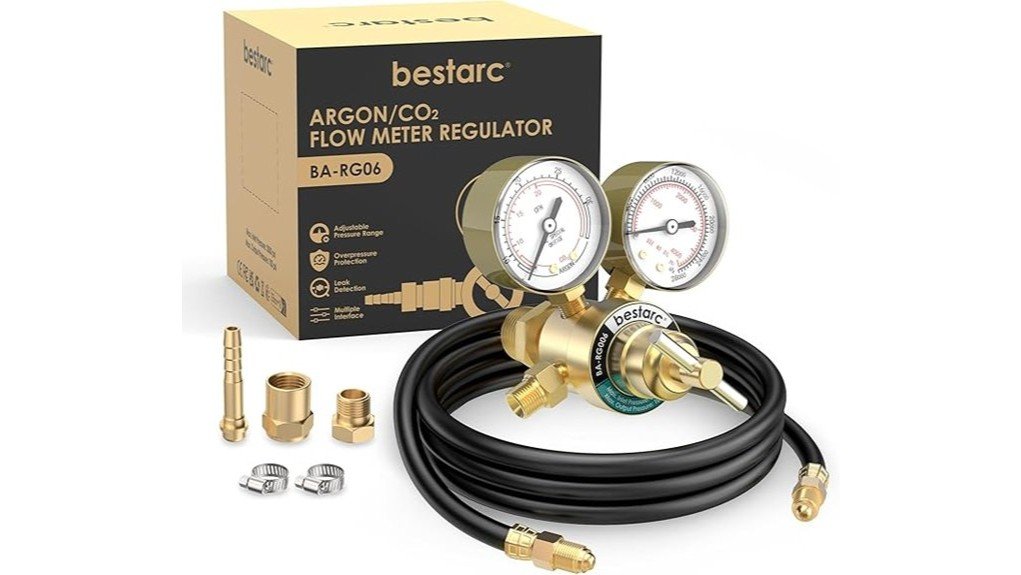
Getting shielding-gas control right matters when you are trying to produce clean MIG or TIG welds without wasting gas. The Bestarc Argon CO2 Regulator combines a brass regulator, dual-gauge design, multiple outlet connections, and a gas hose in one kit. Its biggest advantage is flexibility for common inert-gas welding setups, but you still need to confirm that its CGA-580 inlet matches your exact cylinder valve. This review explains the specifications, setup requirements, limitations, and buyer situations where it makes the most sense.
Quick Verdict
Rating: 8/10, Recommended with caveats
Best For: MIG and TIG welders who need a CGA-580 regulator kit with several outlet connection options.
Bottom Line: The Bestarc regulator gives you a durable brass body, useful connection flexibility, and an included gas hose. The main tradeoff is compatibility: you should verify your cylinder valve and hose fittings before ordering, especially when using a dedicated CO2 cylinder.
Key Specifications
| Specification | Detail |
|---|---|
| Brand | Bestarc |
| Product type | Welding shielding-gas regulator |
| Construction | Brass |
| Inlet connection | CGA-580 |
| Listed inlet/gauge range | 0-4000 PSI |
| Argon flow range | 0-30 CFH |
| CO2 flow range | 0-20 CFH |
| Outlet options | 9/16 x 18 connection, 5/8 x 18 connection, and 1/4-inch barbed fitting |
| Hose | 9.8 ft gas hose on this Amazon variant |
| Welding processes | MIG and TIG |
| Listed gas use | Argon, helium, and compatible shielding-gas applications |
| Included components | Regulator, mounting nut, and gas hose |
Before You Buy: Check the valve on your actual gas cylinder. This regulator uses a CGA-580 inlet. A dedicated CO2 cylinder may use a different connection, such as CGA-320, so do not assume that every cylinder labeled for CO2 will accept the regulator directly.
What Is the Bestarc Argon CO2 Regulator?
The Bestarc unit is a shielding-gas regulator intended for MIG and TIG welding. It connects to a compatible cylinder through a CGA-580 inlet and lets you monitor cylinder pressure while setting the gas flow needed by your welding process.
This Amazon variant includes a 9.8 ft gas hose, so you are getting more than the regulator body alone. The multiple outlet connection options are especially useful when your welder or existing hose does not use the same fitting as another machine in your shop.
The regulator is best viewed as part of your gas-delivery system rather than a universal adapter. Cylinder valve type, shielding gas, hose fitting, and welder requirements all need to match before you pressurize the system.
Key Takeaways
- The brass regulator body is designed for durability and corrosion resistance.
- A CGA-580 inlet makes it suitable for compatible inert-gas cylinder setups used with MIG and TIG welding.
- The listing specifies a 0-4000 PSI inlet or gauge range.
- The listed flow ranges are 0-30 CFH for argon and 0-20 CFH for CO2.
- Multiple outlet options give you more flexibility when matching the regulator to your hose or welding machine.
- This specific Amazon variant includes a 9.8 ft gas hose and mounting hardware.
- You should verify the cylinder connection before purchase instead of assuming all argon and CO2 cylinders use the same valve.
Who Should Buy It?
Best For
- MIG or TIG welders using a compatible CGA-580 shielding-gas cylinder.
- Home shops that want a regulator and long gas hose in the same package.
- Users who need several outlet connection choices for different welding setups.
Skip If
- Your cylinder valve does not match CGA-580 and you want a direct connection without an approved adapter.
- You need a regulator with a different flow range or connection standard.
- You require clearly documented dimensions, weight, certification, or warranty terms before purchasing.
Build Quality and Materials
The Bestarc regulator uses brass construction, which is a sensible material for a component expected to handle repeated cylinder changes and workshop conditions. The product information specifically highlights durability and corrosion resistance as advantages of the brass body.
For you, the practical benefit is straightforward: the regulator is built around metal gas-handling components rather than a lightweight disposable design. That does not remove the need for inspection. Threads, fittings, the hose, and connection surfaces should still be checked before use and whenever the equipment has been dropped or stored for a long period.
Fit and Compatibility
The regulator uses a CGA-580 inlet connector. That makes cylinder compatibility one of the most important checks before you buy. The product is marketed for argon, helium, and CO2-related welding applications, but the label on the gas alone does not guarantee that your particular cylinder has a CGA-580 valve.
On the outlet side, Bestarc provides several connection choices. The product information lists 9/16 x 18 and 5/8 x 18 connections plus a standard 1/4-inch barbed fitting. This gives you more flexibility when connecting the regulator to different hose arrangements.
Pro Tip: Before ordering, compare the CGA number on your cylinder valve and the fitting on your welder’s gas hose with the regulator specifications. Checking both ends takes a minute and can prevent an unusable setup.
Pressure and Gas Flow Control
The listing gives the regulator an 0-4000 PSI inlet or pressure-gauge range. That high-side reading helps you monitor the cylinder side of the gas system while you work.
Bestarc lists a gas-flow range of 0-30 CFH for argon and 0-20 CFH for CO2. CFH means cubic feet per hour, so these values describe gas flow rather than outlet pressure. That distinction matters because your welding procedure uses shielding-gas flow to protect the weld pool from surrounding air.
You should not simply turn the regulator to its highest reading. Set the flow according to your welding process, torch or gun setup, shielding gas, and equipment instructions. Excessive gas flow can waste gas, while insufficient shielding can contribute to poor weld quality.
Hose and Connection Flexibility
This version includes a 9.8 ft gas hose, giving you useful reach between the cylinder and welding machine. That can help when the cylinder needs to stay secured in one position while your welder sits farther away on a cart or workbench.
The included hose is also an important difference between this variant and Bestarc regulator-only options. Check the selected Amazon variation before ordering because the product family contains more than one regulator and hose configuration.
Installing and Using the Bestarc Regulator
Setup is manageable, but compressed-gas equipment deserves careful handling. Start by confirming that the cylinder, regulator inlet, hose, and welder connection are compatible. Inspect the fittings for obvious damage before making the connection.
| Step | What to Do |
|---|---|
| 1. Confirm compatibility | Verify that the cylinder connection matches the regulator’s CGA-580 inlet. |
| 2. Inspect fittings | Check the threads, hose, and connections for visible wear or damage. |
| 3. Secure connections | Connect the regulator and hose according to the product and welding-equipment instructions. |
| 4. Check for leaks | Check connection points before welding and correct any leakage before continuing. |
| 5. Set gas flow | Adjust the flow to the level required by your welding process rather than using an arbitrary setting. |
| 6. Monitor operation | Watch for unstable readings, gas loss, damaged hoses, or connections that loosen during use. |
How It Performs in Real Use
For MIG Welding in a Home Shop
The included hose and multiple outlet choices make the Bestarc practical when you are building a basic shielding-gas MIG setup. Once your cylinder and machine fittings match, you can keep the cylinder secured while routing the hose to a nearby welder or cart.
For TIG Welding
For TIG work, the regulator gives you a dedicated way to control shielding-gas flow within its listed range. The useful part is not simply having a gauge, but being able to make repeatable adjustments while following the flow requirements for your torch, material, and welding procedure.
For Different Shop Setups
The multiple outlet fittings are useful if your equipment collection is not built around one hose connection. You still need to confirm compatibility, but having several supported outlet styles can reduce the need to replace the complete regulator when your hose arrangement changes.
For Occasional Project Use
A regulator-and-hose package is convenient for a garage where the equipment may be stored between projects. Before each return to service, inspect the hose and connections and check for leakage rather than assuming a setup that worked months ago is still ready to use.
Compatibility and Safety
Compressed shielding-gas cylinders store significant energy, so compatibility should never be treated as a minor detail. Use the regulator only with a cylinder, gas, hose, and welding machine that match the applicable connection and pressure requirements.
The CGA-580 inlet deserves particular attention when CO2 is involved. A dedicated CO2 cylinder can use a different valve connection from an argon or inert-gas cylinder. If your fittings do not match, do not force the connection or improvise a substitute fitting.
Follow the instructions supplied with your cylinder, regulator, gas supplier, and welding machine. Stop using the regulator if you find damaged fittings, a damaged hose, persistent leakage, or pressure behavior that you cannot explain safely.
Common Issues and Troubleshooting Tips
A connection will not thread onto the cylinder: stop and verify the CGA connection. Different cylinder valve standards can look similar at first glance but are not interchangeable.
You hear or detect gas leakage: shut down the gas supply and inspect the connection. Do not continue welding until you have found and corrected the cause.
The flow seems inconsistent: check the hose for damage or restriction, confirm the connections are secure, and make sure you are reading the correct scale for the gas being used.
The gauge behaves unexpectedly: discontinue use until you know why. A regulator is part of a pressurized gas system, so unexplained gauge behavior should not be ignored.
The hose does not match your welder: compare your machine’s inlet fitting with the regulator’s available outlet connections before adding adapters or replacement hoses.
Pros and Cons
Pros
- Brass construction provides a solid metal regulator body.
- CGA-580 inlet suits many common inert-gas welding-cylinder setups.
- Multiple outlet connection options improve hose compatibility.
- 9.8 ft gas hose is included with this specific Amazon variant.
- Separate listed argon and CO2 flow ranges make the controls relevant to common welding applications.
Cons
- CGA-580 will not directly fit every cylinder marketed for CO2 use.
- You need to verify both cylinder and welder-side fittings before purchase.
- Key details such as product dimensions and warranty terms are not clearly established in the available product information.
Is It Worth the Price?
The Bestarc regulator offers its strongest value when you need the regulator, hose, and flexible outlet connections together. Buying a complete setup can be more convenient than piecing together several components, especially when you are equipping a new MIG or TIG machine.
It is worth considering if your cylinder already uses CGA-580 and the supplied connection options suit your welder. The value drops quickly if you discover after purchase that your cylinder requires a different regulator connection or that you need extra adapters and fittings.
For that reason, compatibility matters more than chasing the lowest purchase price. A regulator that matches your existing gas system is usually the smarter buy.
How It Compares to Alternatives
The Bestarc 9.8 ft hose model uses a dual-gauge approach and focuses on connection flexibility. If you prefer a visible floating-ball flow tube instead, Bestarc also offers its ARG-2 flowmeter-style regulator, while the YESWELDER QB01 is another CGA-580 flowmeter-style option worth comparing.
The Bestarc reviewed here makes the most sense when you specifically want its dual-gauge layout, included long hose, and several outlet connection choices. A flow-tube model may be more appealing if seeing gas flow on a vertical ball scale is your priority.
Frequently Asked Questions
Is the Bestarc regulator suitable for MIG and TIG welding?
Yes. Bestarc lists this regulator for both MIG and TIG welding applications. You still need a compatible shielding gas, cylinder connection, hose connection, and welding machine.
What cylinder connection does it use?
The regulator uses a CGA-580 inlet. Check the marking or specifications for your cylinder valve before ordering because not every shielding-gas cylinder uses the same connection.
Can I connect it directly to a pure CO2 cylinder?
Not necessarily. The Bestarc regulator has a CGA-580 inlet, while a dedicated CO2 cylinder may use another connection such as CGA-320. Verify the actual valve on your cylinder and use only properly rated, compatible equipment.
What gas-flow ranges are listed?
The main product information lists 0-30 CFH for argon and 0-20 CFH for CO2. Set the actual operating flow according to your welding procedure and equipment instructions rather than automatically using the upper end of the scale.
Does this version include a gas hose?
Yes. The Amazon variant covered in this review is the dual-gauge regulator with a 9.8 ft gas hose. Bestarc sells other regulator configurations, so confirm the selected variation before checkout.
What should I check before the first use?
Verify the cylinder connection, inspect the hose and fittings, and confirm that every connection is secure. Check for leakage before welding and follow the instructions provided with your cylinder and welding equipment.
Who should skip this regulator?
Skip it if your cylinder does not use a compatible CGA-580 connection and you want a direct-fit regulator. It is also less suitable when your application requires a different flow range, regulator design, or clearly documented specifications that this listing does not provide.
The Bottom Line
The Bestarc Argon CO2 Regulator is a practical choice for MIG and TIG users who have a compatible CGA-580 cylinder and want a brass regulator with multiple outlet options and an included 9.8 ft hose. Its connection flexibility is the main strength, while the need to verify cylinder compatibility is the most important limitation. For the right gas setup, our verdict remains 8/10, Recommended with caveats.
Ready to Buy?
Check the latest price, selected hose variant, and product details before you decide.


