Affiliate Disclosure: This roundup is reader-supported. When you click an Amazon link and make a qualifying purchase, we may earn a commission at no extra cost to you.
Rebuilding the same bucket lip, crusher jaw, or wear plate twice in one season is expensive — not because of the rod, but because of the downtime. The right hardfacing rod puts a deposit on that surface which matches how the part is actually wearing, so the repair lasts through the job instead of through the week.
The catch is that “hardest rod wins” is wrong. A chromium-carbide overlay that shrugs off sand will crack under repeated hammering, and a work-hardening manganese deposit that thrives on impact will disappear under pure abrasion. This guide compares seven stick-welding hardfacing electrodes by deposit type, published hardness, rod diameter, package size, polarity, amperage, wear pattern, and finishing needs — so you can match the rod to the wear mechanism instead of guessing.
Always confirm the base metal and follow the electrode maker’s current procedure before welding a critical part.
Quick verdict — pick by the problem, not the price
- Abrasive material is eating the metal away → Blue Demon HC470 (Rc 55–60 chromium carbide, controllable 1/8″ rod).
- Same problem but a large area and a big machine → Rockmount Zeta C (58–62 RC, tubular, fastest deposition, two-layer limit).
- Moderate wear, light impact, occasional repairs → Forney Supercote 1 lb (RC 52–58, all positions, forgiving arc).
- Impact-driven wear on identified high-manganese parts → SUA D256 (work-hardens in service; procedure-sensitive).
- Thin wear edges that need a smooth, polishable face → Shark 11103 (Rockwell C55–60, mirror finish when polished).
Top Picks
| Category | Product | Published Hardness | Best Use |
|---|---|---|---|
| 🏆 Best Overall for Severe Abrasion | Blue Demon HC470 | Rc 55–60 | Bucket lips and teeth, crusher jaws, wear plates, pins, shafts, cams |
| 🧰 Best Small Pack for Occasional Repairs | Forney Supercote 1 lb | RC 52–58 | Moderate abrasion, low impact, and surface buildup on cast or manganese steel parts |
| ⭐ Best Bulk Pack | Forney Supercote 50 lb | RC 52–58 | Frequent shop use when the same moderate-abrasion electrode is already proven for the work |
| 🎯 Best Work-Hardening Option | SUA D256 5/32 in. | ~180–200 HB as welded; ~44–48 HRC work-hardened | Identified high-manganese parts exposed to impact and wear, including crusher and earthmoving components |
| 🚀 Best Larger D256 Size | SUA D256 3/16 in. | ~180–200 HB as welded; ~44–48 HRC work-hardened | Larger work-hardening overlays when the machine, joint, and heat-control procedure suit the rod size |
| 🔰 Best for Fast Deposition | Rockmount Zeta C | 58–62 RC | Extreme-abrasion applications that benefit from a tubular rod and high deposition rate |
| 🎨 Best for a Polishable Finish | Shark 11103 Hardfacing | Rockwell C55–60 | Thin wear edges and farm implements needing abrasion resistance with a finish that can be polished |
How this list is ordered: rods are grouped by alloy family so directly comparable options sit side by side — the two Forney pack sizes together, the two D256 diameters together. It is not a strict best-to-worst ranking.
Check Blue Demon HC470 on Amazon
Match the Rod to Your Welder First
The most common expensive mistake in this category is buying a rod your machine cannot run properly. Check this before anything else:
- 1/8 in. rods (HC470) — comfortable on most 180 A and larger stick machines.
- 5/32 in. rods (Forney Supercote, D256) — Forney lists 115–160 A. You want real, sustained output in that band, not a peak figure on the box.
- 3/16 in. rods (Shark 11103, D256) — Shark lists 125–190 A. Duty cycle matters as much as maximum amperage on long overlays.
- 1/4 in. rods (Zeta C) — Rockmount lists roughly 100 A at this diameter with a wide ±40% working range. The low figure is a feature of the tubular design, but the rod is still physically large and poorly suited to detail work.
- AC users: D256 needs an open-circuit voltage above roughly 70 V. Many small inverter machines do not meet that on AC — check before you buy.
- Rod length: D256 rods in these listings are 16 in. long. They will not fit some rod holders or small rod ovens.
How We Chose These Hardfacing Rods
We kept products that are sold as hardfacing or surfacing stick electrodes. We compared the wear mechanism each rod targets, published hardness, deposit behavior, rod diameter, package size, welding current and polarity information, finishing needs, and the type of base metal described by the manufacturer.
Every specification in this article was checked against the manufacturer’s own published data where that data exists, and anything we could not confirm is labeled as unconfirmed rather than filled in. We have not welded with these specific rods, and we make no claim of hands-on testing. Prices, ratings, and stock levels change constantly and are deliberately excluded.
We did not treat a larger package as automatically better. The 50 lb Forney option is useful only when you already know that Supercote matches your parts and welding procedure. We also separated chromium-carbide-style abrasion rods from manganese work-hardening electrodes because they solve different wear problems.
Before You Buy a Hardfacing Rod
- Identify the wear pattern: Severe abrasion, impact, metal-to-metal wear, and erosion call for different deposits.
- Confirm the base metal: Mild steel, cast steel, cast iron, and austenitic manganese steel may require different preparation and heat-control procedures.
- Check polarity and amperage: Match the rod to your welder’s AC or DC capability, its sustained output, and its open-circuit voltage.
- Choose the rod diameter carefully: A larger electrode can increase deposition but also demands more current and tighter heat control.
- Plan the layer count: Some hardfacing alloys limit the number of layers or expect stress-relief checking.
- Plan the finish: High-hardness deposits usually require grinding rather than conventional machining.
- Follow storage instructions: Low-hydrogen electrodes such as D256 need controlled dry storage and redrying; some coatings do not.
- Prepare the surface: Remove scale, rust, paint, and fatigued metal before welding. This matters more than the rod choice on a worn part.
Safety and procedure note
Hardfacing fumes, hot metal, grinding dust, and alloying elements can be hazardous. High-manganese surfacing electrodes in particular generate heavy fume: increase ventilation, use local exhaust rated for welding fume (a solder or hobby fume extractor is not adequate), and position yourself out of the fume stream. Chromium-bearing hardfacing alloys carry their own exposure cautions — read the current safety data sheet for the exact product.
Use appropriate eye and face protection, protective clothing, and heavy stick-welding welding gloves — choose thick gauntlet-style gloves for stick hardfacing rather than the thin gloves intended for TIG. Do not apply a generic preheat rule to every alloy. High-manganese steel in particular requires careful heat control. Follow the electrode maker’s current technical data for preparation, preheat, interpass temperature, polarity, amperage, and layer limits.
If abrasive material is rapidly wearing through a steel surface, HC470 is the most direct match in this roundup. Its deposit is designed to prioritize wear resistance, not easy machining. That makes it more appealing for parts that need longer service life than for surfaces requiring extensive post-weld shaping. Blue Demon also offers HC470 in 5/32-inch and 3/16-inch diameters if your machine and job favor a larger rod.
Why You’ll Like It
- Targets severe abrasion while tolerating moderate impact, at a published Rc 55–60.
- The 1/8-inch diameter supports more controlled placement than the largest rods in this list.
- Covers a genuinely broad list of manufacturer-stated wear parts, from crusher jaws to cams and eccentrics.
- The coating is specifically formulated to avoid the worm-tracking porosity that plagues this alloy family.
Who Should Buy This
- Maintenance welders rebuilding compatible bucket lips, wear plates, crusher parts, pins, shafts, or cams.
- Buyers who value abrasion life more than easy machining.
- Shops with enough sustained welding output for a 1/8-inch hardfacing electrode.
Who Should Avoid This
- Buyers who need a soft, readily machinable buildup layer.
- Anyone who has not identified the base metal or wear mechanism.
- Work dominated by extreme impact rather than abrasion — a work-hardening manganese deposit suits that better.
Verified Buying Details
| Detail | What to Know |
|---|---|
| Listed size | 1/8 in., 5 lb package (also produced in 5/32 in. and 3/16 in.) |
| Deposit type | Chromium carbide; austenitic matrix with chromium/complex carbides |
| Published hardness | Rc 55–60 as welded |
| Wear pattern | Severe abrasion with moderate impact |
| Typical applications | Crusher jaws, hammers, bucket lips and teeth, wear plates, pins, axles, shafts, cams, eccentrics |
| Polarity, amperage, position | Not stated on the listings and retailer data we checked — confirm with Blue Demon’s current technical sheet before buying |
| Main limitation | The hard deposit is normally finished by grinding, not conventional machining |
Pros and Cons
- Pros: Strong abrasion focus with published hardness, useful 1/8-inch size, broad manufacturer-stated application range, porosity-resistant coating.
- Cons: Hard finishing work, no published polarity or position data on the sources we checked, and not a universal solution for every base metal.
Check Blue Demon HC470 on Amazon
This is the practical small-pack choice when your repair does not need an extreme-abrasion alloy. The 1 lb quantity limits leftover inventory, while the 5/32-inch diameter can provide useful deposition on moderate-wear components. Of everything here, it is also the most forgiving rod to run — worth something if hardfacing is new to you.
Why You’ll Like It
- Small package suits occasional repairs and first-time product evaluation.
- Rated for all-position work, which none of the severe-abrasion rods here can claim.
- Smooth arc and easy slag removal reduce cleanup frustration on long overlays.
- The deposit is described as crack-resistant and forgeable, which matters for specific repair procedures.
Who Should Buy This
- Farm, maintenance, and home shops doing moderate-abrasion repairs.
- Buyers who need only a small quantity or want to trial the rod before committing.
- Welders working on compatible cast-steel or manganese-steel machine parts.
Who Should Avoid This
- Mining, quarry, or earthmoving repairs dominated by severe abrasion or high impact.
- Buyers whose welder cannot supply a sustained 115–160 A for a 5/32-inch rod.
- Anyone who specifically needs a chromium-carbide deposit.
Verified Buying Details
| Detail | What to Know |
|---|---|
| Diameter and pack | 5/32 in., 1 lb |
| Recommended use | Moderate abrasion and low impact; buildup on new or worn cast steel and manganese steel machine parts |
| Welding position | All positions |
| Polarity | DC reverse (DCEP) or AC |
| Listed amperage | 115–160 A |
| Listed hardness | RC 52–58 |
| Deposit behavior | Crack-resistant and can be forged |
Pros and Cons
- Pros: Small package, fully published operating data, all-position capability, smooth arc, easy slag removal.
- Cons: Not intended for severe abrasion or heavy impact, and the 5/32-inch size needs adequate sustained amperage.
Check Forney Supercote on Amazon
This bulk option makes sense only when your shop regularly uses Supercote for moderate-abrasion, low-impact repairs. It reduces the need to reorder small packages, but it creates a larger storage commitment and should not be treated as a substitute for a more suitable severe-wear alloy.
Read the listing carefully on this one
Some marketplace copy for the 50 lb pack describes it as a high-hardness rod for severe abrasion and moderate impact. Forney’s own technical data for the same part number specifies moderate abrasion and low impact at RC 52–58. Where the listing and the manufacturer disagree, go with the manufacturer. If your part is facing severe abrasion, this is not the rod for it regardless of how the product page is written.
Why You’ll Like It
- Large quantity supports repeated maintenance or production work without reordering.
- Uses the same verified diameter, hardness range, polarity, and current range as the 1 lb version.
- Useful for shops with a consistent and documented repair procedure.
Who Should Buy This
- Shops, farms, and contractors already using Supercote regularly.
- Buyers with dry, controlled electrode storage.
- Teams that can justify a 50 lb inventory commitment.
Who Should Avoid This
- One-time users or buyers evaluating the rod for the first time — start with the 1 lb pack.
- Repairs dominated by severe abrasion or heavy impact.
- Anyone without suitable storage for a bulk electrode supply.
Verified Buying Details
| Detail | What to Know |
|---|---|
| Diameter and pack | 5/32 in., 50 lb |
| Recommended use | Moderate abrasion and low impact (per Forney’s own data) |
| Welding position | All positions |
| Polarity | DC reverse (DCEP) or AC |
| Listed amperage | 115–160 A |
| Listed hardness | RC 52–58 |
| Main limitation | Large quantity with the same moderate-wear performance as the small pack |
Pros and Cons
- Pros: Bulk supply, consistent known formulation, useful for repeated jobs.
- Cons: High storage commitment, unnecessary for occasional repairs, not a severe-wear upgrade, and some listing copy overstates what the rod does.
Check the 50 lb Pack on Amazon
The 5/32-inch size is the more controlled D256 option in this roundup. It may suit crusher components, high-manganese rails, bucket parts, and bulldozer components when the base metal and service conditions match the electrode. This is not a general-purpose rod for every bucket or blade, and it is not a rod to learn on.
Why You’ll Like It
- Work-hardening behavior suits impact-assisted wear on compatible manganese-steel parts, where a brittle high-hardness deposit would simply crack off.
- The 5/32-inch diameter gives more control than the 3/16-inch version.
- Runs on AC or DCEP, so it fits a wide range of machines — provided AC open-circuit voltage clears roughly 70 V.
- The 11 lb package supports substantial repair work without the commitment of a 50 lb carton.
Who Should Buy This
- Experienced welders repairing identified austenitic manganese or compatible impact-wear components.
- Buyers who understand low-hydrogen storage and redrying requirements.
- Shops that can genuinely control heat input and interpass temperature.
Who Should Avoid This
- Beginners working on an unknown base metal.
- Applications needing immediate high hardness straight off the arc.
- Precision surfaces that require conventional machining after welding.
- Anyone welding indoors without serious ventilation — this alloy produces heavy fume.
Verified Buying Details
| Detail | What to Know |
|---|---|
| Listed size | 5/32 in. × 16 in. rods, 11 lb package |
| Classification | AWS A5.13 EFeMn-A (D256), low-hydrogen potassium coating |
| Polarity | AC or DCEP; on AC the open-circuit voltage should exceed about 70 V |
| Hardness | About 180–200 HB as welded; roughly 44–48 HRC once work-hardened in service |
| Heat control | Normally no preheat; keep interpass temperature below about 200 °C. In very cold conditions the base may be warmed to roughly 50–100 °C |
| Technique | Low current and narrow beads; peen or water-quench while hot to reduce crack tendency; remove the fatigued layer first |
| Storage | Redry at about 200 °C for 2 hours |
| Finishing | Grinding is the normal method; avoid overheating the deposit |
Important Procedure Note
Austenitic manganese steel is sensitive to excess heat and can crack if it gets too hot. Do not apply a broad preheat recommendation borrowed from another alloy — the published guidance for this electrode is the opposite of what most steels want. Surfacing also generates a large volume of fume, so increase ventilation and stand out of the plume. Use the current instructions supplied with the exact electrode and base metal, including any requirements for low current, narrow beads, interpass control, redrying, peening, or controlled cooling.
Pros and Cons
- Pros: Work-hardening deposit built for impact-wear manganese parts, fully published procedure data, AC/DCEP capability, substantial 11 lb pack.
- Cons: Procedure-sensitive, base-metal identification is essential, heavy fume, 16 in. rods won’t fit every holder or oven, and the deposit is normally finished by grinding.
Check SUA D256 5/32 in. on Amazon
Choose this size only after confirming that your welder, joint design, base metal, and heat-control plan suit a 3/16-inch electrode. It is a scale option rather than a different alloy from the 5/32-inch D256 — every procedure requirement listed for the smaller rod applies here, with less margin for error.
Why You’ll Like It
- Larger diameter can increase deposition on broad repair areas.
- Retains the work-hardening behavior associated with D256 manganese weld metal.
- Useful when the 5/32-inch version would make a large job unnecessarily slow.
Who Should Buy This
- Experienced maintenance welders doing broad overlays on compatible components.
- Shops with sufficient current capacity, adequate duty cycle, and disciplined heat control.
- Buyers who already know D256 suits the base metal and service conditions.
Who Should Avoid This
- Small, thin, or precision repair work.
- Low-output welders that cannot run a 3/16-inch specialty electrode correctly.
- Unknown steels, or applications dominated by pure abrasion with little impact.
Verified Buying Details
| Detail | What to Know |
|---|---|
| Listed size | 3/16 in. × 16 in. rods, 11 lb package |
| Classification | AWS A5.13 EFeMn-A (D256), low-hydrogen potassium coating |
| Polarity | AC or DCEP; on AC the open-circuit voltage should exceed about 70 V |
| Hardness | About 180–200 HB as welded; roughly 44–48 HRC once work-hardened in service |
| Heat control | Normally no preheat; keep interpass temperature below about 200 °C — harder to achieve at this diameter |
| Storage | Redry at about 200 °C for 2 hours |
| Main limitation | Higher current demand and greater risk of exceeding safe interpass temperature |
Pros and Cons
- Pros: Faster coverage than the smaller D256, same work-hardening deposit, useful 11 lb package.
- Cons: Higher current demand, greater heat-control challenge, heavy fume, and less control on small repairs.
Check SUA D256 3/16 in. on Amazon
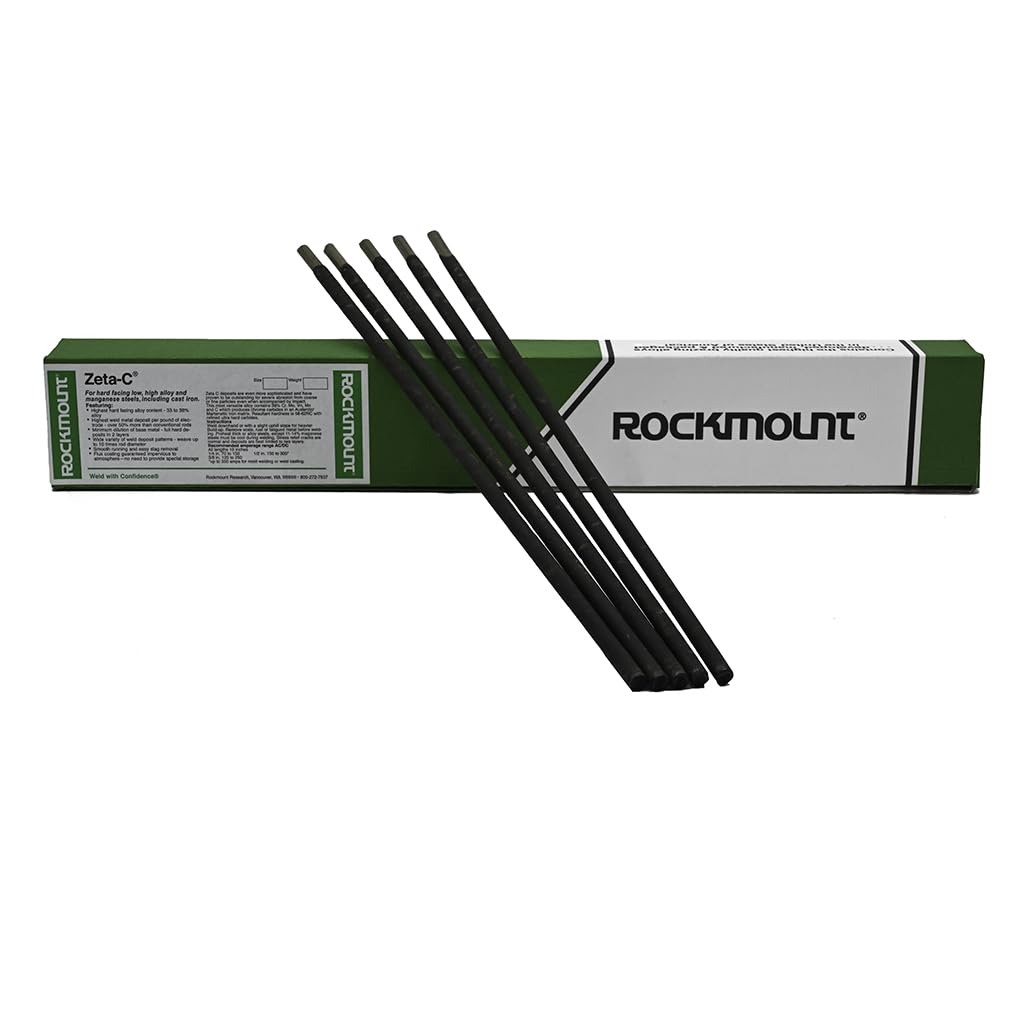
Zeta C is best understood as a fast-deposit severe-abrasion rod rather than a general buildup electrode. It can cover large wear areas quickly, but Rockmount states that deposits should be limited to two layers and that stress-relief cracks are expected with this type of very hard deposit. Those fine checks are normal for the alloy; cracking that runs down into the base metal is not, and means something is wrong with the procedure.
Why You’ll Like It
- Tubular design supports high deposition rates and good electrode recovery.
- Targets extreme abrasion with light-to-moderate impact at 58–62 RC.
- Manufacturer-listed applications include dragline and clam shell buckets, crushing equipment, augers, suction dredge cutters, sizing screens, rolling mill guides, and agricultural implements.
- The flux coating resists atmospheric moisture, so no rod oven or controlled storage is needed — a real cost saving versus low-hydrogen electrodes.
Who Should Buy This
- Professional maintenance teams repairing large, high-abrasion equipment.
- Welders who want faster deposition than a conventional coated rod can provide.
- Shops prepared to follow the two-layer limit and the stress-relief-crack guidance.
Who Should Avoid This
- Small detail work — 1/4 in. is the smallest diameter Rockmount offers in this rod.
- Applications requiring a machinable deposit.
- Anyone planning a thick multilayer buildup without an approved buffer or buildup procedure underneath.
Verified Buying Details
| Detail | What to Know |
|---|---|
| Listed size | 1/4 in., 5 lb pack (Rockmount also produces 3/8 in. and 1/2 in.; other pack sizes are sold) |
| Rod design | Tubular hardfacing electrode, 38% alloy content |
| Hardness | 58–62 RC |
| Current and polarity | About 100 A at 1/4 in. with a wide ±40% working range; AC or DC, using reverse polarity (DCEP) on DC |
| Deposition rate | Up to about 10 lb per hour |
| Layer limit | Limit the hardfacing deposit to two layers; stress-relief cracks are expected |
| Technique | Weld downhill or on a slight uphill slope for heavier buildup; remove scale, rust, and fatigued metal first |
| Preheat | Preheat thick or alloy steels — but 11–14% manganese steels must stay cool during welding |
| Storage | Flux coating resists atmospheric moisture; no special storage required |
Pros and Cons
- Pros: Extreme-abrasion focus, highest hardness here, fastest deposition, wide current tolerance, no special storage burden.
- Cons: Large rod with no small diameters available, hard two-layer limit, expected stress-relief checking, difficult finishing.
Check Rockmount Zeta C on Amazon
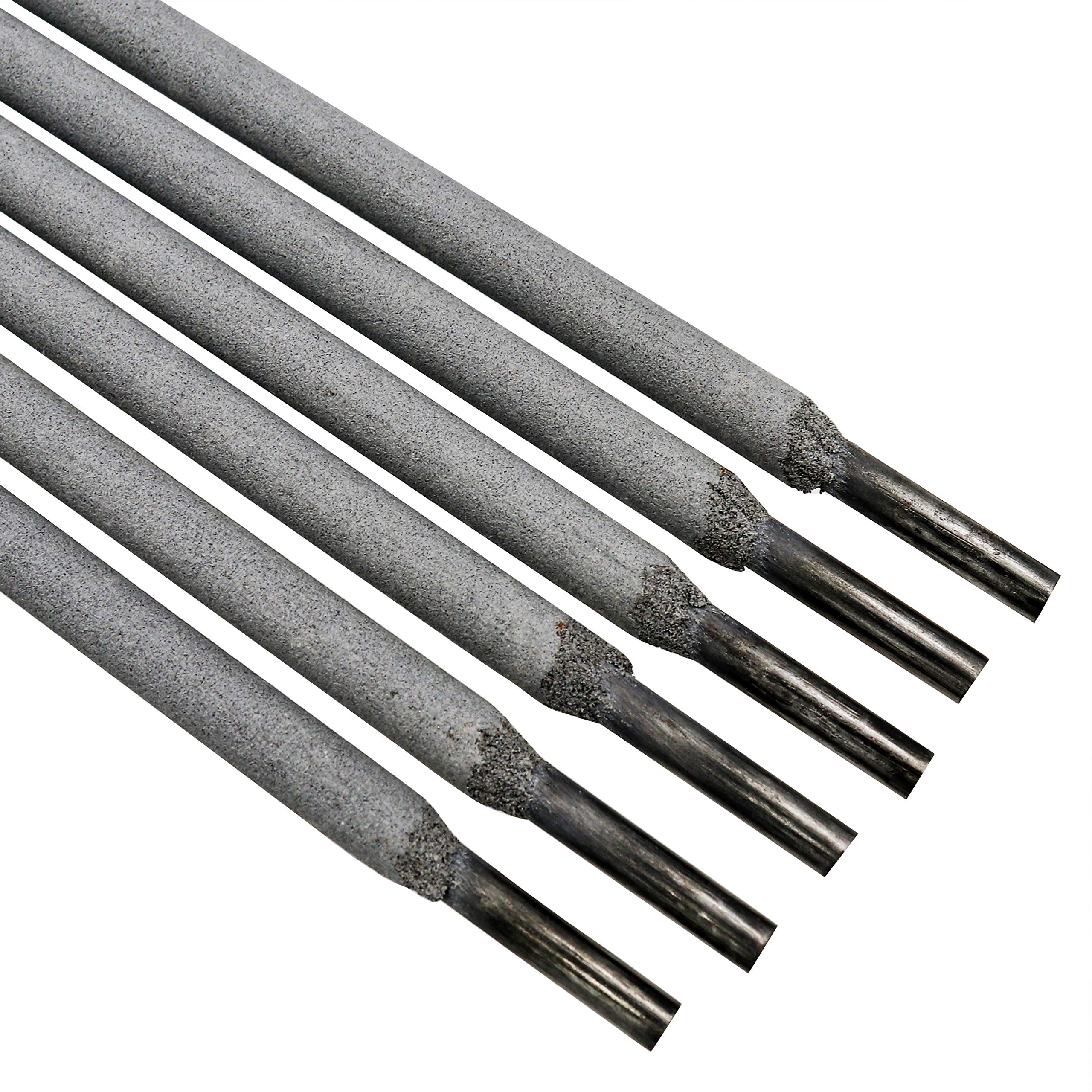
This is the finish-focused choice in the lineup, and its Rockwell C55–60 rating puts it well above the Forney Supercote rods while still being described for thin wear edges on farm implements. That specific, manufacturer-stated use is more credible than broad claims about shafts, rollers, or precision machine restoration.
Listing title note
Some marketplace titles for this item show the diameter as 0.09375-inch, which is 3/32 in. Shark’s own catalogue lists part number 11103 as a 3/16 in. × 14 in. Wearcote hardfacing electrode. Check the product images and specification block before ordering if rod diameter matters to your job.
Why You’ll Like It
- Combines high abrasion resistance at Rockwell C55–60 with moderate impact tolerance.
- Can produce a mirror finish when polished — unusual for a hardfacing deposit.
- One-pound package suits occasional maintenance work without leftover stock.
- Manufacturer-stated fit for thin wear edges on agricultural implements.
Who Should Buy This
- Farm and equipment shops repairing thin wear edges.
- Buyers who care about the appearance or smoothness of the finished overlay.
- Welders with a machine that comfortably holds 125–190 A for a 3/16-inch rod.
Who Should Avoid This
- Very small repairs that need a thinner electrode — Shark offers a 1/8-inch Wearcote for that.
- Large high-deposition jobs better suited to a tubular rod.
- Unknown applications where the base metal or wear pattern has not been identified.
Verified Buying Details
| Detail | What to Know |
|---|---|
| Diameter and length | 3/16 in. × 14 in. (Wearcote, part number 11103) |
| Package | 1 lb |
| Listed amperage | 125–190 A |
| Polarity | Reverse AC / DCEP |
| Listed hardness | Rockwell C55–60 |
| Wear pattern | High abrasion with moderate impact |
| Finish | Can produce a mirror finish when polished |
Pros and Cons
- Pros: Polishable finish, fully published size, amperage, polarity and hardness, small package, credible farm-implement use case.
- Cons: Large diameter for fine work, some marketplace titles state the wrong diameter, and it is not the fastest bulk-deposition option.
Hardfacing Rod Comparison Table
| Product Name | Image | Best For | Rod / Deposit Type | Published Hardness | Welding Details | Buying Note | Amazon |
|---|---|---|---|---|---|---|---|
| Blue Demon HARDCOVER 470 1/8″ Hardfacing Electrode |
 |
Severe abrasion with moderate impact | Chromium carbide hardfacing alloy | Rc 55–60 | SMAW; 1/8 in., 5 lb. Polarity and position not published on the sources we checked | Best overall when abrasion life matters more than machinability. | Check details |
| Forney 42401 Supercote, 5/32 in., 1 lb |
 |
Small moderate-abrasion repairs | Supercote hardfacing electrode | RC 52–58 | DCEP or AC; 115–160 A; all positions | Small pack with smooth arc, easy slag removal, and a forgeable deposit. | Check details |
| Forney 42450 Supercote, 5/32 in., 50 lb |
|
Bulk shop use | Same Supercote formulation in bulk | RC 52–58 | DCEP or AC; 115–160 A; all positions | Buy only when the rod is already proven for recurring work. Listing copy overstates the wear rating. | Check details |
| EFeMn-A D256, 5/32 in., 11 lb |
 |
Work-hardening manganese overlays | EFeMn-A high-manganese surfacing electrode | ~180–200 HB as welded; ~44–48 HRC work-hardened | AC or DCEP (AC OCV above ~70 V); low-hydrogen redry; 16 in. rods | Choose only for compatible base metal and impact-wear service. | Check details |
| EFeMn-A D256, 3/16 in., 11 lb |
|
Larger work-hardening passes | EFeMn-A high-manganese surfacing electrode | ~180–200 HB as welded; ~44–48 HRC work-hardened | AC or DCEP; higher-current 3/16 in. size; 16 in. rods | Requires more machine capacity and tighter interpass control. | Check details |
| Rockmount Zeta C, 1/4 in. |
 |
Extreme abrasion and fast deposition | Tubular high-alloy hardfacing rod (38% alloy) | 58–62 RC | AC or DCEP; about 100 A at 1/4 in. with a ±40% range | Limit the hardfacing deposit to two layers; no special storage needed. | Check details |
| Shark 11103 Hardfacing Rod, 1 lb |
 |
Thin wear edges and polishable finish | Wearcote hardfacing electrode | Rockwell C55–60 | Reverse AC / DCEP; 3/16 in. × 14 in.; 125–190 A | Best when finish quality matters alongside abrasion resistance. | Check details |
How to Match a Rod to the Wear Problem
Severe Abrasion With Moderate Impact
Choose an abrasion-focused hardfacing alloy such as Blue Demon HC470 when sand, soil, aggregate, or other abrasive material removes metal faster than impact deforms it. Rockmount Zeta C is the higher-deposition alternative for large areas and extreme wear, but its two-layer hardfacing limit must be respected.
Moderate Abrasion and Low Impact
Forney Supercote is the more economical match for moderate wear on compatible machine parts, and its all-position rating makes it the most flexible rod here for awkward repairs. The 1 lb and 50 lb products use the same rod; select the package based on actual consumption, not expected performance.
Impact Wear on High-Manganese Parts
D256 is a different type of solution. Its high-manganese deposit starts relatively soft and is intended to work-harden under service. It should not be selected merely because the part is large or ground-engaging. Confirm that the base metal and impact-wear conditions suit an EFeMn-A procedure, and that you can hold interpass temperature down.
Thin Wear Edges and Finish Quality
Shark 11103 is the clearest fit when the manufacturer-supported use is a thin wear edge on a farm implement and the finished deposit may need polishing. At Rockwell C55–60 it is considerably harder than the Supercote rods, so plan on grinding rather than machining.
FAQ
How Do I Choose the Right Hardfacing Rod?
Start with the wear mechanism and base metal, not the hardness number. Use an abrasion-focused alloy for severe abrasive wear, a manganese work-hardening electrode for suitable impact-wear manganese parts, and a moderate-wear rod for lower-demand buildup. Then confirm rod diameter, polarity, amperage, welding position, storage, layer limit, and finishing method against your own machine and shop.
Does a Higher Rockwell Number Mean a Better Rod?
No. Hardness only predicts resistance to abrasive cutting. A 58–62 RC deposit will outlast a 52–58 RC deposit in sand or aggregate, but it is also more brittle and more likely to spall under repeated hammering. D256 illustrates the point: it is the softest deposit in this roundup as welded, at roughly 180–200 HB, and it is the right answer for impact-driven wear precisely because it hardens in service instead of cracking.
What Amperage and Machine Do I Need?
Match the machine to the diameter. Forney’s 5/32-inch Supercote lists 115–160 A, Shark’s 3/16-inch rod lists 125–190 A, and Rockmount lists roughly 100 A for the 1/4-inch Zeta C with a wide tolerance either side. Sustained output and duty cycle matter more than a peak rating on the box, because hardfacing overlays are long runs rather than short tacks. If you are welding D256 on AC, also check that your machine’s open-circuit voltage exceeds roughly 70 V.
What Is the Difference Between Hardfacing and Buildup?
Buildup restores lost dimensions with a compatible, often tougher and more machinable deposit. Hardfacing adds a wear-resistant surface. Some repairs need a buildup layer first and a hardfacing layer on top. Do not use a very hard alloy as an unlimited-thickness filler unless the manufacturer’s procedure specifically allows it.
How Many Layers of Hardfacing Can I Apply?
It depends entirely on the alloy, and it is one of the few limits in this field that is genuinely hard. Rockmount specifies a maximum of two layers for Zeta C. Other alloys have different limits. Exceeding the stated layer count is a common cause of deposits that crack, spall, or separate from the base metal. If you need more thickness than the hardfacing alloy allows, put a buildup electrode underneath it instead.
Do I Need to Redry These Electrodes?
Only some of them. D256 is a low-hydrogen electrode and its published guidance calls for redrying at about 200 °C for two hours, plus dry storage. Rockmount states the opposite for Zeta C — its flux coating resists atmospheric moisture, so no special storage is required. Check the specific product before assuming either way.
How Can I Reduce Cracking When Hardfacing?
Remove fatigued metal, scale, rust, and contamination first; identify the base metal; follow the specified preheat or no-preheat rule; control interpass temperature; use the recommended bead pattern; and respect the maximum layer count. Some very hard deposits form expected stress-relief checks — fine transverse cracks in the overlay are normal for that alloy family. Uncontrolled cracking that runs down into the base metal is a different problem and requires corrective action.
Which Hardfacing Rod Is Best for Beginners?
For moderate-abrasion, low-impact repairs, the 1 lb Forney Supercote pack has the clearest beginner-friendly positioning in this group: the manufacturer lists smooth arc action, easy slag removal, all-position capability, and a crack-resistant deposit. Beginners should still avoid critical equipment until they can identify the base metal and follow a qualified procedure.
Which Hardfacing Rod Is Best for Excavator Buckets?
There is no single answer for every bucket. Blue Demon HC470 is a strong abrasion-focused choice for compatible iron-based bucket lips and teeth. Rockmount Zeta C suits large extreme-abrasion areas with fast deposition. D256 should be considered only when a work-hardening high-manganese procedure matches the actual bucket material and wear mode — and note that Rockmount specifically warns that 11–14% manganese steels must stay cool during welding.
Can I Grind Hardfacing After Welding?
Yes, but high-hardness deposits are slow to grind and generally are not conventionally machinable. Shark 11103 is specifically described as capable of a mirror finish when polished, and D256’s published data names grinding as the normal finishing method with a caution against overheating. For very hard chromium-carbide or tubular deposits, plan grinding time and use suitable abrasives and protective equipment.
Can I Run These Rods on AC?
Forney Supercote lists DC reverse or AC. SUA D256 lists AC or DCEP, with the caveat that AC open-circuit voltage should exceed roughly 70 V. Rockmount Zeta C lists AC or DC, using reverse polarity on DC. Shark 11103 lists reverse AC/DCEP. For Blue Demon HC470 we could not find published polarity data on the listings and retailer pages checked, so confirm it with Blue Demon before assuming AC capability. In every case, verify the current product data, open-circuit-voltage requirement, polarity, amperage, and welding position before buying.
Final Verdict: Which Hardfacing Rod Should You Buy?
Choose Blue Demon HC470 when severe abrasion with moderate impact is the main problem, you want a proven Rc 55–60 chromium-carbide deposit, and a 1/8-inch rod suits your equipment.
Choose Forney Supercote 1 lb for smaller moderate-abrasion, low-impact repairs, or if you want the most forgiving rod here to learn on. Move to the 50 lb pack only after the rod is proven in regular use — and ignore any listing copy that calls it a severe-abrasion product.
Choose SUA D256 when you have a confirmed high-manganese impact-wear application and can genuinely hold interpass temperature down, redry the electrodes, and ventilate properly. Pick 5/32 inch for more control or 3/16 inch for larger passes.
Choose Rockmount Zeta C for extreme abrasion and fast deposition on large wear surfaces, if your shop can work with a 1/4-inch rod and respect the two-layer limit.
Choose Shark 11103 for thin wear edges where a polishable finish is an important part of the repair and Rockwell C55–60 hardness is enough.
Check Blue Demon HC470 on Amazon