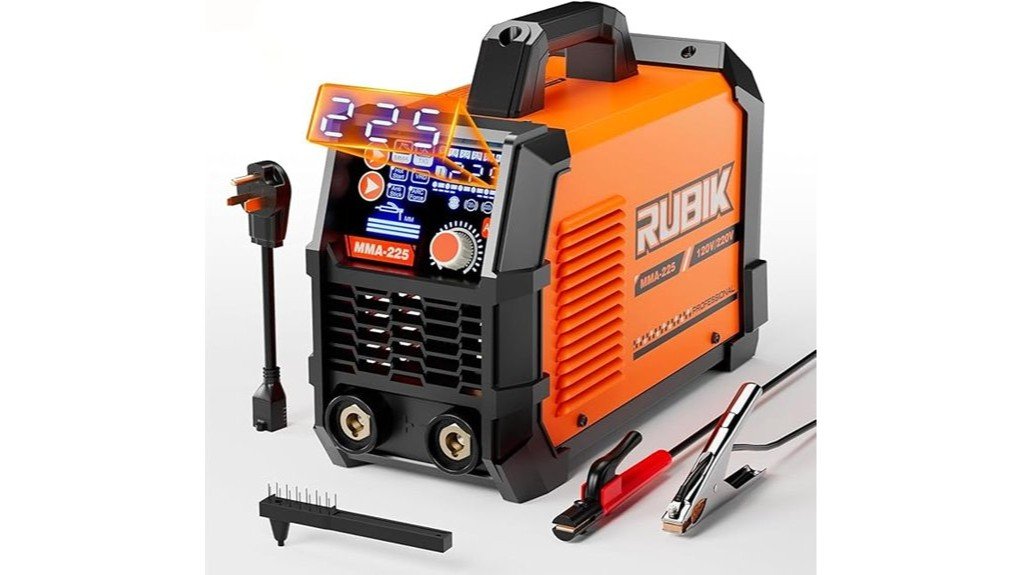
Quick answer: The 225 amp stick welder is a dual voltage (110V and 220V) IGBT inverter machine. Per the listing it offers Hot Start, Arc Force and Anti-Stick, an LCD display and a compact body. It suits hobby and home-shop repairs on mild steel. Check the output chart for 110V, since maximum amps are normally only available on the higher voltage.
If you want a small stick welder that can run on a household outlet or a 220V circuit, a 225 amp stick welder with an inverter is a common choice. This page covers what the listing says about the machine, what the Hot Start, Arc Force and Anti-Stick features do, how amps relate to voltage, and what to check before you buy. We have not tested this welder, so the details below are listing claims.
Specs at a glance (per the listing)
| Item | Per the listing |
|---|---|
| Process | Stick (SMAW) |
| Rated output | 225 amps (max) |
| Input voltage | Dual voltage, 110V and 220V |
| Technology | Digital IGBT inverter |
| Features | Hot Start, Arc Force, Anti-Stick, LCD display |
| Electrode size | Listing mentions roughly 1.6 to 2.5 mm rods |
| Check before buying | Amp output at 110V, duty cycle, plug type, weight, warranty and return terms |
What the 225 amp stick welder features do
| Feature | What it does for you |
|---|---|
| Hot Start | Gives a short burst of extra current at the start so the rod lights more easily |
| Arc Force | Raises current when the arc gets short, helping you avoid the rod sticking and keeping the arc steady |
| Anti-Stick | Cuts current if the rod sticks, so you can free it without it glowing red |
| IGBT inverter | Makes the machine lighter and smaller than older transformer units |
| LCD display | Shows the amp setting so you can match it to the rod |
Dual voltage and real amp output
A 225 amp rating does not mean you get 225 amps from every outlet. A standard 110V or 120V circuit can only supply so much power, so the maximum current available on 110V is lower than on 220V. Look for an output chart on the listing or manual that shows amps at each voltage and the duty cycle.
For most home repairs, 90 to 130 amps with 3/32 or 1/8 inch rods is plenty. If you plan to weld thicker plate, run the machine on 220V.
Who should buy it
Best for
- Home shops that may use either a 110V or 220V outlet.
- Fence, trailer, gate and farm repairs on mild steel.
- Beginners who want Hot Start and Anti-Stick help.
Skip if
- You need a high duty cycle for production work.
- You have only a weak or long extension-cord supply.
- You want to weld aluminum or thin sheet with a stick machine.
Getting started
- Match the plug and breaker to the machine’s input requirement. Do not use thin extension cords.
- Pick a rod for your base metal, such as E6013 for light mild steel work or E7018 for stronger structural welds.
- Set amps from the rod manufacturer’s range, then adjust for arc and puddle.
- Clean the metal and clamp the work lead close to the weld.
- Practice on scrap. Drag or push at a steady angle and keep a short arc.
- Chip the slag and inspect the bead before moving on.
Pro tip: If a rod keeps sticking, raise the amps a little and use a slightly shorter, firmer start.
Safety
Safety note: Wear an auto-darkening helmet rated for stick welding, leather gloves, a flame-resistant jacket and boots. Weld in a ventilated area, keep flammables away and keep a fire extinguisher near. Welding on 220V needs a properly rated circuit, so have an electrician check it if you are unsure.
Pros and limitations
Pros
- Dual voltage gives you flexibility in the shop.
- Hot Start, Arc Force and Anti-Stick help beginners.
- Inverter design is light and portable.
- LCD makes amp setting easy.
Limitations
- Maximum amps are available only at the higher voltage.
- Duty cycle, weight and warranty are not confirmed here.
- Stick welding is not ideal for thin sheet metal.
Alternatives to consider
If you want a different 110V/220V stick machine, compare it with the 250Amp dual voltage stick welder. If you mainly weld thin metal or want clean beads with less spatter, a MIG or flux-core machine may suit you better.
Related guides: 250Amp dual voltage stick welder review · stick welding amperage chart · stick welder settings chart
Frequently Asked Questions
Does a 225 amp stick welder really put out 225 amps on 110V?
Usually not. The 225 amp figure is the maximum, and it normally applies at 220V. Check the listing’s output chart for 110V.
What rods can a 225 amp stick welder use?
The listing mentions roughly 1.6 to 2.5 mm rods, which is about 1/16 to 3/32 inch. Check the manual for larger rod sizes and the rod types the machine supports.
What do Hot Start, Arc Force and Anti-Stick do?
Hot Start makes striking the arc easier, Arc Force keeps the arc steady, and Anti-Stick reduces current when a rod sticks so you can free it.
Is it good for beginners?
Those features help, but stick welding still needs practice. Start with E6013 or E7018 rods on clean mild steel scrap.
What should I check on the listing before buying?
Output amps at each voltage, duty cycle, plug type, weight, warranty and return terms. This page does not confirm those details.