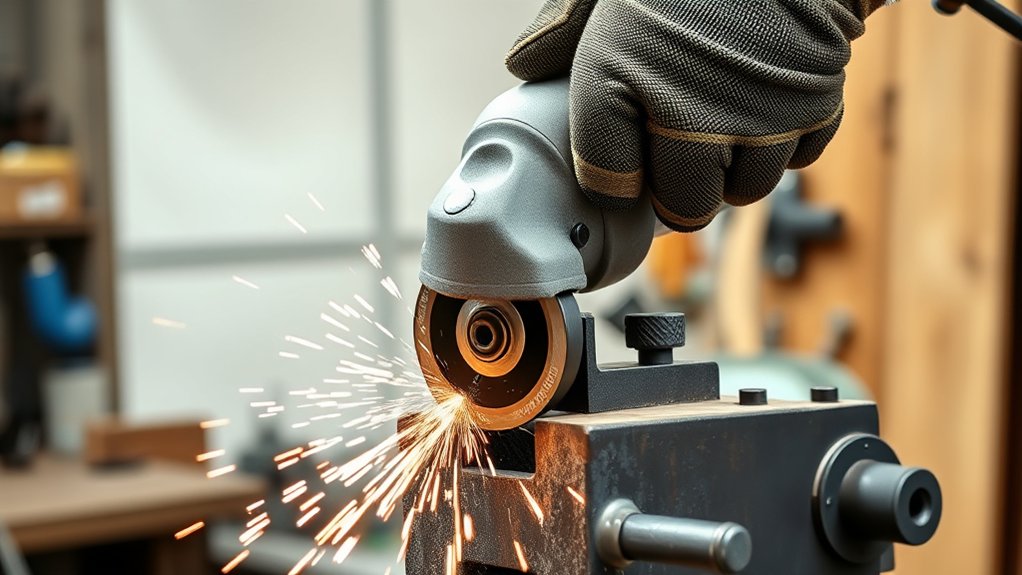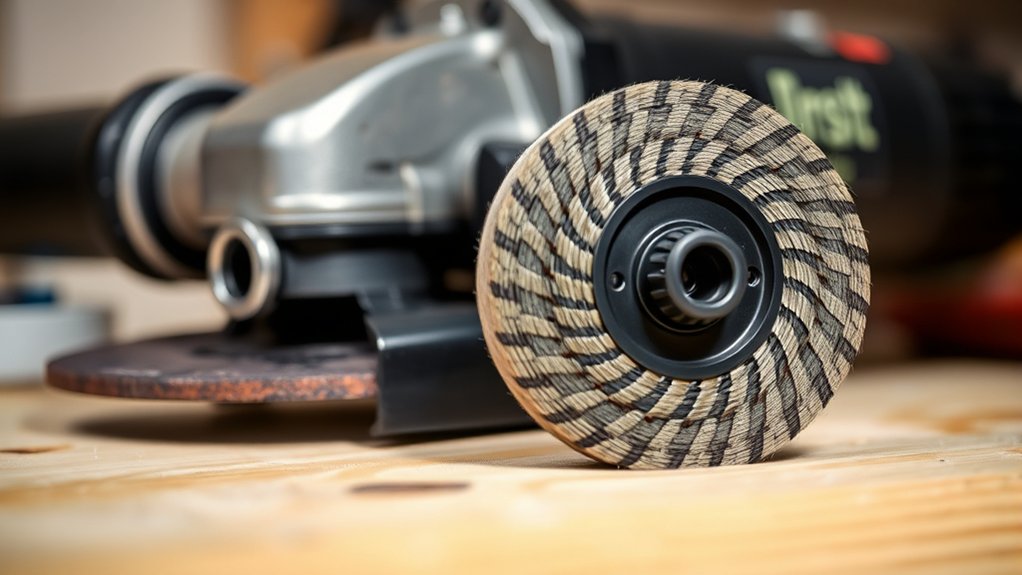
Choosing an angle grinder attachment by appearance alone can damage the workpiece and put the operator at risk. Thin cut-off wheels, bonded grinding wheels, flap discs, diamond blades, and wire wheels may fit the same grinder, but they are built for different contact angles and materials. The wheel label—not whether the package calls it a “disc” or “wheel”—should decide how you use it.
Quick Answer
Use a cut-off wheel when the goal is to separate material, a bonded grinding wheel for heavy stock removal or weld cleanup, and a flap disc for controlled grinding with a smoother finish. Match the attachment’s type, diameter, arbor, material rating, guard, and maximum RPM to the grinder.
Key Takeaways
- A standard cut-off wheel cuts with its outer edge and must not be twisted or used for side grinding.
- A bonded grinding wheel is thicker and designed for stock removal at the working angle stated on its label or instructions.
- A flap disc removes lighter amounts of material while blending scratches and leaving a smoother finish.
- Wheel shape numbers such as Type 1, Type 27, and Type 29 describe the attachment’s form, not its complete list of approved uses.
- Diameter, arbor, guard, flanges, material rating, and maximum RPM must all match the grinder.
- Use only an attachment specifically approved for the material you plan to cut or grind.
Understanding the Basics: What Are Angle Grinder Discs and Wheels?

Angle grinder discs and wheels are rotating attachments used to cut, grind, shape, clean, sand, or finish materials. You will see both words used on product labels. A manufacturer may call the same general attachment a wheel, disc, or abrasive wheel, so the name alone does not tell you whether it is safe for cutting or side grinding.
The reliable way to identify an attachment is to check its shape or type number, construction, dimensions, maximum speed, material rating, and instructions. Never assume that two attachments are interchangeable because they have the same diameter or fit the same spindle.
Cut-Off Wheels or Cutting Discs
A cut-off wheel is a thin bonded-abrasive wheel designed mainly to separate material. Common portable metal cut-off wheels are often about 1 to 3 millimeters thick, although thicker products exist. They may be flat Type 1 wheels or depressed-center Type 27 wheels.
The wheel cuts with its outside edge. Keep a standard cut-off wheel at 90 degrees to the workpiece, guide it straight through the cut, and avoid twisting, bending, or pushing sideways. Norton’s portable cut-off wheel guidance specifically says these wheels should be used for cutting rather than grinding or deburring.
Bonded Grinding Wheels
A bonded grinding wheel is thicker and more rigid than a standard cut-off wheel. Many portable grinding wheels are around 1/4 inch, or roughly 6 millimeters, thick. They are commonly used to remove weld metal, bevel edges, smooth heavy burrs, and shape steel.
Type 27 grinding wheels have a depressed center that creates clearance around the grinder’s flange and lock nut. Type 28 wheels have a more pronounced saucer shape. Use either wheel only at the working angle and on the materials listed by its manufacturer.
Flap Discs
A flap disc has overlapping pieces of abrasive-coated material attached around a hub. As the outer abrasive wears, new abrasive is exposed. This construction lets a flap disc grind and blend in one operation while generally leaving shallower scratches than a hard bonded wheel.
Flat Type 27 flap discs are often used at lower working angles and on flatter surfaces. Conical Type 29 flap discs are usually more aggressive when held at an angle. The permitted angle varies by product, so follow the label instead of relying on one universal number.
Diamond Blades and Wire Wheels
A diamond blade uses a metal core and diamond-containing rim rather than a conventional bonded-abrasive body. Depending on its rating and rim design, it may cut concrete, masonry, stone, tile, or another specified material. Confirm whether the blade is intended for wet use, dry use, or both.
A wire wheel or wire cup uses metal filaments to remove loose rust, paint, scale, and surface contamination. It is not a substitute for a cut-off wheel, and its wires can break free during use. Match its maximum RPM and guard requirements to the grinder just as you would with an abrasive wheel.
Warning: Never apply side pressure to a standard cut-off wheel. Side-loading can crack or break the wheel. Side grinding is permitted only when the attachment is clearly marked and approved for that operation, such as a purpose-built cut-and-grind combination wheel.
Key Differences Between Angle Grinder Discs and Wheels
The key difference is not the word “disc” or “wheel.” It is how the attachment is built and where it is designed to contact the workpiece. A cut-off wheel works with its thin outer edge. A bonded grinding wheel and flap disc use an approved portion of their face at a stated working angle.
| Attachment | Construction | Best For | Working Position | Do Not Use It For |
|---|---|---|---|---|
| Cut-off wheel | Thin bonded abrasive or purpose-rated cutting rim | Separating metal, masonry, or another listed material | Outer edge at 90 degrees to the workpiece | Side grinding, deburring, or twisting in the kerf |
| Bonded grinding wheel | Thick, rigid bonded abrasive | Heavy weld removal, beveling, shaping, and stock removal | Face or edge at the manufacturer’s approved angle | Narrow cutting unless it is rated as a combination wheel |
| Flap disc | Overlapping coated-abrasive flaps | Blending, deburring, rust removal, and smoother finishing | Low or moderate angle, depending on Type 27 or Type 29 design | Deep separation cuts |
| Diamond blade | Steel core with a diamond-containing rim | Rated concrete, masonry, stone, or tile applications | Outer rim aligned with the cut | An unlisted material or side grinding |
| Wire wheel or cup | Crimped or knotted wire filaments | Loose rust, scale, paint, and surface cleaning | As marked for the specific cup or wheel | Cutting or major stock removal |
The safest attachment is not the one that merely fits the spindle. It is the one whose complete label matches the grinder, guard, material, and operation.
When Should You Use a Disc or Wheel?
Choose the attachment by the result you need rather than by thickness alone.
- Make a narrow separation cut: Use a cut-off wheel or a material-rated diamond blade.
- Remove a large weld bead or shape an edge: Use a bonded grinding wheel.
- Blend a weld into the surrounding metal: Use a flap disc with a suitable grit.
- Remove loose rust, paint, or scale: Use a flap disc, nonwoven conditioning disc, or wire wheel as appropriate.
- Cut concrete, tile, masonry, or stone: Use a diamond blade or abrasive masonry wheel specifically rated for that material and for your grinder.
- Cut plastic or composites: Use an attachment only when its manufacturer specifically lists that material. A different cutting tool may provide better control and less heat.
Also consider the finish. A hard grinding wheel removes material quickly but may leave deeper marks. A flap disc generally removes less material per pass and provides more control when appearance matters.
Products Worth Considering
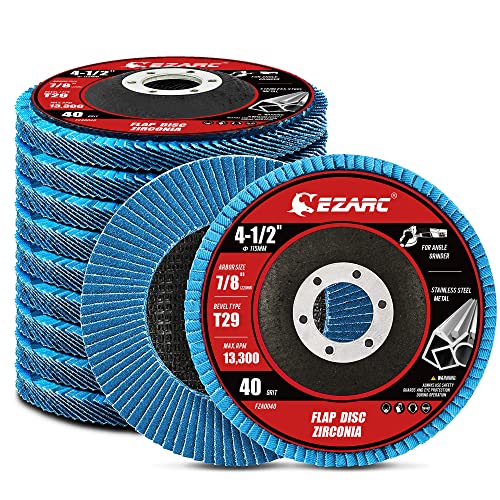
【Great Performance】EZARC flap sanding discs are made of hard zirconia material which lasts longer than standard aluminum oxide abrasive material, built for a more robust and economical grinding wheel
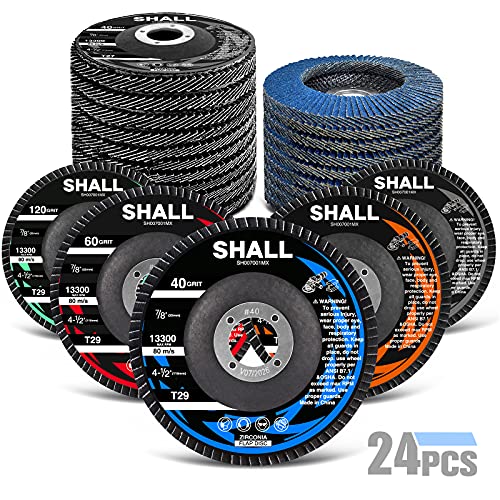
Extreme Durability and Value : Made of hard zirconia alumina material which lasts longer than standard aluminum oxide abrasive material; These flap discs also feature durable fiberglass backing plates requiring less pressure for heavy stock removal and provides with extra secure safe assurance - absorbing vibrations without smear during usage

STRONGEST FIBER BACKING THAN OTHER PRODUCTS:4 1/2 grinding wheels made for TOP-LEVEL Hard zirconia.Good material for griding wheel. This Flap Disc is constructed of industrial grade high density premium zirconia material, increased durability than standard flap discs, built for a more robust and economical grinding wheel
Quick Verdict: Which One Should You Choose?
- Need to separate the workpiece? Choose a cut-off wheel.
- Need aggressive surface removal? Choose a bonded grinding wheel.
- Need to blend, deburr, or finish? Choose a flap disc.
- Need to cut concrete, stone, or tile? Choose a material-rated diamond blade or masonry wheel.
- Need to remove loose surface contamination? Choose a wire wheel, flap disc, or conditioning disc based on the required finish.
Note: Some purpose-built combination wheels are rated for both cutting and grinding. Do not treat an ordinary cut-off wheel as a combination wheel unless the label expressly permits both operations.
Choose a Cut-Off Disc If…
Choose a cut-off disc when you need a straight, narrow cut through a material listed on the wheel. Common jobs include trimming metal stock, shortening bolts, cutting sheet metal, slicing rebar, or making a controlled cut in masonry with the correct wheel.
Align the wheel with the cut before it touches the workpiece. Keep the wheel at 90 degrees, use steady forward pressure, and avoid forcing it. Support and clamp the work so the kerf does not close around the wheel and the offcut cannot fall into the wheel’s path.
If the cut begins to wander, stop and let the wheel come to a complete halt before repositioning. Do not bend the wheel sideways to steer it back to the line.
Choose a Grinding Wheel If…
Choose a bonded grinding wheel when you need to grind down welds, bevel a thick edge, remove heavy burrs, or reshape metal. Its rigid body is designed to withstand approved face-grinding loads that would be unsafe for a standard thin cut-off wheel.
Use the angle shown on the label or in the wheel instructions. Keep the grinder moving so one area does not overheat or become deeply gouged. Excess pressure does not always improve removal speed; it can overheat the workpiece, slow the grinder, and wear the wheel unevenly.
Choose a Flap Disc If…
Choose a flap disc when you want controlled material removal and a smoother surface. Flap discs work well for blending welds, softening sharp edges, removing light scale, preparing a surface for paint, and reducing the deep scratches left by a hard grinding wheel.
Lower grit numbers cut more aggressively, while higher grit numbers leave a finer finish:
- 24–40 grit: Aggressive stock removal, heavy weld blending, and tough scale.
- 60–80 grit: General deburring, weld blending, rust removal, and paint preparation.
- 100–120 grit: Lighter finishing and scratch refinement where the product permits it.
Do not assume that a high-grit flap disc is a polishing wheel. Fine polishing normally requires a purpose-built surface-conditioning or polishing system.
How to Choose the Right Disc or Wheel for Your Job
Products Worth Considering

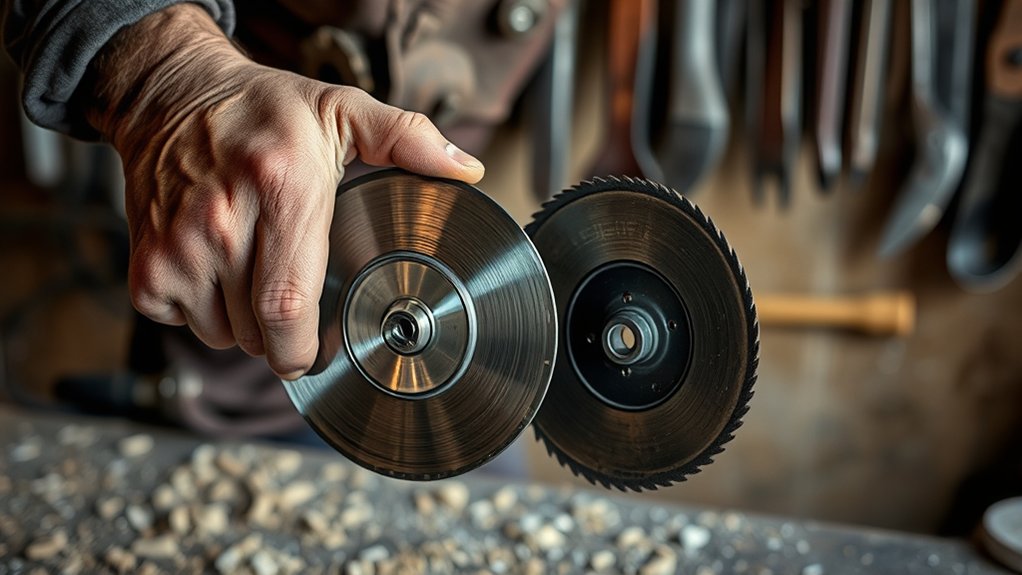
4-1/2 Inch indestructible multi-material cut off disc for Angle Grinders, 7/8" arbor with 5/8" bushing, 3 Pack


[Diamond Technology] 1 equals 100, EZARC diamond 4 1/2 cut off wheel delivers 5,000+ more cuts for metal with much lower cost per cut compared to bonded cut-off wheels
1. Identify the Operation
Decide whether you need to cut, grind, bevel, deburr, clean, sand, blend, or polish. Do not use an attachment for an operation that is missing from its label.
2. Match the Attachment to the Material
A wheel designed for one material may cut poorly, load up, overheat, contaminate the work, or fail when used on another. Check the exact material list rather than relying only on the abrasive grain name.
| Material | Common Suitable Choice | Important Check |
|---|---|---|
| Carbon steel | Metal-rated cut-off wheel, bonded grinding wheel, or flap disc | Confirm the operation, wheel type, and maximum RPM. |
| Stainless steel | Wheel specifically marked for stainless steel or INOX | Avoid cross-contamination from attachments previously used on carbon steel. |
| Aluminum and nonferrous metal | Nonferrous-rated wheel or flap disc designed to resist loading | Do not use a generic ferrous-metal wheel unless the label includes aluminum. |
| Concrete, masonry, or stone | Material-rated diamond blade or abrasive masonry wheel | Check wet/dry use, dust controls, rotation direction, and guard compatibility. |
| Tile | Tile-rated diamond blade, often with a continuous or suitable fine rim | Confirm the blade is approved for the tile type and desired cut quality. |
| Plastic or composites | Only a wheel or blade expressly approved for that material | Heat, melting, fumes, binding, and fiber dust may make another tool safer. |
3. Confirm the Diameter, Thickness, and Arbor
The wheel diameter must not exceed the grinder’s rated capacity or the size accepted by its guard. The arbor hole, threaded hub, flange, or backing pad must fit the grinder exactly. Never force a wheel onto the spindle, drill out an arbor hole, stack unapproved washers, or remove the guard to fit a larger wheel.
Thickness matters because the correct guard and flange arrangement can differ between thin cutting wheels and thick grinding wheels. Follow the grinder manual for the mounting hardware required by each wheel type.
4. Check Maximum RPM
The maximum RPM marked on the attachment must be equal to or greater than the grinder’s rated no-load speed. A wheel rated below the grinder’s speed can be overstressed even if it fits physically.
5. Use the Correct Guard and Mounting Hardware
Use the guard designed for the attachment. Position it between you and the wheel so it can deflect fragments and sparks away from your body. OSHA’s portable-tool requirements state that abrasive wheels must be used with suitable guards and that the guard on a right-angle grinder should be located between the operator and wheel.
Use only the flanges, lock nuts, backing pads, or adapters approved by the grinder and attachment manufacturers. Install the wheel in the marked direction when a rotation arrow is present.
6. Choose the Required Finish
A cut-off wheel creates a kerf but does not finish the cut edge. A grinding wheel removes material quickly but may leave coarse scratches. A flap disc provides more control for blending. Plan the sequence before starting so you do not remove more material than necessary.
Pro Tip: Keep separate attachments for cutting, heavy grinding, stainless steel, aluminum, and finishing. Mark used wheels by material so a carbon-steel wheel is not later used on stainless steel.
Common Disc and Wheel Markings You Should Check
Read the entire label before mounting an attachment. Common markings include:
- Dimensions: Usually diameter × thickness × arbor or bore, such as 115 × 1.0 × 22.23 millimeters.
- Maximum RPM: The highest spindle speed permitted for that attachment.
- Maximum surface speed: Sometimes listed in meters per second or surface feet per minute.
- Wheel shape or type: Examples include Type 1, Type 27, Type 28, and Type 29.
- Material rating: Such as steel, stainless steel, aluminum, concrete, masonry, stone, or tile.
- Approved operations: Cutting, grinding, blending, notching, or a listed combination of uses.
- Abrasive and grit: The grain or product specification and, for coated abrasives, the grit number.
- Rotation arrow: Common on directional diamond blades and some other attachments.
- Safety pictograms: Guard, eye protection, hearing protection, gloves, or restrictions on side grinding.
- Date or storage limitation: Follow any expiration or use-by marking provided by the manufacturer.
Type 27 usually identifies a depressed-center shape. It does not automatically mean that every Type 27 product has the same thickness or approved use. Type 27 grinding wheels, cut-off wheels, combination wheels, and flap discs all exist, so read the complete label.
Note: If any part of the label is missing or unreadable, do not guess at the wheel’s speed or purpose. Replace it with a clearly marked attachment.
Safety Tips for Using Angle Grinder Discs and Wheels
Angle grinders produce high wheel speeds, sparks, fragments, noise, vibration, and dust. Safe use begins before the wheel touches the workpiece.
Before Mounting the Attachment
- Unplug the grinder or remove its battery before changing an attachment.
- Confirm the grinder is switched off before reconnecting power.
- Inspect the wheel for cracks, chips, bends, water damage, missing flaps, exposed backing, or unusual wear.
- Perform a ring test only when it is appropriate for that wheel type and the manufacturer or applicable instructions require it.
- Check the grinder’s no-load speed against the wheel’s marked maximum RPM.
- Confirm the guard, side handle, flanges, lock nut, and backing pad are correct and secure.
- Make sure the wheel rotates freely without touching the guard.
Before Starting the Cut or Grind
- Clamp or support the workpiece so it cannot move, pinch the wheel, or drop unexpectedly.
- Remove fuel, solvents, sawdust, paper, insulation, and other combustible material from the spark path.
- Shield nearby people and property from sparks and fragments.
- Check for hidden electrical wiring, gas lines, plumbing, coatings, or pressurized parts.
- Wear impact-rated safety glasses with side protection. Add a face shield for face protection; do not treat the shield as a substitute for primary eye protection.
- Wear suitable hearing protection, fitted gloves, long nonflammable clothing, and protective footwear based on the task.
- Use suitable ventilation, dust extraction, and respiratory protection when the operation can release harmful dust or fumes.
Test-Run a Newly Mounted Attachment
With the guard installed, hold the grinder so no one is in line with the wheel and run the newly mounted attachment at no load in a protected area for one minute. Stop immediately if it vibrates, runs out of true, rubs the guard, or makes an unusual sound.
During Use
- Use both hands and keep the side handle installed unless the manufacturer expressly allows another setup.
- Let the grinder reach full speed before contacting the workpiece.
- Keep your body out of the wheel’s plane and maintain stable footing.
- Do not force the grinder, twist a cut-off wheel, or use excessive pressure.
- Direct sparks away from your body, other people, hoses, batteries, glass, vehicles, and combustible material.
- Do not set the grinder down until the attachment stops completely.
- Stop if the wheel chatters, smells hot, changes sound, loses cutting speed suddenly, or feels unstable.
Masonry and Silica Dust
Cutting or grinding concrete, brick, mortar, stone, and some engineered surfaces can release respirable crystalline silica. NIOSH identifies cutting, grinding, polishing, and drilling as activities that can make this dust airborne.
Use a compatible dust shroud and extraction system or an approved wet-control method when the tool, blade, and electrical setup are designed for it. Do not add water to a dry electric grinder or wheel unless the complete system is approved for wet use. Follow workplace exposure-control and respiratory-protection requirements.
Warning: Never remove the guard to fit an oversized wheel, use a wheel with an unreadable speed rating, or continue operating an attachment that is cracked, warped, loose, vibrating, or damaged.
Common Disc and Wheel Problems
| Symptom | Possible Cause | Safe Response |
|---|---|---|
| Wheel chatters or vibrates | Damage, incorrect mounting, dirty flanges, wrong arbor, or excessive wear | Stop, disconnect power, inspect the setup, and replace any questionable wheel. |
| Cut wanders | Side pressure, poor work support, worn wheel, or misalignment | Stop and realign. Do not bend the wheel sideways to correct the cut. |
| Wheel cuts slowly | Wrong material rating, glazed abrasive, low grinder speed, or excessive pressure | Verify the material and wheel rating. Replace a loaded, glazed, or worn wheel. |
| Metal turns blue or discolors | Excess heat from pressure, dwell time, or an unsuitable abrasive | Reduce pressure, keep the wheel moving, and use a cooler-cutting attachment rated for the material. |
| Wheel wears unusually fast | Incorrect angle, excessive force, wrong wheel grade, or unsuitable material | Check the instructions, angle, material rating, and grinder speed before continuing. |
| Burning smell or melting | Wrong attachment, overheated workpiece, loaded abrasive, or unsuitable plastic or coating | Stop immediately, ventilate the area, and verify that the attachment is approved for the material. |
Frequently Asked Questions
What is the difference between a grinding wheel and a grinding disc?
The terms overlap. “Grinding wheel” usually refers to a rigid bonded-abrasive attachment made for material removal, while “grinding disc” may refer more broadly to bonded wheels, flap discs, fiber discs, and other angle-grinder abrasives. Use the attachment’s complete label and approved operation rather than relying on the name alone.
What does Type 27 mean on a grinding wheel?
Type 27 describes a depressed-center shape that provides clearance around the mounting hardware. Type 27 products can include grinding wheels, some cut-off wheels, combination wheels, and flap discs, so the type number does not replace the operation and material markings.
What are three different types of angle grinder discs?
Three common types are cut-off wheels for separation cuts, flap discs for blending and finishing, and diamond blades for specified masonry, tile, stone, or concrete applications. Bonded grinding wheels and surface-conditioning discs are also common.
Can you grind with a cutting disc?
Do not grind with a standard cut-off disc. It is thin and designed for edge contact, so side pressure can crack or break it. Grinding is permitted only when the wheel is expressly marked as a combination cut-and-grind product and is used according to its instructions.
What is a grinding wheel called?
A grinding wheel may also be called an abrasive wheel, bonded abrasive, grinding disc, or depressed-center wheel, depending on its construction and the manufacturer’s terminology. The label should state its wheel type, dimensions, speed, materials, and approved operations.
Can you cut metal with a grinding wheel?
A standard bonded grinding wheel is not intended to make narrow separation cuts. Use a metal-rated cut-off wheel instead. A purpose-built combination wheel may cut and grind only when both operations are listed on its label.
Can you put a larger disc on an angle grinder?
Do not install a wheel larger than the grinder’s rated capacity. A larger wheel may exceed the guard’s size, require removal of safety equipment, or have a lower maximum RPM than the grinder. Use only diameters approved by the grinder manufacturer.
Conclusion
The right angle grinder attachment depends on the operation, material, finish, and complete compatibility with the tool. Use a standard cut-off wheel for straight separation cuts, a bonded grinding wheel for heavy material removal, and a flap disc for controlled blending and finishing. Use diamond blades, wire wheels, and combination wheels only for the materials and operations listed on their labels.
Before starting, verify the diameter, arbor, wheel type, material rating, guard, mounting hardware, and maximum RPM. Inspect the attachment, secure the work, protect yourself and nearby people, and stop immediately if the wheel vibrates, binds, overheats, or behaves unexpectedly.
Sources
- OSHA 29 CFR 1910.243: Guarding of Portable Powered Tools — guard placement, wheel inspection, and maximum operating speed.
- OSHA 29 CFR 1926.102: Eye and Face Protection — protection from flying particles and impact hazards.
- NIOSH: Silica and Worker Health — respirable crystalline silica from cutting and grinding mineral-containing materials.
- Norton Abrasives: Do’s and Don’ts of Portable Cut-Off Wheels — 90-degree cutting position, clamping, test running, and prohibition on side grinding.
- Norton Abrasives: Do’s and Don’ts of Type 27 Grinding Wheels — wheel inspection, speed checks, guards, handles, PPE, and working angles.
- 3M Abrasives: Flap Discs — flap-disc construction, wear pattern, grinding, and blending applications.