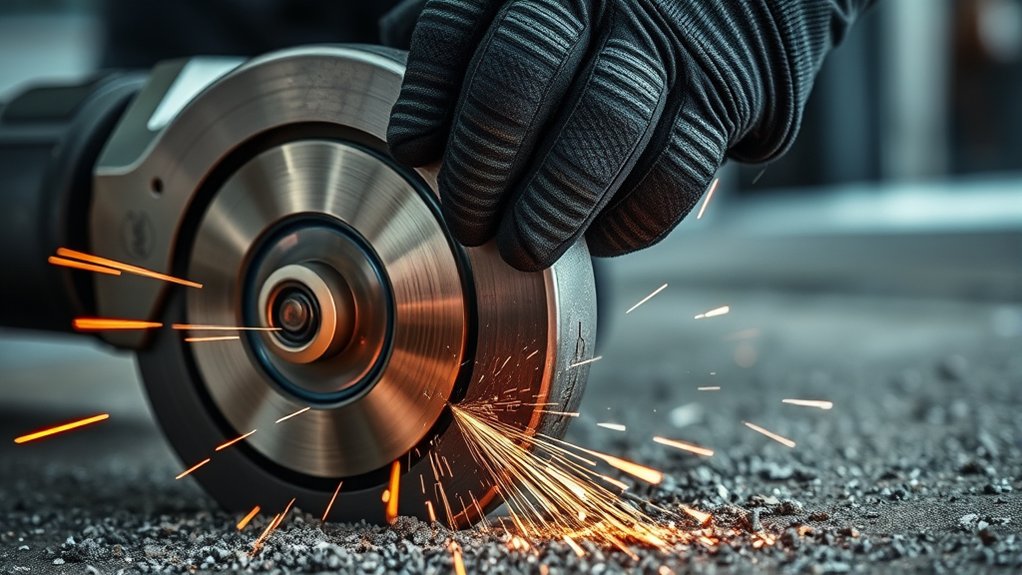
Angle grinder brakes shorten the time a wheel keeps spinning after you release the switch. That can reduce your exposure to a moving accessory, but stopping time depends on the grinder, wheel, speed, and test conditions. A brake is an added safety feature—not a substitute for the correct guard, wheel, personal protective equipment, two-handed control, or waiting for the wheel to stop completely.
Quick Answer
An angle grinder brake uses electronic motor control, mechanical friction, or both to slow the wheel after the switch is released. Manufacturer claims for current grinders range from about 1.25 seconds to under 3 seconds for specified accessories, but there is no universal two-second rule. Check the exact model specification.
Key Takeaways
- Brake stopping time is specific to the grinder, wheel, speed, and manufacturer’s test method.
- A run-down brake, kickback control, restart protection, drop control, and a no-lock paddle switch are separate safety features.
- Never place an angle grinder on a bench or floor until the accessory has stopped completely.
- The brake does not replace the proper guard, compatible wheel, side handle, two-handed grip, or protective equipment.
- Do not open or lubricate internal brake parts unless the manufacturer’s manual specifically authorizes the work.
What’s in This Article
- How Brake Technology Works in Angle Grinders
- How Rapid Deceleration Makes Angle Grinders Safer
- Comparing Brake Functions Across Different Brands
- Essential Safety Features in Angle Grinders
- Which Brake Features Should You Look for When Buying?
- How to Check an Angle Grinder Brake Safely
- Maintenance Tips for Your Angle Grinder Brake System
- What Brake Features Change in Everyday Use
- What’s Next for Angle Grinder Safety Technology?
- Frequently Asked Questions
- Conclusion
- Sources
How Brake Technology Works in Angle Grinders
A normal angle grinder motor stops receiving power when you release its switch, but the wheel’s momentum can keep it rotating. A braking grinder actively works against that momentum so the wheel reaches a complete stop sooner.
The exact stop time is not a universal safety standard. A small, light abrasive disc may stop faster than a larger grinding wheel, wire cup, flap disc, or other approved accessory. Manufacturers may also test different accessories under different conditions, so compare claims only when the model and test details are clear.
Electronic Run-Down Brakes
An electronic brake uses the grinder’s motor controls to create braking force after the switch is released. Electronic systems are common on cordless grinders, but they are also available on corded models. The power source alone does not tell you which brake design a grinder uses.
Mechanical Disc Brakes
A mechanical brake uses friction inside the tool’s drive system to slow the spindle. Certain mechanical systems can continue braking during a power interruption because their operation does not depend entirely on electronic motor control. This capability is model-specific and must be confirmed in the manual.
Brake Controls Are Not the Same Feature
| Feature | When It Activates | What It Does |
|---|---|---|
| Run-down brake | After the operator releases or switches off the tool | Shortens the wheel’s coast-down period. |
| No-lock paddle or deadman switch | When the operator releases the switch | Cuts motor power. A separate brake may then stop the accessory faster. |
| Kickback control or kickback brake | When sensors detect a bind, pinch, stall, or sudden tool movement | Cuts power and, on some models, applies the brake to reduce reaction torque. |
| Mechanical safety clutch | When the wheel binds and torque rises sharply | Limits the amount of torque transferred to the operator. |
| Restart protection | When power returns after an interruption | Prevents the tool from starting until its switch is reset. |
| Drop control | When the tool detects that it has been dropped | Turns off the motor; a brake may then reduce coast-down time. |
Note: Product names such as RAPIDSTOP™, Kickback Brake, KickBack Control, AFT®, and X-Brake refer to brand-specific systems. Read the exact model specification instead of assuming two similarly named features operate identically.
How Rapid Deceleration Makes Angle Grinders Safer
A faster stop reduces the amount of time an exposed accessory remains in motion after you release the switch. This is useful when finishing a cut, changing position, reacting to a loss of control, or preparing to place the tool down.
Enhanced User Safety
Shorter coast-down time can reduce the period in which a moving wheel could contact the operator, clothing, the power cord, the workpiece, or nearby objects. It also makes shutdown behavior more predictable.
However, a brake cannot prevent every grinder injury. It does not correct an improperly mounted wheel, replace the required guard, stop every kickback event, or protect against a wheel that bursts because it is damaged or rated below the grinder’s speed.
Warning: Keep both hands on the grinder and maintain control until the wheel has stopped completely. Never place a grinder on a bench, floor, ladder, or workpiece while its accessory is still moving—even when the tool has a fast brake.
A brake shortens coast-down time. It does not turn a spinning abrasive wheel into a safe surface.
Increased Work Efficiency
A fast brake can reduce the wait between finishing a pass and safely repositioning or storing the tool. That benefit can add up during repetitive fabrication or surface-preparation work. The productivity gain comes from a shorter controlled shutdown—not from putting the tool down before it stops.
Comparing Brake Functions Across Different Brands
Brake claims vary even within the same brand. The following examples show why you must compare exact model numbers rather than relying on a logo or product-family name.
| Brand and Example | Published Brake Claim | Related Controls | Important Caveat |
|---|---|---|---|
| Milwaukee M18 FUEL™ dual-trigger grinder | Most common accessories in under 2 seconds | Dual-trigger activation, AUTOSTOP™ kickback control, overload protection, and ONE-KEY™ | Another Milwaukee braking model lists under 3 seconds for all approved accessories, showing that RAPIDSTOP™ performance is model-specific. |
| DEWALT DCG413B | 2 seconds or less on average | Electronic brake and Kickback Brake | The phrase “on average” matters. Actual stopping behavior can vary with the accessory and conditions. |
| Makita XAG20Z | Grinding or cut-off wheel in 2 seconds or less | Electric brake and adjustable speed | Other Makita grinder sizes publish longer stopping times, so the two-second claim does not cover every model. |
| Bosch GWX14-50PBD | Described as quickly stopping the wheel; no precise time is published on the product page | KickBack Control, restart protection, drop control, soft start, overload protection, and no-lock paddle | Do not convert “quickly” into an unsupported two-second specification. |
| Metabo safety grinders | Mechanical disc brake stops the disc within a matter of seconds | Deadman switch, safety clutch, restart protection, and model-dependent fall protection | The brochure states that certain mechanical brakes continue working during a power interruption, but buyers should confirm the capability for their exact model. |
The comparison shows that “braking grinder” does not describe one fixed level of performance. Stop time, switch type, kickback response, and restart protection must all be checked separately.
Essential Safety Features in Angle Grinders
A brake is only one part of a safe grinder setup. The OSHA-supported angle grinder safety guide emphasizes correct wheel selection, proper guards, two-handed operation, personal protective equipment, and allowing the tool to stop completely.
- Correct guard: Use the guard designed for the wheel and operation. Position its closed section between you and the accessory.
- Compatible accessory: Match the wheel type, diameter, arbor, and thickness to the grinder and task.
- Adequate speed rating: The accessory’s rated RPM must meet or exceed the grinder’s maximum no-load RPM.
- Side handle: Install the handle and use both hands unless the manufacturer provides a different approved control system.
- No-lock switch: A paddle or deadman-style switch can stop motor power when your grip releases.
- Kickback response: An electronic control or mechanical clutch can reduce reaction torque if the accessory binds.
- Restart protection: Prevents unexpected startup after interrupted power.
- Drop control: Shuts the motor off when a compatible model detects a fall.
- Soft start: Reduces the initial startup reaction and helps the operator establish control.
- Personal protective equipment: Use appropriate eye, face, hearing, hand, clothing, and respiratory protection. See this guide to protective equipment for angle grinder use.
Note: A brake does not compensate for a missing guard, cracked wheel, incorrect flange, mismatched RPM rating, side-loading of a cut-off wheel, loose workpiece, or unsafe body position.
Products Worth Considering
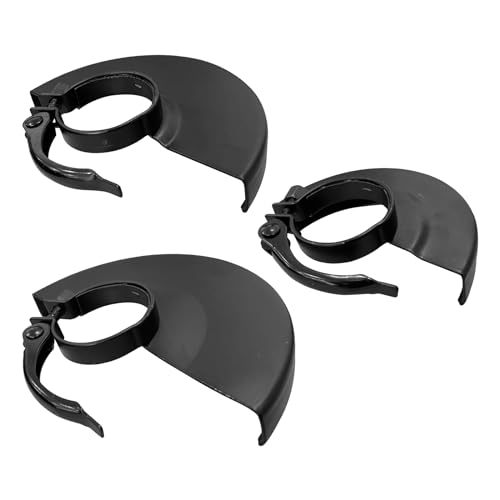
HIGH QUALITY MATERIAL: Angle grinder protective cover is made of iron material with good wear resistance and durability.

Premium metal construction for durability: Our angle grinder stand holder is made of high-quality metal material, ensuring strong hardness and long-lasting durability
Which Brake Features Should You Look for When Buying?

Start with the exact work you plan to do. A compact grinder used with thin cut-off wheels may have different brake performance and guard requirements than a larger tool used with heavy grinding wheels or wire accessories.
When comparing cordless models, do not assume every tool in the same battery platform has a brake. The same rule applies to corded grinders and models that share similar housings.
Pro Tip: Search the manufacturer’s page and manual by exact model number. Record the published stop-time wording, approved accessory sizes, switch type, guard types, and whether kickback, restart, or drop protection is actually listed.
| Feature | What to Verify | Why It Matters |
|---|---|---|
| Published brake time | Exact accessory and wording, such as “under,” “average,” or “most common accessories” | Prevents misleading comparisons between unlike tests. |
| No-lock paddle or dual-trigger control | Whether the motor shuts off when your hand releases the control | Reduces the chance that an uncontrolled tool remains powered. |
| Kickback response | Electronic sensing, kickback brake, torque control, or mechanical clutch | Can reduce reaction torque during a bind, although it cannot eliminate kickback. |
| Restart protection | Whether the switch must be reset after power returns | Helps prevent an unattended or misplaced grinder from starting unexpectedly. |
| Drop control | Whether the model detects a fall and shuts off | Adds protection if the tool leaves your hands. |
| Guards and side handle | Included Type 1/41 and Type 27 guards, adjustment method, and handle positions | The brake cannot protect you from every fragment, spark, or loss-of-control event. |
| Service support | Manual availability, parts support, warranty, and authorized service options | Brake and switch faults may require trained repair rather than user adjustment. |
Products Worth Considering

Brushless motor of the angle grinder requires no brush changes.

【POWERFUL BRUSHLESS MOTOR & 3-SPEED】Engineered for reliable home improvement and garage projects, this cordless angle grinder features a high-efficiency 21V brushless motor delivering up to 8,500 MAX RPM of smooth, robust power. As a versatile grinder tool, its intelligent 3-speed selector (3,000 / 6,000 / 8,500 RPM) lets you effortlessly dial in the exact speed needed for surface polishing, rust removal, smoothing weld seams, or heavy metal fabrication.

Brushless motor of the angle grinder requires no brush changes
How to Check an Angle Grinder Brake Safely
A functional check can help you notice a brake that behaves differently from normal. It is not a substitute for manufacturer testing, and you should never create a bind, drop the tool, or defeat a safety device to test it.
- Read the manual first. Find the manufacturer’s operating instructions and any model-specific brake description or test procedure.
- Disconnect the power. Unplug the cord or remove the battery before inspecting the grinder or accessory.
- Inspect the setup. Confirm that the wheel is undamaged, correctly mounted, approved for the tool, and rated for its maximum RPM. Install the proper guard and side handle.
- Prepare a safe area. Secure the workpiece, clear bystanders and flammable material, and put on the required protective equipment.
- Run the tool without load. Hold it firmly with both hands in a stable position and allow it to reach operating speed.
- Release the switch while maintaining control. Keep holding the grinder away from your body and nearby objects until the accessory stops completely.
- Compare its behavior with the manual and past use. Remove the tool from service if stopping becomes noticeably slower, inconsistent, noisy, or accompanied by unusual heat, smell, or vibration.
Warning: Do not touch the wheel, press it against scrap material, apply side pressure, use the spindle lock, or attempt to stop it by hand. Never test kickback control by intentionally jamming an accessory.
Maintenance Tips for Your Angle Grinder Brake System
A brake system can only perform as designed when the grinder, switch, electronics, accessory, and mechanical parts remain in serviceable condition. Most internal brake work is not a user-maintenance task.
Checks Before Each Use
- Inspect the power cord, plug, battery connection, switch, guard, side handle, flanges, and accessory.
- Check for cracks, chips, unusual wear, looseness, or damage caused by a previous drop.
- Confirm that the switch moves freely and returns as designed.
- Do not use a tool that vibrates abnormally, makes new grinding noises, smells hot, or stops inconsistently.
What to Do If the Brake Isn’t Responding
Release the switch, keep control until the wheel stops naturally, disconnect the power, and remove the grinder from service. Do not continue using it simply because the motor still runs.
A brake fault is different from an angle grinder spindle-lock problem. The spindle lock is used during approved accessory changes when the tool is disconnected and stationary. It must never be used as a running brake.
Arrange service through the manufacturer, an authorized service center, or another qualified repair technician. Internal wear, damaged electronics, a faulty switch, contaminated components, or impact damage may require specialized inspection.
Proper Cleaning and Service Boundaries
Disconnect the grinder before cleaning it. Remove loose dust from the exterior, guard, and accessible ventilation areas only as directed by the manual. Do not spray liquid cleaner, oil, grease, or solvent into the tool.
Do not open the gear housing, inspect internal brake friction parts, or apply lubricant on a fixed monthly or three-month schedule unless the manufacturer provides those instructions for your exact model.
| When | User Action | Do Not |
|---|---|---|
| Before each use | Inspect the exterior, guard, switch, handle, flanges, and accessory. | Operate damaged, loose, vibrating, or unreliable equipment. |
| After dusty work | Disconnect power and clean accessible exterior areas as the manual permits. | Force dust deeper into the housing or use unapproved liquids. |
| When braking changes | Stop using the tool and arrange qualified inspection. | Compensate by pressing the wheel against material or manually stopping it. |
| At manual-specified intervals | Follow the exact service schedule for the model. | Apply a generic lubrication or internal-inspection schedule. |
What Brake Features Change in Everyday Use
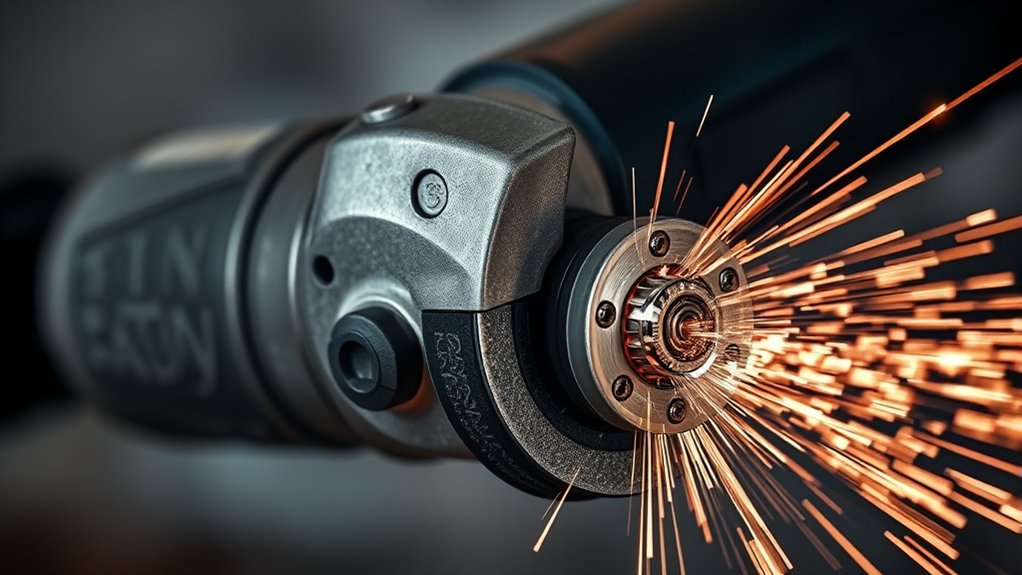
A responsive brake changes the shutdown phase more than the cutting or grinding phase. The wheel reaches rest sooner, so there is less waiting before you can safely reposition, change stations, or store the tool.
- Shorter controlled shutdown: Less time holding a completed tool away from people and objects.
- More predictable behavior: A consistent stop can make repetitive work feel easier to manage.
- Better integration with no-lock controls: Releasing the paddle cuts power and starts the braking sequence without a second action.
- Potential tradeoff: Some brakes feel abrupt, and performance can change with accessory type and size.
- Risk of false confidence: A fast brake may tempt an operator to relax grip or set the tool down too early.
The best user experience comes from a system that combines a suitable brake with a comfortable side handle, predictable switch, correct guard, low vibration, and good balance. Brake speed alone does not determine whether a grinder is safe or comfortable.
What’s Next for Angle Grinder Safety Technology?
Recent products show a clear move toward combining several controls rather than relying on one brake. Current examples include dual-trigger activation that keeps both hands engaged, movement sensing for kickback response, drop detection, restart protection, variable speed, overload protection, and connected-tool management.
Milwaukee’s current dual-trigger grinder combines two-hand activation with RAPIDSTOP™ braking and AUTOSTOP™ kickback control. Bosch offers corded models that combine a brake with KickBack Control, drop control, restart protection, and a no-lock paddle.
Future grinders will likely refine sensor response, control logic, ergonomics, and accessory-specific braking. Claims about artificial intelligence or automatic hazard prediction should be treated as speculation unless a manufacturer documents a real product and explains exactly what the system detects.
Note: New electronics add useful layers of protection, but operator training, wheel inspection, correct guarding, and safe work positioning remain essential.
Frequently Asked Questions
What is RAPIDSTOP™ and how does it differ from a standard brake?
RAPIDSTOP™ is Milwaukee’s name for the braking feature used on certain grinders. Its published stopping performance varies by model and accessory. A current dual-trigger model is described as stopping most common accessories in under two seconds, while another Milwaukee model lists under three seconds for all approved accessories. Always check the exact model specification.
Does a corded angle grinder brake work the same as a cordless one?
Not necessarily. Both corded and cordless grinders may use electronic braking, mechanical braking, or other model-specific designs. Power source alone does not identify the brake type, stopping time, or whether the tool includes kickback, restart, or drop protection.
How do I know if my grinder’s brake is still working correctly?
Follow the model’s manual and observe the grinder during a controlled no-load shutdown. Keep both hands on the tool until the accessory stops. Remove it from service if stopping becomes slower than normal, inconsistent, noisy, or accompanied by unusual heat, smell, or vibration.
What is electronic restart protection and why does it matter?
Restart protection prevents a grinder from starting automatically when power returns after an interruption. The operator must switch the tool off and reset it before operation resumes. This is separate from both the run-down brake and kickback control.
Does an angle grinder brake prevent kickback?
A normal run-down brake activates when the switch is released and does not prevent the wheel from binding. A separate kickback control, kickback brake, electronic torque control, or mechanical clutch may react to a bind and reduce reaction torque. No system can eliminate every kickback event.
Can I set the grinder down as soon as I release the paddle?
No. Continue holding the grinder in a stable position until the wheel has stopped completely. A published two-second or three-second brake claim does not guarantee the accessory has stopped under every real-world condition.
Will the brake work during a power outage?
It depends on the design. Certain mechanical brakes can continue slowing the wheel after power is interrupted, while an electronic brake may depend on available electrical energy and control circuitry. Check the manual for the exact grinder instead of assuming.
Safety Disclaimer: This article is for informational purposes only and does not replace the grinder manufacturer’s instructions, workplace safety rules, or professional technical advice. Use the correct guard and accessory, wear appropriate personal protective equipment, and consult a qualified technician if the brake, switch, electronics, or mechanical parts may be faulty.
Conclusion
An angle grinder brake is valuable because it shortens the wheel’s coast-down period, but its performance must be judged by exact model and accessory—not by a universal two-second claim. Choose a grinder that combines suitable braking with a no-lock control, kickback response, restart protection, correct guards, a secure side handle, and dependable service support. Most importantly, keep control of the tool until the accessory reaches a complete stop.
Sources
- OSHA-supported Angle Grinder Safety guide — guard use, wheel compatibility, PPE, two-handed operation, sparks, and complete-stop guidance
- Milwaukee Tool dual-trigger braking grinder announcement — under-two-second claim for most common accessories, dual-trigger activation, and AUTOSTOP™
- DEWALT DCG413B official product page — average stopping-time and Kickback Brake claims
- Makita XAG20Z official product page — model-specific electric-brake specification
- Bosch GWX14-50PBD official product page — brake, KickBack Control, restart protection, drop control, and no-lock paddle
- Metabo Angle Grinder Safety Solutions brochure — mechanical braking, deadman switches, restart protection, clutches, and guard guidance