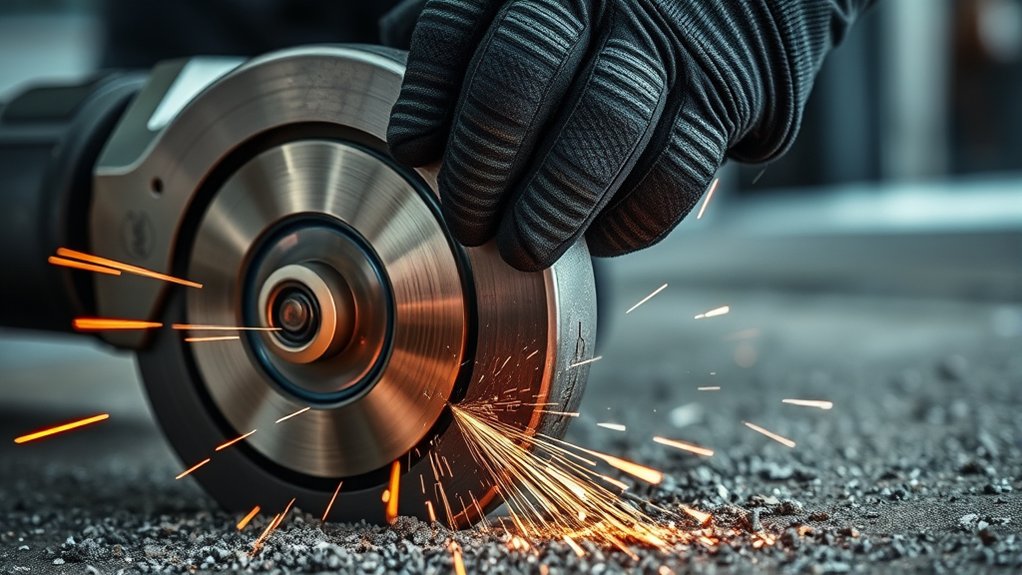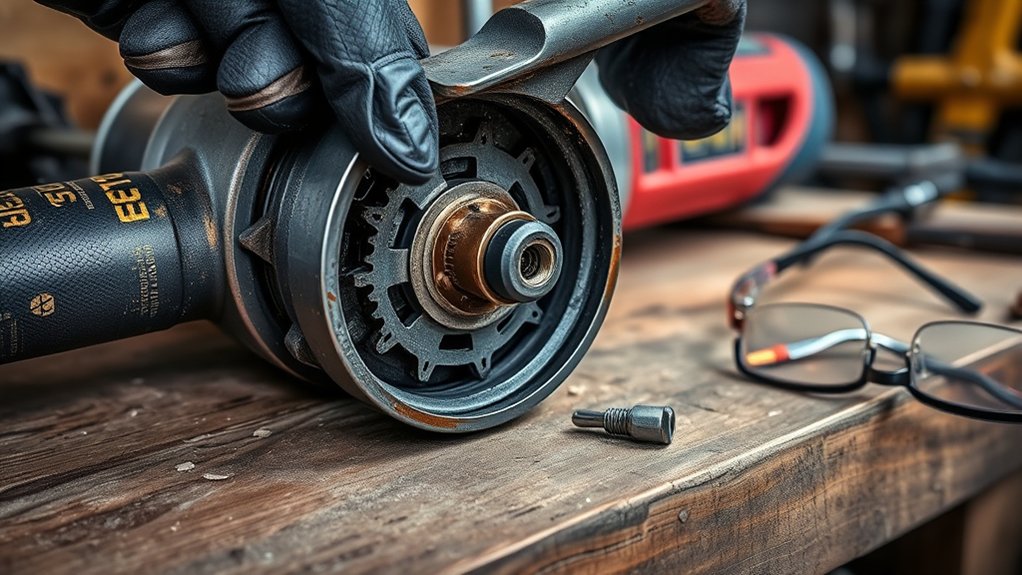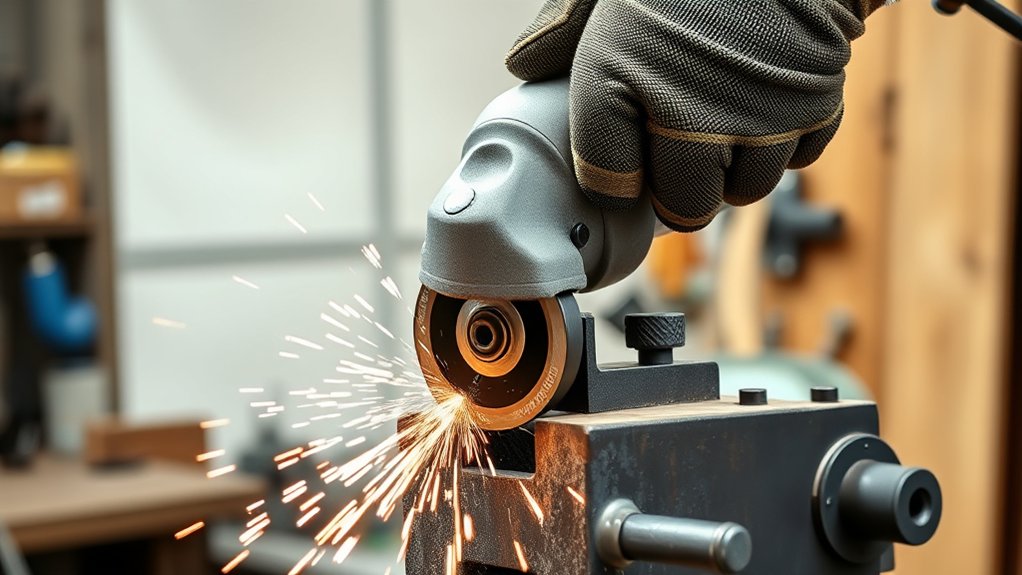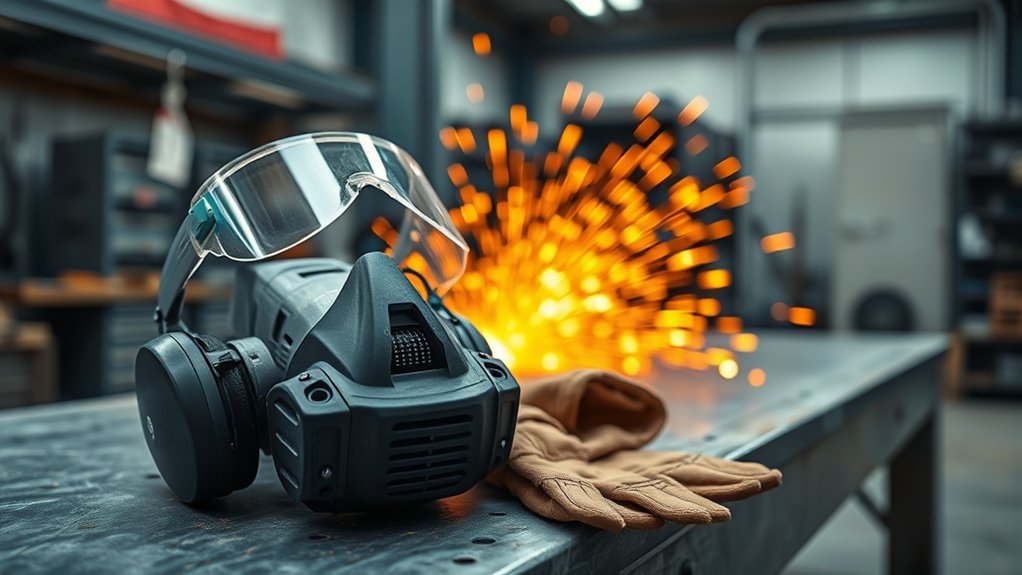
Angle grinder PPE should protect your eyes, face, hearing, hands, body, feet, and lungs from the specific hazards of the job. Wear impact-rated safety glasses with side protection or suitable goggles under a face shield, plus task-appropriate gloves, hearing protection, close-fitting clothing, and sturdy footwear. Add a NIOSH-approved respirator only after identifying the metal, coating, dust, and exposure. PPE is the last line of defense; it cannot make a damaged wheel, missing guard, wrong accessory, loose workpiece, or unsafe technique acceptable.
Last updated: July 23, 2026
Quick Answer
For angle grinding, use two layers of eye and face protection: impact-rated safety glasses with side protection or hazard-appropriate goggles, plus a compatible face shield. Add snug gloves, hearing protection, close-fitting spark-resistant clothing, sturdy footwear, and respiratory protection selected for the identified contaminant. Keep the correct guard and side handle installed, match the wheel to the task and RPM, clamp the work, and clear the spark path.
Key Takeaways
- A face shield is secondary protection. Wear it over impact-rated safety glasses or goggles, never by itself.
- Choose gloves, footwear, clothing, and respiratory protection from the actual hazards—not from a one-size-fits-all checklist.
- The wheel guard, correct accessory, side handle, safe spark path, and secure workpiece are as important as PPE.
- OSHA’s 85 dBA noise action level is an eight-hour time-weighted average; hearing protection must be selected for the measured or expected exposure.
- Do not grind unknown coatings. Paints, plating, and some alloys can create hazardous dust that an ordinary dust mask may not control.
Angle Grinder PPE by Hazard
| Flying particles or wheel fragments | Impact-rated safety glasses with side protection or suitable goggles, plus a compatible impact-rated face shield |
| Fine dust | Dust-appropriate goggles, source capture or ventilation, and a NIOSH-approved respirator selected after identifying the contaminant and exposure |
| Noise | Properly fitted earplugs, earmuffs, or both, selected for the measured or expected exposure |
| Sparks, hot particles, and sharp stock | Snug task-appropriate gloves, close-fitting long sleeves and pants, and an apron or sleeves when the spark or heat exposure requires them |
| Dropped or sharp objects | Sturdy closed footwear, with safety-toe, puncture-resistant, or metatarsal protection when the hazard assessment requires it |
Pre-Operation Gear Checklist for Angle Grinders
Before you start, inspect both your PPE and the grinder. Use this angle grinder wheel guide to check wheel types and task limits. OSHA’s angle-grinder guidance emphasizes the correct wheel, speed rating, guard, side handle, two-handed control, and secure work. A complete PPE set cannot compensate for a cracked wheel, missing guard, wrong accessory, loose workpiece, or flammable material in the spark path.
Essential PPE Items
- Primary eye protection: Impact-rated safety glasses with side protection or sealed goggles selected for the dust and impact hazard.
- Secondary face protection: A compatible impact-rated face shield worn over the glasses or goggles.
- Hand protection: Snug, task-appropriate gloves that resist the sharp edges, abrasion, and heat you expect to encounter.
- Hearing protection: Properly fitted earplugs, earmuffs, or both, selected for the noise exposure.
- Body protection: Close-fitting long sleeves and long pants made for hot-work or spark exposure; use flame-resistant clothing when the hazard assessment or site rules require it.
- Foot protection: Sturdy, closed footwear; add safety-toe, puncture-resistant, metatarsal, electrical-hazard, or other protection when those hazards are present.
- Respiratory protection: A NIOSH-approved respirator selected for the identified contaminant, if ventilation and dust collection do not control exposure.
Pre-Use Equipment Inspection
- Disconnect power or remove the battery before installing or changing an accessory.
- Check the grinder, cord or battery, side handle, flanges, spindle, and guard for damage or looseness.
- Use the guard required for the wheel and task. Position it between your body and the wheel.
- Confirm the wheel type, diameter, arbor, and maximum speed are compatible with the grinder. The accessory’s rated speed must be at least the grinder’s maximum no-load speed.
- Never use a cutting wheel for side grinding, and never use a wheel for a task the wheel or grinder manufacturer does not permit.
- Inspect the wheel for cracks, chips, moisture damage, contamination, or an expired use-by date when the manufacturer provides one.
- Mount the accessory with the specified flanges and tool. Do not force a wheel onto the spindle or use improvised adapters.
- Perform a ring test only when the wheel type and manufacturer instructions call for one; the test is not appropriate for every abrasive product.
- After assembly, stand out of the wheel’s plane and run the tool at no load in a protected area for the time stated in the grinder or wheel manufacturer’s instructions.
Work-Area and Material Check
- Identify the base material and every coating, plating, filler, or residue before grinding.
- Remove combustible materials from the spark path and protect nearby people with suitable screens or barriers.
- Clamp the work securely. Keep cords, hoses, clothing, jewelry, and hair away from the rotating accessory.
- Use local dust extraction or ventilation when the task creates airborne dust. Do not direct airflow so that it carries dust through your breathing zone.
- Follow any required hot-work permit, fire-watch, or area-restriction rules.
- Keep a suitable fire extinguisher nearby when sparks could reach combustible material, and check the area for smoldering debris after the work ends. See this guide to angle grinder sparks and fire safety for more detail.
Warning: Never remove the wheel guard to gain access to a cut. Use the correct guard and accessory for the job, or choose a different tool. A guard helps deflect sparks and may contain some fragments if a wheel fails, but it does not replace eye and face protection.
What Eye Protection Should You Wear for Grinding?
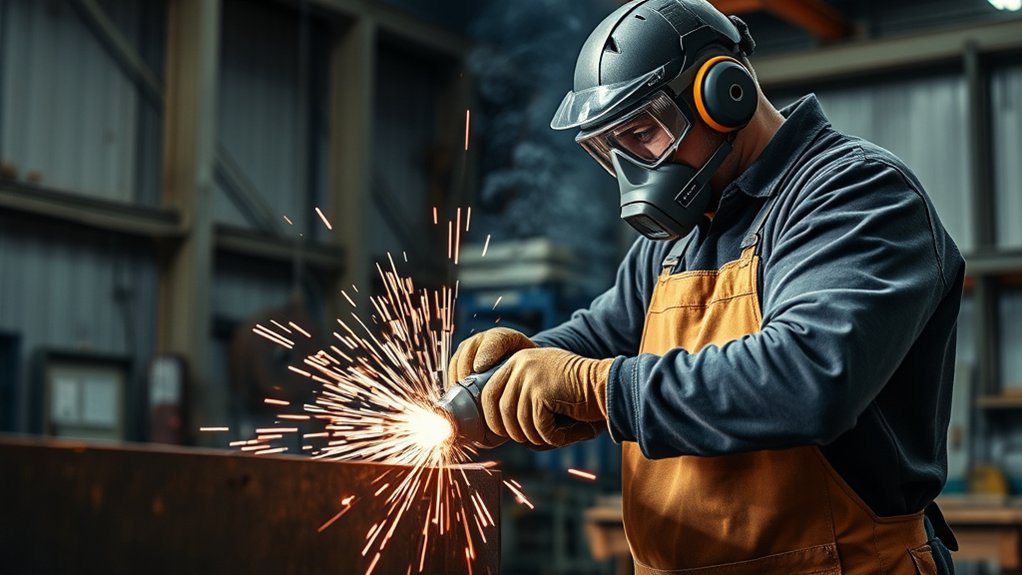
Metal grinding creates high-speed particles that can approach from the front, side, above, or below. Under OSHA’s eye and face protection rule, the protection must match the identified hazard. For high-impact work, look for eyewear and face protection marked for the applicable ANSI/ISEA Z87.1 impact level; the Z87+ mark is commonly used for high-impact-rated protectors.
Warning: Ordinary sunglasses, fashion eyewear, and prescription glasses are not substitutes for impact-rated eye protection during angle grinder work. Wear compliant safety eyewear over prescription lenses or use prescription safety eyewear designed for the hazard.
Products Worth Considering

Industrial Grade Protection - MELASA protective goggles meet ANSI Z87.1 Safety Goggles Standards and CE EN166 certificate requirements, designed for industrial, commercial, and housework.
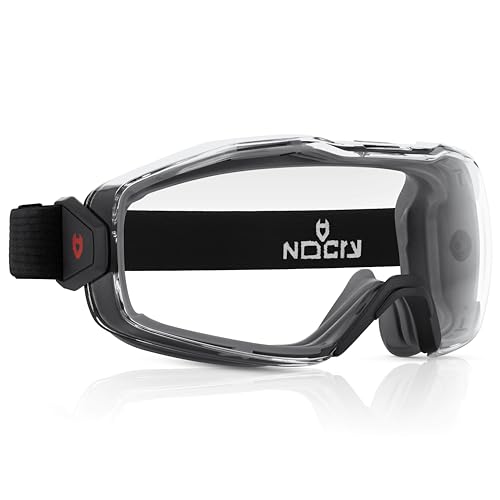
SMOOTH FIT OVER YOUR PRESCRIPTION EYEGLASSES — Want to wear your safety goggles over eyeglasses? These safety goggles fit most prescription eyewear, so you don't have to compromise on your sight. The soft TPR frame gasket with built-in slots creates a secure seal without squeezing your eye goggles or frames.

【Premium Anti-fog Coating】Hydrophilic anti-fog coating can cause fog moisture to hit the lens and absorb into the coating eliminating fog quickly and efficiently, keeping your vision clear.
Safety Glasses or Goggles?
Impact-rated safety glasses with permanent or secure side protection may be suitable for many grinding tasks. Choose goggles when fine dust can move around the frame, when the work position creates exposure from several directions, or when the hazard assessment calls for a closer seal. Indirectly vented or non-vented goggles may be needed for some dust or splash hazards, but the exact design must match the contaminant. On ANSI/ISEA-marked protectors, D4 identifies dust protection and D5 identifies fine-dust protection; these markings supplement, rather than replace, the required impact marking.
Anti-fog and scratch-resistant coatings can improve visibility, but they do not change the impact rating. The eyewear must fit securely without gaps, remain clear, and work with your respirator, hearing protection, and face shield.
Impact Markings, Condition, and Fit
The latest voluntary consensus edition is ANSI/ISEA Z87.1-2025. OSHA 29 CFR 1910.133 lists ANSI Z87.1-2010, ANSI Z87.1-2003, and ANSI Z87.1-1989 (R-1998), while also allowing eye and face protection that an employer demonstrates is at least equally effective. Buy from a traceable manufacturer, read the markings, and follow the product instructions rather than relying on the words “safety glasses” alone.
Replace eyewear that is cracked, deeply scratched, pitted, distorted, chemically damaged, or unable to stay in position. Clean it with products approved by the manufacturer; solvents can damage some lens materials and coatings.
Do You Need a Face Shield With an Angle Grinder?
A face shield protects more of your face from sparks, hot particles, and larger fragments, but it is secondary protection. OSHA’s PPE selection guidance states that face shields should be worn over primary eye protection such as safety glasses or goggles.
Choose a shield that:
- Has the correct impact marking for the hazard and comes from a traceable manufacturer.
- Covers the front and sides of the face without leaving large gaps.
- Fits over your eye protection and respirator without breaking the respirator seal.
- Allows a full field of view and does not drop into the wheel’s path when you bend or turn.
- Uses replacement visors approved for that headgear.
A clear polycarbonate visor is common for grinding, but material alone does not prove compliance. Inspect the visor, crown, pivots, and headband before each use. Replace any part that is cracked, warped, loose, badly pitted, or no longer locks in position.
A face shield protects your face; impact-rated glasses or goggles protect your eyes. For grinding, use both layers when the hazard assessment calls for face protection.
What Gloves Are Best for Angle Grinder Use?
The best glove is the one selected for the sharp edges, heat, abrasion, and handling demands of the task. OSHA does not certify a universal “angle grinder glove.” Its hand-protection rule requires employers to select appropriate protection based on the task, conditions, duration, and hazards.
- Leather gloves may help with sparks, rough edges, and limited heat exposure, but verify the glove manufacturer’s temperature and task limits.
- Aramid or other cut-resistant gloves can improve cut and abrasion resistance when handling sharp stock.
- Heat-resistant gloves may be needed when handling recently ground parts, but heat resistance must be verified for the expected temperature and contact time.
- Coated work gloves may improve grip, but the coating must be compatible with oils, solvents, and other substances present.
The current ANSI/ISEA 105-2024 classification system can help compare cut, puncture, abrasion, and certain heat-performance ratings. A higher cut rating is not automatically better if the glove becomes bulky, reduces control, or does not address the actual hazard.
Pro Tip: Choose snug gloves with secure cuffs and enough dexterity to operate the switch and hold both handles. Keep every part of the glove away from the wheel. Never use a gloved hand to slow, steady, or touch a moving accessory.
What Hearing Protection Do You Need for Grinding?
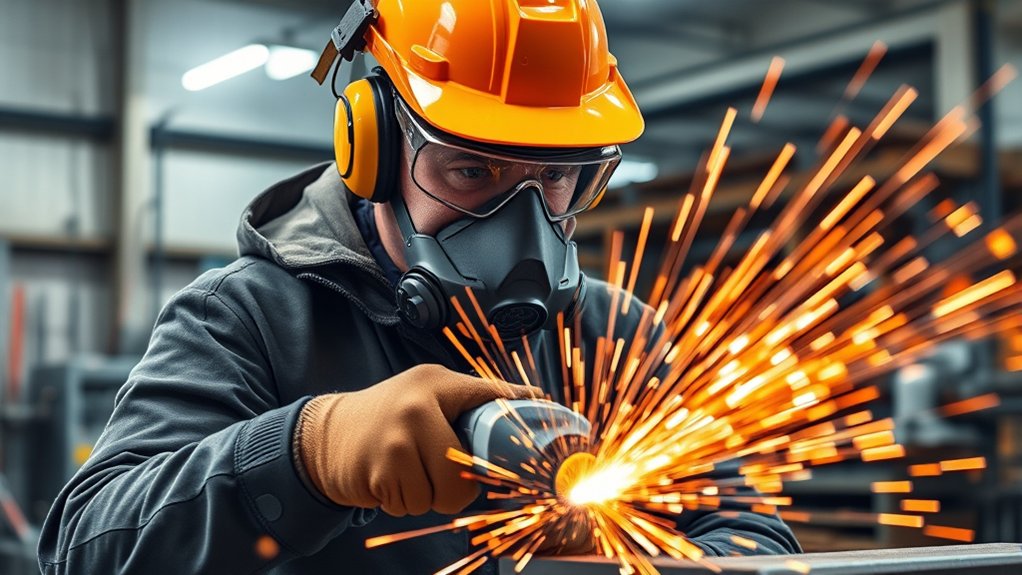
Grinding noise varies with the grinder, wheel, material, pressure, enclosure, and distance. It can reach hazardous levels, so measure exposure when possible and follow site or employer requirements. OSHA’s 85 dBA action level is an eight-hour time-weighted average for general industry—not a statement that every sound above 85 dBA instantly violates the rule.
Choose earplugs or earmuffs by fit, compatibility, and the protection needed for the exposure. The package Noise Reduction Rating (NRR) is a laboratory rating that must be adjusted and evaluated for the actual noise environment; a blanket rule such as “NRR 25 for every grinder” is not reliable. NIOSH advises selecting protection that brings the estimated protected exposure into roughly the 75–85 dBA range, because too much attenuation can make communication and warning signals harder to hear.
- Insert foam plugs with clean hands and follow the roll-pull-hold fitting method supplied by the manufacturer.
- Make sure earmuff cushions seal around the ear and are not lifted by eyewear temples, hair, hats, or respirator straps.
- Use both plugs and muffs when the noise assessment or site program requires double protection. NIOSH recommends double hearing protection for exposures of 100 dBA or greater.
- Replace hardened cushions, stretched headbands, dirty plugs, or any protector that no longer fits correctly.
Note: Consumer noise-canceling headphones are not automatically hearing protectors. Use products with an applicable hearing-protection rating and verify that they provide enough attenuation for the measured exposure.
What Clothing Should You Wear for Angle Grinding?
Wear close-fitting long sleeves and long pants that cover exposed skin without loose cuffs, drawstrings, frayed edges, or open pockets that can catch sparks. Remove jewelry, tie back long hair, and keep clothing away from the wheel.
For routine metal grinding, durable workwear that resists ignition and does not melt easily is preferable. Use flame-resistant clothing when the material, spark volume, surrounding combustibles, employer hazard assessment, manufacturer instructions, or hot-work rules call for it. Flame-resistant does not mean fireproof, and contaminated or damaged garments may provide less protection.
- Keep clothing free of oil, grease, solvents, and combustible dust.
- Button collars and cuffs so sparks cannot collect against the skin.
- Use a leather apron, sleeves, or other task-specific protection when sparks are heavy or directed toward the body.
- Wash and maintain flame-resistant garments exactly as the manufacturer specifies; some cleaners, softeners, bleach products, or alterations can affect performance.
What Footwear Should You Wear for Grinding?
Grinding can expose your feet to dropped tools, sharp offcuts, hot particles, and slippery debris. Wear closed, sturdy footwear with an outsole suited to the floor and work area. Safety-toe footwear is appropriate when falling or rolling objects create an impact or compression hazard, but the protective toe may be steel, alloy, composite, or another compliant design.
Choose Protection for the Actual Foot Hazard
The active ASTM F2413-24 standard covers performance requirements for safety-toe footwear and optional protections such as metatarsal, puncture-resistant, conductive, static-dissipative, and electrical-hazard features. Read the footwear label and select the markings needed for the job. A toe cap by itself does not provide ankle, puncture, metatarsal, or slip protection.
Why Slip-Resistant Soles Matter
Choose an outsole designed for the surface and contaminants in your work area, then keep the tread clean and in good condition. No shoe is slip-proof. Remove metal chips, dust, cords, and wet debris from the floor instead of relying on footwear to compensate for poor housekeeping.
What Respirator Do You Need for Metal Grinding?
Grinding can create particles from the base metal, abrasive wheel, paint, plating, rust, filler, or surface contamination. The correct control depends on what those materials contain. Use source capture, a compatible shroud, local exhaust ventilation, wet methods where the tool and process allow them, or another engineering control before relying on a respirator.
A disposable N95 filtering facepiece respirator filters at least 95% of airborne particles under the NIOSH test and may be suitable for some non-oil particulate hazards after an exposure assessment. A P100 filter filters at least 99.97% of airborne particles under the NIOSH test and is strongly resistant to oil. Neither an N95 nor a P100 particulate filter protects against gases or vapors unless the approved respirator also uses the correct cartridge.
Products Worth Considering

NIOSH P100 RATED PROTECTION: The P100 Half-Mask respirator with replaceable filters offers reliable protection against dust, metal fumes, and oil mist

NIOSH-APPROVED OV/AG/P100 RATED filters for at least 99.97% filtration efficiency against solids and liquid aerosols, as well as oil-based particulates

NIOSH-APPROVED: 3M Particulate Filter 2097, P100 provides at least 99.97% filtration efficiency against solids and liquid aerosols, as well as oil-based particulates
Choose the Respirator by Material and Coating
- Uncoated mild steel: Control dust at the source and select particulate protection from the exposure assessment.
- Stainless or chromium-containing material: Evaluate possible chromium exposure before grinding; do not assume a general dust mask is enough.
- Galvanized or zinc-coated metal: Identify the coating and use ventilation and respiratory protection selected for the resulting airborne hazard.
- Painted, plated, or unknown surfaces: Stop and identify the coating. Lead, cadmium, chromium compounds, and other hazardous substances may require specialized controls, regulated work practices, and medical or exposure monitoring.
- Concrete, mortar, stone, or engineered stone: Treat respirable crystalline silica as a separate hazard and follow the applicable silica-control requirements and tool instructions.
Grinding and welding create different contaminant mixtures. Do not reuse a welding respiratory-protection plan for grinding without a separate assessment of the material, coating, abrasive, and airborne exposure.
Respirator Fit and Use
In a workplace, required respirator use falls under OSHA’s respiratory protection standard, which includes medical evaluation, selection, training, fit testing for tight-fitting respirators, maintenance, and a written program. Facial hair cannot cross the sealing surface or interfere with valves. Perform a user seal check every time you put on a tight-fitting respirator.
Replace filters or cartridges according to the manufacturer, the employer’s change schedule, damage, contamination, breathing resistance, or breakthrough indicators. Do not wait for odor alone; some contaminants have poor warning properties. Never use an air-purifying respirator in an oxygen-deficient or immediately dangerous atmosphere.
Warning: Do not grind unknown paint, plating, or residue. Stop and identify the material first. A particulate respirator cannot make an unidentified chemical exposure safe.
How Do You Check Angle Grinder PPE Compatibility?
PPE can fail when one item interferes with another. Put on the complete set and check it as a system before powering the grinder.
- The face shield must close fully without striking the respirator or pushing the safety glasses out of position.
- Eyewear temples, hair, caps, and respirator straps must not break the seal of earmuffs.
- Safety glasses or goggles must not interfere with the seal of a tight-fitting respirator.
- Gloves must allow full control of the trigger, paddle switch, lock-off, and auxiliary handle.
- Clothing and apron edges must stay clear of the wheel and ventilation openings.
- Head protection may be required where overhead or falling-object hazards exist; use accessories approved for the specific hard hat or helmet.
What Angle Grinder PPE Mistakes Should You Avoid?
- Wearing a face shield alone: Add impact-rated safety glasses or goggles underneath.
- Calling any clear lens “safety glasses”: Check the manufacturer, markings, side protection, condition, and hazard rating.
- Using a generic dust mask: Identify the contaminant and use a NIOSH-approved respirator selected for it.
- Assuming an N95 handles paint fumes or vapors: Particulate filters do not provide gas-and-vapor protection unless the approved respirator has the correct cartridge.
- Choosing gloves only by cut level: Balance cut, abrasion, heat, grip, fit, and dexterity.
- Wearing loose clothing or jewelry: Secure or remove anything that can enter the wheel or catch sparks.
- Picking hearing protection by the biggest NRR number: Select and fit protection for the actual exposure and ensure it works with other PPE.
- Keeping scratched or damaged PPE: Replace items that no longer provide clear vision, secure fit, intact barriers, or reliable protection.
- Using PPE to justify unsafe tool setup: Keep the guard installed, use the side handle, match the wheel to the tool, and secure the workpiece.
How Do You Put On Angle Grinder PPE Correctly?
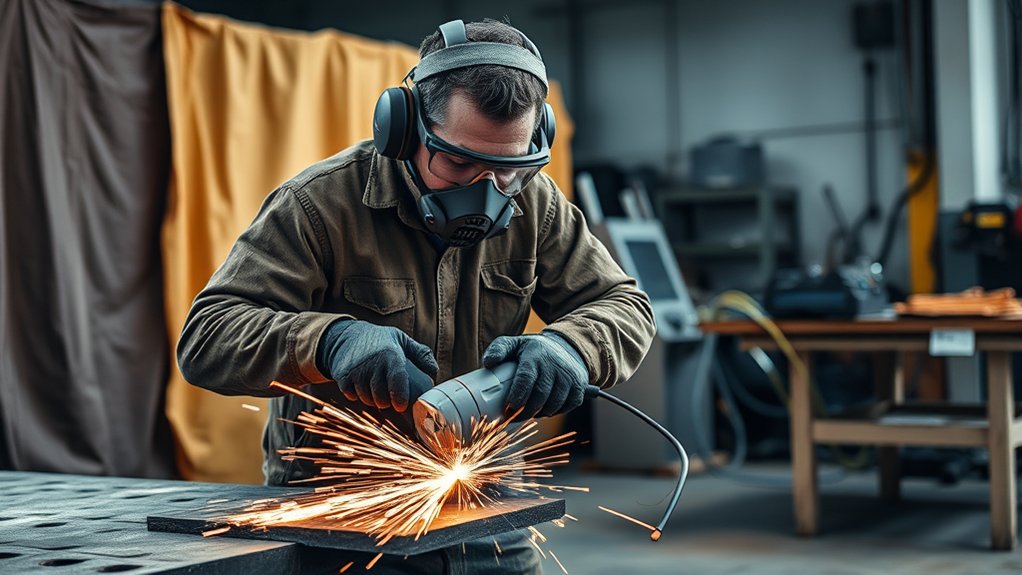
- Identify the hazards. Confirm the material, coating, wheel, expected dust, noise, spark path, and nearby work.
- Control the source. Install the correct guard and side handle, secure the work, remove combustibles, and use dust extraction or ventilation where needed.
- Dress for the task. Put on close-fitting protective clothing and sturdy footwear, then secure hair and remove jewelry.
- Fit hearing and respiratory protection. Insert plugs or seat earmuffs correctly. Put on the selected respirator, adjust straps, and complete the required seal check.
- Add primary eye protection. Put on impact-rated safety glasses with side protection or the selected goggles. Confirm clear vision and secure fit.
- Lower the face shield. Make sure it covers the face, stays locked, and does not disturb the eyewear or respirator.
- Put on the selected gloves. Check that you can operate the switch and hold the grinder with both hands.
- Perform a final compatibility check. Turn your head, bend, and grip the tool while it is unplugged or has the battery removed. Nothing should shift, snag, block vision, or break a seal.
- Inspect after use. Let hot material cool, disconnect the tool, clean PPE as directed, replace damaged parts, and store everything away from dust, sunlight, chemicals, and deformation.
Frequently Asked Questions
What PPE is required when using an angle grinder?
A common baseline is impact-rated primary eye protection, with a face shield added for sparks and fragment hazards. Most grinding also calls for hearing protection, task-appropriate gloves, close-fitting protective clothing, and sturdy footwear. Respiratory, head, metatarsal, puncture, electrical, or flame-resistant protection depends on the material, exposure assessment, manufacturer instructions, employer rules, and work area.
Can I use regular safety glasses instead of goggles for grinding?
Impact-rated safety glasses with adequate side protection may be suitable for some grinding tasks. Goggles are preferable when fine dust can pass around the frames or the work position exposes your eyes from several directions. In either case, use a face shield over the primary eye protection when your face is exposed to sparks or fragments.
Can I wear a face shield without safety glasses?
No. A face shield is secondary protection and can leave gaps around the sides and bottom. Wear impact-rated safety glasses or goggles underneath it so your eyes remain protected if a particle travels around the shield or the visor is lifted.
How loud is an angle grinder, and what hearing protection do I need?
Noise varies by tool, wheel, material, pressure, and room. Measure the exposure when possible. Select earplugs, earmuffs, or both so the expected protected exposure is within the applicable limit and the devices fit correctly with your other PPE. OSHA’s 85 dBA action level is based on an eight-hour time-weighted average.
Are gloves safe to wear with an angle grinder?
Task-appropriate gloves are commonly used to protect against sharp stock, abrasion, and hot particles. They must fit securely and allow full control of the grinder. Keep them away from the rotating accessory, and never touch or slow a moving wheel with a gloved hand.
Do I need an N95 respirator for metal grinding?
Not automatically. An N95 may be suitable for some non-oil particle hazards, but the correct respirator depends on the base metal, coating, abrasive, airborne concentration, and ventilation. N95 and P100 particle filters do not protect against gases or vapors unless the approved respirator also has the correct cartridge.
When should I replace my angle grinder PPE?
Replace PPE when it is cracked, torn, contaminated, deformed, deeply scratched, unable to fit securely, or outside the manufacturer’s service-life instructions. Replace respirator filters and cartridges according to the approved change schedule, damage, contamination, increased breathing resistance, or other manufacturer and workplace criteria.
Can I grind painted, galvanized, or stainless metal with ordinary PPE?
Do not assume ordinary PPE is enough. Identify the metal and coating first. Paint, plating, stainless alloys, and residues may contain lead, chromium, cadmium, zinc, or other substances that require specific dust controls, ventilation, respirators, regulated work practices, or exposure monitoring.
Can I use a welding helmet in grind mode instead of a face shield?
Only when the helmet manufacturer permits grinding and the complete helmet, visor, and installed components carry the impact protection required for the hazard. Grind mode changes the lens shade; it does not by itself prove impact protection. Wear impact-rated safety glasses or goggles underneath because the helmet remains secondary face protection.
Safety Disclaimer: This article provides general information, not a site-specific hazard assessment or professional occupational-safety advice. Follow your grinder and accessory manufacturers’ instructions, applicable OSHA rules, employer procedures, and the direction of a qualified safety professional. Stop work when the material, coating, exposure, or required protection is unknown.
Your PPE is only effective when it matches the hazard, fits correctly, works as a complete system, and stays in serviceable condition. Take a few minutes to identify the material, inspect the grinder and wheel, control dust and sparks, and replace damaged protection before the tool starts.
Sources
- OSHA 29 CFR 1910.132: General PPE Requirements — hazard assessment, selection, condition, and training
- OSHA 29 CFR 1910.133: Eye and Face Protection — eye and face protection requirements and accepted consensus standards
- OSHA Appendix B to Subpart I: PPE Selection Guidelines — face shields worn over primary eye protection and hazard-based selection
- OSHA-Supported Angle Grinder Safety Toolbox Talk — wheel compatibility, guard use, test runs, two-hand control, and PPE
- OSHA 29 CFR 1910.95: Occupational Noise Exposure — noise action level, exposure evaluation, and hearing protectors
- NIOSH Hearing Protection — fit, compatibility, protected exposure, and double protection
- OSHA 29 CFR 1910.134: Respiratory Protection — respirator selection, programs, fit testing, seals, and maintenance
- NIOSH Filtering Facepiece Respirators — N95, P100, particle filtration, and limitations
- International Safety Equipment Association Standards — current ANSI/ISEA Z87.1-2025 eye and face protection and ANSI/ISEA 105-2024 hand protection standards
- ANSI/ISEA Z87.1-2025 Marking Guide — impact, dust, fine-dust, splash, filter, and anti-fog markings
- ASTM F2413-24: Protective Safety-Toe Footwear — current performance requirements and protective-footwear classifications