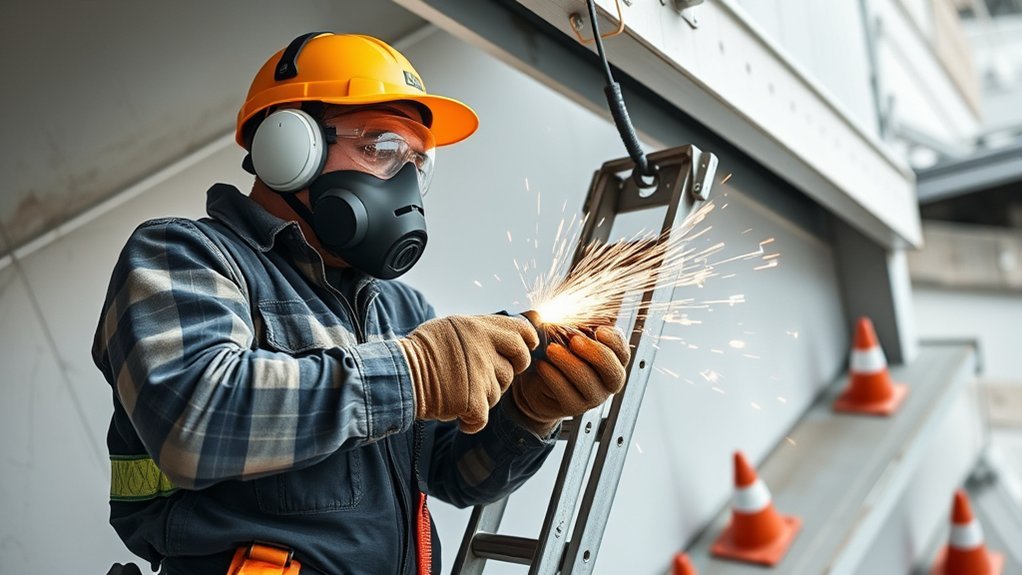
Angle grinder sparks are usually tiny pieces of metal thrown from the workpiece by the abrasive disc. The particles are heated during grinding and continue to oxidize in the air, which produces the bright trails you see. Spark color, length, and branching can offer clues about the metal, but they also create a serious burn and fire hazard.
Quick Answer
An angle grinder sparks when its abrasive disc removes and ejects small metal particles. Many steel particles glow as they oxidize in the air. Normal sparks should leave the workpiece, not the grinder housing. Control them with the correct disc, guard, two-handed grip, fire-resistant shielding, and a clear landing area.
Key Takeaways
- Visible grinding sparks are hot, oxidizing metal particles rather than electrical sparks.
- Mild steel, high-carbon steel, stainless steel, cast iron, aluminum, and titanium can produce very different spark streams.
- Use only a disc that matches the material, grinder size, attachment type, and maximum RPM.
- Never remove the guard, side-load a cut-off wheel, force the grinder, or direct sparks toward people or combustibles.
- Heavy arcing inside the grinder, smoke, a burning odor, rough operation, or sudden power loss means you should stop and disconnect the tool.
At a Glance
| Time Required | About 5–10 minutes for inspection and setup, plus any required post-work fire-watch period |
| Difficulty | Moderate risk; use only after reading the grinder and disc instructions and receiving any required workplace training |
| Tools Needed | Compatible grinder and disc, installed guard and side handle, clamps, eye and face protection, hearing protection, suitable clothing, spark screen, and appropriate fire extinguisher |
| Cost | Usually no added cost when the correct PPE, guarding, clamps, and fire protection are already available |
Warning: Treat the entire spark path and landing area as hot work. Sparks can pass through cracks, enter wall or floor openings, reach the opposite side of a metal panel, or settle in dust and debris where a fire may begin after grinding stops.
Essential Safety Measures When Using Angle Grinders
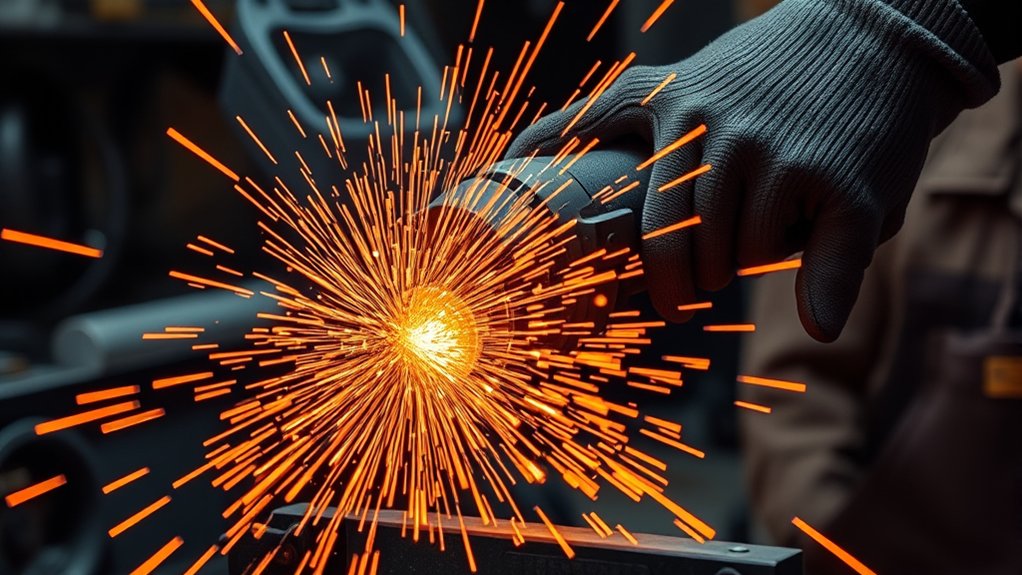
Safe spark control starts before the grinder touches the metal. Follow the tool and attachment manufacturers’ instructions and complete these checks:
- Inspect the grinder. Check the guard, side handle, switch, power cord or battery, spindle, and ventilation openings. Do not use a grinder that is damaged, unusually hot, rough-running, or difficult to control.
- Inspect the disc or attachment. Look for cracks, chips, warping, moisture damage, heavy wear, contamination, or an expired date on bonded wheels. Never install a damaged attachment.
- Match the ratings. The disc’s maximum RPM must equal or exceed the grinder’s maximum no-load RPM. Its diameter, arbor, flange, and intended use must also match the tool.
- Install the correct guard. Position it between your body and the wheel so it helps contain fragments and redirects sparks away from you.
- Secure the workpiece. Clamp it so it cannot move, pinch a cut-off wheel, fall, or redirect the grinder.
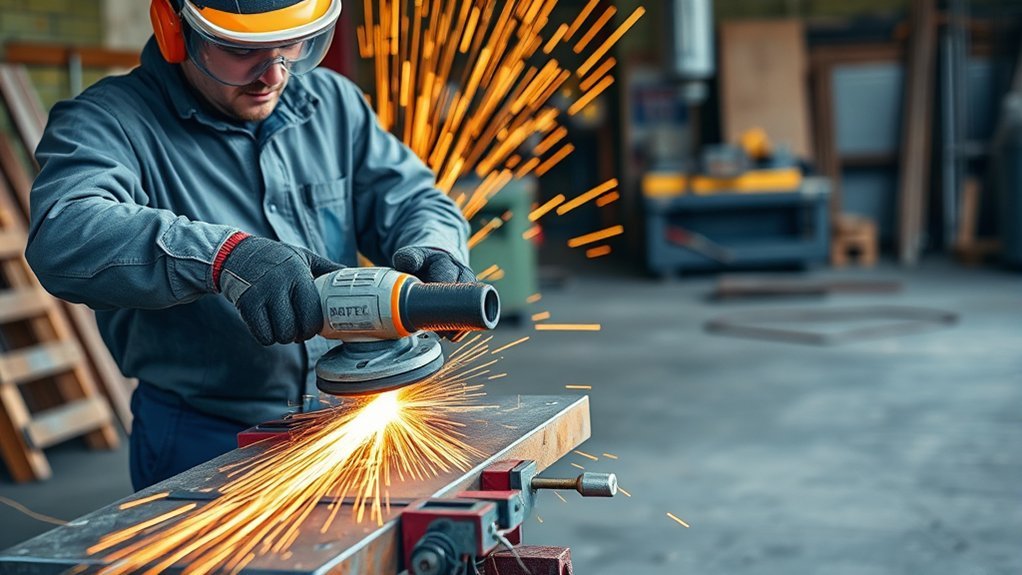
- Wear suitable PPE. Use safety glasses or goggles beneath a face shield, plus hearing protection, protective footwear, close-fitting clothing, and other protection required for the material and task.
- Use both hands. Keep one hand on the main grip and the other on the side handle. Maintain stable footing and keep your body out of the wheel’s direct plane.
The Canadian Centre for Occupational Health and Safety recommends inspecting the grinder and attachment before each use, securing the work, holding the tool with both hands, matching attachment speed ratings, maintaining the guard, and directing sparks away from people.
Products Worth Considering

SUPERIOR PROTECTION — Experience all-around face protection thanks to the curved design of this faceshield. The visor of this face guard is ANSI Z87+ certified, and up to 2x thicker for increased durability. Plus, you can comfortably wear your grinding face shield over prescription glasses.

Included: (1) DeWalt N441218 Angle Grinder Guard Replacement for Angle Grinder DCG414B

HIGH IMPACT FACE SHIELD - Sellstrom's Advantage Face Shield is ideal for various types of machinery, welding, cutting, grinding, woodworking, and other types of work that present potential hazards to the face
What Causes Sparks From Angle Grinders?
Each abrasive grain on a grinding wheel acts like a tiny cutting edge. As the disc moves across the workpiece, it removes small fragments of metal. The particles leave the contact point hot, and reactive metals such as iron continue to oxidize in the surrounding air. That oxidation supplies much of the heat that makes the particles glow.
The bright trail behind a grinder is a stream of heated, oxidizing metal particles—not electricity leaving the workpiece.
The appearance and reach of the spark stream depend on several factors:
- Workpiece composition: Carbon content, alloying elements, hardness, and microstructure affect color, branching, brightness, and spark density.
- Wheel speed: Particle launch speed is influenced strongly by the surface speed of the rotating disc.
- Abrasive type and grit: The abrasive and its roughness affect particle size and how quickly material is removed.
- Pressure: Excessive force can produce more visible sparks and heat, but it also increases the risk of binding, overheating, loss of control, and disc failure.
- Surface condition: Rust, scale, paint, plating, oil, and contamination can change the spark stream and introduce additional hazards.
Which Metals Produce Grinding Sparks?
| Material | Typical Visible Behavior | Important Limitation |
| Mild or low-carbon steel | Long yellow-white stream with relatively few forks | Coatings and alloying elements can alter the pattern |
| Higher-carbon steel | Denser stream with more forks, bursts, or repeated splitting | The pattern cannot confirm an exact grade or carbon percentage |
| Stainless steel | Often fewer, shorter, darker orange sparks than plain carbon steel | Different stainless families produce different patterns; control hazardous dust |
| Cast iron | Shorter, less continuous red or orange stream | Cast composition and wheel choice affect the result |
| Aluminum or copper | Usually few or no obvious visible sparks during ordinary grinding | Use an abrasive specifically approved for the material; dust and wheel loading remain hazards |
| Titanium | Very bright white sparks despite being non-ferrous | Fine titanium particles and dust can present severe fire hazards |
Note: “Non-ferrous” does not mean “non-sparking.” Aluminum and copper often show little visible sparking, while titanium can produce an intense white spark stream.
How Your Steel Choice Affects Sparks
Plain-carbon steels are often described as hypoeutectoid or hypereutectoid according to how their carbon content compares with the eutectoid composition, which is close to 0.8% carbon. This classification describes the steel’s microstructure; it is not a safety rating.
A laboratory study using high-speed video found that sparks from its hypoeutectoid sample commonly split once in a quick burst. Sparks from its hypereutectoid sample showed more complex behavior, including repeated splitting and the continuous release of smaller sparks.
The researchers found that their observations were consistent with a long-standing explanation involving cementite, an iron-carbide phase written as Fe3C. As oxygen enters a particle, oxidation can produce carbon dioxide pockets. Pressure may rise until the brittle outer oxide breaks and the particle splits. The greater amount and distribution of cementite in the hypereutectoid sample helped explain its more frequent and erratic branching.
You can review the study in From the Microstructure of Steels to the Explosion of Sparks.
Can You Identify Steel by Its Sparks?
A spark test can help an experienced operator make a rough comparison between an unknown sample and a known reference. Useful observations include spark color, stream length, volume, branching, and where bursts occur.
However, pressure, wheel condition, wheel speed, surface contamination, heat treatment, lighting, and alloying elements can all change the result. Do not use a hand-held spark test as proof of an exact steel grade. Use traceable material records, positive material identification, spectroscopy, or laboratory analysis when the composition affects welding, structural integrity, heat treatment, or safety.
The Role of Temperature in Angle Grinder Sparks
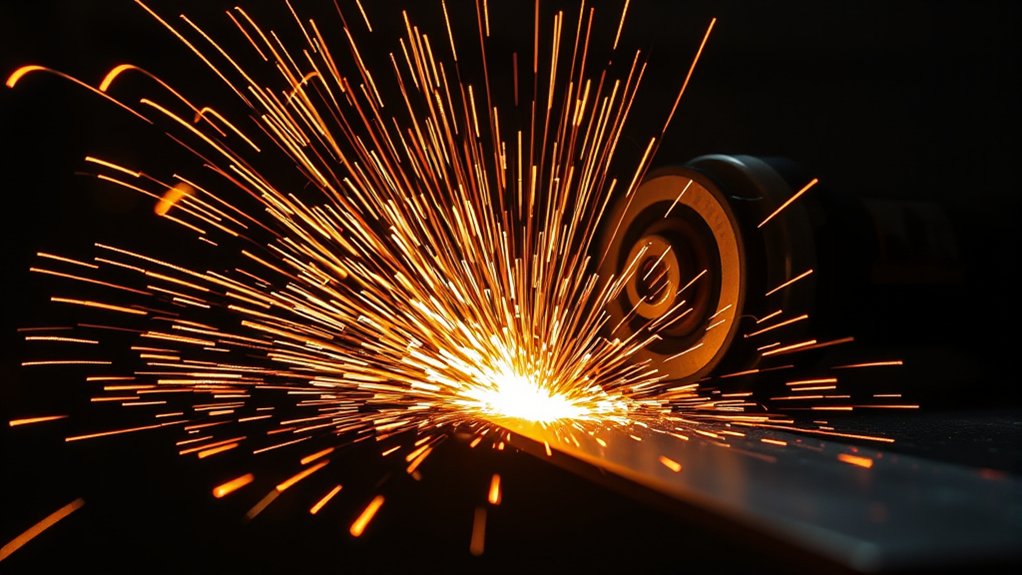
Grinding creates severe local deformation and heating where the abrasive contacts the metal. Once a particle leaves the workpiece, oxidation may continue heating it for a short distance. It then cools through contact with the air and by releasing thermal radiation.
As an oxide layer grows around the particle, it can slow the movement of oxygen into the metal. The spark eventually cools enough to stop glowing. This explains why a visible trail fades, but it does not mean the particle is safe when it lands.
Applied force can change the number and visible reach of sparks. In the steel-spark study, greater force produced more sparks and a longer visible spark field, but the average initial particle speed did not show a clear dependence on force. The measured launch speeds were close to the grinding disc’s tangential speed.
Pro Tip: Let the abrasive do the work. Heavy pressure does not make an unsafe disc cut correctly. If progress is slow, stop and check the disc type, wear, RPM rating, direction, workpiece support, and grinder condition.
How Temperature Influences Spark Splitting and Its Fire Safety Implications
Hotter or larger particles can carry more energy into the landing area, but ignition does not depend on temperature alone. Particle size, quantity, travel path, airflow, fuel type, fuel moisture, dust concentration, and whether a particle becomes trapped can all affect whether a fire starts.
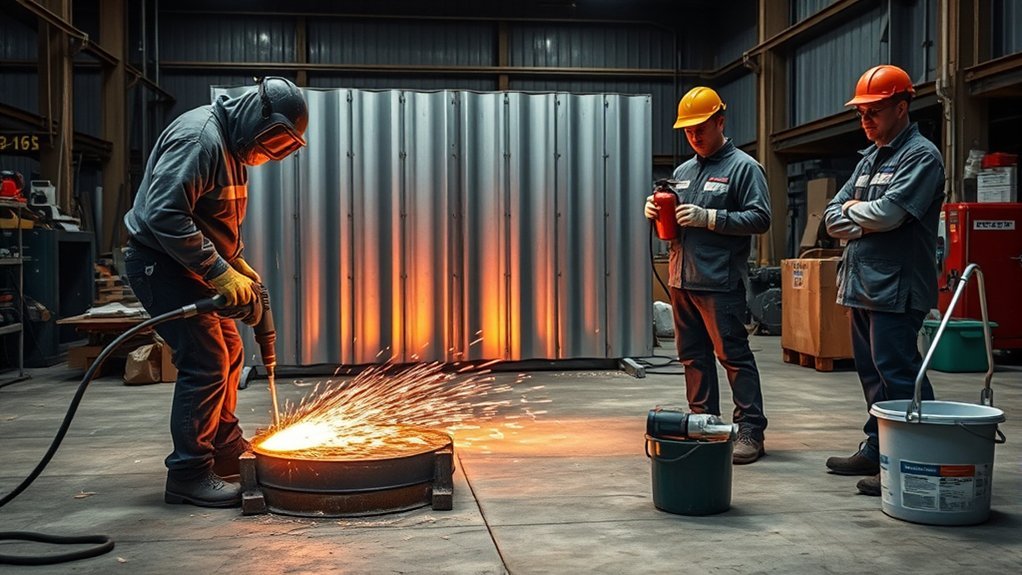
Before grinding, remove combustible materials from the spark path and inspect areas above, below, behind, and on the opposite side of the work. Protect anything that cannot be moved with a suitable fire-resistant screen or cover. Do not use ordinary plastic sheeting, cardboard, clothing, or a flammable drop cloth as a spark barrier.
OSHA’s general-industry hot-work rule uses 35 feet (10.7 m) as a combustible-clearance benchmark for welding and cutting. It also requires a fire watch in specified hazardous conditions and says that watch must continue for at least 30 minutes after the work ends. OSHA’s shipyard guidance expressly includes grinding among spark-producing hot-work operations.
Note: The exact permit, clearance, fire-watch, and monitoring requirements depend on your workplace, jurisdiction, building, and fire conditions. Follow the stricter rule when your employer, fire code, site permit, or local authority requires more protection.
Before, During, and After Grinding Fire Checklist
- Before: Remove combustibles, sweep up dust and debris, check nearby openings, identify hidden spaces, select a safe spark direction, and place suitable extinguishing equipment within immediate reach.
- During: Watch the entire spark path, not only the wheel. Stop when people enter the area, the spark direction changes, a shield moves, or combustible material appears.
- After: Disconnect the grinder, wait for the disc to stop, inspect every exposed and concealed landing area, and continue any required fire watch for the full specified period.
How to Control Grinding Sparks Safely
You cannot eliminate normal steel sparks, but you can control their direction and reduce unnecessary spark production:
- Plan the spark path before starting. Position the work so sparks travel toward bare concrete, clean steel, or another non-combustible collection area.
- Adjust the guard correctly. Keep the guard between your body and the wheel while leaving only the opening needed for the task.
- Use a fire-resistant spark screen. Place it far enough from the wheel that it cannot catch, collapse into the disc, or cause sparks to rebound toward the operator.
- Use the correct working angle. For ordinary surface grinding with a right-angle grinder, follow the disc manufacturer’s specified angle. Do not use the side of a cut-off wheel.
- Apply light, steady pressure. Forcing the wheel can increase heat, binding, kickback, and breakage risk.
- Keep the workpiece stable. Movement can redirect sparks or pinch the disc.
- Stop before repositioning. Release the trigger, wait for the wheel to stop completely, and disconnect the power before changing the guard, disc, handle, or workpiece.
CCOHS’s grinder-attachment guidance recommends inspecting discs, using correct flanges, matching RPM ratings, avoiding twisting and excessive pressure, and running a newly mounted wheel in a protected position before beginning work.
Products Worth Considering

Tailored Fit for Baldor Grinders: Specifically designed for 6" through 8" Wheel Baldor Grinders, this bench grinder tool ensures a snug and secure fit. The product showcases its compatibility on a 6" model, making it a sought-after accessory for those with small grinder or small bench grinder needs.

Cost-Efficient Replacement: Why invest in a complete assembly when you only require a part? This product offers a practical and cost-effective solution for those looking to replace their Baldor GA10 & GA11 eyeshield or GA9 lighted eyeshield. Perfect for those in need of bench grinder replacement parts without the added expense of unnecessary components.

【360° Adjustable Viewing Protection】Designed with a fully adjustable panel that rotates 360 degrees, allowing welders to position the shield at the most comfortable angle for enhanced visibility and eye protection during welding, cutting, and grinding tasks.
Grinding Dust, Coatings, and Ventilation
Spark control does not address every grinding hazard. The process also creates airborne dust and debris that may contain metal, abrasive material, paint, rust, plating, or surface treatments.
- Identify coatings before grinding. Old paint, chromate primer, galvanizing, plating, and unknown industrial coatings may contain hazardous substances.
- Use source capture when required. Position suitable local exhaust close to the grinding point without allowing hoses or equipment to enter the spark path.
- Do not rely on a household fan. A fan may spread dust, disturb the spark stream, or expose other people.
- Prevent dust accumulation. Fine combustible dust can create a flash-fire or explosion hazard when dispersed and exposed to an ignition source.
- Use material-specific respiratory controls. Select ventilation and respiratory protection through the applicable safety data, exposure assessment, and workplace program.
Grinding stainless steel and chromium-containing materials can expose workers to hazardous metal dust. OSHA identifies hexavalent chromium as a carcinogenic substance that can damage the respiratory system, skin, eyes, kidneys, and liver. Do not grind unknown stainless, coated, or plated material in an unventilated space.
Recognizing Dangerous Motor Sparks
Normal workpiece sparks leave the point where the disc contacts the metal. Sparks, flashes, or arcing inside the grinder are electrical or motor-related and require a different response.
| Observation | Likely Meaning | Action |
| Consistent sparks leaving steel at the contact point | Usually normal material removal | Maintain safe direction, pressure, guarding, and fire controls |
| Sudden increase in workpiece sparks with slow cutting | Wrong, glazed, loaded, worn, or overheated abrasive; excessive pressure may also be involved | Stop, disconnect, and inspect the disc and setup |
| Sparks changing direction unexpectedly | Work movement, wheel deflection, poor angle, binding, or loss of control | Release the trigger, wait for a complete stop, and correct the setup |
| New or heavy flashes visible through motor vents | Possible brush, commutator, armature, wiring, contamination, or overload problem | Stop immediately and have the grinder inspected according to its service instructions |
| Smoke, burning odor, melting, crackling, or loss of power | Serious electrical, motor, battery, or overheating fault | Disconnect or remove the battery when safe, move away from combustibles, and do not reuse the tool until repaired |
A small, steady amount of brush arcing may be visible through the vents of some brushed grinders, especially under load. However, you should not assume that every internal flash is normal. Compare the behavior with the manufacturer’s manual and stop using the grinder when the arcing becomes heavier, changes suddenly, circles the commutator, or appears with heat, odor, smoke, rough operation, or reduced power. A brushless grinder should not produce carbon-brush arcing.
Warning: Never open, test, or service a plugged-in grinder. Battery tools can also retain hazardous energy. Use the manufacturer’s service procedure or have the tool inspected by a qualified repair technician.
Frequently Asked Questions
Why is my angle grinder sparking?
Sparks leaving the contact point are usually heated metal particles removed from steel or another reactive metal. Sparks or heavy flashes inside the grinder can indicate worn brushes, commutator damage, contamination, overload, wiring trouble, or another motor fault.
Can sparks from an angle grinder cause a fire?
Yes. Grinding sparks and hot particles can ignite paper, sawdust, dry vegetation, solvents, combustible dust, insulation, fabric, and debris. They may also pass through openings or heat the opposite side of thin metal. Clear and shield the area, keep suitable extinguishing equipment ready, and follow all applicable hot-work and fire-watch rules.
How do you control grinding sparks?
Plan the spark path, reposition the workpiece when possible, adjust the installed guard, use a fire-resistant spark screen, clamp the work securely, hold the grinder with both hands, and apply light, steady pressure. Never aim sparks at people, gas cylinders, vehicles, wiring, glass, batteries, or combustible material.
What causes electrical sparks inside an angle grinder?
On a brushed grinder, electrical contact between the carbon brushes and commutator can produce some arcing. Heavy or newly increased arcing may result from worn or sticking brushes, a damaged commutator or armature, conductive dust, loose wiring, overload, or a failing bearing. Stop using the tool when the arcing is continuous, severe, or accompanied by smoke, odor, heat, noise, or power loss.
Why does aluminum produce fewer visible sparks than steel?
Steel particles often oxidize rapidly enough to glow brightly after leaving the wheel. Aluminum usually produces fewer obvious visible sparks during ordinary grinding, but it still creates heat, chips, and potentially hazardous dust. Use only an abrasive specifically approved for aluminum or other non-ferrous material.
Do more sparks mean the grinder is cutting better?
Not necessarily. Spark volume changes with the metal, wheel, grit, speed, pressure, and contact area. A large spark stream paired with poor material removal may mean the disc is wrong, worn, glazed, loaded, overheated, or being forced. Stop and inspect the setup instead of applying more pressure.
Conclusion
Normal angle grinder sparks come from hot metal particles leaving the workpiece and oxidizing in the air. Their shape and color can provide useful clues about the material, but they cannot confirm an exact alloy or prove that the grinder is operating safely.
Control the hazard by matching the disc to the tool and material, checking its RPM rating and condition, keeping the guard and side handle installed, securing the workpiece, using both hands, and directing the spark stream into a clear, fire-resistant area. Stop immediately when sparks come from the housing or appear with smoke, odor, overheating, vibration, unusual noise, or loss of power.
Sources
- OSHA 29 CFR 1910.252 — General Requirements — combustible clearance, fire-watch conditions, extinguishing equipment, and post-work monitoring.
- OSHA 29 CFR 1910.215 — Abrasive Wheel Machinery — abrasive-wheel guarding requirements.
- CCOHS — Use of Portable Grinders — two-handed control, attachment ratings, inspection, PPE, ventilation, and spark direction.
- CCOHS — Use of Grinder Attachments — disc inspection, flanges, guards, RPM compatibility, pressure, and test running.
- Guillen et al. — From the Microstructure of Steels to the Explosion of Sparks — oxidation, steel microstructure, spark speed, and splitting behavior.
- OSHA — Hexavalent Chromium — health hazards associated with chromium-containing metals and hot-work exposure.