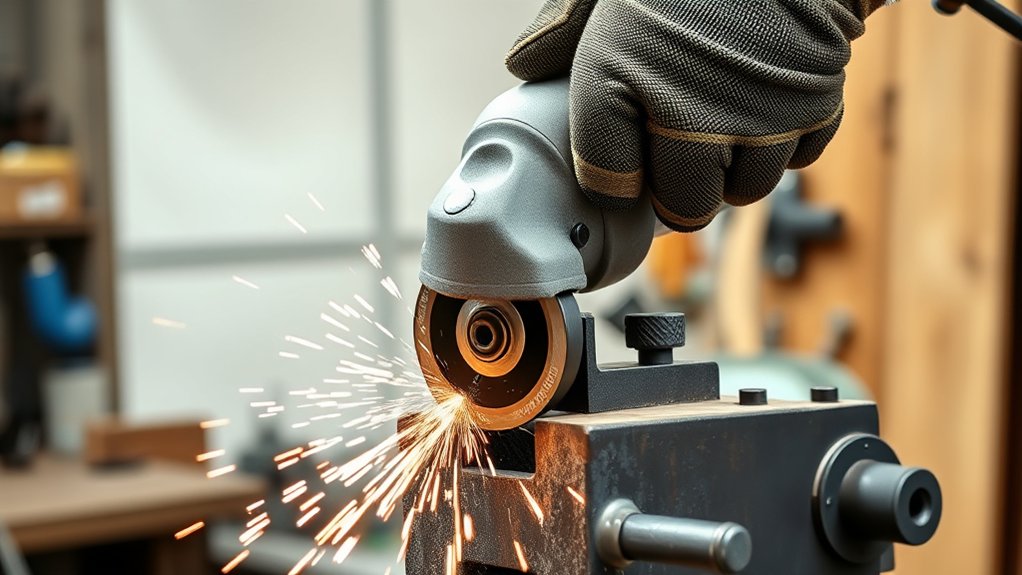
Angle grinder wheels are not interchangeable. A grinding wheel is built to handle surface pressure, a cut-off wheel is built to cut with its edge, and flap, wire, diamond, conditioning, and polishing accessories each work differently. Choosing the wrong attachment, guard, flange, size, or speed rating can damage the wheel and create a serious injury risk.
Quick Answer
Use a grinding wheel for heavy stock removal, a cut-off wheel for straight cuts, a flap or fiber disc for blending, a wire brush for cleaning, and a diamond blade for compatible masonry. Match the material, diameter, arbor, guard, flange, and maximum RPM to your grinder before starting.
Key Takeaways
- Use each wheel only for the application printed on its label. A cutting-only wheel must not be used for side grinding.
- The accessory’s maximum RPM must equal or exceed the grinder’s no-load speed.
- Match the wheel diameter, arbor, flange, and guard to the grinder manufacturer’s instructions.
- Choose abrasives made for the work material; steel, stainless steel, aluminum, tile, and concrete may require different products.
- Use impact-rated eye protection, a face shield, hearing protection, suitable clothing, and task-specific dust controls.
- Inspect every wheel, disc, brush, pad, guard, and flange before use. Do not install damaged or poorly fitting accessories.
Warning: Never put side pressure on a cutting-only wheel. Use the cutting guard and flanges specified in your grinder manual, keep the guard between you and the wheel, and never install a wheel whose maximum RPM is lower than the grinder’s no-load speed.
Angle Grinder Wheels: Types and Uses
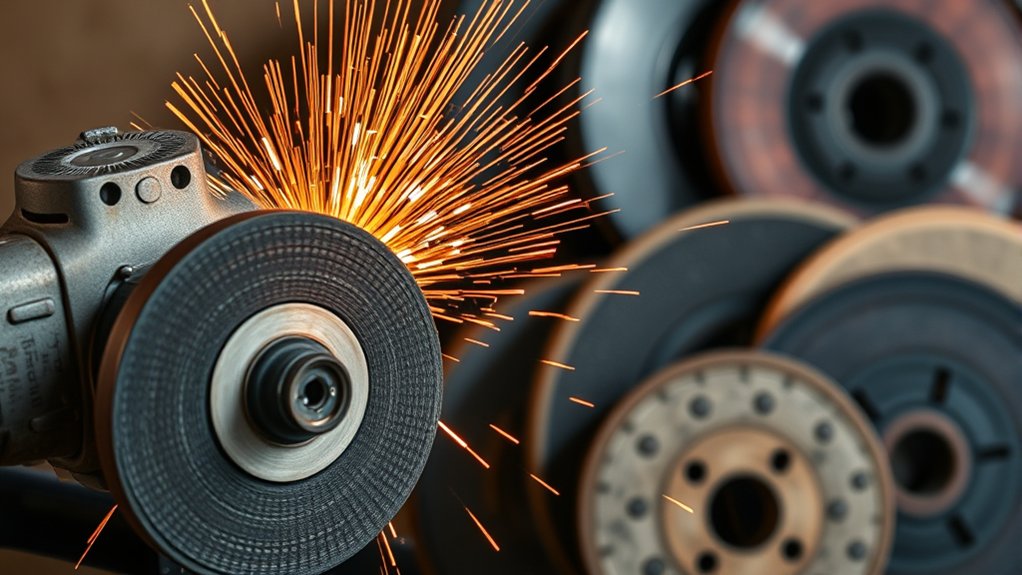
Angle grinders accept several wheel and disc styles, but compatibility depends on more than diameter. The attachment must also fit the spindle or arbor, work with the correct flanges and guard, carry a safe speed rating, and be approved for the material and task.
| Wheel or Attachment | Best Used For | Typical Materials | Main Caution |
|---|---|---|---|
| Grinding wheel | Heavy stock removal, weld grinding, beveling, and shaping | Steel, stainless steel, aluminum, or masonry when specifically labeled | Use the labeled working angle and the correct grinding guard. |
| Cut-off wheel | Straight cuts through sheet, tube, rod, bolts, and fasteners | The metal or masonry listed on the wheel | Do not twist it or use its face for grinding. |
| Flap disc | Blending welds, deburring, edge work, and finishing | Steel, stainless steel, and compatible nonferrous metals | Use the correct Type 27 or Type 29 working angle. |
| Fiber disc | Fast stock removal, weld blending, and surface preparation | Metal and other materials listed by the manufacturer | Requires the correct undamaged backing pad. |
| Wire wheel or cup brush | Rust, scale, paint, weld-spatter, and surface cleaning | Metal and other approved surfaces | Wires can break free; use light pressure and full face protection. |
| Diamond cutting blade | Cutting tile, brick, stone, pavers, and concrete | Specific masonry products listed on the blade | Control silica dust and follow the blade’s wet/dry rating. |
| Diamond cup wheel | Grinding and leveling concrete or masonry surfaces | Concrete, mortar, and compatible stone | Use a compatible shroud and dust extractor. |
| Polishing pad | Final polishing and light defect removal | Metal, stone, paint, or other surfaces named by the pad maker | A fixed high-speed grinder may be too fast for the pad or surface. |
The terms wheel, disc, and blade are sometimes used loosely. The product label is more important than the name used in a store listing. Check whether the accessory is approved for cutting, grinding, sanding, brushing, polishing, or a combination of those operations.
Products Worth Considering

Structural Components: A Cut off wheel typically comprises an abrasive, a binder, and air holes. The abrasive cuts, the binder shapes and strengthens, and the air holes remove swarf and dissipate heat to prevent damage to the cutting disc from overheating

Premium and Value: This 10-pack 4-1/2 x 7/8-inch metal/stainless steel cut-off wheel set is specially formulated for fast cutting in metals and stainless steel

Key Differences Between Grinding Discs and Cut-Off Wheels
Grinding discs and cut-off wheels may have similar diameters, but they are reinforced and shaped for different forces. A grinding wheel works mainly on its face at a specified angle. A cut-off wheel works on its thin outer edge and should remain straight in the cut.
Purpose and Functionality
| Feature | Grinding Disc | Cut-Off Wheel |
|---|---|---|
| Primary contact area | Wheel face at the labeled angle | Thin outer edge |
| Primary task | Shaping, beveling, smoothing, and stock removal | Straight cutting through the workpiece |
| Common thickness | Many conventional wheels are about 1/4 inch, though specialty products vary. | Thin products may be about .040 or .045 inch; thicker versions are also available. |
| Side pressure | Designed for controlled face contact when used as labeled | Not permitted unless the wheel is specifically labeled for cutting and grinding |
| Guard | Compatible grinding guard | Cutting guard specified by the grinder manufacturer |
Combination wheels are a separate category. Some are reinforced and labeled for both cutting and grinding. Do not assume a standard cut-off wheel can do both jobs because it looks similar to a combination wheel.
Thickness and Design Differences
Many conventional depressed-center grinding wheels are approximately 1/4 inch thick because that construction supports stock-removal forces. Thin cut-off wheels may be approximately .040 or .045 inch, while other cutting wheels can be thicker. These dimensions are examples, not universal rules.
A thin wheel produces a narrow cut and removes less material, but it is also more vulnerable to twisting, pinching, and side loading. Keep the grinder aligned with the kerf, secure the work so it cannot close on the wheel, and do not try to steer a cut by bending the disc.
The wheel label—not its color, thickness, or store description—determines whether it may be used for cutting, grinding, or both.
How Wire Wheels Improve Surface Preparation
Wire wheels and cup brushes remove loose rust, paint, scale, weld spatter, and surface contamination without cutting away metal as aggressively as a bonded grinding wheel. They are useful before welding, coating, inspection, or repair.
Crimped Wire vs. Knotted Wire
- Crimped wire is more flexible and works well for lighter cleaning, irregular surfaces, and less aggressive rust or paint removal.
- Knotted wire is stiffer and more aggressive, making it better for heavy scale, weld cleaning, and demanding fabrication work.
- Fine wire tends to flex more and may be less aggressive.
- Thicker wire cuts more aggressively but can be more prone to breakage when overloaded.
Wire Wheel vs. Wire Cup Brush
A wire wheel cleans with the tips of wires around its narrow outer edge. It is useful for seams, edges, and narrow areas. A cup brush presents a wider brushing face and is often better for cleaning flat surfaces.
Use the lightest pressure that performs the work. Excessive pressure bends the wires so their sides rub instead of allowing the tips to clean. This reduces performance and can increase wire fatigue and breakage. Weiler Abrasives recommends matching the brush speed to the tool and keeping the wire rating at or above the grinder’s speed.
Pro Tip: Let the wire tips do the cleaning. Pressing harder usually does not clean faster; it bends the wires, shortens brush life, and can increase the number of broken wires.
Warning: Wire strands can break free at operating speed. Wear impact-rated safety glasses with side protection and a face shield, keep other people clear, and replace any brush with loose, cracked, badly bent, or missing wires.
When Should You Use Flap Discs?
Flap discs use overlapping abrasive cloth flaps that wear away and expose fresh abrasive. They can remove material while leaving a smoother finish than many conventional grinding wheels, which makes them useful for weld blending, deburring, chamfering, edge preparation, and surface refinement.
- Use coarse grits such as 24, 36, or 40 for aggressive stock removal when the disc manufacturer approves the application.
- Use medium grits such as 60 or 80 for weld blending, rust removal, and general surface preparation.
- Use finer grits such as 100 or 120 for lighter finishing and scratch refinement.
- Use an abrasive formulated for the work material, especially when grinding aluminum or stainless steel.
Type 27 vs. Type 29 Flap Discs
- Type 27 flap discs have a flatter profile and are generally used at a shallow angle, commonly about 0–15 degrees when the manufacturer specifies it.
- Type 29 flap discs have a conical profile and are generally used at a steeper angle, commonly about 15–25 degrees when specified.
Do not run a flap disc flat against the work or on its thin edge unless its manufacturer specifically permits that use. The wrong angle can damage the backing, catch an edge, or separate the flaps. Norton’s flap-disc safety guidance also calls for the grinder guard to remain installed.
Diamond Cutting Discs: Angle Grinder Wheels for Hard Materials

Diamond cutting blades are used for tile, brick, concrete, pavers, granite, and other hard mineral materials. The blade must be approved for the exact material, tool speed, diameter, guard, and wet or dry method.
Ideal Applications for Diamond Blades
- Tile installation: A continuous-rim blade can help produce a smoother edge on compatible ceramic or porcelain tile.
- Brick and masonry: Turbo or segmented blades may provide faster cutting and debris clearance.
- Concrete and pavers: Segmented or turbo blades are common, but the blade specification must match cured concrete, green concrete, reinforced concrete, or other material conditions.
- Natural stone: Use a blade approved for the exact stone to reduce chipping, overheating, and premature wear.
Continuous, Turbo, and Segmented Rims
- Continuous rim: Usually selected when edge quality and reduced chipping matter most.
- Turbo rim: Balances cutting speed and edge quality for many masonry applications.
- Segmented rim: Provides open gaps that can improve debris removal and cooling during aggressive masonry cutting.
These categories are general. Always follow the blade maker’s material list and operating instructions rather than choosing by rim appearance alone.
Cutting Techniques and Dust Control
Secure the workpiece and keep the blade aligned with the cut. Apply light to moderate pressure and let the diamond segments cut. Do not twist the blade, force it sideways, or make a curved cut with a wheel designed for straight cutting.
Follow any directional arrow printed on the blade. Confirm the blade diameter, arbor, thickness, maximum RPM, guard, and flanges before installation. The blade’s maximum RPM must be at least as high as the grinder’s no-load speed. You can also review this guide to angle grinder RPM ratings.
Warning: Cutting or grinding concrete, mortar, brick, tile, and stone can release respirable crystalline silica. Use the water-delivery or shrouded dust-collection method approved for the tool and task. Never apply water to an ordinary electric grinder unless the complete tool-and-blade system is designed and approved for wet operation.
For covered construction work, OSHA’s respirable crystalline silica standard lists specified controls for handheld grinders, including integrated water delivery or a commercially available shroud and dust-collection system for qualifying tasks. Workplace respirator requirements depend on the task, duration, location, and control method.
Diamond Cup Wheels
A diamond cup wheel is designed for grinding or leveling a masonry surface rather than slicing through it. It may be used to remove coatings, flatten high spots, smooth concrete, or prepare a floor or wall. Use the grinder, cup-wheel guard or shroud, dust extractor, and working angle specified by the manufacturers.
Polishing Pads: Achieving a Finished Surface
Foam, wool, felt, microfiber, and specialty polishing pads can remove light oxidation, refine sanding marks, or produce a final shine. However, a polishing pad does not automatically make every angle grinder suitable for polishing.
- Check the maximum RPM of the polishing pad and backing pad.
- Follow the compound maker’s recommended speed and surface instructions.
- Use a backing pad with the correct diameter, attachment system, and spindle thread.
- Keep the pad centered to reduce vibration.
- Use light pressure and keep the pad moving to limit heat buildup.
- Clean or replace loaded pads so trapped grit does not scratch the work.
Note: A fixed-speed grinder may run too fast for a polishing pad, compound, coating, or work surface. Use a variable-speed grinder or dedicated polisher when the accessory instructions require lower speed.
Other Useful Angle Grinder Abrasives
Fiber Discs
Fiber discs are abrasive sheets mounted on a rigid backing pad. They can cut quickly and work well for stock removal, weld blending, beveling, and surface preparation. Unlike a flap disc, a fiber disc depends on a separate backing pad for support.
Use only the backing-pad type and density approved for the disc and task. Replace a backing pad that is cracked, warped, badly worn, undersized, or heat-damaged. Never improvise a backing pad from an old wheel or another accessory.
Nonwoven Surface-Conditioning Discs
Nonwoven conditioning discs refine scratches, clean light oxidation, blend surfaces, and prepare metal for coating without removing as much base material as an aggressive grinding wheel. Grades may be described as coarse, medium, fine, or very fine instead of using standard coated-abrasive grit numbers.
Strip Discs
Open-web stripping discs are used for paint, rust, adhesive, gasket residue, and coating removal. Their open structure can resist loading, but the disc must still match the grinder speed and material. Avoid catching the edge of the disc on sharp corners.
Safety Tips for Using Angle Grinder Wheels
Angle grinder safety begins before the wheel touches the work. Disconnect a corded grinder or remove the battery before installing, adjusting, or inspecting an accessory.
Inspect the Tool and Accessory
- Check the wheel or disc for cracks, chips, warping, contamination, missing sections, or heavy wear.
- Inspect wire brushes for loose, cracked, badly bent, or missing wires.
- Check backing pads for cracks, tearing, distortion, and heat damage.
- Confirm that the guard locks securely and can be positioned between you and the accessory.
- Make sure the side handle is installed and tight.
- Inspect the spindle, threads, flange surfaces, and locking nut for damage or debris.
Wear the Right PPE
- Impact-rated safety glasses or goggles with side protection.
- A face shield worn over primary eye protection for fragment and flying-particle hazards.
- Hearing protection suitable for the noise level and duration.
- Close-fitting work clothing, appropriate gloves, and sturdy footwear.
- A correctly selected respirator when required for hazardous dust, coatings, metals, or workplace exposure controls.
OSHA’s portable powered-tool standard, 29 CFR 1910.243, addresses guarding and controls for portable grinders in covered workplaces. Eye and face protection must also match the flying-particle and material hazards.
Mount and Test the Wheel Correctly
- Verify the wheel diameter, arbor, type, application, and maximum RPM.
- Install the guard required for that wheel and operation.
- Use the flanges, backing pad, adapters, and locking nut approved by the grinder manufacturer.
- Make sure the accessory seats properly. Do not force a tight arbor hole onto the spindle.
- Tighten only as directed; overtightening can damage some wheels or flanges.
- Rotate the wheel by hand to check for guard contact or obvious misalignment.
- Restore power, point the wheel away from people, stand out of its plane, and perform the no-load test described in the grinder or accessory manual.
A current DEWALT angle grinder manual, for example, requires guards for grinding wheels, cutting wheels, flap discs, wire brushes, and wire wheels, and calls for a closed two-sided guard with abrasive or diamond cutting wheels on the covered models. Requirements for your grinder may differ, so use its own manual as the final authority.
Control the Work and Sparks
- Clamp or support the workpiece so it cannot shift, pinch, or close on the wheel.
- Keep both hands on the tool and maintain a balanced stance.
- Position the cord away from the rotating accessory and sparks.
- Keep sparks away from fuel, solvents, sawdust, paper, gas cylinders, batteries, glass, vehicles, and other heat-sensitive items.
- Do not stand directly in line with a newly mounted wheel during the initial no-load run.
- Allow the wheel to stop completely before putting the grinder down.
Selecting the Right Angle Grinder Wheel for Your Project
Use the following order when choosing an angle grinder wheel. Starting with the task alone is not enough because two wheels intended for similar work may have different material, speed, guard, or flange requirements.
- Define the operation: Decide whether you need to cut, grind, bevel, blend, clean, strip, sand, condition, or polish.
- Identify the material: Confirm whether the work is carbon steel, stainless steel, aluminum, another nonferrous metal, tile, concrete, brick, stone, paint, or a coating.
- Choose the accessory category: Select a grinding wheel, cut-off wheel, combination wheel, flap disc, fiber disc, wire brush, diamond blade, diamond cup wheel, conditioning disc, stripping disc, or polishing pad.
- Check material compatibility: Use an abrasive specifically approved for the material. Aluminum can load an unsuitable wheel, while stainless work may require a contaminant-free product to reduce unwanted iron contamination.
- Match the diameter: Never install a wheel larger than the grinder is designed to use.
- Match the arbor and attachment: Confirm the center hole, hub thread, adapter, backing pad, and spindle fit.
- Check maximum RPM: The accessory rating must equal or exceed the grinder’s no-load speed.
- Verify the guard and flanges: Grinding, cutting, wire, sanding, and polishing attachments may require different hardware.
- Confirm wet or dry use: Use water only when the tool, blade, electrical setup, and instructions approve it.
- Inspect before use: Reject any product that is damaged, incorrectly stored, contaminated, expired where a discard date applies, or missing readable safety markings.
Products Worth Considering
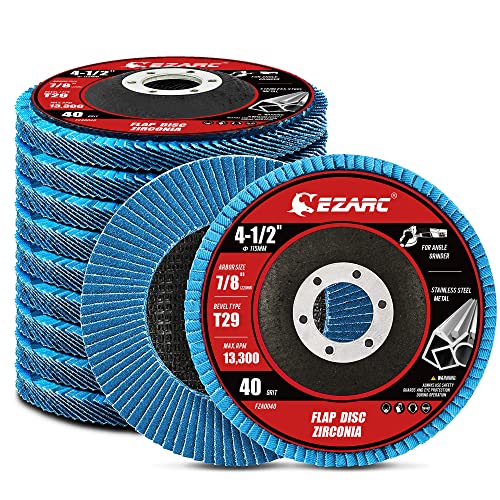
【Great Performance】EZARC flap sanding discs are made of hard zirconia material which lasts longer than standard aluminum oxide abrasive material, built for a more robust and economical grinding wheel

【Ceramic Abrasive】These flap discs are made with industrial-grade ceramic abrasives, offering double the grinding power and superior heat dissipation. Ceramic discs also last 3X longer than zirconia discs and 5X longer than aluminum oxide discs.

HIGH-DENSITY JUMBO DESIGN: Type 29 flap discs with a high-density jumbo layout support surface blending, beveling, grinding, deburring, and edge chamfering. Curved profile aids finishing, stock removal, and rust cleanup for pros and DIY enthusiasts
Choosing Abrasives by Material
- Carbon steel: General-purpose aluminum-oxide, zirconia, or ceramic abrasives may be suitable when labeled for steel.
- Stainless steel: Use products labeled for stainless or INOX work when contamination and finish quality matter.
- Aluminum and soft nonferrous metals: Choose a non-loading product formulated for aluminum. An unsuitable wheel can clog, overheat, and cut poorly.
- Concrete and masonry: Use a masonry abrasive or diamond product made for the exact material and operation.
- Painted or coated surfaces: Identify hazardous coatings before disturbing them and select suitable dust controls and PPE.
Reading Wheel Labels and Ratings
Most grinder wheels and their packaging display the information needed to verify compatibility. Do not use an accessory if critical markings are missing or unreadable.
- Diameter: The wheel’s outside size, such as 4-1/2, 5, 6, 7, or 9 inches.
- Thickness: Affects cutting width, rigidity, and the operations for which the wheel is designed.
- Arbor or center-hole size: Must fit the grinder’s spindle, flange, hub, or approved adapter.
- Maximum RPM: Must equal or exceed the grinder’s no-load RPM.
- Wheel type: Describes the wheel’s shape and, in some labeling systems, its intended mounting style.
- Application: Look for words or symbols identifying cutting, grinding, combination use, sanding, polishing, or brushing.
- Material: Confirms whether the accessory is intended for steel, stainless steel, aluminum, masonry, tile, concrete, or another surface.
- Directional arrow: Some diamond blades and other accessories must rotate in a marked direction.
- Safety pictograms: May show required PPE, prohibited side grinding, wet/dry restrictions, guard use, or damaged-wheel warnings.
Pro Tip: Photograph the wheel label and grinder data plate before starting. You will have a record of the diameter, arbor, application, and speed ratings if the packaging is discarded.
Understanding Type Numbers
- Type 1 or Type 41: Common markings for a flat cut-off wheel.
- Type 27 grinding wheel: A depressed-center grinding-wheel shape commonly used for stock removal and weld grinding.
- Type 27/42 cut-off wheel: A depressed-center cut-off-wheel marking used by some manufacturers and standards.
- Type 28 grinding wheel: A saucer-shaped grinding wheel that may work at a lower angle than a conventional Type 27 wheel.
- Type 27 flap disc: A flatter flap-disc profile.
- Type 29 flap disc: A conical flap-disc profile.
Because similar numbers can appear on grinding wheels, cut-off wheels, and flap discs, never choose an accessory from the type number alone. Read the complete label and use the grinder manufacturer’s accessory chart.
Common Angle Grinder Wheel Mistakes
- Using a cut-off wheel for grinding: Side pressure can crack or break a cutting-only wheel.
- Installing an oversize wheel: A larger wheel may exceed the grinder’s guard capacity and safe surface speed.
- Removing the guard for clearance: This exposes more of the wheel and removes protection from fragments.
- Using the wrong guard: An open grinding guard may not provide the containment required for a thin cutting wheel.
- Ignoring the RPM rating: A wheel rated below the grinder speed can fail from overspeed.
- Using the wrong abrasive on aluminum: Loading can increase heat and reduce control.
- Forcing a diamond blade: Excess pressure can cause overheating, glazing, binding, or loss of control.
- Using a damaged backing pad: A cracked or warped pad can make a fiber or polishing disc unstable.
- Pressing too hard with a wire brush: This bends the wires and can increase breakage.
- Dry grinding silica-containing material without controls: Visible dust is a sign that exposure controls need attention.
- Using a polishing pad at grinder speed without checking its rating: The pad, backing pad, compound, or surface may not tolerate the speed.
Frequently Asked Questions
What are the main types of angle grinder wheels?
Common types include bonded grinding wheels, cut-off wheels, combination wheels, flap discs, fiber discs, wire wheels, wire cup brushes, diamond cutting blades, diamond cup wheels, nonwoven conditioning discs, stripping discs, and polishing pads. Select one by task, material, diameter, arbor, maximum RPM, guard, and flange requirements.
Can you grind with a cut-off wheel?
No, not with a wheel labeled only for cutting. A cutting-only wheel is made to work on its outer edge and can break when side pressure is applied. Grinding is permitted only when the accessory is specifically labeled and reinforced for both cutting and grinding.
What does Type 27 mean on a grinding wheel?
On a bonded grinding wheel, Type 27 usually describes a depressed-center shape used for stock removal, beveling, and weld grinding. However, some depressed-center cut-off wheels carry a Type 27/42 marking. Read the complete label to confirm whether the product is for grinding, cutting, or both.
What is the difference between Type 1/41 and Type 27/42 cut-off wheels?
Type 1/41 cut-off wheels are flat. Type 27/42 cut-off wheels have a depressed center that can provide extra clearance around the flange and workpiece. Their cutting depth, mounting hardware, and guard compatibility may differ, so follow the wheel label and grinder accessory chart.
Is a flap disc better than a grinding wheel?
It depends on the job. A grinding wheel is often preferred for heavy, sustained stock removal. A flap disc can remove and blend material while leaving a smoother finish. Flap discs may also feel easier to control, but they must be used at the angle and speed printed by the manufacturer.
Should I use a wire wheel or a flap disc for rust?
Use a wire brush when you want to remove loose rust and contamination while preserving more base metal. Use a flap disc when the rust is heavier or the surface also needs leveling and blending. Test a small area because either accessory can alter the surface when used too aggressively.
Can any diamond blade cut concrete, tile, and metal?
No. Diamond blades are designed for specific materials and operating conditions. A tile blade, concrete blade, and metal-cutting diamond product may use different bonds, rim designs, speed ratings, and cooling methods. Use only the materials and applications listed on the blade.
Can I use a polishing pad on a standard angle grinder?
Only when the pad, backing pad, compound, grinder speed, and work surface are compatible. Many fixed-speed angle grinders run faster than some polishing systems allow. A variable-speed grinder or dedicated polisher may be required.
Conclusion
Choosing the right angle grinder wheel starts with the operation and material, but it does not end there. Confirm the diameter, arbor, maximum RPM, guard, flanges, working angle, and wet or dry rating before installing anything. Use cutting wheels only for approved cuts, keep guards and side handles in place, control hazardous dust, and replace damaged accessories immediately. The correct setup produces cleaner work and gives the wheel the support and protection it was designed to have.
Sources
- OSHA 29 CFR 1910.243: Guarding of Portable Powered Tools — portable grinder controls and guarding requirements.
- OSHA 29 CFR 1926.1153: Respirable Crystalline Silica — dust-control methods for covered construction tasks involving grinders and silica-containing materials.
- DEWALT DWE43231VS/DWE43240VS Angle Grinder Manual — guard, flange, wheel-mounting, wire-brush, and cutting-wheel instructions for the covered models.
- Norton Abrasives: Right-Angle Grinding Abrasives — grinding-wheel, flap-disc, and fiber-disc applications and safety considerations.
- Norton Abrasives: Do’s and Don’ts of Flap Discs — flap-disc angles, inspection, guard use, speed matching, and PPE.
- Weiler Abrasives: Extending Wire Brush Life — wire selection, pressure, speed, working angle, inspection, and PPE.