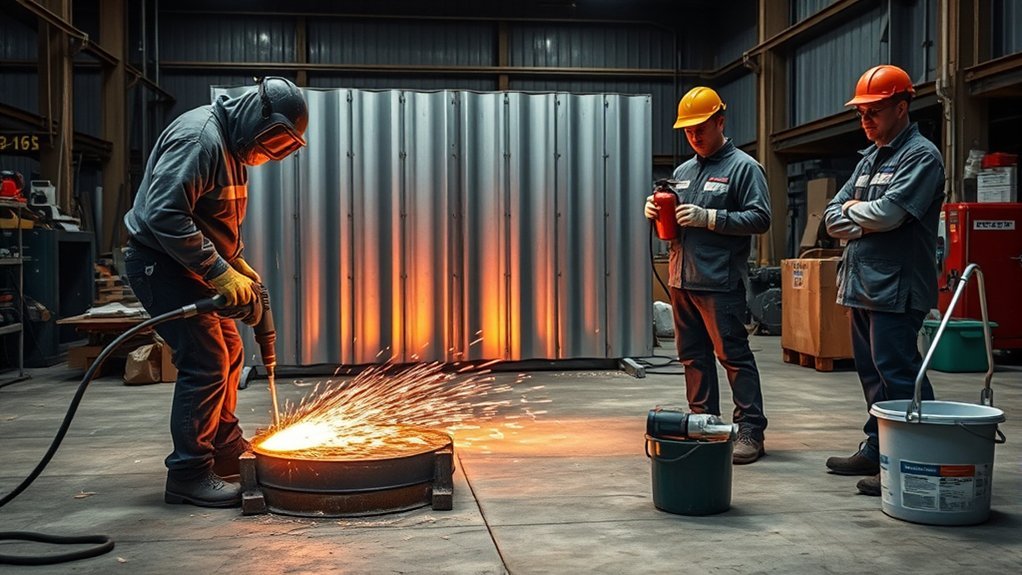
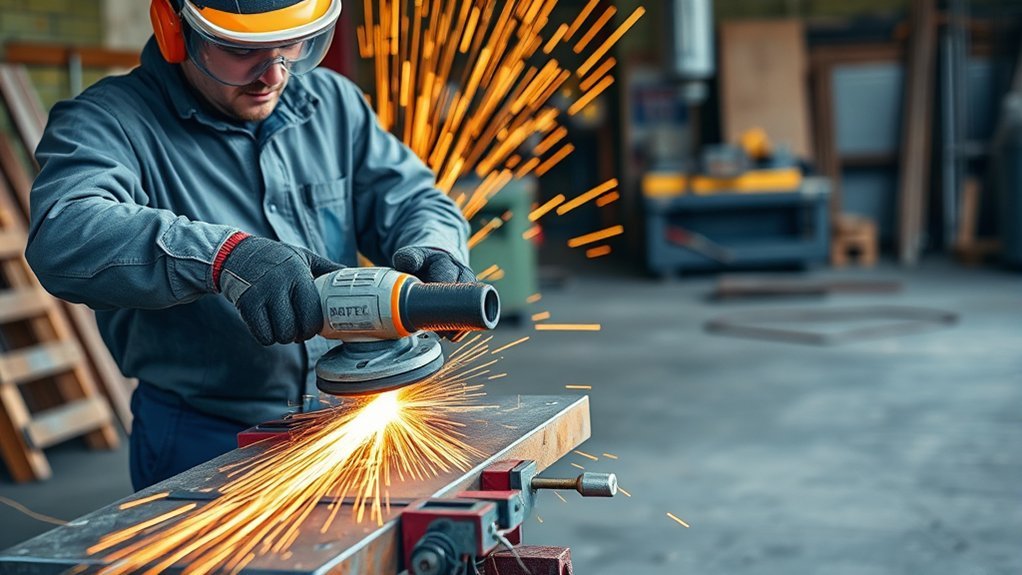
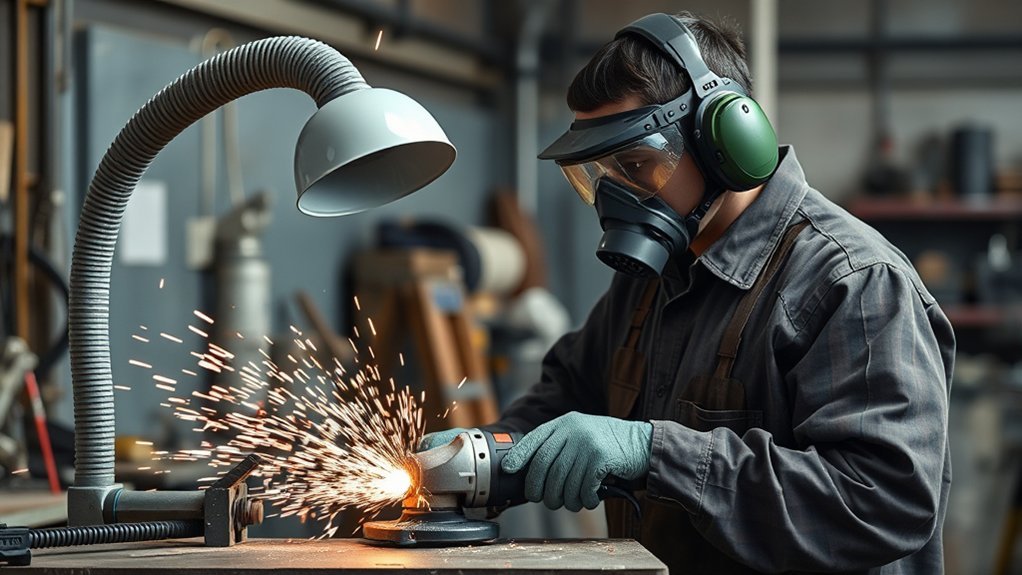
An angle grinder can spin a wheel thousands of times each minute, so speed matching is a safety check, not just a performance choice. RPM tells you how fast the spindle turns. Before installing any wheel, disc, brush, or backing pad, compare the tool’s maximum speed with the accessory’s maximum safe RPM and confirm the size, fit, guard, and intended use.
Quick Answer
RPM means revolutions per minute—the number of times an angle grinder’s spindle turns in one minute. Use only an accessory whose maximum safe RPM is equal to or higher than the maximum speed marked on the grinder. The wheel must also match the tool’s diameter, arbor, guard, and approved application.
Key Takeaways
- Treat the RPM printed on an accessory as a maximum safe limit, not a target or a promise of better performance.
- The accessory’s maximum RPM must meet or exceed the grinder’s maximum marked speed.
- RPM alone does not prove compatibility; diameter, thickness, arbor, mounting method, guard, material, and wheel type must also match.
- Never install a larger wheel by removing the guard or using an unapproved adapter.
- Inspect the accessory, stand out of its plane, and run the newly mounted wheel at no-load speed before touching the workpiece.
At a Glance
| Time Required | About 60 seconds for a pre-use speed and fit check |
| Difficulty | Easy, but every label and mounting detail must be checked |
| Tools Needed | Grinder nameplate or manual, accessory label, correct guard, flange or mounting system, and required PPE |
| Cost | $0 when the correct accessory, guard, and PPE are already available |
What’s in This Article
- What Is RPM and Why Does It Matter for Angle Grinders?
- Understanding Maximum RPM Requirements for Accessories
- Typical Angle Grinder RPM Examples
- Choosing Accessories for Cordless Angle Grinders
- Choosing RPM-Compatible Accessories for Corded Angle Grinders
- Using Variable-Speed Angle Grinders
- Potential Dangers of Using Low-RPM Accessories
- How RPM Ratings Affect Performance and Efficiency
- Angle Grinder Safety Guidelines
- Best Practices for Selecting Angle Grinder Accessories
- Troubleshooting Common Angle Grinder Issues
- How to Keep Your Angle Grinder Safe and Efficient
- Frequently Asked Questions
- Conclusion
- Sources
What Is RPM and Why Does It Matter for Angle Grinders?
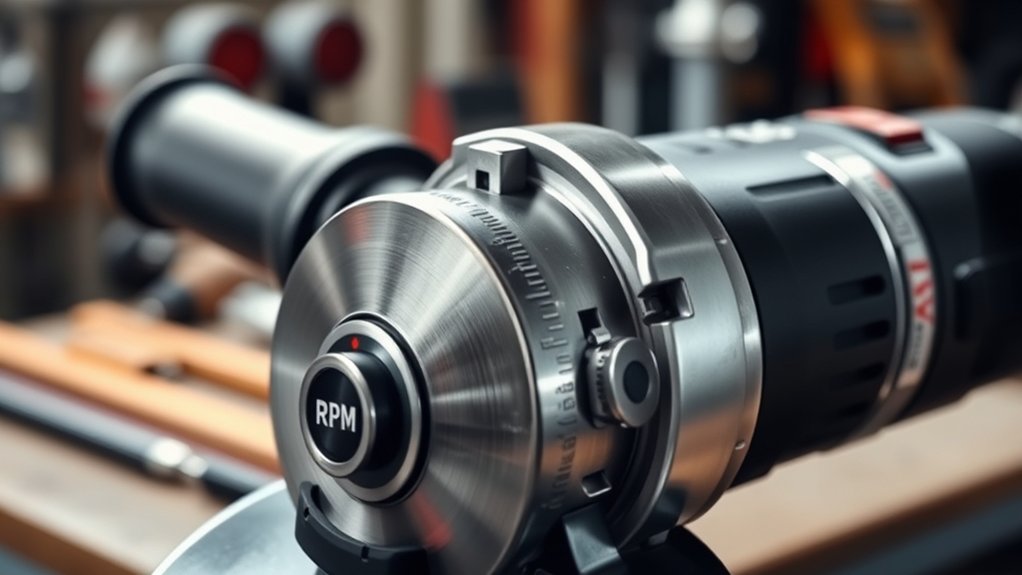
RPM means revolutions per minute. A grinder marked 11,000 RPM can turn its spindle up to about 11,000 revolutions in one minute under the test conditions used by the manufacturer. The number affects cutting action, material removal, vibration, heat, and the forces acting on the accessory.
The number on the grinder is commonly a maximum no-load speed. No-load speed is measured while the accessory is not cutting or grinding. Actual speed usually falls under load, but you must not use that lower working speed to justify an under-rated wheel. Compare the accessory with the maximum speed marked on the tool or stated in its manual.
The core rule is backed by OSHA’s portable abrasive-wheel requirements: the grinder spindle speed must not exceed the maximum operating speed marked on the wheel.
The RPM printed on a wheel is a safety ceiling. It does not mean the wheel must run at that speed or that the highest possible speed gives the best finish.
RPM Versus Surface Speed
RPM counts rotations, but the wheel’s outer edge travels at a surface speed. At the same RPM, a larger-diameter wheel has a faster-moving edge because it covers more distance with each revolution. This is one reason you must never install a larger wheel on a smaller grinder, even when the arbor seems to fit.
Surface speed can be estimated with these formulas:
- Feet per minute: π × wheel diameter in inches × RPM ÷ 12
- Meters per second: π × wheel diameter in meters × RPM ÷ 60
You normally do not need to calculate this yourself. Use the grinder maker’s approved wheel diameter and the accessory maker’s maximum RPM or maximum operating speed marking.
Understanding Maximum RPM Requirements for Accessories
People sometimes search for an accessory’s “minimum RPM,” but the printed speed is normally the maximum safe RPM. It is the highest rotational speed the accessory is designed to withstand. The grinder must not drive the accessory faster than that limit.
Check the grinder first, then check the disc, wheel, cup brush, flap disc, diamond wheel, backing pad, or other attachment. Use the accessory only when its rating is equal to or higher than the maximum speed marked on the tool.
Why the Accessory RPM Rating Matters
An accessory that is oversped can crack, shed material, or break apart. Fragments may travel beyond the immediate work area. The risk remains even when the accessory is new and appears undamaged.
Warning: Never use an accessory with a maximum RPM lower than the maximum speed marked on the grinder. Lowering pressure on the tool does not make an under-rated accessory safe.
How to Read Accessory Markings
A clear accessory label may include several markings. Check all of them before mounting the accessory.
| Marking | What It Tells You | What to Do |
|---|---|---|
| Maximum RPM | Highest permitted rotational speed | Confirm it meets or exceeds the grinder’s maximum marked speed. |
| Maximum operating speed, often m/s | Maximum speed at the wheel edge | Do not exceed it; use the approved wheel diameter. |
| Diameter and thickness | Physical wheel size | Match the grinder’s capacity and the correct guard. |
| Arbor, bore, thread, or mounting system | How the accessory centers and locks onto the tool | Use only the specified flange, nut, thread, or tool-free system. |
| Wheel type and application | Whether it is for cutting, grinding, sanding, brushing, or a specific material | Use it only for the marked operation and material. |
| Direction arrow | Required rotation direction on directional accessories | Align it with the grinder’s rotation arrow. |
| Restrictions and safety pictograms | Limits such as “not for side grinding” or required PPE | Follow every restriction; do not guess from appearance. |
If a wheel has no readable speed rating, size, or intended-use marking, do not use it. Do not transfer assumptions from similar-looking products.
Compatibility With Accessories
RPM is only one part of compatibility. The outside diameter and thickness must fit the grinder and guard. The arbor or thread must match the spindle or mounting system without improvised reducers. The wheel type must match the operation, and the abrasive must be suitable for the work material.
A cutting wheel is designed to cut with its edge and should not be used for side grinding unless the manufacturer specifically marks it for that use. Likewise, a wheel approved for masonry is not automatically suitable for steel, stainless steel, aluminum, or nonferrous metal.
Typical Angle Grinder RPM Examples
There is no single “normal” RPM for every angle grinder. Speed changes with wheel diameter, motor design, gearing, and whether the tool has variable-speed control. These current manufacturer examples show why the nameplate matters:
| Example Tool | Wheel Capacity | Published No-Load Speed |
|---|---|---|
| Makita 9557PB corded grinder | 4-1/2 inches | 11,000 RPM |
| Makita XAG04Z cordless grinder | 4-1/2 or 5 inches | 8,500 RPM |
| Makita XAG20Z variable-speed cordless grinder | 4-1/2 or 5 inches | 3,000–8,500 RPM |
These are examples, not universal ranges. A different model may be faster or slower. Always use the exact speed on your grinder’s label or manual.
Choosing Accessories for Cordless Angle Grinders
Battery voltage does not tell you the grinder’s RPM. Two cordless grinders using similar batteries may have different gearing, wheel capacities, and maximum speeds. Start with the maximum speed marked on the tool, not the battery platform.
Choose an accessory rated at or above that speed, then confirm the wheel diameter, thickness, arbor or mounting system, guard, and approved task. A battery-powered grinder can still overspeed an under-rated accessory and cause serious injury.
Remove the battery before installing or changing an accessory. After mounting, rotate the wheel by hand to confirm that it clears the guard and tool body. Reinstall the battery only after the assembly is secure.
Products Worth Considering

Angle Grinder Wrench & Nut Kit, 7-Piece Set: Includes 1 grinder wrench and 6 flange lock nuts (3 inner, 3 outer) for quick wheel changes and arbor nut replacement on 4-1/2", 5", and 7" grinders.

INCLUDES: 4 1/2" Angle grinder, five grinding wheels and a carrying case

7 amp AC/DC, 12,000 rpm motor of the angle grinder is designed for faster material removal and higher overload protection
Choosing RPM-Compatible Accessories for Corded Angle Grinders
Corded grinders often maintain speed well during demanding work, but the same matching rules apply. Unplug the tool before changing accessories, and never use an extension setup, adapter, or larger wheel that the manufacturer does not approve.
Understand RPM Requirements
Use this check before installing any wheel or attachment:
- Disconnect power: Unplug the corded grinder or remove the cordless battery.
- Find the tool’s maximum speed: Read the nameplate or the current manufacturer manual.
- Read the accessory rating: Confirm its maximum RPM is equal to or higher than the tool’s maximum marked speed.
- Confirm full compatibility: Match diameter, thickness, arbor, flange or mounting system, guard, operation, and work material.
- Inspect and mount correctly: Reject cracked, chipped, bent, contaminated, excessively worn, or unreadable accessories. Use the specified flanges and tighten only as directed.
- Test before contact: Reconnect power, position yourself and bystanders out of the accessory’s plane, and run the tool at maximum no-load speed for the time required by the manual—commonly one minute for a newly mounted accessory.
Selecting Suitable Accessories
Select accessories specifically designed and recommended for the grinder and operation. A wheel that physically attaches may still be unsafe because it is too large, too thick, incorrectly centered, incompatible with the guard, or not approved for that task.
For bonded abrasive wheels, follow the storage and use-by information provided by the wheel manufacturer. Do not use a wheel that has absorbed moisture, been exposed to extreme heat, been dropped, or has an unreadable label unless the manufacturer confirms it remains safe.
Ensuring Safety Compliance
- Use the correct guard: Keep it securely installed and positioned between you and the exposed wheel.
- Use the side handle: Hold the grinder with two hands unless the manufacturer gives a different approved method.
- Secure the workpiece: Prevent movement, pinching, and uncontrolled offcuts.
- Use the wheel only as marked: Do not side-load a cutting wheel or use a grinding wheel for an unapproved material.
- Stop after a drop or impact: Inspect the tool and accessory before restarting.
Using Variable-Speed Angle Grinders
A variable-speed grinder lets you reduce spindle speed for tasks and accessories that the tool manufacturer approves. The correct setting depends on the accessory type, diameter, material, and maker’s recommended operating range.
The accessory’s maximum RPM remains an upper limit at every dial setting. A lower setting does not make an oversized wheel, wrong guard, incorrect arbor, or unapproved accessory safe. Also check whether the grinder manual allows the operation; some models are not approved for polishing, wire brushing, or sanding even when the speed can be reduced.
Note: A maximum RPM marking describes the accessory’s speed limit. It does not identify the ideal working speed. Use the operating range in the accessory instructions and the grinder manual.
Potential Dangers of Using Low-RPM Accessories
The dangerous setup is an accessory with a maximum RPM lower than the grinder’s maximum speed. In that condition, the tool can drive the accessory beyond its design limit. The wheel may crack, burst, shed abrasive, or throw fragments.
Do not rely on light pressure, a short cutting time, or the assumption that the grinder will slow under load. The accessory must be correctly rated before the tool starts.
Overspeed is not the only cause of failure. Wrong flanges, an incorrect arbor, side loading, binding in a cut, impact damage, poor storage, excessive force, or using the wrong wheel type can also produce vibration or breakage.
How RPM Ratings Affect Performance and Efficiency
RPM affects how often abrasive grains or cutting segments contact the work, but faster is not automatically better. The result also depends on wheel type, grit, bond, diameter, tool power, contact angle, pressure, work material, and heat control.
Higher RPM Is Not Always More Efficient
Running within an approved speed range can help an accessory work as designed. Running too slowly may reduce cutting action for some products, while running too fast can exceed the accessory’s limit, create excess heat, increase wear, or cause failure. Use the accessory maker’s recommended range instead of choosing the highest number available.
A wheel with a higher maximum-RPM rating is not necessarily sharper, faster cutting, or longer lasting. The rating mainly tells you the highest safe rotational speed for that product.
Performance Impact of Ratings
| Accessory | Speed Guidance | Common Mistake to Avoid |
|---|---|---|
| Bonded grinding wheel | Stay within the tool and wheel limits; use the recommended grinding angle. | Excessive pressure or using a wheel too large for the guard. |
| Cutting wheel | Use only at an approved speed and cut with the edge. | Twisting in the cut or grinding on the side. |
| Flap disc or sanding accessory | Follow the product’s recommended range; variable speed may improve control when approved. | Assuming the maximum rating is the ideal finishing speed. |
| Wire brush or wheel | Stay below the brush’s maximum RPM and inspect for loose or broken wires. | Using a brush larger than the grinder allows. |
| Diamond wheel | Match diameter, RPM, material, cutting direction, and dust-control method. | Using an unapproved blade or reversing a directional wheel. |
Angle Grinder Safety Guidelines
High-speed accessories can create flying fragments, sparks, noise, dust, and kickback. Use these safety practices every time:
- Read both manuals: Follow the grinder instructions and the accessory label or instructions.
- Disconnect power before setup: Unplug the cord or remove the battery before changing or adjusting accessories.
- Check RPM and fit: Confirm speed, diameter, thickness, arbor, flange, guard, and intended use.
- Inspect the accessory: Look for cracks, chips, warping, tears, loose wires, missing segments, contamination, or an unreadable label.
- Use the correct guard: Position it to shield you from the wheel and direct sparks and fragments away from your body.
- Wear suitable PPE: Use safety glasses and a face shield where flying debris is possible, plus hearing protection, suitable gloves, nonflammable close-fitting clothing, and respiratory protection when required.
- Control the work area: Secure the workpiece, keep bystanders away, and remove combustible materials from the spark path.
- Test the mounted accessory: Stand out of its plane and run it at no load before contacting the workpiece.
- Use two hands and a stable stance: Keep the side handle installed and position your body so kickback will not drive the tool into you.
- Let the tool stop completely: Do not set it down while the accessory is still turning.
Warning: Grinding or cutting stone, concrete, brick, block, or mortar can create respirable crystalline silica. Use the dust controls and respiratory protection required for the material and job. OSHA identifies grinding of silica-containing materials as a source of hazardous fine dust.
For workplace tasks involving silica-containing materials, review OSHA’s crystalline silica guidance and any applicable exposure-control rules. For home projects, use a compatible shroud or dust-control system recommended by the tool and accessory makers, work with ventilation, and avoid creating uncontrolled dust clouds.
Pro Tip: After installing a wheel, rotate it by hand before reconnecting power. It should turn freely without rubbing the guard, flange, or tool housing.
Best Practices for Selecting Angle Grinder Accessories
Selecting the right accessory improves safety, control, and finish quality. Use this checklist before every installation:
| What to Check | Safe Requirement |
|---|---|
| Maximum RPM rating | Equal to or higher than the grinder’s maximum marked speed |
| Wheel diameter and thickness | Within the grinder and guard capacity |
| Arbor or mounting system | Correct fit with the specified flange, nut, thread, or tool-free mount |
| Guard type | Approved for the wheel and operation, including cutting versus grinding |
| Material and operation | Marked for the work material and intended cutting, grinding, sanding, or brushing task |
| Condition and label | Undamaged, correctly stored, within any marked use-by period, and fully readable |
| Manufacturer approval | Specifically allowed by the grinder and accessory instructions |
Do not use homemade bushings, stacked washers, modified guards, saw-chain woodcarving blades, or toothed saw blades unless the grinder manufacturer expressly approves the exact system. Physical attachment alone does not prove safe operation.
Products Worth Considering


[High-Performance Cutting] Designed for cutting metal & stainless steel, these cut off wheels 4 1/2 inch work efficiently with any angle grinder wheel, supporting speeds up to 13,300 RPM.
Troubleshooting Common Angle Grinder Issues

Stop using the grinder if it wobbles, vibrates heavily, overheats, makes a new noise, smells burned, or loses speed unexpectedly. Disconnect power before inspecting it.
| Symptom | Possible Causes | Safe Response |
|---|---|---|
| Overheating or frequent thermal shutdown | Excess pressure, blocked vents, dull or wrong accessory, overloaded motor, or internal fault | Stop, let the tool cool, clean vents as directed, verify the accessory, and reduce force. Service the tool if the problem returns. |
| Wheel wobble | Bent or damaged wheel, debris on flanges, wrong arbor, incorrect mounting, or spindle damage | Remove the accessory, clean and inspect mounting surfaces, and replace damaged or mismatched parts. |
| Heavy vibration | Out-of-balance accessory, loose mounting, broken wires or segments, worn bearings, or gear damage | Do not continue. Inspect the accessory and mount; have the grinder serviced if vibration remains with a known-good approved accessory. |
| Speed drops sharply in the cut | Too much pressure, binding, weak battery, inadequate power supply, wrong wheel, or motor overload | Release pressure, remove the wheel from the cut, correct work support, and verify power and accessory selection. |
| Motor runs but the accessory does not turn | Loose or incorrect mount, damaged spindle lock, stripped gear, clutch or drive failure, or internal damage | Switch off immediately. Do not keep running the motor; have the drive system inspected by a qualified service provider. |
Never solve a speed or fit problem by removing the guard, forcing an adapter, overtightening the flange nut, or installing a larger wheel.
How to Keep Your Angle Grinder Safe and Efficient
Good maintenance helps the grinder hold its designed speed, cool properly, and keep the accessory centered. Follow the manufacturer’s service schedule and remove the tool from use when a switch, guard, spindle, cord, battery interface, or side handle is damaged.
| Maintenance Task | When to Check |
|---|---|
| Inspect accessory condition and label | Before each use and after any drop or impact |
| Confirm RPM, size, arbor, guard, and task | Before installing every accessory |
| Clean air vents using the approved method | After dusty work and whenever airflow is restricted |
| Inspect cord, plug, battery, and battery interface | Before each use |
| Inspect guard, side handle, spindle, flanges, and lock nut | Before each use and during accessory changes |
| Check for new noise, vibration, heat, or speed changes | During every job |
Store wheels in a dry, protected location where they will not be bent, dropped, frozen, overheated, or contaminated. Keep each accessory’s label and instructions with the product when possible.
Frequently Asked Questions
What Is a Good RPM for an Angle Grinder?
There is no single best RPM for every angle grinder. Use the speed designed for the tool and the operating range approved for the accessory and material. Small fixed-speed grinders may run around 8,500 to 11,000 RPM in current manufacturer examples, while variable-speed models can run lower. Check the exact nameplate and manual.
What Does RPM Mean on a Grinder?
RPM means revolutions per minute. It tells you how many times the spindle can turn in one minute. The tool’s maximum marked RPM is the number you compare with the accessory’s maximum safe RPM.
What Does 3,000 RPM Mean?
It means the spindle or accessory completes 3,000 revolutions each minute. A grinder operating at 3,000 RPM is not automatically unsafe. However, an accessory marked with a maximum of 3,000 RPM must never be installed on a grinder that can reach a higher speed, such as 8,500 or 11,000 RPM.
What Is the Best RPM for Grinding?
The best RPM depends on the wheel, diameter, material, grinder, and desired finish. Follow the accessory maker’s recommended operating range and the grinder manual. Do not treat the accessory’s maximum RPM as the ideal working speed.
Can You Use a Higher-RPM Wheel on a Lower-RPM Grinder?
Yes, from a speed-rating standpoint, a wheel rated above the grinder’s maximum speed can be acceptable. It must still match the approved diameter, thickness, arbor, flange, guard, operation, and material. A higher RPM rating alone does not prove full compatibility.
Can I Use a 12,000-RPM Wheel on an 11,000-RPM Grinder?
The speed ratings are compatible because 12,000 RPM is above the grinder’s 11,000-RPM maximum. You still need to confirm the wheel size, thickness, arbor, mounting method, guard, wheel type, condition, and approved material.
Does a Higher Maximum RPM Make a Wheel Cut Faster?
No. A higher maximum-RPM marking mainly shows that the wheel can safely withstand a higher rotational speed. Cutting performance depends on the abrasive, bond, grit, wheel design, material, tool power, pressure, and approved operating speed.
Does Wheel Diameter Matter When Matching RPM?
Yes. A larger wheel edge travels faster at the same RPM and may not fit inside the correct guard. Use only the diameter and thickness approved for the grinder. Never remove a guard or use an adapter to fit a larger wheel.
Can a Variable-Speed Setting Make an Under-Rated Wheel Safe?
Only use accessories and speed settings specifically allowed by both manufacturers. Do not use a lower dial setting to justify a wheel that is the wrong size, type, or mounting system. When the manual requires the accessory rating to match the tool’s maximum marked speed, follow that requirement.
Safety Disclaimer: This article is for general information and does not replace hands-on training, workplace rules, the grinder manual, or the accessory manufacturer’s instructions. Stop using any tool or accessory that is damaged, mismatched, unstable, or behaving abnormally.
Conclusion
RPM tells you how fast an angle grinder spindle turns, but safe accessory selection requires more than comparing two numbers. The accessory’s maximum RPM must meet or exceed the tool’s maximum marked speed, and the diameter, thickness, arbor, mounting hardware, guard, operation, material, and condition must all match. A one-minute pre-use check can prevent a dangerous setup and improve control throughout the job.
Sources
- OSHA 29 CFR 1910.243: Guarding of Portable Powered Tools — wheel inspection, guard requirements, spindle-speed checks, and mounting rules.
- OSHA: Crystalline Silica Overview — dust hazards created by grinding stone, concrete, brick, block, and mortar.
- Bosch GWS12V-30 Operating and Safety Instructions — accessory speed limits, one-minute no-load testing, correct guards, and the distinction between maximum safe speed and efficient operating speed.
- Makita 9557PB Product Specifications — current example of an 11,000-RPM corded 4-1/2-inch grinder.
- Makita XAG04Z Product Specifications — current example of an 8,500-RPM cordless 4-1/2- or 5-inch grinder.
- Makita XAG20Z Product Specifications — current example of a variable-speed grinder with a 3,000–8,500-RPM range.