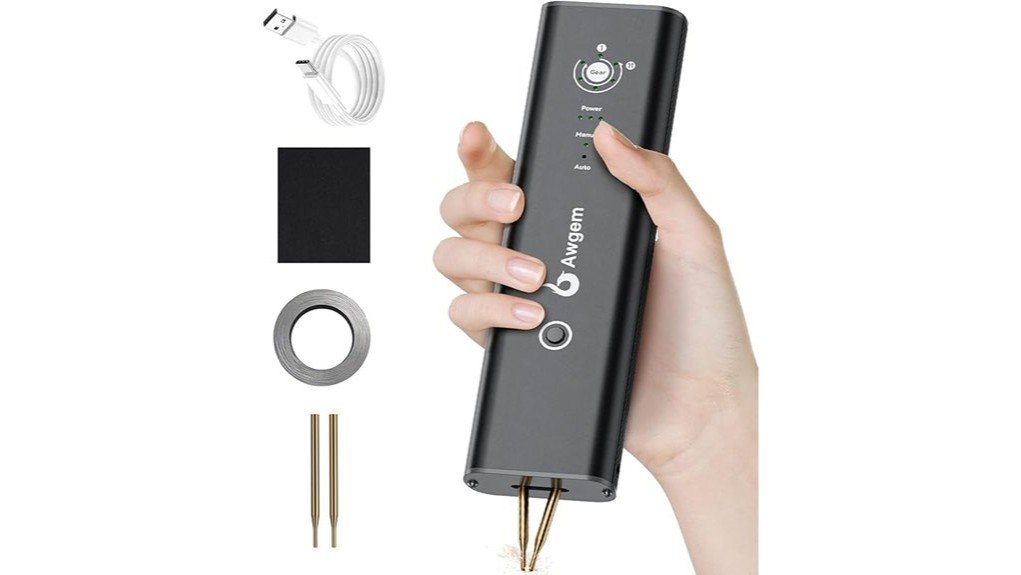
A compact spot welder can make small battery-pack repairs easier, but only when its output matches the strip, cell, and workload. The Awgem Handheld Spot Welder is built for light nickel-strip work with 11 power levels, dual-pulse output, and automatic or manual triggering. Its one-piece design is convenient for hobby use, though the stated 0.2mm nickel-plated sheet limit and incomplete published specifications keep it out of the heavy-duty category. This review explains where it fits, how to use it more consistently, and what you should confirm before buying.
Quick Verdict
Rating: 7.5/10, recommended with caveats
Best For: DIY battery repairs, small pack assembly, and occasional nickel-strip welding
Bottom Line: The Awgem is easy to store and gives you more control than a fixed-output mini welder. Its practical limit is light-duty work, and you should verify the exact package contents, charging details, and warranty on the current listing.
Key Specifications
| Specification | Detail |
|---|---|
| Brand | Awgem |
| Model or version | 11-gear handheld version; exact model code is not confirmed on the accessible listing details |
| Product type | Rechargeable handheld battery spot welder |
| ASIN | B0DS8N1Y7Z |
| Design | Integrated power supply and welding pins for one-handed operation |
| Power adjustment | 11 adjustable output levels |
| Welding modes | Automatic and manual |
| Pulse system | Dual-pulse output |
| Stated material range | Nickel-plated sheet from 0.1mm to 0.2mm; listing title also mentions iron and stainless steel |
| Battery compatibility stated | Cylindrical lithium cells including 18650, 26650, and 32650, plus some mobile-phone, NiMH, and NiCd battery work |
| Maintenance feature | Replaceable welding pins |
| Protection features stated | Overcharge, short-circuit, abnormal-temperature, and low-voltage protections |
| Best use | Occasional DIY battery-pack repair and assembly with thin compatible strip |
What Is the Awgem Handheld Spot Welder?
The Awgem is a small battery-powered spot welder that joins thin metal strip to battery terminals through short electrical pulses. Unlike a bench unit with a separate welding pen, its power supply and contact pins are built into one handheld body. That layout reduces cables and keeps the setup manageable on a crowded workbench.
The 11-level version is aimed at hobbyists repairing or assembling small battery packs. It supports automatic triggering for repeated contact welds and manual triggering when you want to position the pins before firing. Its stated nickel-plated sheet range of 0.1mm to 0.2mm makes it a light-duty tool rather than a replacement for a high-current bench welder.
Who Should Buy It?
Best For
- DIY users welding thin nickel-plated strip to compatible cylindrical cells
- Hobbyists who need a compact tool for occasional pack repair or assembly
- Users who want both automatic and manual triggering without a separate welding pen
Skip If
- You need reliable output for thick tabs, busbars, large metal parts, or production work
- You require fully documented battery capacity, dimensions, duty cycle, and warranty before purchase
- You plan to work in wet, dusty, or uncontrolled outdoor conditions
Before You Buy: Confirm that your strip is the stated material and thickness. A claim such as “up to 0.2mm” does not guarantee the same weld quality on pure nickel, nickel-plated steel, iron, and stainless steel because their electrical resistance and heat behavior differ.
Feature-by-Feature Review
Integrated One-Handed Design
The built-in welding pins remove the need for a separate pen and heavy lead set. This can make it easier to hold the strip in place with one hand while positioning the welder with the other. The tradeoff is that the full tool sits directly above the work, so access may be tight around closely spaced cells or pack frames.
11 Adjustable Power Levels
Eleven output levels give you room to tune the weld instead of relying on one fixed pulse. Start low, make sample welds on the same strip material, and increase one level at a time. Too little output can leave a weak joint, while too much can burn through the strip or add unnecessary heat to the cell terminal.
Dual-Pulse Output
The dual-pulse system sends two controlled pulses during each weld cycle. In practical terms, this is intended to improve contact and help form a more consistent joint. It still depends on clean tips, even pressure, adequate battery charge, and compatible material, so the feature does not remove the need for testing.
Automatic and Manual Modes
Automatic mode is useful when you are making a series of similar welds because contact can trigger the cycle without a separate button press. Manual mode is better when pin placement matters more than speed. The manual trigger sits near the thumb area, which supports steadier one-handed positioning.
Replaceable Welding Pins
The contact pins are replaceable, which matters because oxidized, pitted, or rounded tips can reduce current transfer. Cleaning the tips may restore performance, but replacement gives you another option after wear becomes visible. Check that replacements match the tool before ordering them.
Built-In Protection Features
The product details list overcharge, short-circuit, abnormal-temperature, and low-voltage protections. These features may help protect the tool, but they do not make damaged or incorrectly handled battery cells safe. You still need to inspect every cell, keep conductive tools away from exposed terminals, and stop if the tool or battery becomes unusually hot.
How It Performs in Real Use
For 18650-Style Battery Packs
The Awgem makes the most sense for small packs built with compatible cylindrical cells and thin nickel-plated strip. Its compact body can move from cell to cell without a separate foot pedal or bench transformer. Consistency will depend on keeping the strip flat and applying even pressure with both pins.
For Small Electronics and Repair Work
Manual mode is the better choice for careful repairs where you need time to align the contacts. The listing mentions mobile-phone batteries and other battery types, but compatibility should never be assumed from shape alone. Check the cell chemistry, terminal layout, and repair procedure before welding.
For Repeated Welding Sessions
A handheld battery welder is not designed like a production machine. During a long series of high-output welds, pause to check the body temperature and the condition of the tips. If weld strength falls, recharge the tool, clean the contacts, and let it cool before raising the power level.
For Storage and Portable Use
The integrated design is easier to store than a bench welder and separate pen. Keep it powered off in a dry place where the pins cannot bridge metal objects. Portable does not mean weatherproof, so use it only in a clean, protected workspace.
Setup Tips for Better Welds
- Inspect the cells first. Do not weld leaking, swollen, dented, corroded, or overheated batteries.
- Confirm the strip. Match the material and thickness to the tool’s stated range instead of assuming all “nickel” strip behaves the same.
- Charge the welder. A low internal battery can produce weak or inconsistent welds.
- Clean both contact points. Remove oxidation or residue from the welding pins and strip surface with an appropriate fine abrasive.
- Practice on scrap. Use the same strip type and thickness, begin at a low setting, and increase gradually.
- Apply even pressure. Both pins should contact the strip firmly and at the same time.
- Inspect each joint. A weld should hold the strip without excessive burning, holes, or visible cell damage.
- Allow cooling breaks. Stop when the tool, pins, strip, or cell becomes unusually hot.
Pro Tip: Make a small test coupon with the same strip before touching a battery. A gentle peel test can reveal a weak weld or excessive burn-through without risking your final pack.
Compatibility and Safety
Battery spot welding combines high current, conductive metal, and energy-dense cells. Work on a nonconductive, uncluttered surface and remove loose jewelry or metal objects that could bridge terminals. Use eye protection, keep a suitable emergency plan for battery fires, and follow the cell maker’s handling limits.
Do not place both pins directly across opposite battery terminals, and do not continue welding a cell that shows heat damage, venting, odor, swelling, or discoloration. The tool’s protective electronics cannot prevent every short circuit or battery failure caused by poor pack design or damaged cells.
For e-bike, power-tool, vehicle, or other high-energy packs, cell matching, insulation, fusing, battery-management-system wiring, and pack construction are as important as the weld itself. Those projects are better left to an experienced battery rebuilder when you cannot verify the full design and safety requirements.
Pros and Cons
Pros
- Integrated design avoids a separate welding pen and cable set
- Eleven power levels provide useful adjustment for thin strip
- Automatic mode helps with repeated welds, while manual mode improves placement control
- Dual-pulse output is designed for more consistent joints
- Replaceable pins make wear easier to manage
Cons
- The stated 0.1mm to 0.2mm nickel-plated sheet range limits it to light-duty work
- Results may require trial and error with power, pressure, strip material, and battery charge
- Exact battery capacity, charging time, package contents, dimensions, duty cycle, and warranty are not fully confirmed for this ASIN
Is It Worth the Price?
The Awgem is worth considering as a budget-friendly hobby tool when you only need occasional welds on thin compatible strip. Its value comes from the adjustable output, dual trigger modes, compact design, and replaceable contacts rather than industrial power or extensive published specifications.
You will get the most value if you already understand basic battery-pack safety and are willing to test settings before each material change. It is not the best fit when downtime, repeatability, or documented duty-cycle performance matters more than portability.
How It Compares to Alternatives
The Seesii Mini Spot Welder and Kerpu Mini Spot Welder are worth comparing if you want another compact battery-powered format, especially when their listings provide clearer battery or accessory details. A SUNKKO 709A is a larger bench-style option for buyers who value a more stationary setup and broader workshop capability over one-handed portability.
The Awgem makes the most sense when simple storage, manual and automatic modes, and 11-step adjustment matter more than thick-material capacity. Compare current manuals and package contents rather than choosing by the maximum thickness claim alone.
Frequently Asked Questions
What thickness can the Awgem Handheld Spot Welder handle?
The accessible product details state a range of 0.1mm to 0.2mm for nickel-plated sheet. Treat 0.2mm as a stated ceiling, not a guarantee across every metal type or battery condition.
Can it weld pure nickel strip?
The exact ASIN details emphasize nickel-plated sheet, while the listing title also mentions iron and stainless steel. Pure nickel may require different current than nickel-plated steel, so confirm the manual and test the exact strip before using it on a pack.
Does it work with 18650 batteries?
Yes, 18650 cells are specifically named in the product title and supporting details. The broader documentation also references 26650 and 32650 cylindrical cells, but you should confirm cell condition and pack design before welding.
Should you use automatic or manual mode?
Automatic mode is convenient for repeated, evenly spaced welds after you have confirmed the setting. Manual mode gives you more control when positioning is tight or the repair requires extra care.
Why are the welds weak or inconsistent?
Common causes include a low internal battery, dirty pins, uneven pressure, oxidized material, or an output level that is too low. Correct those issues one at a time and test on scrap before increasing power.
How long does the Awgem take to charge?
A reliable charging time is not confirmed in the accessible details for this ASIN. Follow the included manual and use only the specified charger or input rating rather than relying on a generic estimate.
Is it suitable for outdoor or professional use?
It is best treated as a light-duty tool for a dry, protected workspace. No verified weather-resistance or production-duty rating is available for this ASIN, so it should not replace a professional bench welder.
What should you confirm before ordering?
Check the current listing for the exact model, included accessories, charger requirements, warranty, return terms, and replacement-pin availability. Seller bundles can change, so use the live package list rather than older photos or copied descriptions.
The Bottom Line
The Awgem Handheld Spot Welder is a sensible choice for hobbyists who need a compact, adjustable tool for occasional thin-strip battery work. Its strongest points are the one-piece design, 11 power levels, dual modes, and replaceable pins, while its main limitation is the light-duty 0.2mm stated ceiling and incomplete model-specific documentation. Skip it for production work, thick conductors, or high-energy pack projects that require professional equipment and verified procedures.
Ready to Buy?
Check the latest price, package contents, and product details before you decide.