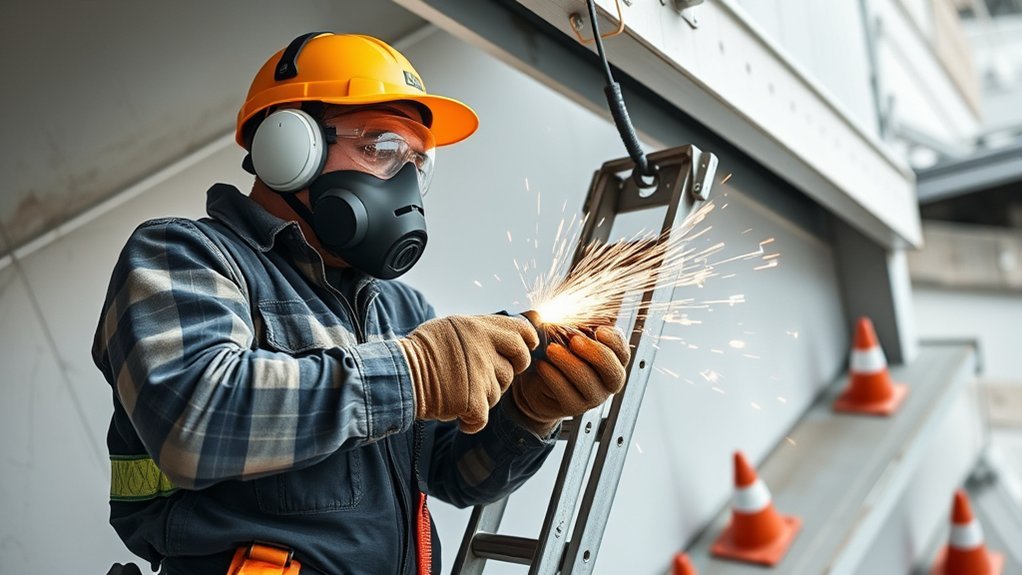
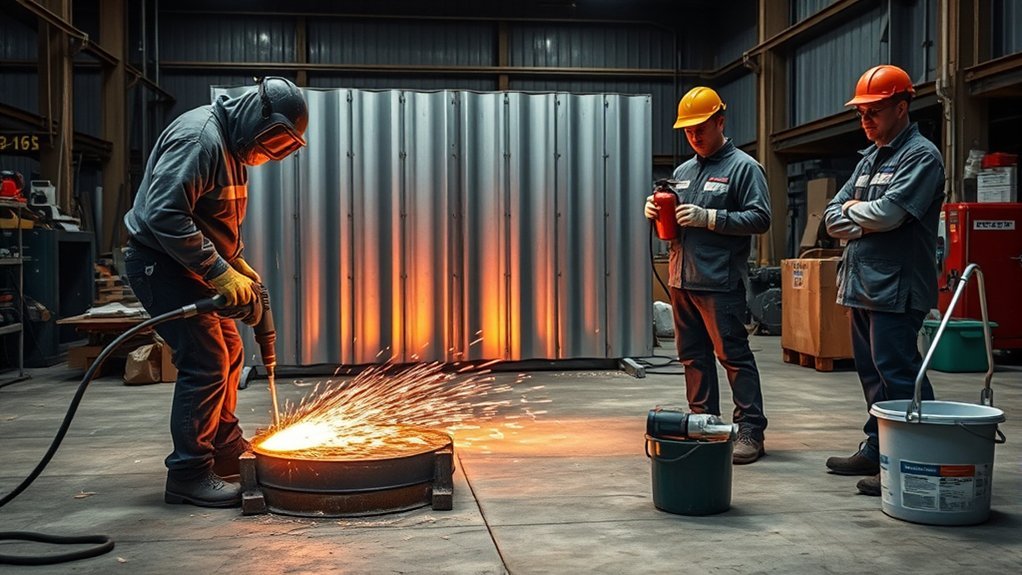
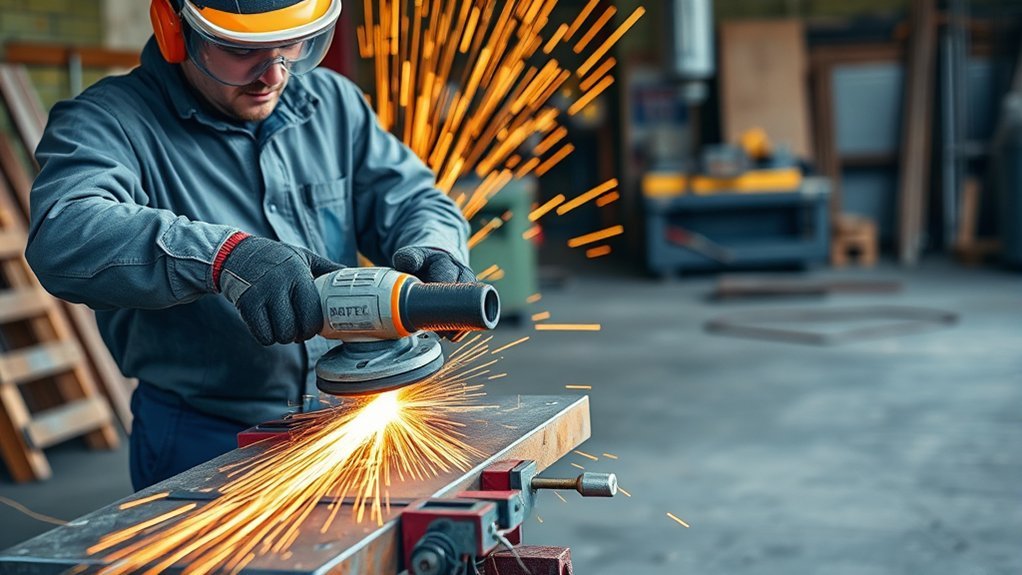
The wrong angle grinder wheel can slow the job, damage the workpiece, or fail at high speed. Each wheel or disc has a specific purpose, from cutting steel to stripping rust, blending a weld, or grinding concrete. This guide explains the main angle grinder wheel types, how their labels differ, and how to choose a compatible accessory safely.
Quick Answer
Use a grinding wheel for heavy metal removal, a cut-off wheel for straight cuts, a flap or fibre disc for blending and finishing, a wire or strip disc for rust and paint, and a diamond blade or cup wheel for masonry. Always match the diameter, arbor, guard, flanges, material rating, and maximum RPM to your grinder.
Key Takeaways
- Choose the wheel by both the material and the task; grinder diameter alone is not enough.
- Use a cut-off wheel only on its edge unless it is clearly marked as a combination cut-and-grind wheel.
- Flap discs and fibre discs blend metal more smoothly than rigid grinding wheels, but fibre discs require the correct backing pad.
- Concrete and masonry work needs a compatible diamond accessory plus effective silica-dust control.
- Never exceed the wheel’s marked maximum RPM or use a wheel that does not fit the grinder’s guard, arbor, and flanges.
At a Glance
| Time Required | About 5–10 minutes to identify, inspect, and mount the correct wheel |
| Difficulty | Beginner to intermediate; safe operation still requires training and the grinder manual |
| Tools Needed | Angle grinder, correct guard and side handle, compatible wheel, required flanges or backing pad, and mounting wrench if applicable |
| Cost | Varies by wheel type, diameter, abrasive grade, and whether a backing pad or dust shroud is required |
Angle Grinder Wheel Types and What Each One Does
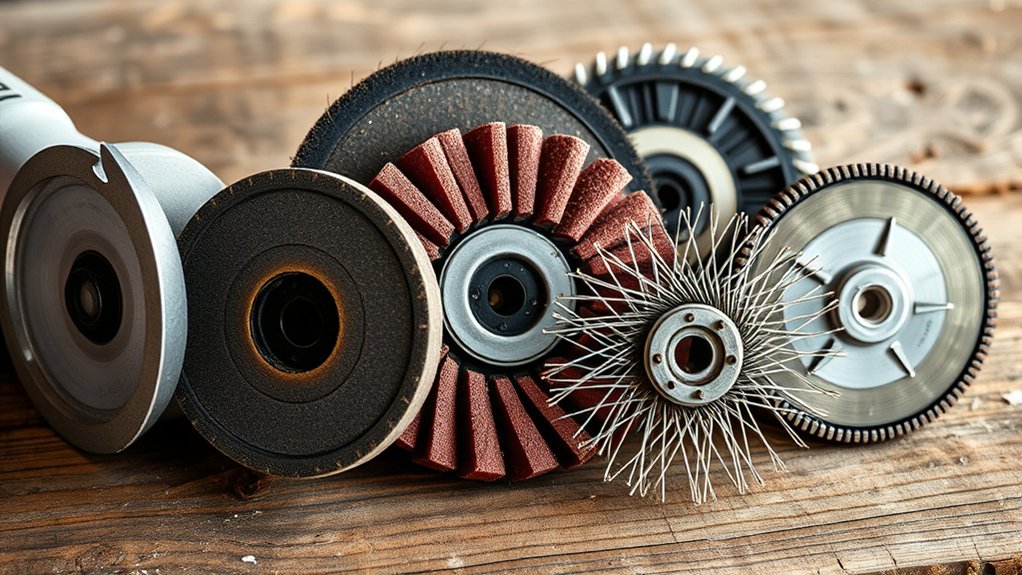
People often use the words wheel and disc for the same angle grinder accessory. The important details are the accessory’s construction, shape, diameter, thickness, arbor or thread, maximum speed, approved material, and intended operation.
A wheel that cuts well may not be safe for side grinding. A surface-cleaning disc may strip paint but will not cut steel. A diamond cutting blade and a diamond cup wheel also do different jobs: one cuts with its edge, while the other grinds with its face.
| Task | Typical Material | Best Starting Choice | Important Note |
|---|---|---|---|
| Heavy stock or weld removal | Steel or cast iron | Depressed-center grinding wheel | Use only on materials named on the label. |
| Straight cutting | Bar, tube, sheet, bolts | Cut-off wheel | Do not twist it or grind on its side. |
| Blend welds and edges | Steel or stainless steel | Flap disc | Choose Type 27 or Type 29 to suit the contact angle and task. |
| Fast metal grinding | Carbon steel or stainless steel | Fibre disc | Requires the correct rated backing pad. |
| Remove rust, paint, or scale | Metal | Wire brush or clean-and-strip disc | Knotted wire is heavier-duty; crimped wire is lighter and more flexible. |
| Surface refinement or polishing | Metal, stone, or approved coatings | Nonwoven, sanding, or polishing disc | Use the required backing pad and speed range. |
| Cut concrete, brick, or pavers | Masonry | Segmented or turbo diamond blade | Use dust control and only a wet-rated system if water is applied. |
| Make cleaner tile cuts | Ceramic, porcelain, stone | Continuous-rim diamond blade | Confirm the blade is approved for the exact tile or stone. |
| Level or grind concrete | Concrete or masonry | Diamond cup wheel | Use the specified cup-wheel guard and dust shroud. |
Warning: Never install an oversized wheel, remove the guard to make a wheel fit, or use an unapproved toothed saw blade or chain-style carving attachment. Use only accessories recommended for your grinder and the exact operation.
Grinding Wheels for Heavy Metal Removal
Grinding wheels are thick, rigid, bonded abrasives made for shaping, beveling, smoothing welds, and removing larger amounts of metal. A depressed-center Type 27 wheel is a common shape for right-angle grinders because the recessed center provides clearance for the flange nut.
Grinding wheels work well when durability and stock removal matter more than a fine finish. They usually leave deeper scratch marks than flap or fibre discs, so a second finishing step may be needed before painting or coating.
Choose the abrasive and grit from the wheel label, not by color. Aluminum oxide is common for general steel work. Zirconia alumina and ceramic abrasives are often used for harder or higher-production grinding. Silicon carbide appears in products made for materials such as masonry or some nonferrous metals, but the label must specifically approve the workpiece.
Products Worth Considering

HEAVY-DUTY PERFORMANCE: Our product is specifically designed for heavy grinding, beveling, and weld removal, making it ideal for demanding applications

Designed for grinding and stock removal

HEAVY-DUTY PERFORMANCE: Our product is specifically designed for heavy grinding, beveling, and weld removal, making it ideal for demanding applications
Grit Selection for Grinding and Finishing
Lower grit numbers are coarser and remove material faster. Higher grit numbers leave a smoother surface but remove less material. Exact results vary by abrasive type, pressure, tool speed, and workpiece.
| Typical Grit Range | Common Use | Expected Finish |
|---|---|---|
| 24–36 | Heavy stock removal, weld leveling, beveling | Fast cut with deep scratches |
| 40–60 | General grinding, deburring, weld blending | Balanced removal and finish |
| 80–120 | Smoothing, blending, and paint preparation with flap, fibre, or sanding discs | Finer scratch pattern |
| Finer than 120 | Surface refinement or polishing with a product designed for that step | Fine finish; not a substitute for a dedicated polishing pad or compound |
Keep steady, moderate pressure and let the abrasive cut. Excess force raises heat, can glaze or wear the wheel, and makes the grinder harder to control.
Note: Aluminum and other soft nonferrous metals can load some ordinary grinding wheels. Use only a wheel labeled for that metal. For stainless steel, use a contamination-free wheel and keep it separate from tools used on carbon steel.
Cut-Off Wheels for Metal
Cut-off wheels have a thin bonded profile for making straight cuts through metal bars, bolts, sheet, pipe, and tubing. Their narrow kerf helps them cut quickly and waste less material than a thick grinding wheel.
Type 1 flat and Type 27 depressed-center cut-off wheels are common profiles. The correct guard, flange arrangement, and mounting method depend on the grinder and wheel, so follow both manuals. A thin wheel often cuts faster and cleaner, while a thicker wheel may feel less flexible and can suit thicker stock, but it also makes a wider cut.
Keep the wheel aligned with the cut. Do not bend, pinch, or twist it in the kerf. Support the work so the cut does not close on the wheel, and let the wheel reach full speed before contact.
Warning: Do not grind with the side of a standard cut-off wheel. Side pressure can break the wheel. Side grinding is acceptable only when the accessory is clearly marked and approved as a combination cut-and-grind wheel.
Flap Discs for Grinding and Finishing
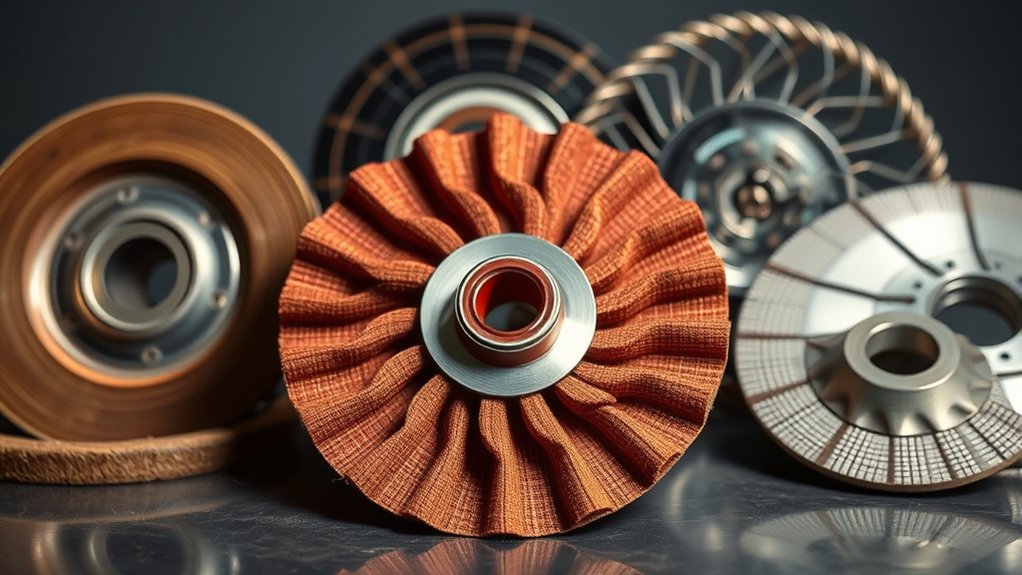
Flap discs combine grinding and finishing. Their overlapping abrasive flaps wear back during use and expose fresh abrasive, which helps maintain a consistent cut while leaving a finer finish than many rigid grinding wheels.
Use a flap disc to smooth welds, break sharp edges, blend grinding marks, deburr parts, or prepare metal for paint. Type 27 flap discs have a flatter profile for flatter surfaces and lighter finishing. Type 29 discs have a conical profile that can provide more aggressive contact on contours, edges, and heavier grinding work.
- Choose the grit: Use coarse grit for faster stock removal and finer grit for blending or finish preparation.
- Match the material: Select a disc labeled for carbon steel, stainless steel, aluminum, or the exact alloy.
- Use the correct contact angle: Follow the flap-disc and grinder instructions rather than forcing the full face flat against the work.
- Stop at the backing plate: Replace the disc when the flaps are badly torn, glazed, uneven, or worn far enough to expose the backing.
Flap discs work especially well after rough grinding because they can refine the surface before coating, welding, or final assembly.
Pro Tip: Start only as coarse as needed. A 40- or 60-grit flap disc often removes weld high spots while giving better control than jumping straight to the coarsest option. Move to 80 or 120 grit when the shape is correct and only the scratch pattern needs refinement.
Fibre, Sanding, and Polishing Discs
Fibre discs are coated abrasive discs that mount on a separate backing pad. They can remove metal quickly and are useful for weld grinding, beveling, deburring, and blending. The backing pad supports the disc and must match its diameter, attachment system, and maximum RPM.
Sanding discs and nonwoven surface-conditioning discs handle lighter material removal, scratch refinement, paint preparation, and finishing. Polishing pads use suitable compounds to create a final sheen on materials approved by the pad and compound manufacturer.
Do not run a fibre or sanding disc without its specified backing pad. A pad that is too soft, too small, damaged, or rated below the grinder’s speed can make the accessory unstable.
Wire Wheels, Wire Cups, and Strip Discs
Wire wheels and wire cup brushes remove rust, paint, scale, weld discoloration, and light corrosion. Knotted wire is stiffer and better for heavy cleaning or descaling. Crimped wire is more flexible and better for lighter cleaning and surface preparation.
Wire brushes can change the surface less than a grinding wheel, but they are not gentle by default. A coarse, knotted brush can scratch the workpiece, round edges, or throw broken wires. Inspect the brush before use, keep the guard in place, and wear safety glasses plus a face shield.
Clean-and-strip discs and other open-web nonwoven discs are useful alternatives when you want to remove coatings, rust, or adhesive without digging into the base metal as aggressively as a grinding wheel. They are not cutting wheels.
Note: Use a stainless-steel wire brush only on stainless steel and keep it separate from carbon-steel brushes. Cross-contamination can leave iron particles that later rust on the stainless surface.
Diamond Blades and Diamond Cup Wheels for Masonry
Diamond cutting blades cut hard materials such as concrete, brick, block, pavers, tile, stone, and masonry. The metal bond around the rim wears during use and exposes fresh diamond abrasive. Choose the rim style and bond for the exact material; Makita distinguishes segmented, turbo, and continuous-rim blades by cutting speed and finish.
- Segmented rim: Fast, cooler cutting for concrete, brick, block, pavers, and similar masonry when the blade label approves the material.
- Turbo rim: A balance of cutting speed and a smoother edge on many construction materials.
- Continuous rim: Cleaner, more precise cuts in ceramic, porcelain, granite, marble, and other tile or stone products listed on the blade.
Diamond cup wheels are for surface grinding rather than straight cutting. They can remove coatings, flatten high spots, and grind concrete or masonry. Use the cup-wheel guard and dust shroud specified for the grinder and wheel.
Some diamond accessories are dry-rated, some are wet-rated, and some allow either method. Never add water to a dry-only grinder or improvise a hose. For silica-containing materials, use an integrated wet system approved for the tool or a compatible shroud and vacuum dust-collection system that follows OSHA silica-control guidance.
Warning: Concrete, brick, mortar, stone, and many tiles can release respirable crystalline silica. Control dust at the source. Where an approved wet system is used, follow electrical-safety requirements, including ground-fault protection and watertight connections.
NIOSH testing found that the evaluated grinder-and-shroud combinations reduced concrete-grinding dust exposure by at least 90%, showing why dust collection should be treated as a core control rather than an optional cleanup step.
How to Read an Angle Grinder Wheel Label
Before mounting any accessory, read the label and compare it with the grinder manual. Do not rely on appearance alone. A safe match includes all of the following:
- Wheel type and operation: Cutting, grinding, blending, cleaning, sanding, polishing, or masonry grinding.
- Approved material: Steel, stainless steel, aluminum, concrete, masonry, tile, stone, or another named material.
- Diameter and thickness: The wheel must fit inside the specified guard and remain within the grinder’s capacity.
- Arbor, bore, or thread: The mounting hole or thread must match the spindle and approved flanges or attachment system.
- Maximum operating speed: The wheel’s marked maximum RPM must meet or exceed the grinder’s no-load speed, consistent with OSHA portable-tool requirements.
- Direction arrow: Install directional diamond blades and other marked accessories so rotation matches the arrow.
- Wet or dry rating: Use water only when the wheel, grinder, and control system permit it.
- Safety symbols and restrictions: Follow all required PPE, guard, contact-angle, and prohibited-use markings.
How to Choose the Right Angle Grinder Wheel
- Identify the material. Separate carbon steel, stainless steel, aluminum, concrete, masonry, tile, and stone because they do not all use the same abrasive.
- Define the operation. Decide whether you need to cut, grind, blend, clean, sand, or polish.
- Check the grinder manual. Confirm allowed accessory types, wheel diameter, guard type, spindle thread or arbor, flanges, backing pad, and no-load RPM.
- Read the wheel label. Verify the material rating, use restriction, dimensions, maximum speed, wet or dry rating, and direction of rotation.
- Choose the finish level. Use a coarse abrasive for heavy removal and progress to finer grits only as needed.
- Plan the controls. Secure the workpiece, remove flammables, control sparks and dust, and select the required PPE before starting.
For stainless steel, choose an abrasive labeled for stainless steel and avoid using a wheel or wire brush that has already touched carbon steel. For aluminum, use an accessory specifically labeled for aluminum or nonferrous metal.
Products Worth Considering


[High-Performance Cutting] Designed for cutting metal & stainless steel, these cut off wheels 4 1/2 inch work efficiently with any angle grinder wheel, supporting speeds up to 13,300 RPM.

Stainless steel wire for improved durability and grinding performance.
Angle Grinder Wheel Safety Checks
- Disconnect power. Unplug the grinder or remove the battery before changing an accessory.
- Inspect the tool. Check the guard, side handle, spindle, flanges, cord or battery connection, switch, and ventilation openings.
- Inspect the wheel. Reject accessories with cracks, chips, torn flaps, bent cores, missing wires, water damage, heavy wear, unreadable labels, or other defects.
- Use the correct test. Perform a ring test only when the wheel type and manufacturer instructions call for one; it does not apply to every disc, brush, or diamond blade.
- Verify compatibility. Confirm diameter, arbor or thread, wheel type, guard, flanges or backing pad, direction, material rating, and maximum RPM.
- Mount without force. The wheel should seat correctly without being forced onto the spindle. Use only the specified flanges and tighten only as directed.
- Wear the right PPE. Use safety glasses, a face shield, hearing protection, suitable gloves and clothing, and respiratory protection when the hazard assessment or applicable rules require it.
- Control the work area. Clamp the workpiece, keep people out of the wheel plane, remove combustible material, and use effective dust collection or wet controls where needed.
- Test before contact. Hold the grinder with both hands, stand out of the wheel’s direct path, and let it reach full speed in a protected position before touching the work.
- Stop safely. Wait for the accessory to stop fully before setting the grinder down. Disconnect power before inspecting a wheel after a jam, drop, or unusual vibration.
Common Wheel Selection Mistakes
- Choosing by wheel diameter but ignoring the arbor, guard, flange, material, or RPM rating.
- Using a cut-off wheel for side grinding or twisting it to widen a cut.
- Mounting a fibre or sanding disc without its rated backing pad.
- Using a masonry or concrete wheel on metal, or a metal wheel on masonry, unless the product is explicitly labeled for both.
- Using an ordinary steel abrasive on aluminum or contaminating stainless steel with a carbon-steel wheel or brush.
- Removing the guard or using a larger wheel to gain more cutting depth.
- Adding water to a grinder or blade that is not approved for wet use.
- Pressing so hard that the wheel overheats, binds, chatters, or slows the grinder.
- Continuing to use an accessory after a drop, impact, jam, crack, missing label, or unusual vibration.
Frequently Asked Questions
What are the different types of angle grinder wheels?
The main types are grinding wheels, cut-off wheels, combination cut-and-grind wheels, flap discs, fibre discs, sanding and nonwoven discs, wire wheels or cup brushes, diamond cutting blades, diamond cup wheels, and polishing pads. Each accessory must be labeled for the grinder, material, speed, and operation.
What is the difference between a grinding wheel and a flap disc?
A grinding wheel is a rigid bonded abrasive for heavy stock and weld removal. A flap disc uses overlapping coated-abrasive flaps, conforms better to the work, and usually leaves a smoother finish. Flap discs are often easier to control for blending and surface preparation.
What is the difference between a grinding wheel and a cut-off wheel?
A grinding wheel is thick and designed to remove material with an approved grinding surface. A cut-off wheel is thin and designed to cut with its edge. Do not apply side pressure to a standard cut-off wheel.
What are the common grinding-wheel abrasive materials?
Common abrasive grains include aluminum oxide, zirconia alumina, ceramic alumina, silicon carbide, and diamond. Grain type alone does not prove compatibility, so use the wheel’s material and application markings as the final guide.
Can you use the same angle grinder wheel on metal and concrete?
Usually not. Metal cut-off and grinding wheels are made for named metals, while concrete and masonry commonly use diamond blades or cup wheels. Use one accessory on both only when the manufacturer explicitly labels it for both materials and the grinder setup is compatible.
What grit flap disc should you use for weld removal?
A 36- or 40-grit flap disc is a common starting point for faster weld removal, while 60 grit gives more control and a smoother result. Move to 80 or 120 grit for blending after the weld is level. The best choice depends on the metal, weld size, and finish target.
Can you put a larger wheel on an angle grinder?
No. Do not exceed the grinder’s listed wheel diameter or remove the guard to create clearance. A larger wheel may exceed the guard design, spindle speed limits, and safe operating conditions even if the arbor hole appears to fit.
Does the wheel’s maximum RPM need to be higher than the grinder’s RPM?
Yes. The accessory’s marked maximum operating speed must meet or exceed the grinder’s no-load speed. Never use a wheel with a lower RPM rating than the tool.
Conclusion
The right angle grinder wheel helps you work faster, cleaner, and with better control. Match the accessory to the material and task first, then confirm the diameter, arbor or thread, guard, flanges or backing pad, maximum RPM, and wet or dry rating.
Use grinding wheels for heavy shaping, cut-off wheels for straight cuts, flap or fibre discs for blending, wire or strip discs for cleaning, and diamond blades or cup wheels for masonry. Inspect every setup before use, control sparks and dust, keep the guard and side handle installed, and stop immediately if the grinder vibrates, binds, or sounds unusual.
Sources
- OSHA 29 CFR 1910.243: Guarding of Portable Powered Tools — guard position, wheel inspection, mounting, and maximum-speed compatibility.
- OSHA: Handheld Grinders for Tasks Other Than Mortar Removal — silica-dust controls, wet methods, vacuum shrouds, and electrical precautions.
- 3M: Angle Grinder Systems for Metal Fabrication — grinding wheels, cut-off wheels, flap discs, fibre discs, and surface-conditioning options.
- Makita: Diamond Blade Rim Types — segmented, turbo, and continuous-rim applications.
- Bosch Professional: Knotted Wire Wheel for Heavy Cleaning — heavy-duty wire-wheel uses on steel.
- NIOSH: Control of Hazardous Dust When Grinding Concrete — evidence for grinder shrouds and local exhaust ventilation.