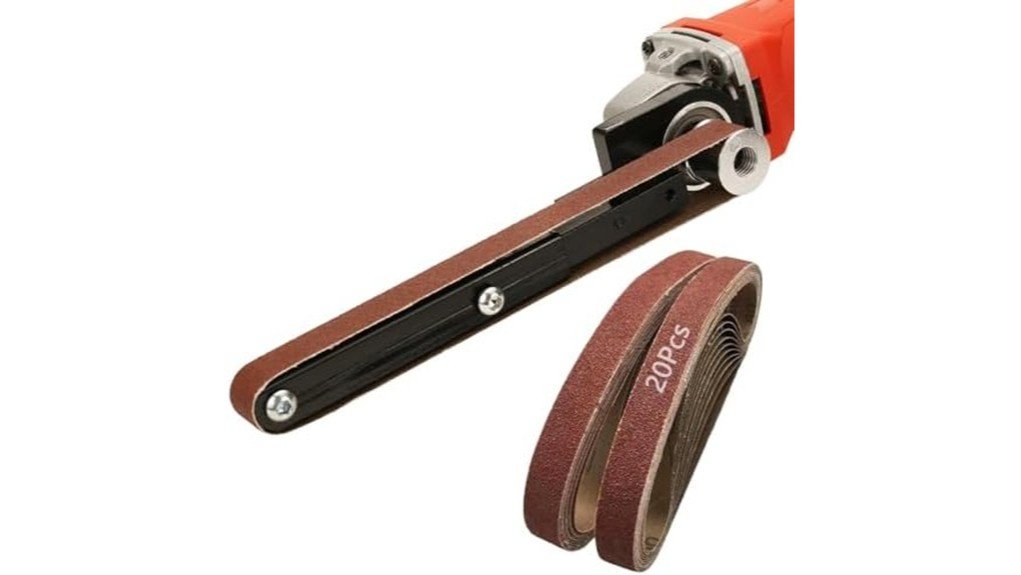
An angle grinder belt sander attachment turns a compatible angle grinder into a narrow belt sander for corners, weld seams, rust spots and small edges. This one fits grinders whose gear case or flange base measures about 1.73 to 1.78 inches (44 to 45.3 mm) per the listing, so measure your grinder before you order.
As an Amazon Associate I earn from qualifying purchases. Buying through these links costs you nothing extra.
Quick Answer: Will It Work on Your Grinder?
It works if your grinder matches the listed flange size, runs within the attachment’s speed limit, and you only need a narrow belt rather than a wide sanding surface. If the flange is outside the 44 to 45.3 mm range, the attachment may not seat or track correctly. In that case, look at the other belt sander attachment we cover, which lists a different fit range.
Listed Specs at a Glance
These details come from the product listing and were not measured or bench-tested here. Confirm them on the Amazon page before buying.
| Item | Per the listing |
|---|---|
| Weight | About 1.5 lb |
| Construction | Metal body |
| Belt support | Dual bearing design with a built-in high-strength spring |
| Belt guide | Grooved driving wheel to help stop belt drift |
| Flange base fit | About 1.73 to 1.78 in (44 to 45.3 mm) |
| Install time | About two minutes |
| Typical jobs | Grinding, polishing, rust removal, weld smoothing, light woodworking |
Fit Checklist Before You Buy
- Measure the flange base or gear case neck on your grinder and compare it with the 44 to 45.3 mm range.
- Check that the spindle thread and guard area leave room for the attachment. Read your grinder manual for accessory notes.
- Find your grinder’s no-load speed (RPM) on the nameplate and compare it with the attachment’s rating on the listing. Never run an accessory above its rated speed.
- Confirm which belt size the attachment takes before you buy spare belts.
- Make sure you can still hold the grinder body securely with the attachment fitted.
How to Fit an Angle Grinder Belt Sander Attachment
- Unplug the grinder, or remove the battery on a cordless model.
- Take off the grinding disc and guard if the attachment instructions call for it.
- Slide the attachment onto the flange base and tighten it as the instructions describe.
- Fit the sanding belt over the wheels and check that it sits in the driving wheel groove.
- Spin the belt by hand and look for rubbing or drift.
- Wear eye, hearing and breathing protection, then run the grinder briefly away from the work to check belt tracking.
The listing describes installation as taking about two minutes. Take longer the first time and follow the instructions that come with the product.
What It Is Good For
- Weld cleanup: a narrow belt reaches beside seams and into corners that a disc cannot.
- Rust removal on small parts: useful on brackets, edges and tight spots.
- Metal polishing: finer belts can smooth stainless steel and aluminum edges.
- Light woodworking: shaping small edges and tight curves.
Limits to Know
- It is not a replacement for a full-size belt sander on wide panels or doors.
- Fit is the main risk. It will not suit every grinder.
- Belt size, grit range and number of belts included should be checked on the listing.
- Sanding aluminum, painted or coated metal makes dust you should not breathe. Use a respirator rated for the dust.
Safety Notes
A belt attachment turns a high-speed tool into something that can grab loose clothing and fling sparks. Wear safety glasses, hearing protection and gloves that will not snag, keep sparks away from flammable material, and let the belt do the cutting with light pressure. Stop if the belt frays, slips or makes unusual noise. See our 5-inch angle grinder roundup if you also need a grinder.
Related guides: Belt Sander Attachment for Angle Grinder: 20-Belt Kit Review | Rocsuk Belt Sander Attachment for Angle Grinder Review | Best Angle Grinder 2026: Corded & Cordless Picks
Frequently Asked Questions
Can I turn any angle grinder into a belt sander?
No. The attachment has to match your grinder’s flange base size and speed rating. Per the listing, this one fits flange bases of about 44 to 45.3 mm. Check your grinder before ordering.
How long does installation take?
The listing says about two minutes. Allow more time on the first fit so you can check belt tracking and read the instructions.
What materials can I sand with it?
The listing points to metals such as stainless steel and aluminum, plus wood. Choose belt grit for the job: coarse for rust and shaping, fine for finishing.
How often should I replace the sanding belts?
Replace a belt when it clogs, glazes, frays or tears. How long that takes depends on the material and how hard you press.
What safety gear should I wear?
Eye protection, hearing protection, a respirator or dust mask suited to the material, and snug clothing. Unplug the grinder before changing belts or fitting the attachment.