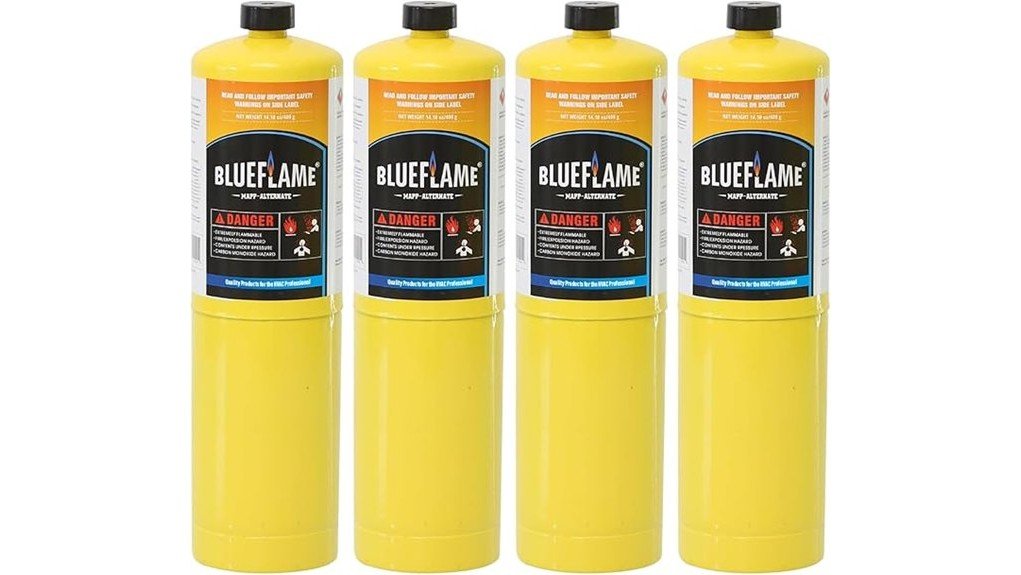
A propane torch may feel slow when you need to heat a stubborn fitting, complete a brazing job, or bring metal up to temperature quickly. The BlueFlame MAPP ALTERNATE Gas Cylinder Pack of 4 is positioned as a hotter propylene-based option for compatible hand torches. Each disposable cylinder contains 14.1 oz of fuel, but the package does not include a torch head. This review explains its verified specifications, compatibility limits, safety requirements, and the types of projects that justify buying four cylinders at once.
Our verdict is based on the current Amazon listing, the BlueFlame product page, and the manufacturer’s safety data sheet. We did not conduct an independent laboratory flame-temperature or runtime test.
Quick Verdict
Editorial Rating: 8/10, recommended with compatibility and safety caveats
Best For: Frequent torch users who need four hotter-burning cylinders for brazing, soldering, HVAC work, metal heating, or suitable DIY projects.
Bottom Line: The BlueFlame four-pack offers 14.1 oz propylene cylinders, an advertised flame temperature up to 3,730°F, and compatibility with suitable CGA-600 torch heads. Its main tradeoffs are the four-cylinder commitment, strict storage requirements, and the need to confirm that your torch supports this fuel before attachment.
Key Specifications
| Specification | Verified or Listed Detail |
|---|---|
| Brand | BLUEFLAME MAPP GAS PRO |
| Model | BlueFlame MAPP ALTERNATE |
| ASIN | B0DFDWRXX8 |
| Manufacturer | My Energy |
| Product Type | Disposable propylene torch-fuel cylinders |
| Package Quantity | Four cylinders in the linked Amazon listing |
| Fuel Amount | 14.1 oz per cylinder |
| Fuel | Propylene-based MAPP alternate fuel |
| Purity Claim | Advertised as 99.9% high-purity propylene; the manufacturer’s SDS lists C3H6 at 99.6% by weight |
| Advertised Temperature | Up to 3,730°F, depending on the torch and operating conditions |
| Torch Connection | Designed for compatible torch heads with CGA-600 threads |
| Cylinder Construction | Yellow metal cylinder |
| Included Components | Four disposable fuel cylinders; torch head not included |
| Listed Uses | Brazing, soldering, heating, HVAC work, plumbing, paint removal, crafts, and manufacturer-listed culinary applications |
| Primary Safety Classification | Extremely flammable liquefied gas under pressure |
What Is the BlueFlame MAPP ALTERNATE?
The BlueFlame MAPP ALTERNATE is a disposable fuel cylinder filled with propylene-based gas for compatible hand torches. The linked ASIN includes four 14.1 oz cylinders, making it a supply pack for repeated jobs rather than a single-cylinder trial purchase.
Despite the familiar MAPP wording, this is a modern MAPP alternate rather than the original discontinued MAPP-gas formulation. Its main selling point is a hotter and faster-heating flame than standard propane when it is paired with a suitable torch. BlueFlame lists brazing, soldering, HVAC work, plumbing, metal heating, crafts, and selected culinary uses among its intended applications.
You can review the manufacturer’s product details and BlueFlame safety data sheet before using the cylinders.
Who Should Buy It?
Best For
- Regular torch users who can use all four 14.1 oz cylinders.
- Buyers with a confirmed CGA-600-compatible torch rated for propylene or MAP-Pro-type fuel.
- Projects where faster heating than standard propane can reduce waiting time.
Skip If
- You need only one cylinder for an occasional light-duty project.
- Your torch manual allows propane only or uses a different connection.
- You lack a cool, secure, and well-ventilated cylinder-storage area.
Before You Buy: The linked Amazon ASIN is a four-pack of fuel cylinders. It does not include a torch, hose, regulator, stand, or other accessories. Confirm that your torch supports propylene fuel and uses a CGA-600 connection before ordering.
Feature-by-Feature Review
Advertised Heat Output
BlueFlame advertises an in-air flame temperature up to 3,730°F. That figure places the fuel in the same general heat-output category as other modern MAP-Pro-style cylinders and above standard propane for many hand-torch applications.
The number should not be treated as the temperature of every workpiece. Torch design, flame adjustment, air movement, ambient temperature, distance from the work, and the material’s ability to absorb heat all affect performance. The practical advantage is faster heat transfer, not a guarantee that every job will reach 3,730°F.
Propylene Fuel and Flame Consistency
The Amazon listing and manufacturer page market the cylinders as containing 99.9% high-purity propylene. BlueFlame’s SDS lists C3H6 at 99.6% by weight, so the public product claim and safety-document composition are not identical.
That small documentation difference does not automatically indicate poor performance, but buyers who require an exact industrial gas composition should ask BlueFlame for clarification before purchase. For typical torch work, the more important questions are whether the torch supports propylene and whether the flame remains stable at the required setting.
CGA-600 Torch Compatibility
The listing uses broad wording such as “standard torch heads,” while the manufacturer gives the more useful detail: a compatible torch should have CGA-600 threads and be rated for the fuel. This connection is common on disposable hand-torch cylinders, but thread fit alone does not prove that a torch is approved for every fuel.
Check the torch head’s label and manual for MAP-Pro, propylene, or MAPP-alternate support. Do not force a connection, use an improvised adapter, or attach a damaged torch head.
Cylinder Construction and Package Format
Each yellow cylinder uses a metal body and contains 14.1 oz of fuel. Amazon identifies the included component as a disposable MAPP-alternate fuel cylinder, so this is not a refillable-tank system.
The four-pack is convenient when you perform recurring shop or service work and want spare cylinders on hand. It is less attractive for someone who completes one small project every few years, because unused pressurized cylinders still need suitable storage.
How It Performs in Real Use
For Brazing, Soldering, and HVAC Tasks
The higher heat output can bring fittings and joints to working temperature faster than a basic propane setup. This may help during suitable brazing, soldering, plumbing, and HVAC jobs when the torch, filler material, and workpiece are all matched correctly.
The cylinder does not determine the entire process. Joint size, base metal, torch output, filler alloy, ventilation, and local codes still matter. Refrigerant, fuel-gas, and regulated HVAC work should be completed by a qualified technician where required.
For Automotive and Metal Heating
A hotter hand torch can be useful for controlled heating, loosening some seized hardware, or preparing metal for a suitable repair process. The faster heat transfer may shorten the time spent holding the flame on the workpiece.
Keep the flame away from fuel lines, brake hoses, wiring, batteries, pressurized components, upholstery, coatings, and hidden combustible material. Verify what is behind the work area before applying heat.
For DIY, Paint Removal, and Craft Work
BlueFlame lists paint removal, glass melting, woodwork, and jewelry making as possible applications. The concentrated heat may improve speed, but it also increases the chance of scorching, warping, igniting nearby material, or damaging a finished surface.
Test the setup on scrap material when practical. Older paint may contain hazardous substances, so identify the coating and follow appropriate removal rules before heating it.
For Culinary Torch Tasks
The listing advertises uses such as searing, grilling vegetables, lighting charcoal, and caramelizing crème brûlée. Use the cylinder for food-related work only when the torch manufacturer explicitly approves the torch and fuel combination for that application.
Work in a properly ventilated area, keep the cylinder away from cooking heat, and follow the torch maker’s lighting and shutdown instructions. The cylinder itself is a fuel source, not a complete culinary torch kit.
How to Use It Correctly
- Read both labels first. Confirm that the torch manual permits propylene or MAP-Pro-type fuel and specifies a CGA-600 connection.
- Inspect the equipment. Do not use a dented, rusted, punctured, leaking, or heat-damaged cylinder. Check the torch connection and seals as directed by its manual.
- Attach it in a safe area. Keep ignition sources away while connecting the torch, and follow the manufacturer’s exact attachment procedure.
- Follow the approved leak check. Stop immediately if you detect leakage, unusual odor, hissing, or a damaged connection. Do not continue testing a suspect cylinder near a flame.
- Wear suitable protection. Match eye, hand, clothing, and respiratory protection to the torch process and work material.
- Shut down before storage. Turn off the torch, allow the equipment to cool, and follow the torch manual before disconnecting or storing the cylinder.
Pro Tip: Check your expected cylinder use before choosing this ASIN. The four-pack can offer better convenience for repeat work, but a single-cylinder alternative may be easier to store and more economical for one small project.
Safety, Storage, Transport, and Disposal
The BlueFlame SDS classifies this product as an extremely flammable liquefied gas under pressure. The document warns that the gas can form explosive mixtures with air and that heated containers may rupture. A claimed leak-resistant design does not remove the need for inspection, ventilation, and careful handling.
- Keep cylinders away from sparks, smoking, open flames, hot surfaces, and direct sunlight.
- Store them in a dry, cool, well-ventilated place away from incompatible materials and food containers.
- Avoid breathing vapors and do not use the product in a poorly ventilated or confined work area.
- Do not puncture, burn, modify, or attempt to refill a disposable cylinder.
- Keep cylinders secured against falls, impacts, and unauthorized use.
Empty cylinders may still contain hazardous residue or pressure. Follow the product label and local household-hazardous-waste or recycling rules rather than placing a cylinder in regular recycling without approval. The U.S. Environmental Protection Agency’s household hazardous waste guidance can help you locate the correct local process.
Do not plan to carry a filled fuel cylinder on an airplane. The TSA’s flammable-material guidance restricts compressed gas cylinders and requires any permitted empty cylinder to be visibly empty. Airline and transportation rules may be stricter.
Pros and Cons
Pros
- Four 14.1 oz cylinders support repeated jobs and reduce the need for frequent reordering.
- Advertised heat output up to 3,730°F can provide faster heating than standard propane.
- CGA-600 compatibility suits many approved disposable-cylinder torch heads.
- Useful across suitable brazing, soldering, HVAC, plumbing, metal-heating, craft, and culinary applications.
- Manufacturer product information and a dedicated safety data sheet are available online.
Cons
- The linked listing requires buying four cylinders and does not include a torch head.
- Compatibility must be confirmed from the torch manual, not assumed from thread fit alone.
- The advertised 99.9% purity claim differs from the SDS composition figure of 99.6% by weight.
Is It Worth the Price?
The BlueFlame four-pack is worth considering when you regularly use a compatible torch and value the convenience of having spare high-heat cylinders ready. Its value comes from the package quantity, 14.1 oz capacity per cylinder, and faster heating potential compared with standard propane.
The current price should be compared on a per-cylinder basis because competing products may be sold individually, in pairs, or in larger cases. Also account for the fact that the package includes fuel only. You still need a compatible torch head and any task-specific safety equipment.
This pack is not the best value for occasional low-heat work that a cheaper propane cylinder can handle. It makes more sense for repeat brazing, soldering, repair, or workshop use where the added heat provides a practical time benefit.
How It Compares to Alternatives
The Bernzomatic 14.1 oz MAP-Pro Hand Torch Cylinder is the most direct mainstream alternative and is available in single and multi-cylinder packages. It may be easier to source locally, while the BlueFlame ASIN makes more sense when its four-pack cost and CGA-600 compatibility suit your existing setup.
A standard propane cylinder is usually the simpler choice for lighter heating, basic utility work, or infrequent use. BlueFlame is the better fit when your approved torch can use propylene and your work benefits from faster heat transfer. BlueFlame also lists two-, six-, eight-, and twelve-cylinder variants, so compare package quantities before committing.
Frequently Asked Questions
Is BlueFlame MAPP ALTERNATE the same as original MAPP gas?
No. It is a modern propylene-based MAPP alternate intended to deliver higher heat than standard propane. Do not assume that its chemical formulation is identical to the original MAPP gas.
How many cylinders are included with ASIN B0DFDWRXX8?
The linked Amazon listing is a pack of four cylinders. Each cylinder contains 14.1 oz of fuel, and no torch head is listed as an included component.
Can I use these cylinders with any standard torch head?
No. BlueFlame specifies a high-quality compatible torch with CGA-600 threads, and your torch must also be rated for propylene or MAP-Pro-type fuel. Check the torch label and manual before connecting a cylinder.
How hot does BlueFlame MAPP ALTERNATE burn?
The product listing advertises a flame temperature up to 3,730°F. Actual flame and workpiece temperatures depend on the torch, adjustment, weather, distance, and material being heated.
Can this fuel cylinder weld metal?
The listing mentions welding along with brazing and soldering, but a fuel cylinder alone does not determine process capability. The torch system, oxygen supply, base metal, filler material, and required joint temperature determine whether welding is possible.
Can BlueFlame MAPP ALTERNATE be used for cooking?
BlueFlame advertises searing, grilling, charcoal lighting, and crème brûlée among its applications. Use it for food only with a torch and procedure that the equipment manufacturer specifically approves for culinary work.
How should unused and empty cylinders be stored or discarded?
Store cylinders in a cool, dry, well-ventilated place away from sunlight, heat, flames, sparks, and incompatible material. Empty cylinders may still present a hazard, so follow the label and your local hazardous-waste or approved recycling instructions.
Can BlueFlame fuel cylinders be taken on an airplane?
Do not pack a filled cylinder in carry-on or checked baggage. TSA rules generally permit only compressed gas cylinders that are clearly and visibly empty, and the airline may impose additional restrictions.
The Bottom Line
The BlueFlame MAPP ALTERNATE four-pack is a practical choice for repeat torch users who need more heat than standard propane and already own a confirmed CGA-600-compatible torch. Its main strengths are four 14.1 oz cylinders, an advertised temperature up to 3,730°F, and broad project coverage.
Skip it when you need only one cylinder, your torch supports propane only, or you cannot meet the product’s storage and ventilation requirements. Our 8/10 recommendation reflects its useful specifications while accounting for the four-pack commitment, fuel-composition documentation difference, and strict compatibility requirements.
Ready to Buy?
Confirm the current package quantity, torch compatibility, price, and seller details before you decide.