Yes, altitude affects shielding gas coverage when you weld. As elevation rises, atmospheric pressure and air density drop, so the gas stream around the arc can spread out, thin, and lose protection more easily. That makes torch angle, nozzle position, gas flow, wind control, and leak checks more important than they are at lower elevations.
Quick Answer
Altitude can reduce shielding gas coverage because lower air pressure and lower density make the gas envelope easier to disturb. Start with your normal WPS or machine setting, then increase flow in small 2–5 CFH steps only if test beads show porosity, oxidation, or unstable coverage.
Key Takeaways
- Higher elevation lowers air pressure and density, which can make shielding gas less stable around the arc.
- Do not solve every altitude problem by cranking up flow. Too much gas can turn turbulent and pull air into the weld zone.
- For TIG, a gas lens, correct cup size, short arc length, and clean tungsten usually help more than flow alone.
- For MIG, nozzle cleanliness, contact-tip-to-work distance, wind control, and leak-free hoses are critical.
- Use test beads and visual inspection to tune the setup for the actual elevation, joint, gas, and weather.
At a Glance
| Time Required | 5–15 minutes to check leaks, clean the nozzle, make a test bead, and tune flow. |
| Difficulty | Moderate. The adjustment is simple, but reading the weld and avoiding turbulence takes practice. |
| Tools Needed | Flowmeter or regulator, correct nozzle or cup, leak-check solution, clean consumables, wind screen, and scrap test coupons. |
| Cost | Usually low if you already have shielding gas. A gas lens, larger cup, or replacement hose may add cost. |
What Altitude Does to Shielding Gas Coverage
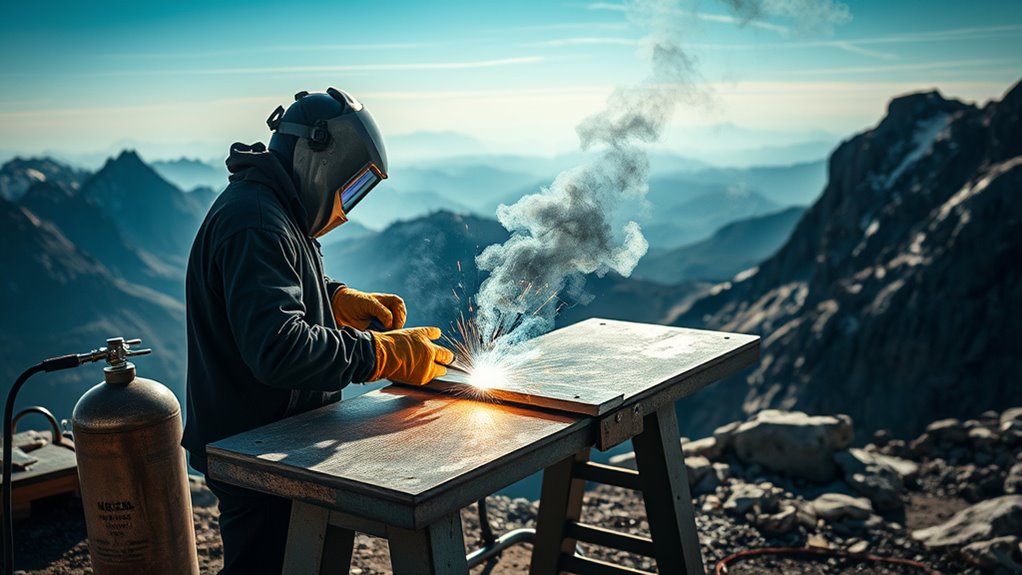
As altitude increases, air pressure and air density decrease. That matters because shielding gas has to form a stable envelope around the arc, tungsten, filler wire, and molten weld pool. When the surrounding air is thinner, that envelope can spread and break up more easily, especially outdoors or near a draft.
Shielding gas is not just “more gas.” It is controlled coverage. If the plume is smooth, it pushes oxygen, nitrogen, and moisture away from the weld zone. If the plume turns turbulent, it can mix with surrounding air and pull contamination into the puddle.
| Elevation | Approximate effect on air | What it means for welding |
|---|---|---|
| Sea level | Full baseline pressure and density | Normal WPS or machine-chart settings are the best starting point. |
| 5,000 ft | Noticeably lower pressure and density | Coverage may need cleaner nozzle control and small flow changes. |
| 7,000 ft | Shielding is easier to disturb | Use test beads and watch closely for pinholes, oxidation, or unstable arc behavior. |
| 10,000 ft | Lower density makes wind and drafts more punishing | Wind screens, gas lenses, nozzle fit, and leak checks become even more important. |
Warning: Do not aim shop ventilation, fans, or compressed air across the weld zone. Ventilation protects your breathing zone, but crossflow can blow shielding gas away from the arc and increase porosity.
Why Weld Porosity Increases at High Elevation
Porosity happens when gas pockets remain trapped in the weld as it solidifies. At high elevation, the shielding envelope can become easier to disturb, so oxygen, nitrogen, and moisture can enter the arc zone more easily. That contamination can create pinholes, worm tracks, weak spots, and rough bead appearance.
Altitude is rarely the only cause. Dirty base metal, damp filler, a clogged nozzle, a loose hose fitting, wrong torch angle, long arc length, and wind can all create the same symptoms. That is why the best fix is a full shielding check, not just a higher flow setting.
Lower Pressure, More Porosity Risk
Lower pressure does not automatically ruin a weld, but it gives you less margin for error. A torch angle that works at sea level may expose the leading edge of the puddle at elevation. A nozzle with spatter buildup may still seem usable in a calm shop but fail outdoors on a mountain job site.
The key is to protect the puddle until the metal is stable. For TIG, that means keeping the tungsten and hot bead under shielding during and after the arc. For MIG, it means keeping the nozzle close enough, clean enough, and centered enough to blanket the fusion zone.
Gas Expansion at Altitude
With lower surrounding pressure, the gas stream can expand and lose focus sooner after it leaves the cup or nozzle. That is why a larger cup, a gas lens, or a better nozzle position can help. These changes control how gas reaches the weld instead of simply pushing more volume through the system.
Watch the bead, not just the regulator. If the bead shows scattered pinholes, dark oxidation, soot, cloudy TIG tungsten, or a wandering arc, treat it as a shielding problem until you prove otherwise.
Pro Tip: Make one short test bead before the real weld whenever you change elevation, gas bottle, nozzle, cup size, wind screen, or work location. A 30-second test can save a full repair pass.
How to Adjust Shielding Gas Flow at Altitude
Start with the flow listed in your welding procedure, machine chart, or consumable guidance. Then adjust only after you check the basic setup. For many shop TIG and MIG jobs, flow often falls somewhere around 10–35 CFH, but the right number depends on gas type, cup or nozzle size, joint design, current, transfer mode, and wind exposure.
Flow Rate Adjustment
- Set your normal baseline. Use the WPS, machine chart, or your proven sea-level setting as the starting point.
- Check for leaks. Inspect the cylinder connection, regulator, hose, torch connection, solenoid, and nozzle area.
- Clean the gas path. Remove MIG spatter from the nozzle or install a clean TIG cup and screen.
- Make a test bead. Use the same material, joint position, stickout, and wind exposure as the real weld.
- Increase slowly. If the bead shows shielding problems, raise flow by 2–5 CFH and test again.
- Stop when the bead improves. If more flow makes the bead worse, back down and fix turbulence, wind, or nozzle position.
Do not assume that high altitude always needs a large flow jump. A small increase plus better torch control is often enough. If you double the flow without checking the gas path, you may create turbulence and waste gas while the real problem remains.
Laminar Coverage Control
The goal is smooth coverage over the weld pool. In TIG, a gas lens can help straighten flow and reduce turbulence before the gas exits the cup. In MIG, a clean nozzle and correct contact-tip-to-work distance help the gas blanket stay centered over the wire and puddle.
- Keep TIG arc length short and steady.
- Use enough TIG post-flow to protect the tungsten and hot bead.
- Keep MIG stickout consistent for the wire size and transfer mode.
- Use wind screens outdoors, even when the breeze feels light.
- Keep the nozzle or cup close enough without touching the puddle.
Note: If you are welding under a qualified WPS, do not change gas type, mixture, flow range, electrical settings, or technique beyond the allowed limits without approval.
Best GTAW Shielding Gas Setup for High Altitude
For GTAW, also called TIG welding, shielding quality depends heavily on cup size, gas lens condition, tungsten stickout, arc length, and post-flow. A gas lens is one of the best upgrades for high-altitude TIG work because it helps smooth the shielding stream and protects a wider area around the tungsten and puddle.
Use the smallest arc length you can control. Long arcs expose the weld pool and can make the shielding envelope less effective. Keep tungsten stickout reasonable for the cup and joint. If you need more stickout for access, use a larger cup or gas lens instead of simply increasing flow.
- Cup and gas lens: Use a gas lens when coverage is unstable or the tungsten needs more stickout.
- Pre-flow: Use enough pre-flow to purge air from the cup before arc start.
- Post-flow: Keep shielding on the tungsten and hot bead after arc stop.
- Tungsten condition: Regrind or replace contaminated tungsten before blaming altitude.
- Gas choice: Pure argon is common for TIG, while argon/helium blends may help on some thicker or high-conductivity materials when the procedure allows it.
At elevation, better gas control usually beats higher gas flow. A clean gas lens, steady hand, and short arc can do more than an oversized flow setting.
Products Worth Considering
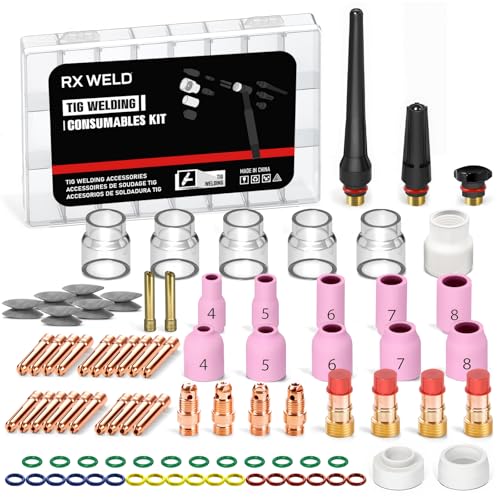
87 PCS tig torch accessories (consumables) with 12 tig cups.

SPECIFICATION: 49PCS TIG Torch Accessories kit (consumables).

Fit QQ300 DB PTA SR WP CK 17 18 26 TIG Welding Torch
High-Altitude MIG Welding Settings
MIG welding at altitude needs the same shielding discipline, but the problem often shows up at the nozzle. Spatter buildup, a loose diffuser, long stickout, or wind can break coverage before the gas reaches the puddle. Clean the nozzle and diffuser before changing voltage or wire feed speed.
If the arc sounds harsh, the bead is porous, or the edges look oxidized, check these items first:
- Nozzle cleanliness: Remove spatter that blocks or redirects gas.
- Contact-tip-to-work distance: Keep stickout consistent with your wire and transfer mode.
- Gun angle: Avoid angles that outrun the gas shield and expose the leading edge of the puddle.
- Wind control: Use screens outdoors and avoid welding in direct cross-drafts.
- Flow setting: Raise flow in small steps only after the gas path and wind control are correct.
- Gas mix: Use the gas blend required for the wire, base metal, and transfer mode.
Do not compensate for a dirty joint by increasing gas. Oil, paint, rust, moisture, zinc coating, and primer can all cause porosity or fumes. Clean the joint properly and follow the coating-removal and respiratory-safety requirements for the material.
Products Worth Considering
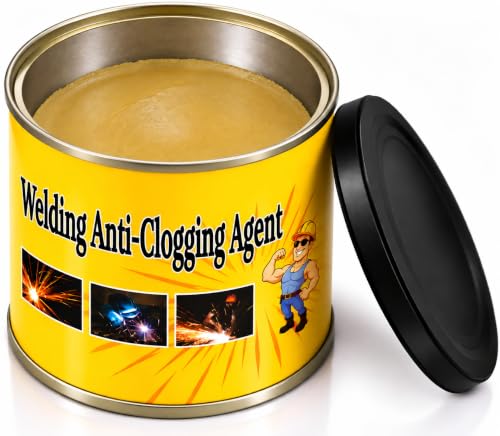
Eliminate Tip Clogging for Smooth MIG Welding: Essential welding accessories & supplies. Works as an anti spatter welding spray alternative, keeps MIG welding accessories clog-free for consistent welds.

Gel eliminates erratic operation with a film that will not clog orifices and threads on MIG nozzles and contact tips

The blades cut away the built up spatter helping prolong the nozzle life, and reduces the chances of wire sticking.
How to Prevent Shielding Gas Loss on Site
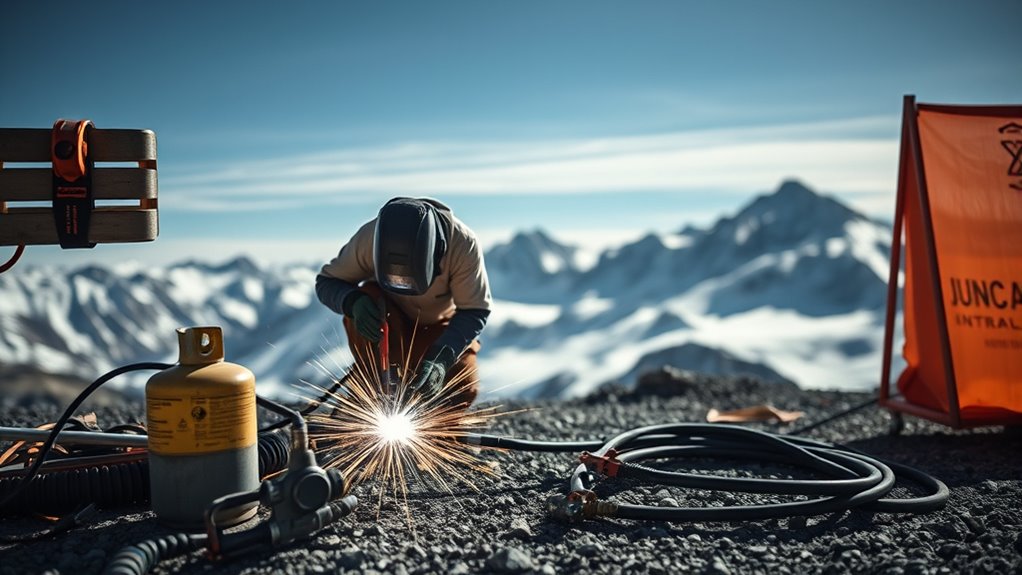
On-site welding adds wind, hose movement, uneven ground, cylinder changes, dust, and drafty work areas. At altitude, those small issues can become more noticeable because the shielding envelope is easier to disturb. Before each critical weld, check the whole gas path from cylinder to cup or nozzle.
- Use leak-check solution on fittings after changing cylinders or regulators.
- Keep hoses away from sharp edges, hot metal, and vehicle traffic.
- Confirm the flow at the torch when possible, not only at the regulator.
- Use wind screens that block crossflow without trapping fumes around your face.
- Clean the nozzle, diffuser, cup, and gas lens before the test weld.
- Store filler rods and wire so they stay dry and clean.
Warning: Argon, helium, and other shielding gases can displace oxygen in confined or poorly ventilated spaces. Follow confined-space rules, use atmospheric testing where required, and never rely on shielding gas as ventilation.
Troubleshooting High-Altitude Shielding Problems
| Symptom | Likely cause | Fix |
|---|---|---|
| Small pinholes in the bead | Air intrusion, dirty material, damp filler, or poor coverage | Clean the joint, check leaks, shield from wind, then raise flow slightly if needed. |
| TIG tungsten turns gray, blue, or crusty | Too little post-flow, poor cup coverage, or contaminated gas path | Increase post-flow, inspect the gas lens, reduce stickout, and regrind the tungsten. |
| MIG bead looks sooty or oxidized | Nozzle blockage, long stickout, wrong angle, or draft | Clean the nozzle, shorten stickout, improve gun angle, and block crosswind. |
| More flow makes porosity worse | Turbulence from excessive flow | Reduce flow, use a better cup/nozzle setup, and control wind instead. |
| Porosity appears only outdoors | Wind or moving air stripping the gas shield | Use wind screens, reposition the work, or switch to a process better suited for wind if allowed. |
Frequently Asked Questions
Why do welding health risks matter on high-altitude jobs?
High-altitude work can involve wind screens, tents, confined spaces, or awkward outdoor setups. Those controls may protect the weld, but you still need safe ventilation, PPE, eye protection, and fume control. Do not trade breathing-zone safety for gas coverage.
What is the rule of 33 in TIG welding?
The “rule of 33” is not a universal TIG standard. For TIG gas flow, use the WPS, cup size, gas lens setup, tungsten stickout, material, and test bead results. A small cup in a calm shop and a large gas-lens cup outdoors will not need the same setting.
What is the golden rule for shielding gas coverage?
Keep the molten puddle and hot metal protected until they can no longer react badly with air. That means clean gas delivery, correct torch angle, proper cup or nozzle distance, enough pre-flow and post-flow for TIG, and no cross-drafts across the weld.
What factors affect shielding gas choice for welding?
Shielding gas choice depends on the welding process, base metal, filler metal, transfer mode, joint design, thickness, desired penetration, required code or WPS, and environment. Altitude and wind do not replace those factors, but they can make coverage control more demanding.
Should I always increase shielding gas flow at high altitude?
No. Increase flow only after checking leaks, nozzle condition, cup size, torch angle, stickout, wind, and material cleanliness. If the gas stream becomes turbulent, more flow can make porosity worse instead of better.
Conclusion
Altitude does affect shielding gas coverage when you weld, but it does not create one fixed flow-rate rule. Lower pressure and lower air density make the shielding envelope easier to disturb, so you need cleaner gas delivery, better torch control, wind protection, and careful test beads. Start from your normal WPS or machine setting, adjust in small steps, and stop when the weld proves the coverage is stable.
Sources
- NASA Glenn Research Center: Earth Atmosphere Model — supports the pressure and density changes with altitude.
- OSHA: Welding, Cutting, and Brazing Hazards and Solutions — supports welding safety, PPE, fumes, UV, burns, and electrical hazard guidance.
- OSHA: Confined Spaces — supports confined-space ventilation and atmospheric safety context.
- Gas Tungsten Arc Welding Reference — supports TIG/GTAW shielding gas, gas lens, and turbulence-control principles.
- Gas Metal Arc Welding Reference — supports MIG/GMAW shielding gas, porosity, and gas-flow dependency principles.