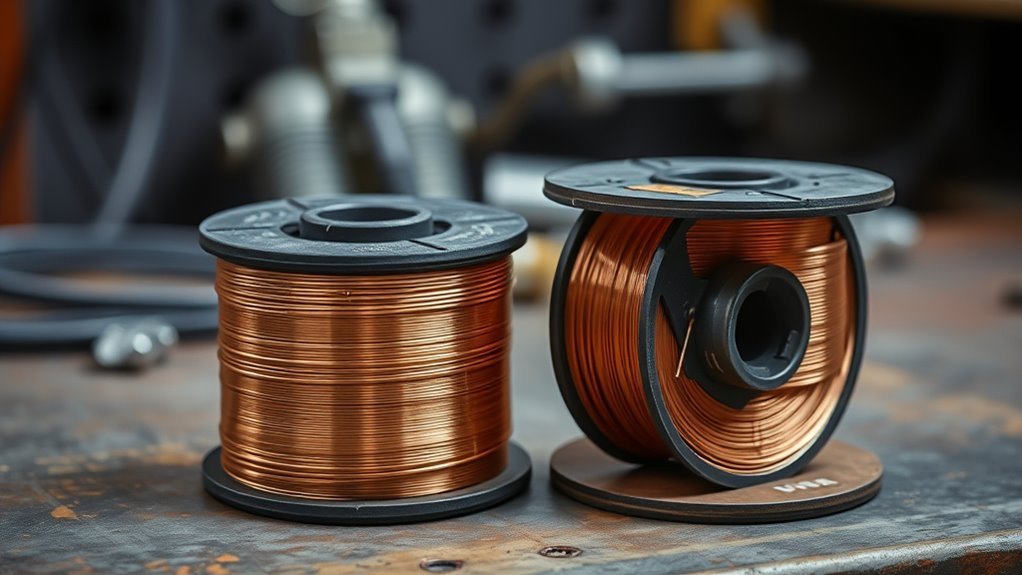
Choosing between a 4-inch and an 8-inch MIG wire spool comes down to machine fit, welding frequency, wire type, and how much wire you expect to use. A 4-inch spool is lighter and easier to store or swap. An 8-inch spool holds more wire and can reduce reloads during regular shop work. Spool diameter does not determine weld penetration or thin-metal control, so you must also match the wire diameter, classification, drive rolls, liner, contact tip, polarity, and shielding requirements to your welder and project.
Quick Answer
Choose a 4-inch MIG wire spool for occasional welding, portable setups, spool guns, or frequent wire changes. Choose an 8-inch spool when your welder supports it and you use the same wire regularly. The larger spool reduces changeovers, but it does not improve weld quality by itself.
Key Takeaways
- A 4-inch spool is compact, light, easy to store, and practical for occasional work or frequent wire changes.
- An 8-inch spool holds more wire and reduces reloads during longer or more frequent welding jobs.
- Spool diameter affects capacity and machine fit, while wire diameter affects amperage range, deposition rate, and setup.
- Your welder manual must approve the spool diameter, hub arrangement, adapter, retaining hardware, and supported wire size.
- A larger spool often has a lower unit cost, but only when you compare equivalent wire classifications, diameters, and brands.
4-Inch vs. 8-Inch MIG Wire Spools
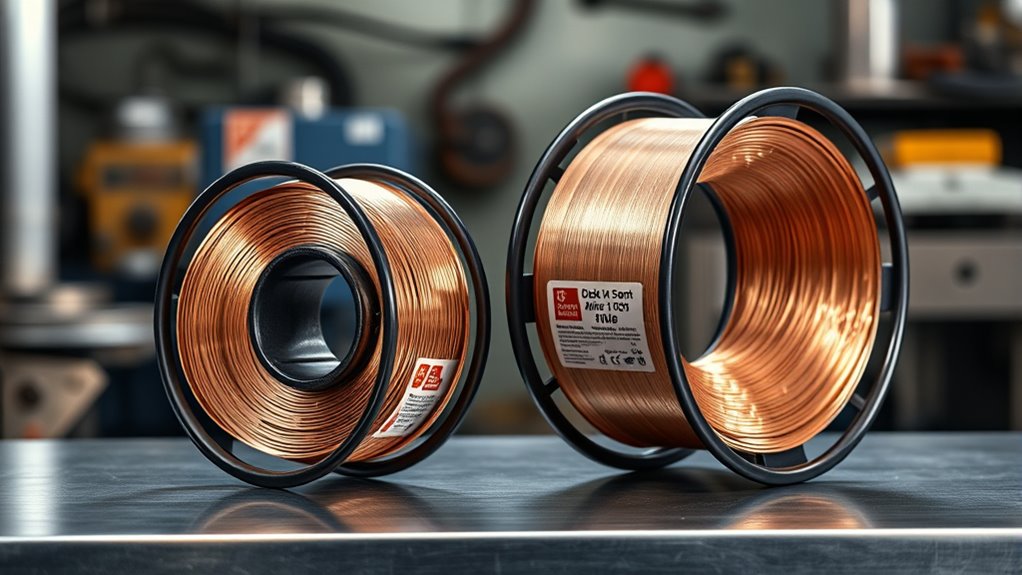
The measurements refer to the approximate outside diameter of the spool. A 4-inch spool is about 102 mm across, while an 8-inch spool is about 203 mm. Current machines such as the Miller Millermatic 211 PRO are designed to accept both sizes, but this does not mean every MIG welder can do the same.
The main differences are wire capacity, machine compatibility, handling weight, storage space, and how often you must stop to install another spool. A 4-inch package normally contains much less wire than an 8-inch package, but the exact net weight varies with the wire material, diameter, winding, spool design, and manufacturer. Read the package label instead of estimating capacity from spool diameter alone.
A 4-inch spool is easier to carry and swap. It is useful when you weld occasionally, move the machine often, or keep several wire types available. An 8-inch spool is more convenient when you repeatedly use the same wire and want fewer interruptions during long jobs.
Check compatibility before comparing cost. Your machine must have enough cabinet clearance, the correct spindle or hub arrangement, suitable retaining hardware, and a feed system rated for the spool. The wire must also match the drive-roll groove, liner, contact tip, polarity, and machine output range.
Spool diameter tells you how the wire package fits and how much it can hold. Wire diameter and classification tell you how the wire must be fed and welded.
A larger spool often reduces cost per pound because you buy more wire in one package, but that is not guaranteed. Compare the same brand, AWS classification, wire diameter, and coating before deciding that the larger option is cheaper.
Wire quality matters separately from spool size. For example, an ER70S-6 wire is selected for its classification and welding characteristics, not because it comes on a particular spool diameter.
At a Glance
| Best Small-Spool Choice | A 4-inch spool for occasional repairs, portable setups, spool guns, limited storage, and frequent wire changes. |
| Best Large-Spool Choice | An 8-inch spool for regular shop work, longer welding sessions, repeated use of one wire, and fewer reloads. |
| Main Compatibility Check | Confirm manual approval, cabinet clearance, hub fit, retaining hardware, wire diameter, drive rolls, liner, and contact tip. |
| Biggest Mistake | Buying a larger spool for its unit price before confirming that the welder can hold and feed it safely. |
What Spool Size Does and Does Not Change
Spool size changes how much wire is available, how heavy the loaded machine becomes, how much cabinet space the package needs, and how often you stop to reload. It can also affect hub hardware and the amount of rotating mass the feed system must control.
Spool size does not directly change voltage, amperage, penetration, shielding gas, or travel speed. If two spools contain the same classification and diameter of wire, the welding settings remain based on the wire, joint, material thickness, transfer mode, and machine.
For example, .030-inch ER70S-6 on a 4-inch spool and .030-inch ER70S-6 on an 8-inch spool can use the same starting settings. The 8-inch package simply lets you weld longer before replacing it.
Note: Spool diameter and net wire weight are related, but they are not interchangeable specifications. Always check both values on the package.
When a 4-Inch MIG Wire Spool Makes Sense
A 4-inch MIG wire spool makes sense for small jobs, light fabrication, tack welding, patch panels, farm repairs, garage projects, mobile work, and occasional use. Its compact size simplifies setup and storage, particularly when space is limited.
A smaller package also lets you keep several wire types or diameters without buying a large quantity of each. That can be useful when you switch between solid mild-steel wire, stainless wire, and compatible flux-cored wire.
Because you can finish a small spool sooner, the remaining wire may spend less time exposed to shop humidity and contamination. This is useful when clean wire matters, including stainless work where avoiding cross-contamination from carbon-steel tools is part of good preparation.
Best for Small Jobs
For quick repairs and limited fabrication, a 4-inch spool gives you enough wire without adding unnecessary weight or inventory. It is easier to remove when the project ends, and it fits many machines designed for hobby or mobile use.
| Situation | Why a 4-Inch Spool Helps | Important Limitation |
|---|---|---|
| Occasional repairs | Lower initial quantity and easier storage | More reloads if the job becomes large |
| Frequent wire changes | Less unused inventory in each classification | Each spool may cost more per pound |
| Portable welding | Less weight inside the machine | The welder must still approve the spool format |
| Thin sheet work | Convenient when the required fine wire is sold in a small package | Wire diameter and settings, not spool diameter, control the arc |
You can keep one small spool of solid mild-steel wire, one of compatible flux-cored wire, and one specialty wire without committing to a large roll of each. This is useful when you rarely weld the same material twice.
Easier Setup and Storage
A 4-inch spool is lighter and easier to control while installing it. It also fits more easily in sealed bins, cabinets, toolboxes, or indoor storage areas.
The smaller package can make frequent wire changes faster, especially when the welder uses simple hub hardware. However, you still need to install any required washer, spring, adapter, retaining ring, or locking hardware exactly as the manufacturer specifies.
Its lower weight also helps when you regularly lift the machine onto a vehicle, cart, or workbench. The practical benefit is portability, not a change in weld performance.
Lower Wire Waste
A 4-inch spool can reduce unused inventory when you need only a small amount of a particular wire. You can change material or diameter without leaving a large roll unused for months.
This approach may also reduce losses from rust or contamination when you weld infrequently. It does not make the wire immune to moisture, so any opened spool still needs clean, dry storage.
Smaller spools can be economical for low-volume work even when their cost per pound is higher. The relevant question is whether you will use the entire package while it remains in good condition.
Pro Tip: If you weld only occasionally, remove an opened spool after the job and keep it in a clean, sealed container in a dry indoor area. Label the container with the wire classification, diameter, polarity, and shielding requirement.
Why Choose an 8-Inch MIG Wire Spool
An 8-inch MIG wire spool is often the better choice when you weld frequently, run long beads, or use the same wire classification every week. Its larger capacity reduces spool changes and makes it less likely that you will run out in the middle of a project.
Fewer changeovers reduce downtime because you spend less time opening the wire compartment, replacing hardware, threading wire, and checking feed tension. A larger package may also lower the cost per pound when you compare equivalent products.
The tradeoffs are extra weight, a larger storage footprint, and a greater amount of wire exposed if you leave the spool installed for a long period. An 8-inch spool makes the most sense when your usage rate is high enough to finish it before rust or contamination becomes a problem.
The larger spool does not make the weld stronger or cleaner by itself. You still need the correct wire classification and preparation. This is particularly important for applications such as MIG welding galvanized steel, where coating removal, ventilation, process selection, and safety precautions matter more than spool capacity.
How MIG Wire Spool Size Affects Compatibility
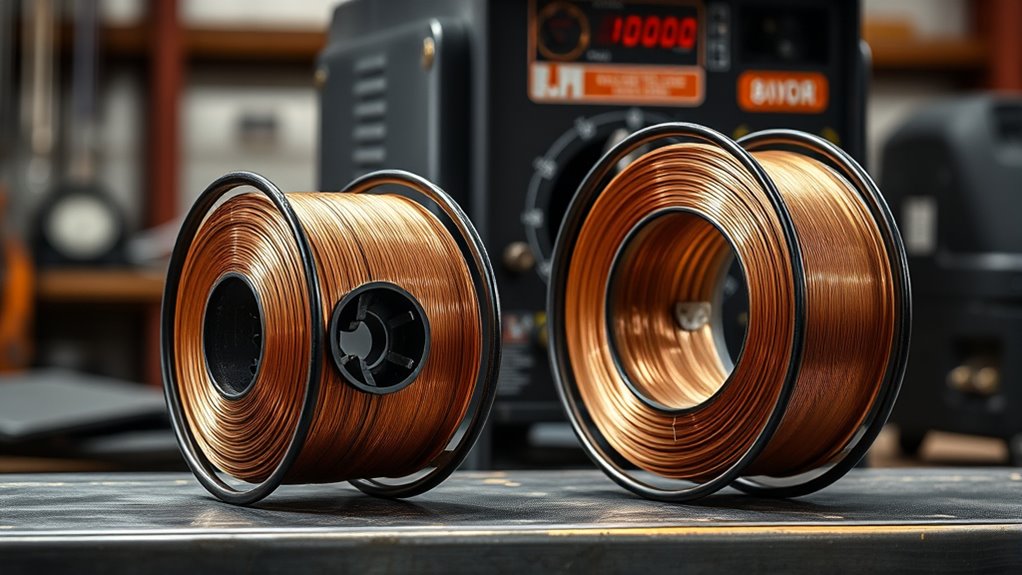
MIG wire spool size affects compatibility because the wire compartment, spindle, hub, adapter, retaining system, and brake or tension hardware are designed around specific package dimensions and weights.
Do not assume that all portable welders accept only 4-inch spools or that all larger welders accept 8-inch spools. Some compact machines accept both. Others support only one size. A manufacturer may also require different hardware for each spool.
For example, the Hobart Handler 125 is a hobby-class machine whose hub assembly accommodates both 4-inch and 8-inch spools. That is why the owner’s manual or official specification must be the deciding source.
A poor fit can cause spool wobble, excessive drag, overrun, wire slipping, irregular feed speed, or stoppages. These problems can contribute to inconsistent arc starts, birdnesting, bead variation, and rework. Review common wire-feed problems and solutions if the machine still feeds poorly after the correct spool is installed.
Warning: Do not force an 8-inch spool into a machine designed only for a 4-inch package. Do not use a homemade external holder or adapter unless the welder manufacturer approves the spool weight, feed path, hub hardware, and enclosure arrangement.
MIG Spool Compatibility Checklist
Check all of the following before buying or installing a spool:
- Approved spool diameter: Confirm that the manual lists 4-inch, 8-inch, or both.
- Cabinet clearance: Make sure the spool can rotate without rubbing the door, wiring, gas hose, or frame.
- Hub and spindle fit: Check the center opening, spindle diameter, locking pin, and hub design.
- Required hardware: Identify the correct adapter, washer, spring, retaining ring, nut, or cap.
- Maximum package weight: Do not assume that every spool of the same outside diameter has an approved weight.
- Wire diameter range: Match the wire to the machine, gun, liner, contact tip, and available drive-roll grooves.
- Wire type: Solid steel wire and flux-cored wire may require different grooves and polarity.
- Feed path: The wire should enter the inlet guide straight without pulling sideways from the spool.
Spool Gun vs. the Spool Inside the Welder
A spool gun carries a small wire spool directly on the gun. It is commonly used for aluminum because the short feed distance helps reduce buckling and birdnesting in soft wire. Miller describes spool-gun setups that place a 4-inch, 1-pound spool close to the gun’s drive mechanism.
The spool inside a standard MIG welder feeds wire through the full gun cable. A machine may accept a 4-inch or 8-inch internal spool while its optional spool gun accepts only a small spool. These are separate specifications, so check both the welder manual and the spool-gun documentation.
How to Change a MIG Wire Spool Safely
Use your machine’s manual as the primary procedure because hub hardware and threading steps vary. The following sequence is a safe general approach for common compact MIG welders.
- Switch off and disconnect the welder. Unplug a corded machine or isolate its input power before opening the drive compartment or changing feed components.
- Wear safety glasses and gloves. The cut wire end can spring outward, and spool edges or loose wire can cut your hands.
- Secure the old wire. Hold the wire firmly before cutting it, then fasten the loose end through the spool’s retaining hole so the roll cannot unravel.
- Remove the retaining hardware. Keep washers, springs, adapters, rings, or nuts in their correct order.
- Install the new spool in the correct feed direction. The wire should unwind toward the inlet guide without crossing the spool or rubbing the cabinet.
- Install the correct hub hardware. Follow the manual for the selected spool size.
- Set hub or brake tension. Use only enough resistance to prevent the spool from freewheeling after the drive rolls stop. Miller’s current instructions describe a setting where slight force is needed to rotate the spool.
- Confirm the drive-roll groove. Match the groove to the wire diameter and type.
- Thread the wire while controlling the loose end. Keep the gun cable as straight as practical and guide clean wire through the inlet guide and drive rolls.
- Set drive-roll pressure. Use enough pressure to feed without slipping, but do not crush or deform the wire.
- Install the matching contact tip. Confirm polarity and shielding requirements from the wire label and welder chart.
- Test the feed. Restore power, feed wire according to the manual, and check for smooth movement before welding.
The Miller Millermatic 211 PRO owner’s manual shows separate hardware arrangements for 4-inch and 8-inch spools and explains hub-tension and threading checks.
Spool Capacity, Cost, and Downtime Comparison
The biggest practical difference is how often you stop welding. A 4-inch spool normally costs less at checkout because it contains less wire, but you replace it sooner. An 8-inch spool requires a larger initial purchase but usually lasts much longer.
| Comparison Point | 4-Inch MIG Wire Spool | 8-Inch MIG Wire Spool |
|---|---|---|
| Best use | Small repairs, portable work, specialty wire, occasional use | Regular shop work, longer runs, repeated use of one wire |
| Handling | Light and easy to install or remove | Heavier and less convenient to swap frequently |
| Storage | Fits small sealed containers and shelves | Needs more room and stronger support |
| Initial purchase | Usually lower | Usually higher |
| Cost per pound | Often higher for equivalent wire | Often lower for equivalent wire |
| Reload frequency | More frequent | Less frequent |
| Exposure risk | May be finished sooner by an occasional user | Can remain open longer if usage is low |
If you weld once a month, the unit-cost advantage of an 8-inch spool may not matter. If you weld every week, the saved reload time and larger wire reserve may be more valuable.
Which MIG Wire Spool Fits Your Project
Choose the spool by starting with machine compatibility, then estimate how quickly you will use the wire. A 4-inch spool suits low-volume work, frequent wire changes, spool-gun use, and compact storage. An 8-inch spool suits repeated work with the same wire and projects where stopping to reload would be disruptive.
- Use a 4-inch spool for portable, occasional, or specialty-wire work.
- Use an 8-inch spool for regular jobs when the machine supports it.
- Select the wire type and diameter for the metal and joint, not for the spool size.
- Confirm polarity, shielding gas, drive rolls, liner, and contact tip.
- Estimate whether you can use the package before storage conditions damage it.
Outdoor gas-free welding applies only when you use a compatible self-shielded flux-cored wire. Solid MIG wire still needs the specified shielding gas. A product such as the wire discussed in this flux-core wire review must be matched to the welder’s approved diameter, polarity, and drive-roll setup.
Products Worth Considering

E71T-GS FLUX CORE WIRE: This self-shielding, AWS E71T-GS flux-cored wire excels due to its advanced core design, delivering exceptional arc stabilization and high feedability for effortless welding. The core also incorporates powerful deoxidizing agents, ensuring clean, reliable welds even when welding through light rust or mill scale.

Robust Welding Performance: The 0.035" diameter wire is optimized for stronger and more substantial welding tasks, providing reliable and durable welds for various applications.

Premium Quality Material: This 2 lb. roll of 0.035" flux core welding wire is manufactured from AWS E71T-GS mild steel, delivering consistent performance and strong, reliable joints. Each spool is made of new ABS plastic sheets for excellent durability and impact resistance built to last through demanding jobs
How to Choose the Right MIG Wire Spool
Use this order when selecting wire:
- Check spool fit. Confirm that the manual approves the physical spool diameter and package weight.
- Choose the process and wire classification. Decide whether you need solid gas-shielded wire, gas-shielded flux core, self-shielded flux core, stainless wire, or another compatible filler metal.
- Choose wire diameter. Match it to the machine’s output, material thickness, joint, and available consumables.
- Match the feed system. Use the correct drive-roll groove, inlet guide, liner, and contact tip.
- Check polarity and shielding. Follow the wire label and manufacturer chart.
- Compare package economics. Consider total price, cost per pound, expected usage, storage time, and reload frequency.
| Factor | What to Check |
|---|---|
| Use frequency | Small spool for occasional use; larger spool for regular use |
| High-volume work | Choose the largest manufacturer-approved package that you will use promptly |
| Wire diameter | Match the drive rolls, liner, contact tip, output range, and project |
| Wire type | Confirm classification, polarity, shielding gas, and approved feed components |
| Cost | Compare equivalent products by net wire weight, not spool diameter alone |
| Machine fit | Check compartment clearance, hub arrangement, adapter, retainer, and weight limit |
For flux-cored wire, use the wire manufacturer’s recommendations and a reliable flux-core welding settings chart as a starting point. Fine-tune the settings on clean scrap that matches the project material.
Products Worth Considering

ER70S-6 MIG WIRE: It's the most common wire of the copper-coated mild steel GMAW (MIG) wires for single or multiple pass welding.

Lincoln ED030584 .035", NR-211, LB Spool, Inner Shield Flux-Core Welding Wire

High-quality: ARCCAPTAIN's ER70S-6 mig welding wire .030" meets industry standards(Net Weight: 10lbs), ensuring consistent performance, superior strength. With its smooth feeding and stable welding parameters, you can achieve optimal penetration, high deposition rates, and exceptional overall welding performance.
Wire Diameter and Spool Size Are Not the Same Thing
Spool size is the physical diameter of the package. Wire diameter is the thickness of the electrode. A manufacturer may supply the same wire diameter on several spool sizes.
Common nominal pairings include .023 inch with about 0.6 mm, .030 inch with about 0.8 mm, .035 inch with about 0.9 mm, and .045 inch with a metric size near 1.2 mm. These are commercial pairings rather than exact mathematical equivalents, so use the size printed on the wire, drive roll, and contact tip.
Wire diameter influences the usable output range, deposition rate, feed speed, contact-tip size, and starting parameters. Miller’s MIG parameter guidance notes that material thickness, joint design, welding position, and wire diameter all affect the required settings.
Before buying, confirm four separate specifications:
- Spool diameter and net package weight
- Wire diameter
- Wire classification and material
- Welder and feed-system compatibility
How to Read a MIG Wire Label
A useful wire label should identify more than the spool diameter. Look for:
- Wire classification: such as ER70S-6 or a specific flux-cored classification
- Wire diameter: in inches, millimeters, or both
- Net wire weight: the amount of consumable on the spool
- Spool dimensions or package code: where supplied
- Required shielding gas: or a statement that the wire is self-shielded
- Recommended polarity: verify this against the welder manual
- Lot or batch identification: useful for traceability
- Applicable standard: such as AWS A5.18 for covered carbon-steel solid-wire classifications
Under AWS A5.18/A5.18M:2021, the classification system covers carbon-steel electrodes and rods for gas-shielded arc welding. In a designation such as ER70S-6, “ER” indicates electrode or rod, “70” identifies the tensile-strength class under the standard’s test conditions, “S” identifies solid wire, and the suffix provides additional classification detail.
Storage Tips for MIG Wire Spools
MIG wire can collect moisture, dust, oil, and rust. Contamination can increase feed resistance, clog the liner, damage consumables, destabilize the arc, and contribute to weld defects.
- Store spools in a clean, dry area away from open doors, wet floors, and condensation.
- Keep unused or partly used wire in its original packaging or a sealed container.
- Avoid touching clean wire with oily or greasy gloves.
- Keep the identification label with the spool.
- Inspect older wire for rust, dirt, bent edges, crossed turns, or damaged flanges.
- Do not feed visibly rusty wire through the liner and gun.
- Let a cold spool reach room temperature before opening sealed packaging in a warm, humid shop to reduce condensation risk.
ESAB’s MIG wire selection guidance recommends keeping wire in a clean, dry environment and protecting it from moisture, dust, oil, and other contaminants.
A 4-inch spool may suit an occasional welder because it can be finished sooner. An 8-inch spool can remain equally clean when it is used regularly and stored correctly.
Note: If feeding becomes poor immediately after changing spools, do not assume the new wire is defective. Recheck spool alignment, hub tension, drive-roll groove, drive pressure, liner condition, contact-tip size, and the path into the inlet guide.
Common Mistakes When Buying MIG Wire Spools
- Buying the wrong physical spool size: The package may not fit or may require hardware the machine does not include.
- Assuming an adapter solves every fit problem: The machine must also support the spool weight, feed path, and retaining arrangement.
- Confusing spool diameter with wire diameter: A larger spool does not automatically contain thicker wire.
- Ignoring wire classification: Two wires of the same diameter may have different shielding, polarity, chemistry, and applications.
- Using the wrong drive-roll groove: This can deform the wire, create dust, or allow slipping.
- Overtightening hub tension: Excessive drag makes the feeder work harder and can produce irregular feeding.
- Using too little hub tension: The spool may overrun and create loose loops after the motor stops.
- Overbuying wire: A large spool can become contaminated before it is used when welding is infrequent.
- Storing opened wire in damp air: Both small and large spools can rust.
- Assuming all flux-cored wire is gas-free: Some flux-cored classifications require shielding gas.
The safest buying sequence is simple: read the welder manual, confirm spool fit, choose the correct wire classification and diameter, then match the drive rolls, liner, tip, polarity, and shielding setup.
Troubleshooting After Changing Spool Size
| Symptom | Likely Checks |
|---|---|
| Spool keeps turning after trigger release | Increase hub or brake tension slightly and check that all hub parts are installed correctly. |
| Motor turns but wire slips | Check for excessive spool drag, wrong groove, low drive pressure, a blocked liner, or an undersized tip. |
| Wire birdnests near the drive rolls | Check tip blockage, liner resistance, drive pressure, groove selection, gun-cable bends, and spool alignment. |
| Spool wobbles | Verify the hub adapter, center fit, locking pin, retainer, and spool condition. |
| Feed speed pulses | Look for crossed wire, damaged spool flanges, excessive brake tension, debris, a worn liner, or a damaged drive roll. |
| Wire rubs the cabinet | Stop using the setup. The spool may be too large, incorrectly mounted, or missing required hardware. |
Frequently Asked Questions
What is the most common wire size for MIG welding?
.030-inch and .035-inch wire are common for general steel fabrication, while .023 or .024-inch wire is also used for lighter sheet work. The best diameter depends on the welder’s output range, material thickness, joint, transfer mode, and available drive rolls, liner, and contact tips.
What does ER70S mean?
ER70S is the beginning of an AWS solid carbon-steel filler-metal classification. “ER” means the product can be used as an electrode or rod, “70” identifies the 70-ksi tensile-strength class under specified test conditions, and “S” means solid. A suffix such as “-6” completes the classification and identifies additional composition or usability requirements.
Is .030 or .035 wire better?
Neither is universally better. .030-inch wire is commonly useful for lighter material and lower-output machines. .035-inch wire can provide more deposition for heavier work when the welder supports it. Match the wire to the machine chart, base-metal thickness, joint, gas, tip, liner, and drive rolls.
What is the difference between 0.8 and 0.9 MIG wire?
0.8 mm wire is thinner and is commonly paired with the nominal .030-inch range. 0.9 mm wire is commonly paired with .035 inch and can support greater deposition when the machine and project require it. Use the exact size marked on the wire, drive roll, and contact tip.
Can I use an 8-inch spool in a welder made for 4-inch spools?
Only when the welder manufacturer specifically approves the 8-inch spool and any required adapter or hub hardware. A larger package may exceed the cabinet clearance, spindle design, retaining system, or supported rotating weight of a 4-inch-only machine.
Does a bigger MIG wire spool improve weld quality?
No. A larger spool mainly provides more wire and fewer reloads. Weld quality depends on wire classification and diameter, clean material, stable feeding, correct settings, shielding, polarity, joint preparation, torch angle, and travel speed.
Does changing from a 4-inch to an 8-inch spool change my settings?
Not when the new spool contains the same wire classification and diameter. Voltage and wire-feed settings are based on the wire, material, joint, and process. You may need to reset hub tension and confirm that the correct adapter and retaining hardware are installed.
How tight should a MIG wire spool be?
Set the hub or brake tension only tight enough to prevent the spool from overrunning after feeding stops. It should rotate with light resistance rather than spin freely or drag heavily. Follow the exact procedure in your welder manual.
Are 4-inch spools only for spool guns?
No. Many compact welders accept a 4-inch spool inside the machine, and some also accept an 8-inch spool. Spool guns commonly use small 4-inch rolls, but their spool specification is separate from the welder’s internal wire compartment.
Conclusion
Choose a 4-inch MIG wire spool when you value low weight, compact storage, frequent wire changes, or a smaller quantity for occasional work. Choose an 8-inch spool when your machine supports it, you use the same wire regularly, and fewer reloads will save meaningful time.
Confirm the physical spool fit before buying. Then match the wire classification and diameter to the drive rolls, liner, contact tip, polarity, shielding requirements, machine output, and project. The right spool should rotate smoothly, feed straight into the inlet guide, and provide the amount of wire you can use and store properly.
Sources
- Miller Millermatic 211 PRO Owner’s Manual — 4-inch and 8-inch spool installation, drive-roll selection, hub tension, and wire-threading guidance.
- Hobart Handler 125 Specifications — example of a compact welder that supports both 4-inch and 8-inch spools.
- Miller MIG Weld Defect Guidance — spool-gun use and short feed-path benefits for soft aluminum wire.
- AWS A5.18/A5.18M:2021 — classification requirements for carbon-steel electrodes and rods used in gas-shielded arc welding.
- ESAB MIG Wire Selection Guide — wire-diameter selection and clean, dry storage guidance.
- Miller MIG Parameter Guide — factors that determine voltage and wire-feed starting settings.