Disclosure: As an Amazon Associate, we earn from qualifying purchases. If you click a link on this page and make a purchase, we may receive a small commission at no extra cost to you.
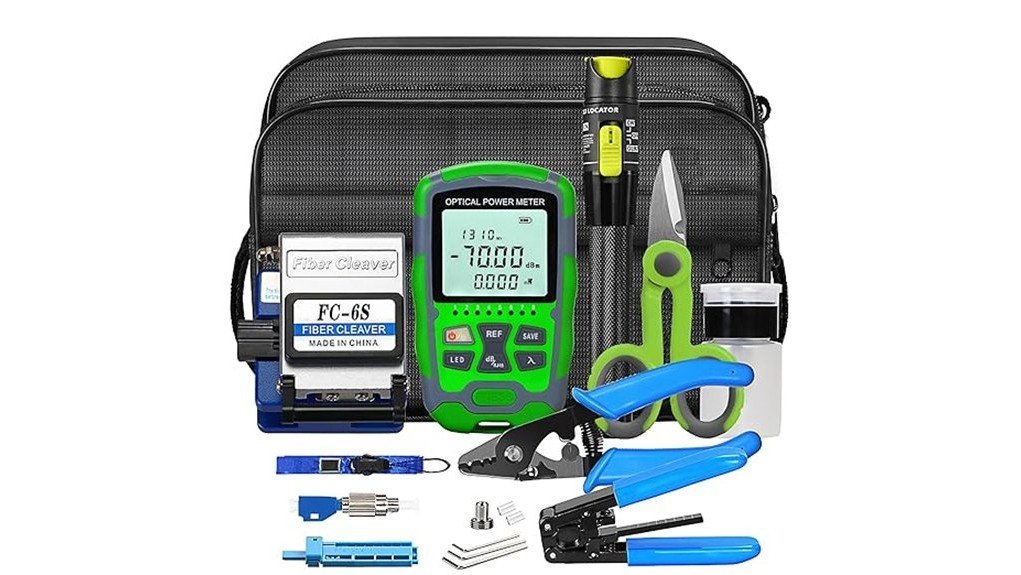
Fiber termination work gets frustrating when you have a cleaver in one case, a power meter somewhere else, and no fault locator when you actually need one. The SAIVXIAN Fiber Optic Termination Tool Kit brings several common FTTH preparation and testing tools into one portable package, including an FC-6S cleaver, M7 optical power meter, stripping tools, cleaning supplies, and a visual fault locator. Its biggest strength is convenience for routine field work, but it is not a fusion splicer and it still requires you to understand proper fiber preparation and safety. This review explains what you actually get, where the kit is most useful, and which limitations you should know before buying.
Quick Verdict
Rating: 8/10, Recommended with caveats
Best For: FTTH installers and network technicians who want fiber preparation, basic testing, fault tracing, and cleaning tools in one field kit.
Bottom Line: The SAIVXIAN kit covers several of the most common tasks around mechanical fiber termination and troubleshooting without forcing you to buy every hand tool separately. The tradeoff is that it does not replace a fusion splicer or professional training, and some advertised capabilities such as long-distance VFL visibility depend heavily on the actual fiber link and working conditions.
| Specification | Detail |
|---|---|
| Brand | SAIVXIAN |
| Model | M7-6S-VFL30KM |
| Style | TZ5 |
| Product Type | FTTH fiber optic termination and testing tool kit |
| Cleaver | FC-6S optical fiber cleaver with 3-in-1 fiber holder |
| Holder Support | Designed for common drop-cable, pigtail, and 0.25 mm bare-fiber preparation |
| Optical Power Meter | M7 3-in-1 OPM with optical measurement, RJ45 network testing, and LED function |
| OPM Wavelengths | 850, 980, 1270, 1300, 1310, 1490, 1550, 1577, 1625, and 1650 nm |
| Visual Fault Locator | 30 mW VFL, marketed for up to roughly 20 to 30 km testing conditions |
| Adapter | FC-LC adapter included |
| Other Tools | Fiber stripping pliers, cleaning bottle, cleaning paper, and 2-in-1 fixed-length device |
| OPM Power | 2 AAA batteries |
| Batteries Included | No |
| Storage | Portable fiber optic tool bag |
Key Takeaways
- The kit combines fiber preparation, optical testing, basic network testing, fault tracing, and cleaning tools in one field bag.
- The FC-6S cleaver uses a 3-in-1 holder so you can work with several common fiber and drop-cable formats without repeatedly changing clamps.
- The M7 optical power meter supports 10 standard wavelengths and also includes RJ45 network testing and an LED function.
- The included 30 mW visual fault locator is useful for continuity checks and locating visible high-loss points, although real usable distance varies with the link.
- This is a termination and testing kit, not a fusion-splicing system, so it is best for buyers who already know which connection method their job requires.
What Is the SAIVXIAN Fiber Optic Termination Tool Kit?
The SAIVXIAN M7-6S-VFL30KM is a portable FTTH fiber preparation and troubleshooting kit. Instead of focusing on one tool, it combines the items you commonly need before and after making a mechanical fiber connection: stripping tools, an FC-6S cleaver, cleaning supplies, an optical power meter, a visual fault locator, and related accessories.
The main appeal is organization. If you work on residential fiber drops, patch connections, maintenance calls, or similar field tasks, carrying a single bag is easier than assembling several separate tool cases. The kit also gives you both preparation and diagnostic capability, which can help when a job involves more than simply cutting and terminating a fiber.
Before You Buy: This kit does not include a fusion splicer. If your work requires fusion splicing rather than mechanical or connector-based termination, you will still need the correct splicing equipment.
Who Should Buy It?
Best For
- FTTH installers who want common termination and test tools in one bag.
- Network technicians handling fiber drop troubleshooting and maintenance.
- Experienced DIY or technical users who already understand basic fiber preparation procedures.
Skip If
- You specifically need a fusion splicer or OTDR.
- You need laboratory-grade certification equipment with documented calibration specifications.
- You are completely new to fiber work and expect the tool kit itself to replace proper training.
Key Features of the Fiber Optic Termination Tool Kit
FC-6S Optical Fiber Cleaver
The FC-6S cleaver is one of the most important parts of the kit because a clean, consistent cleave is essential before many mechanical termination and splicing procedures. Its 3-in-1 holder is designed to accommodate common drop-cable, pigtail, and bare-fiber formats without forcing you to swap holders for every job.
That makes it useful for technicians who regularly move between indoor drop cable and smaller exposed fiber during FTTH work. You still need to prepare the fiber correctly, clean it, and follow the connector or splice manufacturer’s required cleave length. The holder simplifies the physical setup, but it does not remove the need for careful technique.
M7 3-in-1 Optical Power Meter
The included M7 optical power meter supports 10 wavelength settings: 850, 980, 1270, 1300, 1310, 1490, 1550, 1577, 1625, and 1650 nm. That range covers several wavelengths commonly encountered in fiber testing and access-network work.
The M7 also combines RJ45 network testing and an LED function with optical measurement. That is useful when your service call involves both fiber and copper network cabling because you can perform basic checks without reaching for another small tester. The meter requires two AAA batteries, and the product listing states that those batteries are not included.
30 mW Visual Fault Locator
The kit includes a 30 mW visual fault locator with an FC-LC adapter. A VFL injects visible red light into the fiber so you can trace continuity and identify some breaks, severe bends, bad connections, or high-loss points where light becomes visible.
The product is marketed with a distance figure of roughly 20 to 30 km under testing conditions. You should treat that number as a rated capability rather than a guaranteed real-world troubleshooting distance. Connector loss, fiber condition, bends, ambient lighting, cable construction, and other factors can affect how useful the visible signal is in practice.
Essential Tools Included in the Kit
Beyond the three headline tools, SAIVXIAN includes several smaller items that make the package more useful as an actual field kit. You get fiber optic stripping pliers, a cleaning bottle, cleaning paper, and a 2-in-1 fixed-length device, along with the storage bag.
This combination matters because fiber termination is a sequence rather than a single cut. You normally need to expose the fiber correctly, remove coating or jacket material as required, clean the fiber, establish the proper prepared length, cleave it, make your connection, and then test the result. Having those tools together can reduce time lost searching through separate cases.
Pro Tip: Before heading to a job, add fresh AAA batteries and any connector-specific consumables your installation method requires. The kit provides preparation and test tools, but it does not automatically include every fast connector, mechanical splice, or job-specific consumable you may use.
Performance and Usability Assessment
Ease of Use
The main usability advantage is the all-in-one layout. The cleaver, meter, VFL, stripping tools, and cleaning accessories cover several steps of a normal FTTH service workflow. For an experienced technician, that can reduce the number of individual tools that have to be packed and tracked.
The FC-6S 3-in-1 holder also removes some setup work when changing between common fiber formats. However, the kit should not be described as completely automatic. Proper stripping depth, cleaning, cleave length, connector preparation, and testing still depend on your technique and the specifications of the connector or termination system you are using.
Testing Flexibility
The M7 meter is more flexible than a basic single-purpose power meter because it combines optical measurement with RJ45 testing and an LED. Its 10 wavelength selections make it suitable for checking several common fiber network wavelengths rather than locking you into one narrow application.
The VFL adds a second troubleshooting method. A power meter tells you about optical power, while a VFL can help you visually trace continuity and identify certain high-loss points. These tools complement each other, but they do not replace advanced diagnostic equipment such as an OTDR when you need detailed event location, distance measurements, or certification-level records.
How It Performs in Real Use
For FTTH Drop Termination
For a residential fiber drop, the combination of stripping tools, fixed-length device, cleaning supplies, and FC-6S cleaver gives you the basic preparation tools needed before installing a compatible connector or mechanical termination. The benefit is speed and organization rather than a new termination method.
For Basic Optical Power Checks
After a connection is completed, the M7 meter lets you check optical power at supported wavelengths. This can help you determine whether light is reaching the point you are testing and whether additional troubleshooting is needed. You should compare results against the specifications of the network or equipment you are servicing rather than relying on a single universal target value.
For Fault Tracing
The 30 mW VFL is useful when you need a visible reference for continuity, connector problems, sharp bends, or breaks that allow red light to escape. It is especially practical around patching, short access links, connectors, and locations where a visible fault is easier to find than an intermittent numerical reading.
For Field Carry
The included tool bag keeps the smaller pieces together and makes the kit easier to transport between service calls. That is a practical advantage for technicians who otherwise have to keep a cleaver, cleaning products, power meter, VFL, and stripping tools in several separate cases.
Setup Tips Before First Use
- Install batteries before leaving for the job. The M7 requires two AAA batteries, and they are not included.
- Confirm the termination method. Make sure you have the correct fast connector, mechanical splice, or other consumables for the fiber system you are servicing.
- Match the meter wavelength. Select the wavelength appropriate for the signal you are testing before interpreting the reading.
- Keep fiber ends and tools clean. Contamination can add loss and can make a good mechanical connection perform poorly.
- Follow the connector’s cleave-length specification. A capable cleaver cannot compensate for an incorrect prepared length.
- Test after termination. Use the meter or other appropriate network test equipment to confirm the completed connection instead of assuming a visually clean termination is good.
Fiber Optic Safety and Handling
Fiber work creates very small glass scraps during stripping and cleaving. Wear suitable eye protection, keep track of fiber shards, and dispose of them in an appropriate container instead of brushing them onto the floor or work surface.
You should also avoid looking directly into a fiber connector or bare fiber end. Optical communication signals may be outside the visible range, so the absence of visible light does not prove that the fiber is inactive. Verify that the fiber is safe before inspection and follow your employer’s procedures, equipment instructions, and applicable laser-safety practices.
The same caution applies when using the visual fault locator. It produces visible laser light for tracing the fiber, so never intentionally direct its output toward your eyes or another person’s eyes.
Pros and Cons
Pros
- Combines fiber preparation, cleaning, fault tracing, and power measurement tools in one bag.
- FC-6S cleaver uses a convenient 3-in-1 holder for several common fiber formats.
- M7 power meter supports 10 wavelength selections.
- RJ45 testing and LED functions add utility beyond basic optical measurement.
- 30 mW VFL and FC-LC adapter expand the kit’s troubleshooting capability.
Cons
- No fusion splicer is included, so the kit cannot cover every fiber termination method.
- The M7 requires two AAA batteries that are not supplied in the package.
- New users still need proper fiber handling, cleaning, cleaving, and laser-safety knowledge.
Is It Worth the Price?
The strongest value argument for this kit is consolidation. Buying a cleaver, optical power meter, VFL, strippers, cleaning supplies, and storage separately can quickly create a more complicated setup. Here, the main tools needed for basic FTTH preparation and troubleshooting arrive as one coordinated package.
It is therefore worth considering if you regularly perform fiber drop installation or maintenance and want a portable general-purpose kit. The value is less compelling if you already own professional test equipment or if your work requires a fusion splicer, OTDR, calibrated certification tester, or other specialized equipment that this package does not include.
How It Compares to Alternatives
SAIVXIAN also sells related configurations using an X5 cleaver with a D7 optical power meter, while other kits pair a 6S-style cleaver with a simpler G710A/Y710A-style meter. Those alternatives may make more sense if you prefer a different cleaver design or do not need the M7’s combination of optical measurement, RJ45 testing, and LED functionality.
The M7-6S-VFL30KM configuration makes the most sense when you specifically value the FC-6S 3-in-1 holder and M7 multifunction meter in the same package. Before ordering, check the exact style or model shown on the current product page because similarly named fiber kits can contain different cleavers and meters.
Frequently Asked Questions
Is the SAIVXIAN tool kit suitable for beginners?
A beginner can learn to use the individual tools, but the kit should not be treated as a substitute for fiber termination training. You need to understand stripping, cleaning, cleave length, connector preparation, optical testing, and safe handling of fiber shards and optical sources.
Does this kit include a fusion splicer?
No. The package contains fiber preparation and testing tools, including the FC-6S cleaver, M7 optical power meter, VFL, strippers, and cleaning accessories. If your installation method requires fusion splicing, you need a separate fusion splicer.
Which wavelengths can the M7 optical power meter measure?
The listing specifies 10 wavelength selections: 850, 980, 1270, 1300, 1310, 1490, 1550, 1577, 1625, and 1650 nm. Select the wavelength that matches the optical signal or system you are testing.
Are batteries included with the M7 meter?
No. The M7 optical power meter requires two AAA batteries, and the product information states that the batteries are not included. It is worth adding batteries to your field bag before your first job.
Will the visual fault locator always work at 30 km?
The VFL is marketed as a 30 km model, with seller information describing testing over roughly 20 to 30 km. Actual useful visibility can vary because of fiber loss, connectors, bends, cable construction, and working conditions, so you should not treat 30 km as a guaranteed fault-location distance on every link.
Can the M7 also test RJ45 network cables?
Yes. The M7 is listed as a 3-in-1 device combining optical power measurement, RJ45 network testing, and an LED function. This can be useful on service calls where both optical fiber and copper Ethernet cabling need basic checks.
What warranty comes with this fiber optic kit?
A specific manufacturer warranty period could not be confirmed for this exact kit. Check the current Amazon listing and seller terms before purchase if warranty coverage or return support is an important part of your decision.
The Bottom Line
The SAIVXIAN M7-6S-VFL30KM Fiber Optic Termination Tool Kit earns an 8/10 recommendation for technicians who want a portable set covering fiber preparation, cleaning, optical power checks, RJ45 testing, and visual fault tracing. Its strongest advantage is the range of tools supplied in one bag, while its main limitation is that it does not include advanced equipment such as a fusion splicer or OTDR.
If those limitations match your workflow and you already understand proper fiber handling, this is a practical kit to consider. If you need certification-grade testing or fusion-splicing capability, you should choose equipment built specifically for those tasks.
Ready to Buy?
Check the latest price, exact kit configuration, and product details before you decide.