
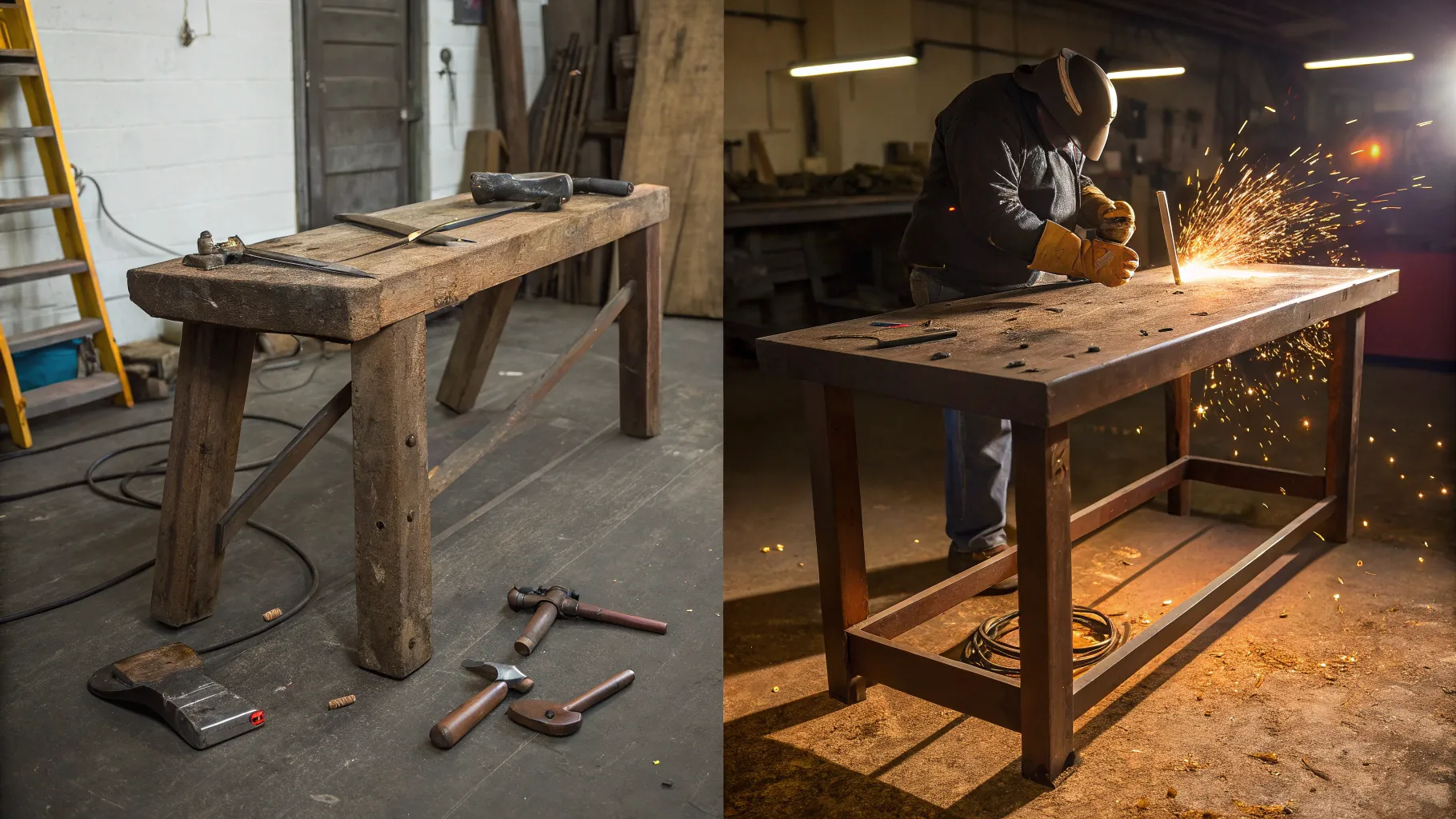
A shaky workbench can come from two different problems: the frame racks sideways, or one leg does not contact the floor. Loose fasteners, cracked welds, a flexible top, or weak leg-to-frame joints can add more movement. Diagnose the cause first, then use the lightest effective repair, such as tightening hardware, adding diagonal steel bracing, reinforcing corners, or installing load-rated leveling feet.
Quick Answer
To fix a shaky workbench, first determine whether it rocks on an uneven floor or racks within the frame. Tighten loose joints, repair damage, add gussets or diagonal steel braces where the frame flexes, and install load-rated adjustable feet when all four legs do not sit firmly. Tack, recheck, weld in a balanced sequence, then level and test the bench.
Key Takeaways
- Separate floor rocking from frame racking before you cut or weld anything.
- Tighten or repair weak joints before adding steel; bracing cannot compensate for cracked or badly corroded legs.
- Use diagonal bracing or corner gussets to stop sideways movement, and size every part for the bench frame and expected load.
- Choose leveling feet by their manufacturer-rated load capacity, thread size, base size, and floor type.
- Control welding heat with sound fit-up, balanced tacks, short weld sequences, and repeated square checks.
At a Glance
| Time Required | About 4 to 8 hours for diagnosis, fabrication, welding or bolting, leveling, and finishing |
| Difficulty | Intermediate if welding; beginner-friendly when using properly designed bolted braces |
| Tools Needed | Tape measure, square, level, clamps, drill, metal-cutting tools, hand tools, and a suitable welder when using welded reinforcement |
| Cost | Low to moderate; it depends on steel size, four rated feet, fasteners, consumables, primer, and paint |
What’s in This Article
- Diagnose the Source of the Wobble
- Why a Shaky Workbench Is Dangerous
- Design Goals for a Stable Workbench Retrofit
- Before You Begin
- Materials and Tools You Need
- Step-by-Step Fabrication and Assembly
- Welding Tips That Help Keep the Frame Square
- Assembly, Testing, and Proofing the Result
- Maintenance, Upgrades, and Uses
- Common Mistakes to Avoid
- Frequently Asked Questions
- Final Thoughts and Next Steps
Diagnose the Source of the Wobble
Do not assume every shaky bench needs more steel. Empty the work surface, unplug mounted tools, and press gently at each corner while another person watches the legs and joints from a safe position. The movement pattern usually points to the real problem.
| What You See | Likely Cause | First Fix to Try |
|---|---|---|
| Two opposite corners lift or tap the floor | Uneven floor, unequal leg length, or a twisted frame | Level the bench with rated feet or durable metal shims, then recheck frame square |
| The top shifts sideways while all feet stay planted | Frame racking, weak corners, or missing diagonal bracing | Tighten joints and add a rigid diagonal brace, X-brace, shear panel, or gussets |
| A leg or rail moves at one connection | Loose fastener, cracked weld, elongated hole, or crushed thin sheet | Repair the damaged joint before adding new bracing |
| Only a mounted vise or machine vibrates | Flexible top, weak mounting plate, or loose equipment bolts | Reinforce the local mounting area and tighten the equipment correctly |
Check the tabletop too. A heavy steel frame can still feel unstable when a thin top flexes around a vise or drill press. In that case, add a backing plate or local support under the tool instead of overbuilding every leg.
Why a Shaky Workbench Is Dangerous
When a bench shifts during tack welding, grinding, drilling, or clamping, your work can lose alignment. A moving frame may loosen a clamp, change a cut line, disturb a jig, or make a hot workpiece slide.
The risk increases around abrasive wheels, cutting discs, hot metal, and heavy vises. Unexpected movement can change your body position or pull the work toward a moving tool. A stable bench does not replace proper clamping, guarding, or personal protective equipment, but it removes one avoidable source of motion.
Your goal is to stop racking, create firm floor contact, repair weak joints, and control vibration at its source. A careful retrofit often solves those problems without replacing the whole table.
Design Goals for a Stable Workbench Retrofit
Start with clear goals before you cut steel. A focused plan keeps the repair simple and helps you avoid adding weight where it does not improve stiffness.
- Stability: Stop unwanted lateral and vertical movement during the bench’s intended work.
- Compatibility: Match brace size and attachment method to the existing legs, rails, wall thickness, and tabletop.
- Adjustability: Create firm contact on uneven floors with leveling feet or durable shims.
- Load path: Carry force from the tabletop into the legs and floor without concentrating it in a thin or damaged section.
- Vibration control: Reduce frame motion and reinforce local tool mounts where vibration begins.
- Access: Keep knee space, drawers, shelves, electrical cords, and clamp locations usable.
- Modularity: Leave room for future shelves, vise mounts, casters, or fixture points when those upgrades are part of the plan.
Diagonal bracing works because a rectangular frame can rack into a parallelogram when its joints flex. A properly attached diagonal turns that flexible rectangle into triangles. If you use thin flat strap that performs best in tension, an X-brace can resist movement in both directions. A single rigid tube or angle brace may be enough when it can carry both tension and compression.
A bench that rocks needs better floor contact. A bench that racks needs stronger joints or diagonal bracing. Treating the wrong problem adds work without removing the movement.
Before You Begin
Estimated total time: Plan for about 4 to 8 hours for a small or medium bench. Heavy coating removal, custom brackets, damaged joints, or a bolted retrofit may add time.
This guide fits welded mild-steel benches best. If the frame is aluminum, wood, galvanized steel, unknown alloy, very thin formed sheet, or badly rusted, use a material-specific repair plan. Bolted reinforcement may be safer than welding to thin or coated sections.
Warning: Welding, cutting, and grinding create fire, fume, burn, noise, and eye hazards. Remove combustibles, protect nearby surfaces from sparks, provide suitable ventilation, keep appropriate fire-extinguishing equipment available, and wear task-specific eye, face, hearing, hand, body, and respiratory protection. Follow OSHA welding guidance, ANSI Z49.1:2021, OSHA angle-grinder guidance, your equipment manuals, and local rules.
- Unload the bench and remove flammable liquids, rags, sawdust, coatings, and clutter from the hot-work area.
- Unplug bench-mounted tools and protect cords, gas hoses, bearings, electronics, and finished surfaces from heat and grinding dust.
- Identify paint, plating, galvanizing, or other coatings before heating them. Remove coatings from the weld zone with a safe method and control the resulting dust and fumes.
- Do not weld on a sealed, pressurized, contaminated, or unknown container or hollow item.
- Support the frame so it cannot shift or fall while a foot, brace, or lower rail is removed.
- Use a qualified fabricator or engineer when the bench supports people, lifting equipment, large machinery, unusually heavy loads, or safety-critical work.
Materials and Tools You Need
The right materials depend on the bench’s dimensions, frame wall thickness, joint condition, and intended load. There is no universal plate or tube size that safely fits every workbench.
- Mild-steel angle, square tube, rectangular tube, or flat bar sized to the span and brace layout
- Flat plate for gussets, foot plates, local backing plates, or bolted clamp plates
- Adjustable leveling feet with a manufacturer-rated load capacity, suitable base diameter, and thread size
- Nuts, coupling nuts, threaded inserts, washers, and locking hardware that match the chosen feet
- Bolts specified for the bracket and joint design when using a bolted retrofit
- Welding wire, electrode, shielding gas, and consumables that match the base metal and welder
- Angle grinder with the correct guard and wheel, metal-cutting saw, drill or drill press, clamps, tape measure, square, straightedge, and spirit level
- Welding helmet, safety glasses, gloves, protective clothing, hearing protection, and any respiratory protection required by the hazard assessment
For many small shop benches, 6 mm plate can make a stiff gusset or foot plate, while 8 mm plate may suit a larger foot mount or heavily loaded local bracket. Treat those sizes as starting points, not ratings. A thick plate welded to a thin, corroded leg can simply move the failure into the leg.
Choose each leveling foot by its published capacity rather than thread size alone. Include the bench, mounted tools, stored material, workpieces, and expected working force. Manufacturer data also matters because base material, stud grade, swivel angle, floor condition, and off-center loading can reduce usable capacity. JW Winco’s leveling-foot data shows why capacity must be checked for the exact model.
Note: M12 describes the thread, not the foot’s safe load. Two M12 feet can have very different capacities and base designs.
Products Worth Considering

✔Heavy Duty & Large Furniture Leg Levelers- Allow easy leveling of furniture at home, office, restaurant, school or café, to match in same height. They allow raising your furniture, and help slide your furniture at ease !

TRUE 3/8"-16 UNC THREAD: Not for metric M10. WARNING: Ensure furniture's 3/8" (9.52mm) threaded hole. Measure outer diameter(avoid ruler for accuracy) & thread count. Longer steel threads for custom workbenches.

Industrial-Grade Durability: Made of 0.08″ thick galvanized steel, the heavy duty leveling feet can support up to 330lbs each. The L-shaped mounting bracket transfers the load to the bracket, not just the screw, providing rock-solid stability. Replace flimsy shims with professional-grade leveling feet
Step-by-Step Fabrication and Assembly
Work in stages so you can check fit and alignment as you go. Diagnose, measure, clean, cut, dry-fit, tack or bolt, recheck, finish, level, and test before painting.
- Evaluate the bench and identify the movement.
- Measure the frame and choose a brace layout.
- Repair damaged joints and prepare the steel.
- Cut anchor plates, gussets, and braces.
- Dry-fit and tack or bolt the parts.
- Add triangulation and cross bracing.
- Complete the welds with controlled heat.
- Install and lock the leveling feet.
- Level, test, inspect, and finish the steel.
Products Worth Considering

Heavy-Duty Construction: Get 10 rugged steel gusset plates in a versatile 3" x 3" x 1/4" triangle size. Each plate weighs 0.25 lbs with a solid 6mm thickness, giving you dependable strength and a generous quantity for everything from quick fixes to full-scale builds

Low Carbon Steel, Surface Treatment: Plain Finish

Innovative 5-hole Layout: different from standard triangular brackets, these weld on gusset feature a pre-drilled 5-hole structure; The reserved holes serve as convenient anchor points for securing bungee cords and ratchet straps, and enable temporary bolt alignment before formal welding, bringing higher flexibility for your assembly work
1. Evaluate the Bench and Identify the Movement
Check the frame for rust-through, cracks, failed welds, loose fasteners, elongated holes, bent rails, uneven legs, and thin sections that may not accept a sound weld. Mark every moving joint with chalk or a paint marker.
Measure the distance between the legs, the diagonal dimensions of rectangular sections, and the clearance around shelves, drawers, and your feet. Decide whether the repair will be welded, bolted, or a combination of both.
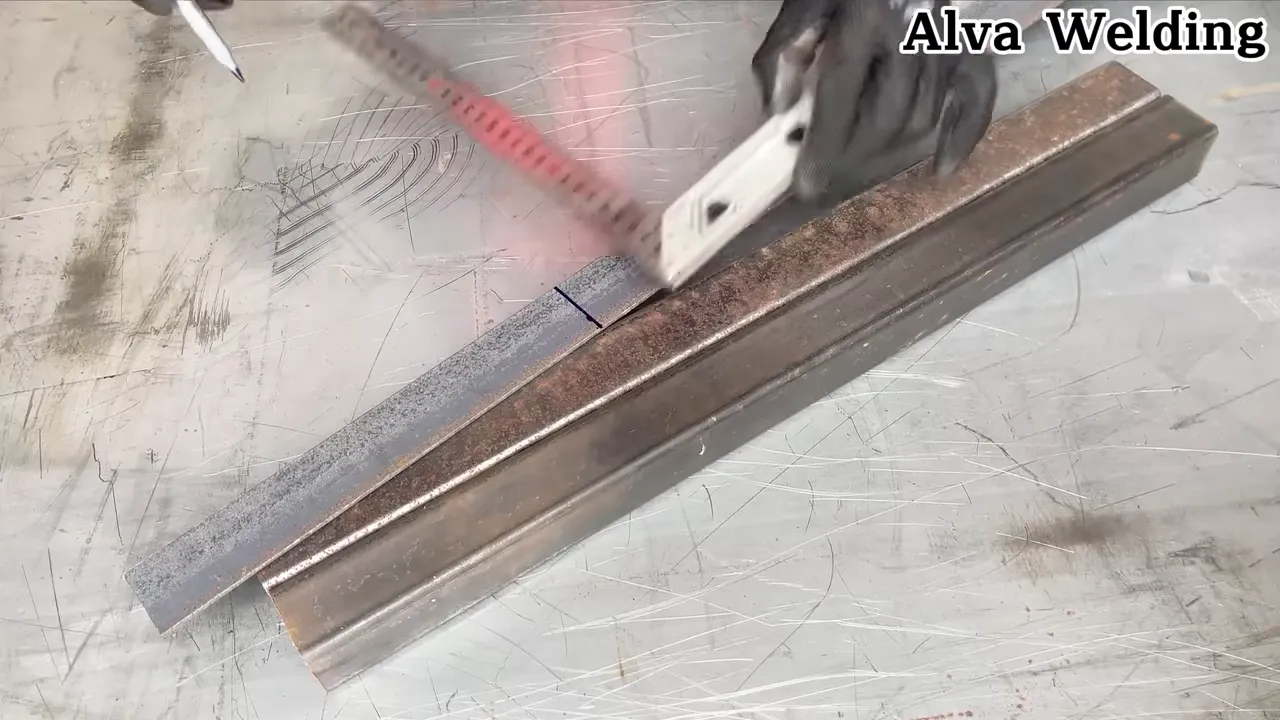
2. Choose the Bracing Layout
Place braces in the plane that moves. Side-to-side movement usually needs bracing across the back or front face. Front-to-back movement needs bracing on one or both end frames. Keep the front open when you need knee room or access to drawers.
Use one of these layouts:
- Corner gussets: Good for improving a weak leg-to-rail joint, but small gussets alone may not stop movement across a long span.
- Single rigid diagonal: Effective when the brace and both connections can carry tension and compression.
- X-brace: Useful with thin straps or when you need resistance in both diagonal directions.
- Shear panel: A securely attached steel or structural sheet panel can stiffen a back or side while also closing the frame.
- Lower stretcher: Connects legs and gives diagonal braces a lower attachment point, but a horizontal rail alone may not stop racking.
3. Repair Damage and Prepare the Steel
Fix cracked welds, missing fasteners, torn holes, and severe corrosion before adding new reinforcement. If the remaining steel is too thin or deeply pitted, replace that section rather than covering it with a plate.
Clean each weld zone to sound bare metal. Remove oil, paint, rust, and heavy mill scale far enough from the joint to prevent contamination. Deburr cut edges and round sharp corners that could cut hands, hoses, or power cords.
4. Cut Anchor Plates, Gussets, and Braces
Cut the foot plates and gussets to fit the actual frame rather than relying on a generic template. Keep enough material around holes and weld toes to avoid a narrow, tear-prone edge. The required edge distance depends on the fastener, plate thickness, loading, and joint design.
For an M12 through-bolt, select the clearance series from ISO 273 or the hardware manufacturer’s drawing. A 13.5 mm hole is a common general-purpose ISO 273 clearance shown in Bossard’s technical table; do not assume the original 13 mm value is suitable for every fit or fabrication tolerance.
Use a saw or cutting method suited to the material. Secure the work, use the correct wheel or blade, and allow hot parts to cool before handling or measuring them.
5. Dry-Fit and Tack or Bolt the Parts
Clamp every piece in place before final attachment. Check that the feet will remain accessible and that braces will not block drawers, shelves, clamps, or electrical outlets.
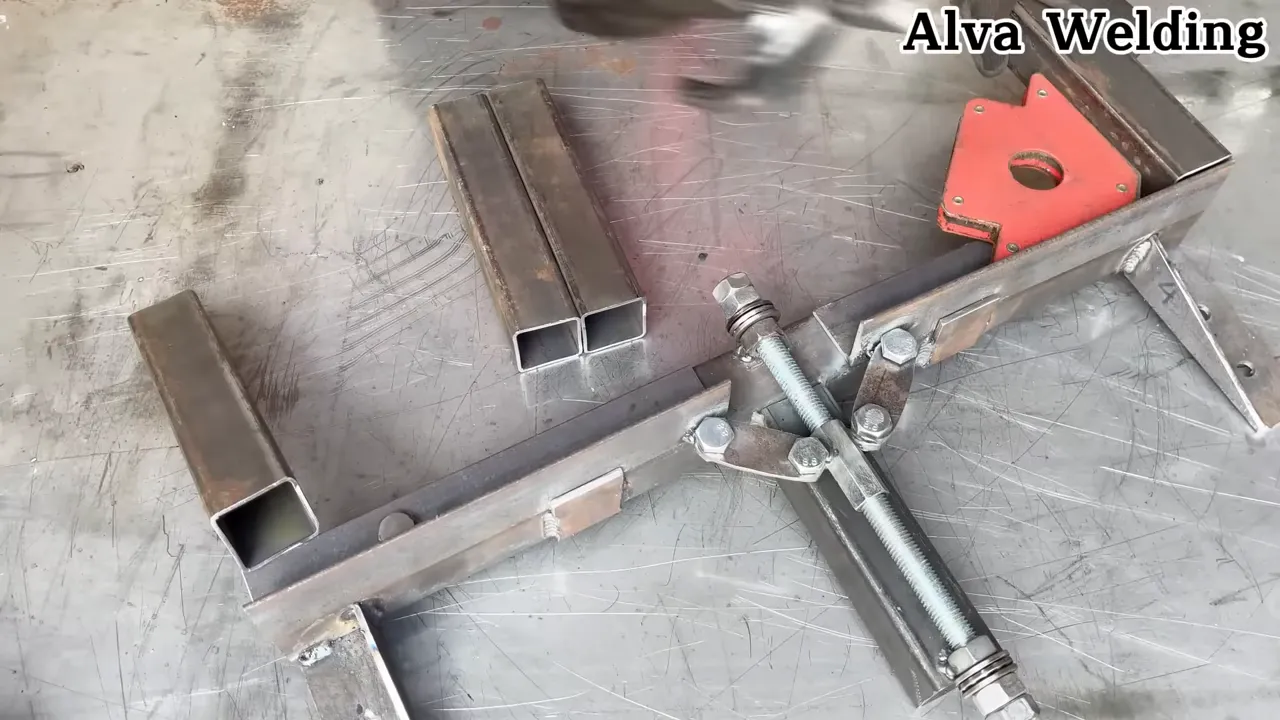
For welded parts, place enough sound tacks to hold alignment without prescribing an arbitrary number for every joint. Recheck leg spacing, diagonals, tabletop level, and square after tacking. For bolted parts, use clamp plates or brackets that spread load instead of crushing thin tube walls.
Pro Tip: Mark a reference line across each joint before welding. If the marks separate or shift, you can see distortion before it becomes difficult to correct.
6. Add Triangulation and Cross Bracing
Fit the diagonal brace tightly between strong parts of the frame. A brace attached to a flexible sheet-metal tab will not perform like one tied into the main leg and rail.
When using flat straps, install both diagonals as an X when one strap may go slack under reverse loading. When using rigid angle or tube, one diagonal can work if its end connections are strong and the brace does not buckle under compression. Add corner gussets where the leg-to-top joints still flex.
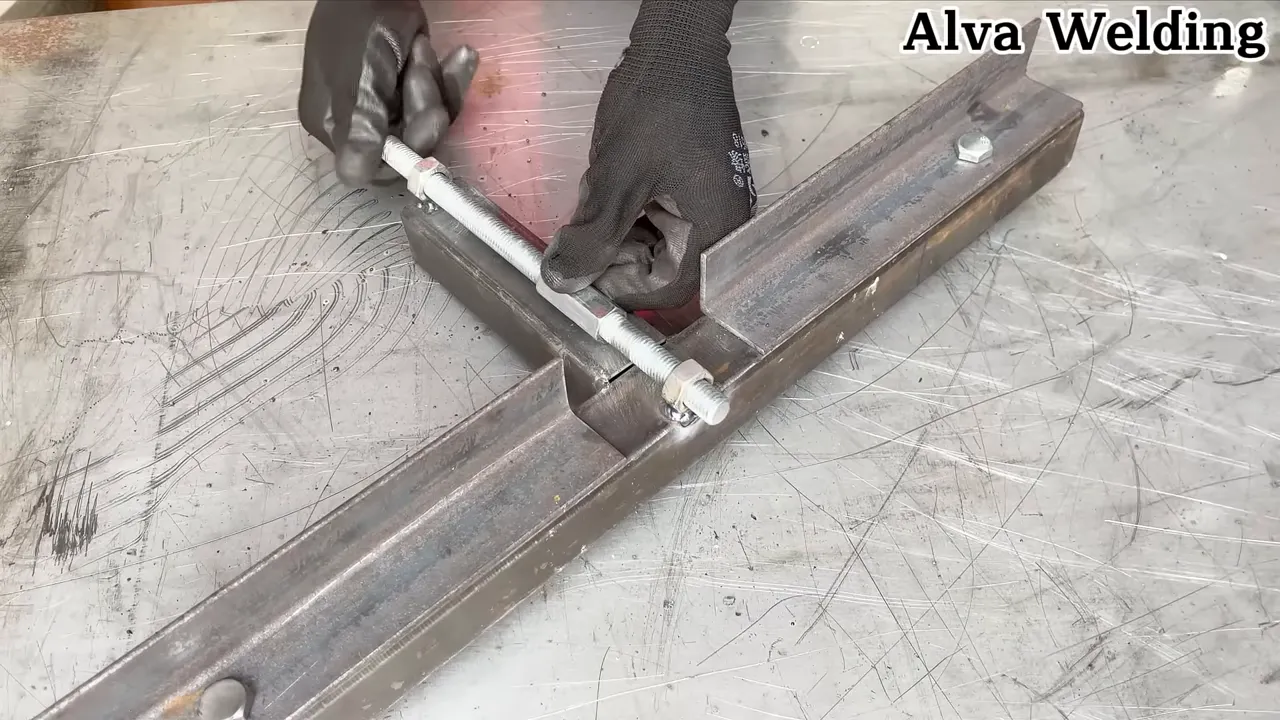
7. Complete the Welds With Controlled Heat
Use the joint size and weld length required by the repair, but avoid overwelding. Work in a balanced sequence, move between separated joints, and allow cooling time when the frame begins to pull. Lincoln Electric recommends limiting unnecessary weld metal, using intermittent welds where the design permits, and balancing welds to reduce distortion in fabricated assemblies.
Do not replace a required continuous structural weld with stitch welds merely to save time. If you do not know the required weld size, or the bench carries unusually heavy or dynamic loads, have the connection reviewed by a qualified person.
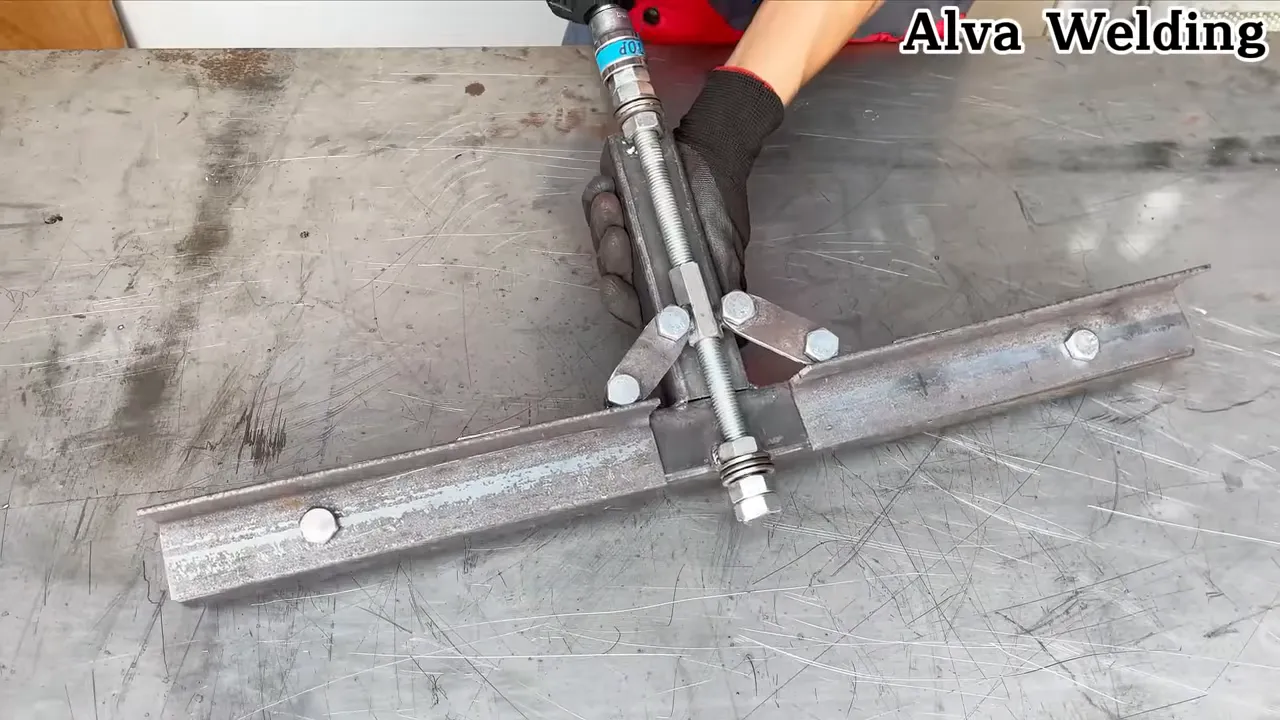
8. Install and Lock the Leveling Feet
Use a welded coupling nut, threaded insert, tapped block, or through-plate arrangement that provides enough thread engagement and support for the chosen foot. Follow the foot manufacturer’s drawing and installation instructions.
Install the feet with the specified nut and washer arrangement. Adjust them until all four bases contact the floor and the tabletop is level in both directions. Then tighten the jam or lock nuts against the mounting points so normal vibration cannot change the setting.
9. Level, Test, Inspect, and Finish
Check the tabletop with a level in both directions. Press at each corner to confirm that no foot lifts. Then apply controlled side pressure at the top edge while watching the joints, braces, and foot plates.
If movement remains, identify where it starts instead of adding random weld. A loose top may need more fasteners, a long frame may need a brace in the other plane, and a thin tool-mount area may need a backing plate.
After the bench passes inspection, remove spatter and sharp edges without grinding away sound fillet welds. Clean the steel, apply a compatible rust-inhibiting primer, and add the top coat after the metal has cooled and the coating system’s surface-preparation requirements are met.
Welding Tips That Help Keep the Frame Square
Welding reinforcement to an existing frame works best when you control fit-up, heat input, and restraint. The exact settings depend on material thickness, joint design, wire or electrode, shielding gas, welding position, and machine.
- Tack before final welding: Use sound tacks at balanced locations, then verify dimensions before committing to full welds.
- Avoid overwelding: More weld metal adds shrinkage and does not automatically make a thin frame safer.
- Balance the sequence: Alternate between opposite or separated joints instead of completing one hot side first.
- Use intermittent welds only where suitable: They can reduce heat input, but the connection still needs enough weld for its load.
- Match the process to the job: MIG welding can work well on clean mild steel, but settings must come from the welder’s chart, filler-metal guidance, and a test coupon.
- Protect thin tube: Use backing or a bolted solution when the wall is too thin to accept the intended weld without burn-through or local failure.
- Keep easy positions when possible: Rotate removable parts so welds can be made flat or horizontal with better visibility and control.
- Grind with care: Remove spatter and sharp projections, not the throat of a sound fillet weld.
- Stop when alignment changes: Let the frame cool, release inappropriate restraint if safe, and correct the fit before continuing.
For mild-steel MIG welding, 0.8 mm or 0.030-inch solid wire is a common all-around option, but it is not a complete setting. Miller’s parameter guidance emphasizes matching voltage and wire-feed speed to material thickness, wire diameter, and the machine. Test on offcuts of the same thickness before welding the bench.
Assembly, Testing, and Proofing the Result
Test the retrofit before trusting it with precise work. Begin with the bench unloaded. Confirm that all four feet contact the floor, every lock nut is tight, and no cable or hose is trapped under a foot.
- Push steadily at the front, back, and both ends while watching the braces and joints.
- Measure the frame diagonals again if the top no longer looks square.
- Add normal shop weight in stages, staying below the capacity of the bench and feet.
- Repeat the push test and inspect for lifted feet, slipping joints, cracked paint at weld toes, or permanent bending.
- Mount the vise or machine and test it at low force before returning to normal work.
Do not start by striking a workpiece hard with a hammer. Shock loading an unstable or newly repaired bench can hide the source of movement and expose a weak connection suddenly. Increase force in controlled steps and stop if any part shifts, cracks, or deforms.
Try a few light clamping, layout, or tack-welding tasks after the static checks. Clamps should stay tight, parts should hold position, and the bench should not walk across the floor.
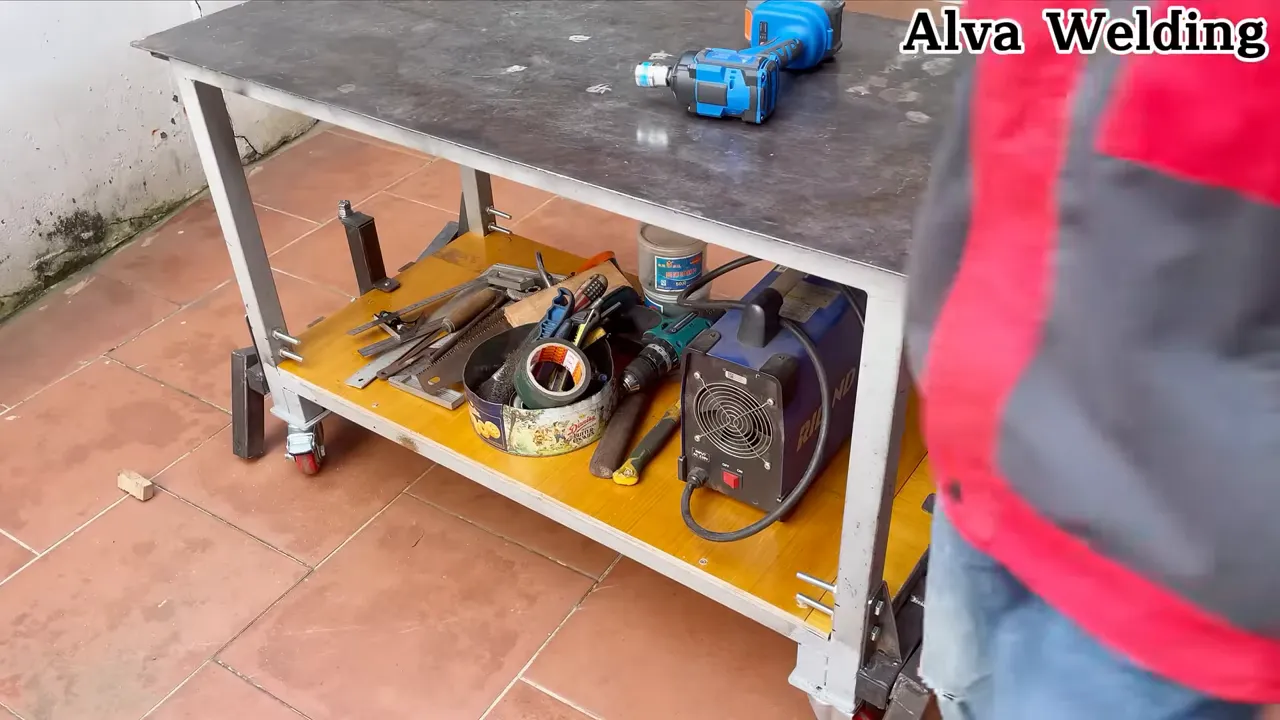
Note: A workshop push test confirms that the repair feels stable in normal use; it does not create a certified load rating.
Maintenance, Upgrades, and Uses
A strong retrofit still needs routine checks. Vibration, moisture, impact, and moving the bench can loosen hardware or expose a weak point over time.
- Inspect welds and steel: Look for cracks, rust streaks, bent braces, paint separation, and fresh movement marks.
- Check fasteners and feet: Retighten loose hardware using the manufacturer’s instructions, and confirm that every lock nut remains seated.
- Relevel after moving: A different floor location can change which foot needs adjustment.
- Protect the coating: Touch up chipped primer and paint before corrosion spreads under a plate or around a weld.
- Add casters carefully: Use a rated retractable-caster or mobile-base system that lowers the bench onto stable feet for work. Small caster brakes alone may allow movement during heavy grinding or hammering.
- Reinforce tool mounts locally: Use backing plates under heavy vises, rollers, or machines instead of relying on a thin tabletop.
- Control equipment vibration: Use manufacturer-approved isolation pads where appropriate, but do not make a cutting or grinding machine unstable.
Bracing generally reduces gross frame movement, but it may change how vibration travels through the bench. If one machine remains noisy or harsh, inspect its balance, mounting, guards, bearings, and local support before adding soft pads.
Common Mistakes to Avoid
Most failed bench retrofits come from treating the wrong cause, attaching strong parts to weak metal, or rushing fit-up and welding.
- Adding braces before tightening loose bolts or repairing cracked welds
- Using leveling feet to hide a twisted or damaged frame
- Choosing feet by thread diameter without checking rated capacity and base design
- Using a 13 mm hole for every M12 installation without checking the required clearance series
- Welding thick plates to thin, corroded legs without reinforcing the load path
- Using only horizontal rails when the real problem is diagonal racking
- Installing a single thin strap that goes slack when the load reverses
- Welding long beads on one side before checking square
- Grinding away too much weld after final assembly
- Testing with heavy blows before the static checks are complete
- Adding casters that do not provide a rigid working position
- Ignoring coatings, fumes, fire hazards, guards, or ventilation
Note: If the frame uses very thin formed steel, a broad bolted plate or shear panel may work better than concentrated welds.
Frequently Asked Questions
How thick should the anchor plates be for a standard two-meter bench?
There is no universal thickness based on bench length alone. For many light or medium shop benches, 6 mm plate can make a stiff gusset or foot plate, and 8 mm can suit a larger local mount. The correct size depends on the frame wall thickness, brace span, attachment, foot design, and expected load. Do not weld a thick plate onto rusted or very thin legs without repairing the load path.
Can you attach the retrofit without welding?
Yes. You can use through-bolted diagonals, clamp plates, structural sheet panels, or purpose-made brackets. Spread the load with suitable plates or washers so thin tube does not crush, use hardware selected for the joint, and recheck the fasteners after the first few work sessions.
Will adding plates and braces reduce grinder vibration?
They usually reduce visible frame movement when racking is the cause, but they can also change how higher-frequency vibration travels through the bench. If vibration remains, check the grinder or machine, its mounting plate, wheel condition, balance, bearings, and local tabletop stiffness.
What welding process and settings work best for the retrofit?
MIG, flux-cored, stick, or TIG can work when the process matches the steel, thickness, joint, position, and welder. For clean mild steel, 0.8 mm or 0.030-inch MIG wire is a common all-around choice, but use the machine chart and filler-metal guidance, then confirm the settings on matching scrap. Do not copy one voltage and wire-feed setting across different machines or steel thicknesses.
How do you prevent plate warping during welding?
Use accurate fit-up, balanced tacks, the smallest suitable weld, a planned sequence, and cooling time. Move between separated joints instead of concentrating heat in one area. Intermittent welds can reduce distortion where the connection design allows them, but they should not replace required weld length.
Are adjustable leveling feet necessary?
They are useful when the floor is uneven or the bench moves between locations. A bench on a flat floor with equal legs may not need them. Leveling feet correct floor contact; they do not replace diagonal bracing or repair loose joints.
How do you choose the load rating for leveling feet?
Add the bench, mounted tools, stored material, and expected workpiece weight. Then select a foot whose published capacity comfortably covers its share of the load under the real mounting angle and floor conditions. Use the manufacturer’s data because the same thread size can appear on feet with very different capacities.
Where should you place diagonal braces?
Place them in the face that racks. Brace the back for left-to-right movement and the end frames for front-to-back movement. Tie the ends into strong rails and legs, not flexible tabs. Keep the front open when access matters, or use short knee braces near the corners.
Can you paint over welded areas right after welding?
No. Let the steel cool, remove spatter and residue, clean away oil and dust, and prepare the surface for the chosen coating. Apply a compatible rust-inhibiting primer before the top coat when the paint system calls for one.
How long does the whole project take?
A planned retrofit on a small or medium bench often takes about 4 to 8 hours. Diagnosis and layout may take an hour or more, followed by cutting, fitting, welding or bolting, leveling, inspection, and coating preparation. Damage repair or custom feet can extend the job.
Is this retrofit suitable for outdoor benches?
Yes, when the materials and finish suit the environment. Use corrosion-resistant or properly coated hardware, seal water traps where the design permits, keep drain paths open in hollow sections, and inspect the bench more often. Choose leveling feet with bases and studs rated for outdoor exposure.
Final Thoughts and Next Steps
A shaky bench usually needs one of three things: better floor contact, stronger joints, or diagonal resistance to racking. Start by watching where the movement begins. Tighten and repair first, then add gussets, braces, foot plates, or leveling feet only where they solve the diagnosed problem.
Use materials that match the existing frame, select every foot by its rated capacity, and control welding heat with balanced fit-up and repeated checks. Test the repair with steady, increasing force before returning to heavy work.
A stable bench makes welding, grinding, drilling, clamping, and layout work safer and more accurate. The best retrofit is not the heaviest one; it is the one that creates a clear load path, firm floor contact, and joints that stay tight.
Sources
- OSHA: Welding, Cutting, and Brazing Hazards and Solutions — welding fumes, radiation, PPE, and hot-work hazards
- American Welding Society: ANSI Z49.1:2021 — welding safety, ventilation, fire prevention, and protection of personnel
- Lincoln Electric: Weld Distortion — balanced welds, intermittent welding, and avoiding unnecessary weld metal
- Miller Electric: Setting Correct MIG Parameters — matching wire, voltage, and wire-feed speed to the job
- ISO 273:1979 and Bossard technical data — clearance-hole series and a general-purpose M12 example
- JW Winco: Leveling Feet and Load Capacity — model-specific mounting and load-capacity information

