Store shielding gas cylinders as pressure vessels, not as ordinary shop supplies. Keep them upright, secured, capped when not connected for use, clearly labeled, and away from heat, traffic, ignition sources, and incompatible gases. For welding shops, garages, labs, and fabrication areas, the safest setup is a dry, well-ventilated, clearly marked storage zone with regular inspections and a simple leak-response plan.
Quick Answer
Store shielding gas cylinders upright and secured with chains, straps, or a cylinder rack. Keep valve protection caps on when cylinders are not connected, store them in a dry and well-ventilated area, separate oxygen from fuel gases or combustibles, inspect labels and valves, and contact the supplier if a leak cannot be stopped safely.
Key Takeaways
- Secure every cylinder upright so it cannot tip, roll, fall, or be struck by carts, vehicles, doors, or falling objects.
- Keep valve protection caps hand-tight whenever cylinders are stored, moved, or not connected for use.
- Store cylinders in a dry, well-ventilated, assigned area, never in lockers, closets, or other unventilated enclosures.
- Separate oxygen cylinders from fuel-gas cylinders or combustible materials by 20 feet, or use a compliant 5-foot noncombustible barrier.
- If a cylinder leaks, isolate the area, close the valve only if safe, move the cylinder outdoors if trained to do so, tag it, and call the supplier.
At a Glance
| Time Required | 10–20 minutes for a basic storage-area check; inspect cylinders before each move or use. |
| Difficulty | Moderate safety task; simple steps, but high consequences if done wrong. |
| Tools Needed | Cylinder cart, chains or straps, cylinder rack, PPE, labels/signs, SDS access, leak detector or oil-free soap solution, fire extinguisher. |
| Cost | Often $0–$75 if you already have racks, straps, signs, and leak-check supplies; more if you need a dedicated cylinder cabinet or cart. |
How to Store Shielding Gas Cylinders Safely
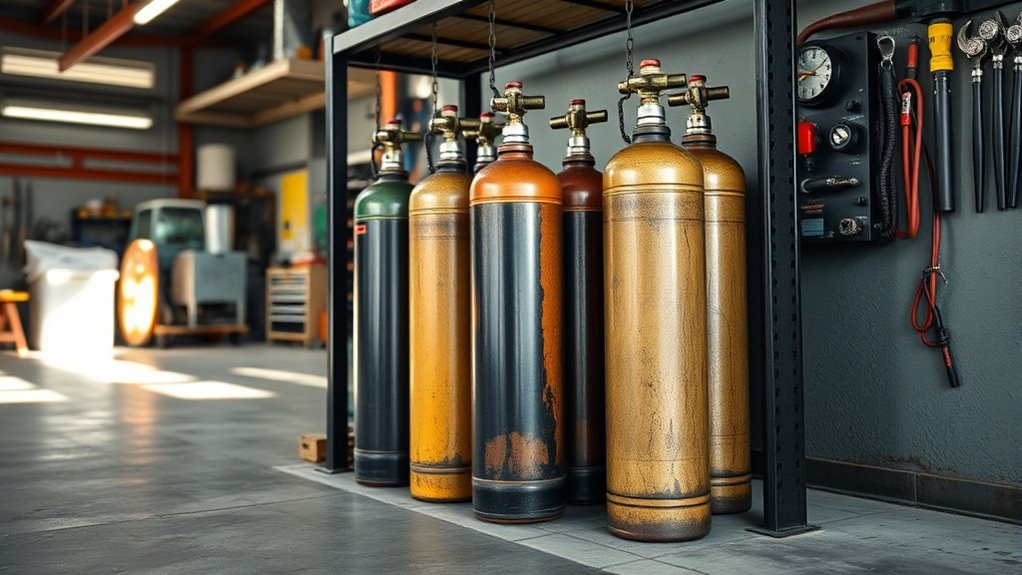
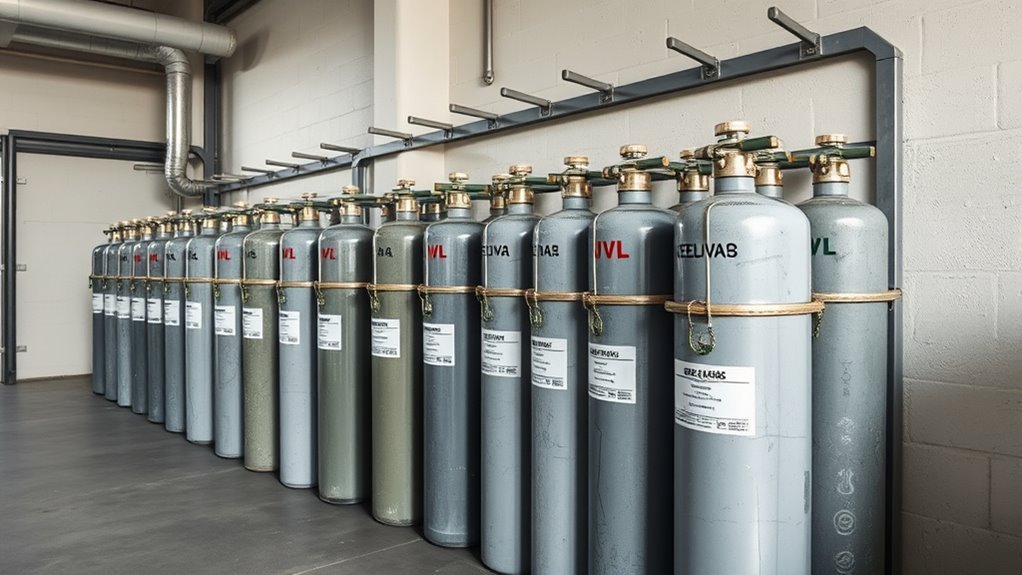
To store shielding gas cylinders safely, keep each cylinder upright and secured so it cannot tip. Use a cylinder rack, wall chain, floor stand, or nonconductive strap that holds the cylinder body firmly in place.
Install the valve protection cap whenever the cylinder is not connected for use. OSHA requires valve protection caps to be in place where a cylinder is designed to accept a cap, except when cylinders are in use or connected for use under its welding and cutting standard. You can review the storage rule in OSHA 29 CFR 1910.253.
Use a storage area that is dry, well-ventilated, and protected from impact. Keep cylinders away from radiators, flames, sparks, hot work, direct heat, elevators, stairs, gangways, forklift lanes, and congested walkways. Follow the gas supplier’s Safety Data Sheet for any cylinder-specific temperature, ventilation, and storage limits.
Keep cylinder labels readable. Do not rely on cylinder color alone, because color systems can vary by supplier, region, or gas service. If a label is missing, damaged, or unreadable, treat the cylinder as contents unknown and contact the supplier before storing, connecting, or moving it.
Separate full and empty cylinders when possible, and mark the status clearly. Empty cylinders still need closed valves, caps, upright storage, and secure restraints because they can retain pressure and still create a valve or impact hazard.
Warning: Do not store cylinders in closets, lockers, unventilated cabinets, vehicle trunks, or confined spaces. Leaking argon, carbon dioxide, helium, or mixed shielding gas can displace oxygen without giving a strong warning odor.
Identify Shielding Gas Cylinder Hazards
You need to control two hazard groups: the physical cylinder hazard and the gas-specific hazard. The cylinder can fall, crush, leak, or release pressure violently if the valve is damaged. The gas can also create oxygen displacement, fire-support, or compatibility risks depending on the contents.
Physical Cylinder Hazards
Shielding gas cylinders are heavy, narrow, and pressurized. A falling cylinder can crush a foot or hand, damage the valve, break a regulator, or create an uncontrolled gas release. Keep cylinders upright, capped, and secured before you walk away from them.
Before storage or use, inspect the cylinder body, shoulder, neck ring, valve, cap threads, regulator connection, and label. Look for dents, deep rust, burns, gouges, loose caps, missing labels, oil, grease, damaged fittings, or signs that the cylinder was dropped. OSHA’s general compressed-gas rule requires employers to determine that compressed gas cylinders under their control are in safe condition by visual inspection. See OSHA 29 CFR 1910.101 for the general compressed-gas inspection requirement.
Pro Tip: Put a small inspection tag or log near the cylinder rack. Check the rack, chains, caps, labels, leaks, and floor condition at the same time each week.
Gas-Specific Chemical Risks
Common shielding gases such as argon, helium, and carbon dioxide can act as simple asphyxiants. They may not be highly toxic in normal welding use, but they can displace breathable air in low spots, pits, tanks, trailers, or rooms with poor ventilation.
OSHA defines an oxygen-deficient atmosphere as less than 19.5% oxygen by volume. In confined-space work, an oxygen level below 19.5% or above 23.5% is considered a hazardous atmosphere. Check OSHA 29 CFR 1910.146 when cylinders, purge gas, or shielding gas may affect a confined space.
Some shielding blends may also contain oxygen, hydrogen, or other active gases. Treat each cylinder according to its label and SDS, not according to a generic “welding gas” assumption. Keep oil and grease away from oxygen service, and never use damaged, incompatible, or forced fittings.
Label and SDS Checks
Before you store or connect a cylinder, read the product label and match it to the work. Confirm the gas name, mixture, hazard class, supplier, and any special storage instructions. Then review the Safety Data Sheet for ventilation, fire, pressure, exposure, first-aid, and emergency guidance.
Never identify a cylinder only by color, cap style, or where it was found in the shop. If the label is missing or illegible, isolate the cylinder, tag it as unknown, and call the supplier. Do not connect a regulator, open the valve, or attempt to “test” the contents yourself.
Set Up a Safe Storage Area
Choose a dedicated storage zone that is easy to see, easy to reach, and protected from traffic. The best location is dry, cool, well-ventilated, and away from welding sparks, grinding sparks, open flames, electrical panels, exits, stairs, lifts, and forklift impact zones.
Build the area around these rules:
- Use a cylinder rack, wall bracket, chain, or strap for every cylinder position.
- Keep cylinders upright and capped unless connected for use.
- Post signs that identify stored gases and warn against smoking, flame, and unauthorized handling.
- Keep the floor level, dry, and free of scrap metal, cords, slag, and oil.
- Leave clear access for inspection, emergency removal, and fire response.
- Keep fire extinguishers accessible and inspected according to your site plan.
- Store empty and full cylinders in separate marked areas when space allows.
- Keep SDS documents available to workers who handle or connect cylinders.
If your shop stores multiple gases, create labeled zones for oxygen, fuel gases, inert shielding gases, empty cylinders, and cylinders waiting for return. This reduces mix-ups and makes inspections faster.
Note: OSHA rules are minimum safety requirements. Your local fire code, insurance policy, building rules, gas supplier, or site safety program may require stricter storage distances, signage, cabinets, or ventilation.
Products Worth Considering

Side-Mount Design: Hooks install around the cylinder neck, valve and hoses from the side, with no need to remove valves or disconnect regulators and hoses. Keeps welding essentials visible and within reach.

Compatible Fit: Designed for Oxy-Mapp and for Oxy-Propane cylinder systems, providing a secure and stable mounting solution for compatible fuel tanks.

Organize Torch Storage: Keep propane torches, MAPP gas bottles and small fuel cylinders stored upright and easy to reach in your garage, workshop, shed or tool area
Separate Oxygen, Fuel, and Inert Gases
Separate gases by compatibility, not by convenience. Oxygen cylinders must not be stored near fuel-gas cylinders, acetylene, oil, grease, or other combustible materials. OSHA requires oxygen cylinders in storage to be separated from fuel-gas cylinders or combustible materials by at least 20 feet, or by a 5-foot noncombustible barrier with at least a half-hour fire-resistance rating. The same separation rule appears in OSHA’s construction welding standard, 29 CFR 1926.350.
Fuel gases need their own controlled area. Store acetylene cylinders valve end up, and keep them away from heat, open flame, hot metal, and oxygen storage unless a compliant separation method is in place.
Inert shielding gases such as argon and helium are usually not flammable, but they still deserve a clearly labeled storage zone. Keeping them separate from fuel gases reduces selection errors, regulator mix-ups, and clutter around high-risk gases.
The safest cylinder layout is easy to inspect: oxygen in one marked area, fuel gases in another, inert shielding gases in a third, and empty cylinders clearly separated from full cylinders.
Products Worth Considering

Strong Compatibility: This high-quality cylinder tank rack measures 325 × 330 × 1197 mm / 12.79 × 12.99 × 47.12 inches and is made from durable carbon steel with excellent weight capacity. Easy to install with complete accessories, it’s ideal for both gas cylinder storage warehouses and transport vehicles. The sturdy packaging protects against impact and drops, ensuring safe delivery.

Size: about 8.5*10.5cm.

STURDY AND DURABLE MATERIAL - Propane tank holder Made of high-quality alloy steel, it has been thickened and reinforced, and is protected by a powder coating. It has excellent stability and is extremely durable.
Handle and Move Cylinders Safely
Move cylinders only when the valve is closed, the regulator is removed, and the valve protection cap is installed if the cylinder is designed for one. Wear safety shoes, gloves suited for cylinder handling, and eye protection when your site requires it.
Proper Cylinder Transport
Use a cylinder hand truck, cart, or carrier made for compressed gas cylinders. Secure the cylinder to the cart before moving it, and keep the route clear of hoses, scrap, cords, wet spots, and door edges.
Do not drag, slide, drop, strike, or roll cylinders across the floor. Do not lift a cylinder by the valve cap, valve, regulator, or handwheel. OSHA’s construction rule requires valve caps to be secured, cylinders transported by powered vehicle to be vertical, and a suitable cylinder truck, chain, or steadying device to keep cylinders from being knocked over while in use.
If cylinders are transported in a vehicle, secure them upright, ventilate the vehicle space, protect them from heat, and follow DOT, supplier, and local transport rules. Do not leave cylinders loose in a trunk, van, or enclosed trailer.
Safe Valve Handling
Handle valves slowly and deliberately. Before connecting a regulator, inspect the valve outlet and regulator connection for dirt, oil, grease, damage, wrong threads, or missing seals. Use only the correct regulator and connection for that gas.
Stand to the side of the outlet and regulator face when opening a cylinder. Open the valve slowly. Never use a hammer, pipe wrench, pry bar, or extra force to open a stuck valve. If a valve will not open by hand or with the proper key, tag the cylinder and notify the supplier.
When work is finished, close the cylinder valve. If the cylinder is being stored rather than kept connected for immediate use, remove the regulator, install the cap, secure the cylinder, and return it to the assigned storage area.
What to Do If a Cylinder Leaks
If you suspect a leak, stay calm and act in order. Close the cylinder valve only if you can do so without putting yourself in danger. Keep flames, sparks, welding arcs, grinders, cigarettes, vehicles, and electrical ignition sources away from the leak area.
Use a commercial leak detector or an oil-free soap-and-water solution if your site procedure allows it. Never use oil, grease, flame, or improvised chemicals to check for leaks. If bubbles appear, the leak is active.
If the leak stops when the valve is closed, tag the cylinder and report it according to your shop procedure. If the leak cannot be stopped safely, evacuate nearby workers, ventilate the area if you can do so safely, keep people away, and call the gas supplier or emergency services. If trained and safe to do so, move the cylinder outdoors to a secure, well-ventilated area away from ignition sources.
Warning: Do not try to repair cylinder valves, fuse plugs, safety devices, threads, or pressure-relief parts. Tag the cylinder, isolate it, and follow the supplier’s instructions.
Shielding Gas Cylinder Storage Checklist
Use this checklist before opening the shop, after deliveries, and whenever cylinders are moved:
- Upright: Every cylinder is standing valve end up unless a specific cylinder design or supplier instruction says otherwise.
- Secured: Chains, straps, or racks hold the cylinder body firmly in place.
- Capped: Valve protection caps are installed on stored or moved cylinders.
- Labeled: Gas name, mixture, supplier label, and empty/full status are readable.
- Separated: Oxygen is separated from fuel gases and combustibles by the required distance or barrier.
- Ventilated: Storage is not in a closet, locker, vehicle trunk, pit, or unventilated enclosure.
- Protected: Cylinders are away from heat, sparks, flame, impact, electrical circuits, and heavy traffic.
- Clean: Oxygen cylinders and fittings are free of oil and grease.
- Inspected: Cylinder body, valve, cap, fittings, and regulators show no damage or leaks.
- Documented: SDS documents and supplier contact information are easy to find.
Common Storage Mistakes to Avoid
Avoid these common cylinder storage mistakes:
- Leaving a cylinder freestanding “just for a minute.”
- Using a valve cap as a lifting handle.
- Storing oxygen next to acetylene, propane, oil, grease, or combustible materials.
- Leaving regulators attached to cylinders that are being stored or transported.
- Storing cylinders where forklifts, doors, carts, or falling materials can strike them.
- Keeping cylinders in a closed vehicle, locker, or cabinet without ventilation.
- Assuming a cylinder is empty because the pressure is low.
- Relying on color instead of the label and SDS.
- Trying to repair a leaking valve instead of calling the supplier.
Frequently Asked Questions
How should shielding gas cylinders be stored?
Store shielding gas cylinders upright, secured with chains, straps, or a rack, in a dry and well-ventilated area. Keep valve caps installed when cylinders are not connected for use, keep labels readable, and protect cylinders from heat, impact, traffic, and ignition sources.
What are the OSHA requirements for gas cylinder storage?
OSHA requires compressed gas cylinders to be inspected, handled safely, stored in protected and ventilated locations, capped when required, and separated from incompatible materials. For welding and cutting, oxygen cylinders in storage must be separated from fuel-gas cylinders or combustibles by 20 feet or by a 5-foot noncombustible fire-rated barrier.
What gas cylinders should not be stored together?
Do not store oxygen cylinders next to fuel-gas cylinders, acetylene, propane, oil, grease, or other combustible materials unless the required distance or barrier is in place. Also keep corrosive, toxic, flammable, oxidizing, and inert gases organized by label, SDS, and local code requirements.
How should gas cylinders be stored when not in use?
When cylinders are not in use, close the valve, remove the regulator if the cylinder is going back into storage, install the valve protection cap, secure the cylinder upright, and return it to its assigned storage area. Mark empty cylinders clearly and keep them secured like full cylinders.
Can argon and carbon dioxide cylinders be stored indoors?
Yes, they can usually be stored indoors when the area is dry, well-ventilated, protected from impact, and compliant with the SDS, supplier instructions, OSHA rules, and local fire code. Do not store them in unventilated closets, lockers, pits, or enclosed vehicles because leaking gas can displace oxygen.
What should I do with a cylinder that has no readable label?
Do not use it, connect it, open it, or guess the contents by color. Tag it as unknown, isolate it in a secure area, and contact the gas supplier for identification, pickup, or replacement instructions.
Conclusion
Safe shielding gas cylinder storage comes down to control: keep cylinders upright, secured, capped, labeled, separated, ventilated, and inspected. Use OSHA rules, the cylinder SDS, supplier instructions, and your local fire code as your baseline. If a cylinder leaks, do not improvise a repair. Close the valve only if safe, isolate the area, tag the cylinder, ventilate carefully, and call the supplier or emergency services when needed.
Sources
- OSHA 29 CFR 1910.101 — Compressed gases general requirements — visual inspection and general compressed-gas handling requirements.
- OSHA 29 CFR 1910.253 — Oxygen-fuel gas welding and cutting — cylinder storage, valve caps, heat protection, oxygen separation, acetylene orientation, and leak response.
- OSHA 29 CFR 1926.350 — Gas welding and cutting — construction cylinder transport, upright securing, valve caps, separation, and storage guidance.
- OSHA 29 CFR 1910.146 — Permit-required confined spaces — oxygen-deficient atmosphere definition and hazardous-atmosphere thresholds.